Endowment Plan Break-Even Analysis Singapore 2026: When Do You Actually Make Money?
A data-driven guide for Singapore investors — break-even timelines, IRR calculations, and when to exit early.
Most Singapore endowment plans hit break-even between Year 5 and Year 8, depending on the plan type, premium structure, and insurer. Before break-even, surrendering your policy means getting back less than you paid in. After break-even, your guaranteed surrender value exceeds total premiums paid — and the longer you hold, the higher your effective IRR climbs. Here’s how to calculate yours and decide whether the timeline works for you.
Not financial advice. All figures are for educational reference only. Data verified as at 29 October 2026. Always refer to your specific policy illustration for precise surrender values.
Table of Contents
Contents — Click to expand
- What Is Break-Even for an Endowment Plan?
- Typical Break-Even Timeline by Plan Type
- Worked Example: 10-Year Endowment Plan
- How to Calculate Your Endowment Plan IRR
- Endowment Plan IRR vs Other Singapore Fixed Income Instruments
- What Factors Affect Your Break-Even Point?
- When to Exit Before Break-Even
- Frequently Asked Questions
What Is Break-Even for an Endowment Plan?
Break-even for an endowment plan is the point at which your policy’s surrender value equals or exceeds the total premiums you have paid into it. Before this point, if you cancel your policy and receive the surrender value, you will get back less than you put in — resulting in a net loss.
Every endowment plan in Singapore has two components in its surrender value:
- Guaranteed surrender value (GSV) — the minimum amount the insurer is contractually obligated to pay if you terminate early. This is printed in your policy schedule.
- Non-guaranteed bonuses — accumulated reversionary bonuses and terminal bonuses that the insurer may (but is not obligated to) pay, based on the performance of the participating (par) fund.
Your break-even analysis must consider both: the guaranteed break-even year (based on GSV alone) and the projected break-even year (based on total surrender value including non-guaranteed bonuses). The guaranteed break-even typically occurs 1–2 years later than the projected break-even.
Understanding your break-even point matters for three practical reasons:
- If you face a financial emergency and must surrender, knowing your break-even tells you exactly how much you’d lose at each policy year.
- It lets you compare the endowment’s effective return against alternatives like Singapore Savings Bonds or Singapore T-bills 2026 on a like-for-like basis.
- If you’re considering partial withdrawals or policy loans, knowing your break-even prevents accidentally reducing your value below the premiums paid threshold.
Typical Break-Even Timeline by Plan Type
Break-even timelines vary significantly by plan type. As a general guide based on typical Singapore endowment plan structures in 2026:
| Plan Type | Tenor | Projected Break-Even | Guaranteed Break-Even | Typical IRR at Maturity |
|---|---|---|---|---|
| Short-term endowment (par) | 2–3 years | Year 1–2 | Year 2–3 | 2.5–3.5% |
| Medium-term endowment (par) | 5–7 years | Year 4–5 | Year 5–6 | 3.0–4.0% |
| Long-term endowment (par) | 10–25 years | Year 5–8 | Year 7–10 | 3.5–4.5% |
| Non-par endowment | Varies | Year 3–5 | Year 3–5 | 2.0–3.0% |
| Single premium endowment | 2–5 years | Year 0–1 | Year 0–1 | 2.0–3.5% |
Source: Illustrative ranges based on typical Singapore insurer policy illustrations, Oct 2026. Actual values vary by insurer, plan, and participating fund performance. IRR figures include projected non-guaranteed bonuses where applicable.
Key takeaway: Short-term and single premium endowment plans break even earliest — often within the first year or two. Long-term regular premium plans (10+ years) take the longest to break even but typically deliver the highest IRR at maturity, making them more rewarding for patient, long-horizon investors.
Worked Example: 10-Year Endowment Plan
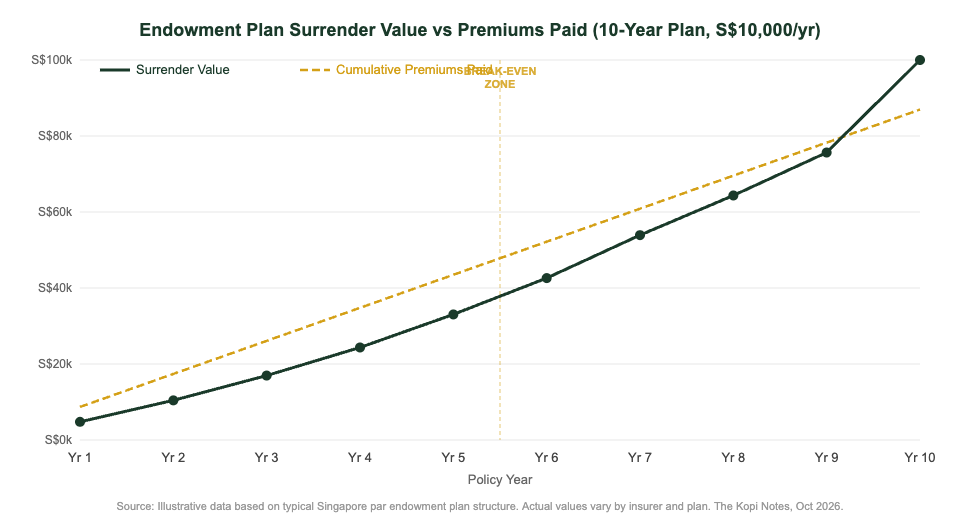
To make this concrete, consider a typical Singapore investor — let’s call her Mei — who purchases a 10-year participating endowment plan with an annual premium of S$10,000 (total premiums over 10 years: S$100,000).
Based on a typical policy illustration from a major Singapore insurer:
| Policy Year | Total Premiums Paid | Guaranteed Surrender Value | Total Surrender Value (Proj.) | Gain / (Loss) |
|---|---|---|---|---|
| 1 | S$10,000 | S$3,200 | S$5,500 | (S$4,500) |
| 3 | S$30,000 | S$17,500 | S$19,500 | (S$10,500) |
| 5 | S$50,000 | S$45,000 | S$51,000 | +S$1,000 |
| 7 | S$70,000 | S$73,500 | S$80,500 | +S$10,500 |
| 10 (Maturity) | S$100,000 | S$108,000 | S$118,000–S$125,000 | +S$18,000–S$25,000 |
Source: Illustrative values based on typical Singapore par endowment plan structure, Oct 2026. Actual figures will differ by insurer and participating fund performance. “Projected” values include non-guaranteed bonuses and are not guaranteed.
In this example:
- Projected break-even: approximately Year 5 (S$51,000 total surrender value vs S$50,000 premiums paid)
- Guaranteed break-even: approximately Year 7 (S$73,500 guaranteed surrender value vs S$70,000 premiums paid)
- Effective IRR at maturity (projected): approximately 3.2–3.8% p.a.
- Effective IRR at maturity (guaranteed only): approximately 1.5–2.0% p.a.
This illustrates why it’s critical to check both the guaranteed and projected figures in your policy illustration — the gap between them can be significant.
How to Calculate Your Endowment Plan IRR
Internal Rate of Return (IRR) is the most meaningful metric for evaluating an endowment plan. Unlike simply comparing the maturity value to total premiums paid (which ignores the time value of money), IRR accounts for the timing of each cash flow.
Simple IRR calculation steps:
- List all your premium payment dates and amounts as negative cash flows (money going out).
- List the maturity or surrender payout as a positive cash flow (money coming in).
- Use Excel’s
=XIRR(values, dates)function to calculate the annualised IRR.
Example for Mei’s plan (annual premium S$10,000, maturity payout S$118,000 at Year 10):
In Excel:
Cash flows: -10,000 (Year 0), -10,000 (Year 1), …, -10,000 (Year 9), +118,000 (Year 10)
=XIRR(B1:B11, C1:C11) → approximately 3.4% p.a.
For the guaranteed-only scenario (maturity payout S$108,000), the same calculation gives approximately 1.8% p.a. — which is competitive with fixed deposits but below current Singapore Savings Bond rates.
The difference between your guaranteed IRR and projected IRR (in Mei’s case, 1.6 percentage points) represents your exposure to participating fund performance risk. In a low-interest-rate environment or poor fund performance year, the actual IRR may end up closer to the guaranteed figure.
To use our Singapore retirement calculator, you can model your endowment plan payout as a lump-sum contribution at your target retirement age to see how it fits into your overall retirement plan.
Endowment Plan IRR vs Other Singapore Fixed Income Instruments
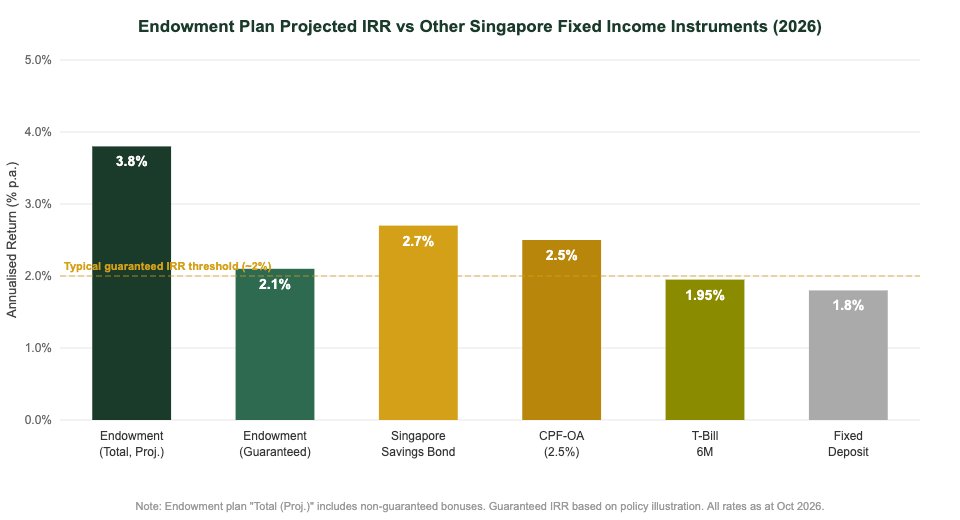
How does an endowment plan compare to other capital-safe or near-capital-safe options available to Singapore investors in 2026? The table below gives a direct comparison:
| Instrument | Return (p.a.) | Tenor | Capital Guaranteed? | Liquidity |
|---|---|---|---|---|
| Endowment Plan (Projected) | 3.0–4.5% | 5–25 years | No (non-guaranteed portion) | Low |
| Endowment Plan (Guaranteed) | 1.5–2.5% | 5–25 years | Yes (at maturity) | Low |
| Singapore Savings Bonds | 2.70% (10-yr avg) | Up to 10 years | Yes (backed by Singapore govt) | High |
| T-Bills (6-month) | 1.95% | 6 months | Yes (backed by Singapore govt) | High |
| CPF-OA | 2.50% | Ongoing | Yes | Low (CPF restrictions) |
| Fixed Deposits | 1.80% | 1–3 years | Yes (SDIC up to S$100k) | Medium |
Source: MAS, CPF Board, Singapore government bond auction results, insurer policy illustrations. Rates as at October 2026. Endowment plan IRR figures are illustrative ranges based on typical Singapore par plan structures.
Key insight: On a projected basis, a well-structured long-term endowment plan (3.5–4.5% projected IRR) outperforms most capital-safe alternatives in Singapore — but only if you hold to maturity. The tradeoff is significantly lower liquidity and the non-guaranteed nature of the bonus component. If liquidity is a priority, the Singapore Savings Bonds guide covers an alternative that lets you redeem monthly with no penalty.
For investors seeking higher returns with more liquidity, a robo-advisor like Syfe (referral code: SRPRFFFCD) or Endowus (referral code: 2V343) may be worth considering as a complement to your endowment plan — particularly for the portion of your portfolio not earmarked for protection or forced savings.
What Factors Affect Your Break-Even Point?
Not all endowment plans break even at the same speed. Six main factors determine your specific break-even timeline:
- Plan tenor (duration): Shorter plans (2–3 year) typically break even faster in absolute terms. Longer plans (10–25 year) take more years to break even, but deliver higher IRR at maturity — they front-load higher costs and commissions, which push the break-even later.
- Premium payment term: A plan with a 5-year premium payment term on a 10-year policy will break even later in the early years (you’re paying more per year) but the total premiums are the same. Limited payment plans often have steeper early-year surrender penalties.
- Participating vs non-participating (par vs non-par): Par plans include non-guaranteed bonuses that can accelerate your break-even on a projected basis. Non-par plans have fully guaranteed (but lower) returns — your projected and guaranteed break-even coincide, giving you more certainty.
- Insurer’s participating fund performance: For par plans, the insurer’s par fund return directly affects bonus declarations. In a year where the fund performs poorly (e.g., 2022–2023 global market downturn), bonuses may be cut, pushing your projected break-even later.
- Premium loading and charges: Higher upfront charges (distribution costs, agent commissions) delay break-even. Direct-purchase endowment plans (sold without agents) sometimes have lower charges and earlier break-even points — though product selection is more limited.
- Sum assured vs total premiums ratio: A plan with a high sum assured relative to premiums often includes a larger mortality charge, which can delay break-even compared to a savings-focused endowment with minimal life cover.
Always read the “Benefit Illustration” table in your policy document. It shows your guaranteed and projected surrender values at each policy year — this is your primary reference for calculating break-even.
When to Exit Before Break-Even
Breaking even should not be your only consideration when evaluating whether to surrender an endowment plan early. There are legitimate scenarios where exiting before break-even is the financially rational choice:
- Opportunity cost is too high: If your endowment’s guaranteed IRR is 1.8% and you have access to a risk-free Singapore Savings Bond yielding 2.70%, holding an illiquid endowment just to avoid a small loss may not make sense for your overall portfolio. The opportunity cost of the locked-up capital could exceed the break-even loss.
- Financial emergency: If you have a genuine cash flow crisis and the endowment is your only accessible asset, the surrender loss may be lower than the cost of a high-interest personal loan. Always exhaust endowment policy loan options first — they allow you to access funds without full surrender.
- Major life change: Divorce, emigration, or a significant change in financial goals may make an endowment plan structurally incompatible with your new situation. Review carefully with a licensed financial advisor.
- Insurer downgrade: If your insurer’s credit rating has deteriorated significantly, the additional risk may not justify continuing the policy. Singapore insurers are regulated by MAS and are required to maintain policyholder protection funds, but this is a theoretical risk worth monitoring for very large policies.
What not to do: Do not surrender an endowment plan simply because you’re unhappy with near-term bonus rates. Participating fund performance is cyclical — poor bonus years are often followed by recovery years. If the plan’s guaranteed floor still meets your baseline return requirement, staying the course is generally advisable.
For investors building a long-term passive income strategy, understanding whether passive income Singapore strategies via S-REITs or ETFs might supplement or replace endowment plans is worth exploring in parallel. You can model the scenarios using our Singapore retirement calculator.
Frequently Asked Questions
When does an endowment plan break even in Singapore?
Most Singapore endowment plans break even on a projected basis (including non-guaranteed bonuses) between Year 5 and Year 8, depending on the plan type. On a guaranteed basis only, break-even typically occurs 1–3 years later. Short-term endowment plans (2–3 year) and single premium plans break even earliest, often within the first 1–2 years. Long-term regular premium plans (10–25 years) take longer to break even but deliver higher IRR at maturity.
What happens if I surrender my endowment plan before break-even?
If you surrender your endowment plan before break-even, you will receive a surrender value that is less than the total premiums you have paid — resulting in a net loss. For example, if you paid S$30,000 in premiums over 3 years and your surrender value is S$19,500, you would lose S$10,500. This loss is highest in the early years (Year 1–2) and decreases as you approach break-even. Before surrendering, consider whether a policy loan (borrowing against the policy’s surrender value) might address your immediate cash need without permanent loss.
How do I calculate my endowment plan's IRR?
The simplest method is to use Excel’s XIRR function. Enter all your premium payments as negative cash flows with their payment dates, and the maturity payout as a positive cash flow on the maturity date. The formula =XIRR(values, dates) returns the annualised internal rate of return. You should calculate IRR twice — once using the guaranteed maturity value (from your policy’s benefit illustration) and once using the projected maturity value (including non-guaranteed bonuses). The difference shows your bonus-dependent return upside.
Is an endowment plan better than a Singapore Savings Bond?
It depends on your priorities. Singapore Savings Bonds offer government-backed capital safety with full liquidity (redeemable any month with no penalty) and a 10-year average yield of around 2.70% (as at Oct 2026). Endowment plans offer higher projected IRR (3.0–4.5% at maturity) but with very low liquidity, a multi-year commitment to receive full returns, and non-guaranteed bonus exposure. If liquidity is important to you, SSBs are superior. If you can commit capital for 10+ years and want a forced savings mechanism with life protection, a long-term endowment may deliver better returns.
Do endowment plan payouts get taxed in Singapore?
No. Endowment plan maturity payouts are not subject to income tax in Singapore. Both the guaranteed payout and the non-guaranteed bonuses are received tax-free by the policyholder. This is one of the advantages of endowment plans over certain other investment vehicles. However, if the plan was funded using SRS (Supplementary Retirement Scheme) contributions, the SRS withdrawal rules apply when you eventually withdraw from SRS — 50% of SRS withdrawals after the statutory retirement age are taxable.
Can I use a policy loan to avoid surrendering before break-even?
Yes. Most Singapore endowment plans allow you to take a policy loan of up to 80–90% of the plan’s current surrender value. The interest rate on policy loans is typically 5–6% p.a., which is lower than personal loan rates. If you need temporary liquidity, a policy loan lets you access funds without surrendering the policy — your coverage and projected maturity benefits remain intact. However, outstanding loans plus interest will be deducted from your maturity payout, so they should be repaid as soon as your cash flow allows.
Does my endowment plan's break-even change if bonus rates are cut?
Yes. If your insurer cuts reversionary bonus rates, your projected surrender value in future years will be lower than illustrated in your original policy benefit illustration. This means your projected break-even year may shift later by 1–2 years. The guaranteed break-even does not change — guaranteed surrender values are contractually fixed at policy inception. This is why financial planners recommend treating the projected figures as aspirational targets rather than certainties, and stress-testing your break-even using the guaranteed figures alone as your worst-case scenario.
Plan Your Retirement Around Your Endowment
Use our free Singapore retirement calculator to model how your endowment maturity payout fits into your overall retirement income plan.
Get Free Insurance Advice
Speak with a licensed insurance advisor. No obligation, no cost.
By submitting this form, you agree to our Privacy Policy.
This article was researched with the help of AI. While we strive to keep all information accurate and up to date, there may be errors. If you notice any discrepancies, please contact us.