Mapletree Logistics Trust (M44U) FY2027 DPU Forecast: Will Distributions Recover?
Singapore’s largest logistics REIT — analysed for income investors tracking the FY2027 distribution outlook.
Mapletree Logistics Trust (SGX: M44U) is Singapore’s largest logistics REIT, holding approximately 185 properties across nine Asia-Pacific and European markets. After three years of DPU compression driven by rising borrowing costs and a challenging China portfolio, FY2027 recovery depends on three catalysts: Federal Reserve rate cuts easing interest expense, stabilising China occupancy rates, and active portfolio reconstitution. At current indicative yields of 5.8–6.5%, income-focused investors are watching this REIT closely.
Not financial advice. All figures are for educational reference only and are estimates unless otherwise noted. Data as at October 2026 unless stated.
Table of Contents
What Is Mapletree Logistics Trust?
Mapletree Logistics Trust (MLT) is a Singapore-listed real estate investment trust (REIT) that owns and manages a diversified portfolio of logistics and warehouse facilities across Asia-Pacific. Listed on the Singapore Exchange (SGX) under the ticker M44U in July 2005, MLT was one of the first pure-play logistics REITs in Asia and remains the largest by assets under management.
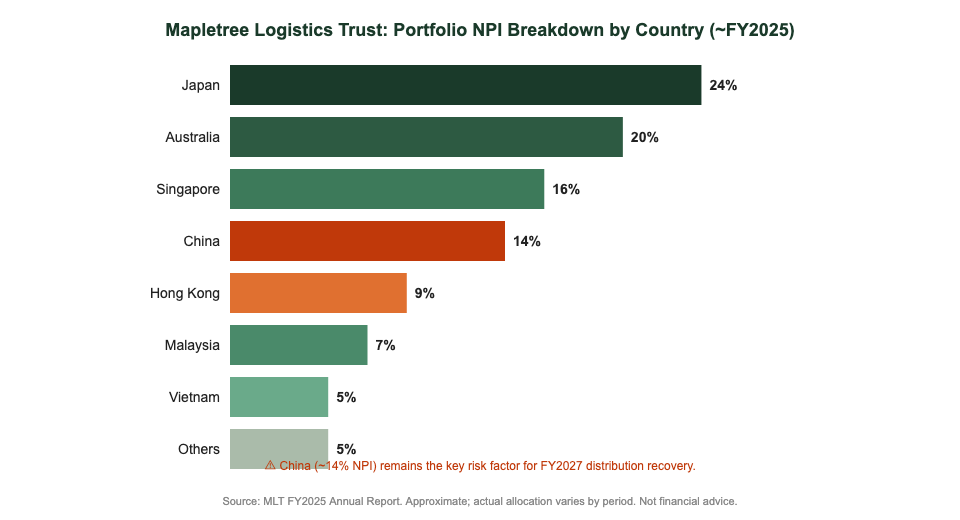
MLT’s portfolio spans approximately 185 properties across nine countries: Singapore, Japan, Australia, South Korea, Malaysia, Vietnam, China, Hong Kong, and India. Japan and Australia are the two largest contributors to net property income (NPI), collectively accounting for over 40% of total income. The REIT is managed by Mapletree Logistics Trust Management Ltd, a wholly-owned subsidiary of Mapletree Investments Pte Ltd — the property arm of Temasek Holdings.
As a key constituent among the best S-REITs in Singapore 2026, MLT is favoured by income investors for its diversified logistics exposure and semi-annual DPU distributions. The REIT distributes income twice yearly, typically in February and August, with distribution periods ending September 30 and March 31 respectively.
Key Facts at a Glance
| Metric | Detail |
|---|---|
| SGX Ticker | M44U |
| Full Name | Mapletree Logistics Trust |
| Manager | Mapletree Logistics Trust Management Ltd |
| Sponsor | Mapletree Investments Pte Ltd (Temasek-backed) |
| Listed | 28 July 2005, SGX Mainboard |
| Number of Properties | ~185 (as at FY2025) |
| Countries | 9 (Singapore, Japan, Australia, South Korea, Malaysia, Vietnam, China, Hong Kong, India) |
| Distribution Frequency | Semi-annual (February & August) |
| Gearing Ratio | ~38–40% (as at FY2025) |
| Financial Year End | 31 March |
Source: MLT SGX filings, Mapletree Investments. Figures as at FY2025 (ended March 2025).
MLT DPU History: Three Years of Compression
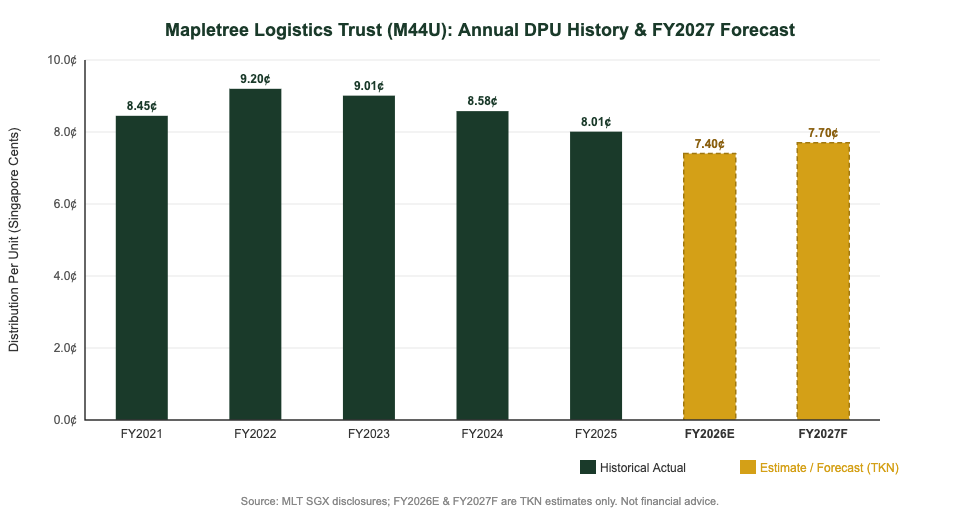
MLT’s distribution history tells the story of post-pandemic recovery followed by sustained compression. From a peak of approximately 9.20 cents per unit in FY2022, MLT’s annual DPU declined steadily as higher-for-longer interest rates increased borrowing costs across the portfolio. By FY2025 (ended March 2025), estimated DPU had fallen to approximately 8.01 cents — representing a cumulative decline of around 13% from peak. The current trajectory suggests FY2026 (ended March 2026) may see a further decline to approximately 7.40 cents before a modest recovery in FY2027.
| Financial Year | Period | Est. Annual DPU (S¢) | YoY Change |
|---|---|---|---|
| FY2021 | Apr 2020 – Mar 2021 | 8.45 | — |
| FY2022 | Apr 2021 – Mar 2022 | 9.20 | +8.9% |
| FY2023 | Apr 2022 – Mar 2023 | 9.01 | −2.1% |
| FY2024 | Apr 2023 – Mar 2024 | 8.58 | −4.8% |
| FY2025 | Apr 2024 – Mar 2025 | 8.01 | −6.6% |
| FY2026E | Apr 2025 – Mar 2026 | 7.40 (TKN est.) | −7.6% |
| FY2027F | Apr 2026 – Mar 2027 | 7.50–8.00 (TKN forecast) | +1% to +8% recovery |
Source: MLT SGX filings (approximate actuals FY2021–FY2025). FY2026E and FY2027F are TKN estimates only. Not financial advice.
The compression from FY2023 to FY2026 was driven by three primary factors. First, MLT’s weighted average cost of debt rose from approximately 2.3% in FY2022 to around 3.6% in FY2025, adding roughly S$50–60 million in annual interest expense. Second, occupancy and rental income from MLT’s China portfolio declined due to structural oversupply in the domestic logistics warehouse segment. Third, currency headwinds from a weakening Japanese yen reduced the SGD value of Japan’s NPI contribution, which typically represents approximately 22–25% of total net property income.
FY2027 DPU Forecast: Key Recovery Drivers
For FY2027 (April 2026 to March 2027), three potential catalysts support a DPU stabilisation and modest recovery thesis:
1. Interest Cost Reduction via Rate Cuts
The US Federal Reserve began its rate-cutting cycle in late 2024, and Singapore’s Swap Offer Rate (SOR) has tracked lower accordingly. MLT’s weighted average cost of debt — approximately 3.4–3.6% in FY2025 — is expected to moderate as fixed-rate hedges roll off and new borrowings are taken at lower prevailing rates. A 50 basis point reduction in weighted average borrowing cost on MLT’s estimated S$5.5 billion total debt book would save approximately S$27 million in annual interest expense, equivalent to approximately 0.5–0.6 cents per unit in additional distributable income.
2. Japan Portfolio Stability
Japan remains MLT’s single largest country by NPI contribution (approximately 24%). As covered in our earlier MLT Japan and Australia portfolio analysis, the REIT’s Japanese assets benefit from long weighted average lease expiries (WALEs) and stable yen-denominated income. Even with JPY/SGD volatility, the underlying occupancy (approximately 98%) and rent renewal environment in Japan’s logistics sector remains favourable given structural undersupply in major logistics hubs.
3. Portfolio Reconstitution and Asset Recycling
MLT has been actively divesting non-core and lower-yielding assets — particularly older properties in China and Singapore — to recycle capital into higher-quality acquisitions in Australia, Japan, and South Korea. This reconstitution strategy aims to improve the overall portfolio NPI yield, partially offsetting the China drag. In FY2025, MLT divested approximately S$300–400 million of assets at premiums to book value, generating divestment gains that contributed to distributions. Continued execution of this strategy in FY2026 and FY2027 is a key upside driver for the distribution recovery thesis.
China Portfolio: The Ongoing Wildcard
China represents approximately 14% of MLT’s NPI — down from a peak of around 22% as the REIT has actively divested Chinese assets. The structural challenges in China’s logistics property market — oversupply from e-commerce platform-owned warehouses, slowing domestic consumption growth, and broader property sector stress — have weighed on occupancy (estimated 85–90% in China versus 95%+ for the rest of the portfolio) and rental reversions.
The key question for FY2027 is whether China’s logistics market stabilises sufficiently to support occupancy recovery. Government stimulus programmes announced in late 2024 and 2025 have provided modest support, but structural oversupply in tier-2 and tier-3 city logistics parks remains a headwind. TKN’s base case assumes China occupancy recovers to approximately 88–92%, contributing a modest 0.1–0.2 cent per unit uplift to distributable income. The bear case — China occupancy falling below 85% — could negate a significant portion of the interest cost savings. This makes China the single most important variable in the FY2027 DPU outcome.
Investors seeking passive income from Singapore REITs should weigh this China exposure carefully against the relatively stable income from MLT’s Japan and Australia portfolios when assessing risk-adjusted yield.
Interest Rate Sensitivity Analysis
MLT’s balance sheet is partially hedged via interest rate swaps. As at the latest reporting period, approximately 72–78% of MLT’s borrowings were at fixed rates, with the remainder at floating rates. This means the rate cut benefit will not flow through immediately — fixed-rate hedges roll off progressively over FY2026 and FY2027, with the full benefit of lower rates likely materialising by FY2028. The table below illustrates the potential DPU impact under three interest rate scenarios:
| Scenario | Avg. Cost of Debt | Annual Interest Saving vs FY2025 | Est. DPU Impact |
|---|---|---|---|
| Bear (rates stay elevated) | 3.6% | — | 0 additional cents |
| Base (−50bps vs FY2025) | 3.1% | ~S$27M | +0.5¢ per unit |
| Bull (−100bps vs FY2025) | 2.6% | ~S$55M | +1.0¢ per unit |
TKN estimates based on approximate MLT total debt of S$5.5B. For illustration only. Actual savings depend on hedge roll-off schedule. Not financial advice.
Note that the above analysis covers interest cost savings only. The full FY2027 DPU outcome will also be affected by NPI growth (or contraction) from portfolio changes, currency movements (particularly JPY/SGD), and any equity-raising activities by the REIT. Investors can use our Singapore retirement calculator to model how different yield scenarios affect their income planning goals.
Valuation & Investor Verdict
MLT has historically traded at a premium to book value (P/NAV above 1.0x) during periods of accommodative monetary policy, reflecting its blue-chip status, Temasek-backed sponsor, and growing regional logistics footprint. As at mid-2026, with DPU under pressure and borrowing costs still elevated, the P/NAV has compressed to an estimated 0.85–0.95x range — representing a potential discount to the underlying asset value of the portfolio.
At indicative yields of approximately 5.8–6.5% (based on FY2026 estimated DPU of 7.40 cents), MLT offers a meaningful income spread relative to the Singapore T-bills (approximately 1.95% as at October 2026) and Singapore Savings Bonds (approximately 2.70% p.a. as at October 2026). For investors with a 2–3 year holding horizon who believe in the rate-cut-driven recovery thesis, the current pricing may represent an attractive entry point.
Key decision factors for income investors: (1) conviction on the China recovery timeline — a prolonged China drag extending into FY2027 is the primary downside risk; (2) the pace of interest rate normalisation — faster cuts accelerate the DPU recovery; and (3) tolerance for near-term DPU volatility as hedge books roll over. MLT remains a core logistics REIT holding for Singapore income investors, accessible through platforms including Syfe, FSMOne, and IBKR.
Disclaimer: This analysis is for informational purposes only and does not constitute financial advice. DPU forecasts are TKN estimates based on publicly available data and are subject to significant uncertainty. Always conduct your own due diligence and consider your personal financial situation before investing.
Frequently Asked Questions
What is Mapletree Logistics Trust and what does it invest in?
Mapletree Logistics Trust (SGX: M44U) is a Singapore-listed REIT that owns and manages a portfolio of logistics and warehouse facilities across Asia-Pacific. It holds approximately 185 properties in nine countries including Singapore, Japan, Australia, South Korea, Malaysia, Vietnam, China, Hong Kong, and India. MLT was listed on SGX in July 2005 and is sponsored by Mapletree Investments, the property arm of Temasek Holdings. The REIT distributes income semi-annually in February and August.
What is Mapletree Logistics Trust's FY2027 DPU forecast?
Based on TKN estimates, MLT’s FY2027 DPU (for the financial year ending March 2027) is forecast in the range of 7.50 to 8.00 Singapore cents per unit, compared to an estimated 7.40 cents in FY2026. This represents a potential 1–8% recovery, contingent on Fed rate cuts reducing borrowing costs and stabilisation of the China portfolio occupancy. These are TKN estimates only and not financial advice — actual DPU will depend on many factors including currency movements, NPI performance, and any capital management actions by the REIT manager.
Why has MLT's DPU been falling since FY2022?
MLT’s DPU peaked at approximately 9.20 cents in FY2022 and has declined since due to three main factors: (1) a significant rise in borrowing costs as global interest rates increased, adding approximately S$50–60M in annual interest expense as the weighted average cost of debt rose from ~2.3% to ~3.6%; (2) weaker occupancy and rental income from MLT’s China portfolio, which faces structural oversupply in the logistics warehouse sector; and (3) currency headwinds from a weakening Japanese yen, which reduced the SGD value of Japan’s NPI contribution (approximately 24% of total NPI).
Is MLT a good dividend REIT for Singapore investors?
MLT offers indicative yields of approximately 5.8–6.5% based on FY2026 estimated DPU — significantly higher than Singapore Savings Bonds (~2.70% p.a.) or T-bills (~1.95% as at October 2026). For income-focused Singapore investors with a 2–3 year horizon, MLT provides diversified logistics REIT exposure backed by a Temasek-linked sponsor and a portfolio spanning nine countries. Key risks include China portfolio performance, interest rate trajectory, JPY/SGD currency movements, and potential equity-raising dilution. This is not financial advice; consult a licensed financial adviser.
What is MLT's gearing ratio and is it a concern?
MLT’s gearing ratio is approximately 38–40% — within MAS’s regulatory ceiling of 50% for Singapore REITs. While this is on the higher side relative to some peers, MLT has demonstrated disciplined capital management through active asset divestment and recycling. At current gearing levels, MLT has limited headroom for large-scale debt-funded acquisitions without a rights issue or private placement, which could dilute DPU per unit. The gearing level is not a near-term concern from a regulatory standpoint, but investors should monitor it in the context of any new acquisition announcements.
Can I buy Mapletree Logistics Trust with my SRS funds?
Yes. As a Singapore Exchange-listed stock, MLT (SGX: M44U) is eligible for purchase using Supplementary Retirement Scheme (SRS) funds through SRS-eligible brokerages including DBS Vickers, OCBC Securities, UOB Kay Hian, FSMOne (referral code P0544985), and Syfe Brokerage (referral code SRPRFFFCD). Note that MLT is not on the CPF Investment Scheme (CPFIS) approved list for CPF Ordinary Account (OA) investments, so it cannot be purchased using CPF-OA funds.
Invest in Singapore Logistics REITs
Access Mapletree Logistics Trust through these platforms. Use our referral codes for sign-up bonuses.
This article was researched with the help of AI. While we strive to keep all information accurate and up to date, there may be errors. If you notice any discrepancies, please contact us.