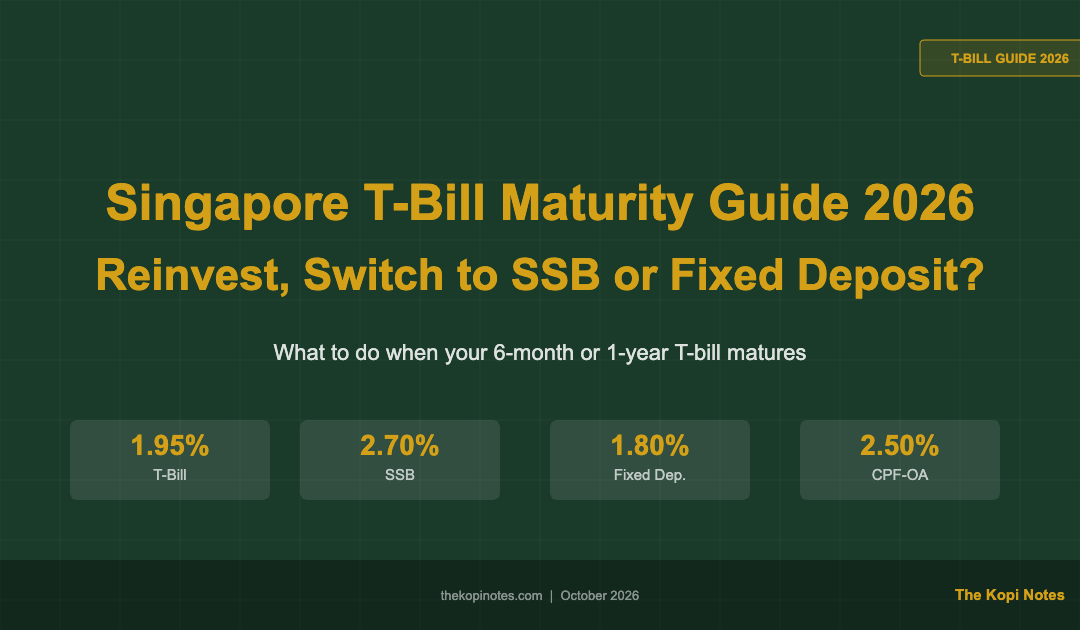
Singapore T-Bill Maturity Guide 2026: Reinvest, Switch to SSB or Fixed Deposit?
What every Singapore investor should do when their 6-month or 1-year T-bill matures — current rates compared, step-by-step reinvestment guide.
When your Singapore T-bill matures, the principal and interest are credited back to your bank account or CPF-OA within 2 business days. At current rates (October 2026), 6-month T-bills are yielding approximately 1.95% p.a., while Singapore Savings Bonds (SSB) offer around 2.70% for the first year — making SSB the higher-yielding option for liquid cash unless you specifically need T-bill flexibility. Here’s how to decide what to do with your proceeds.
Not financial advice. All figures are for educational reference only. Data as at October 2026 unless noted.
Table of Contents
Contents — Click to expand
- What Happens When Your T-Bill Matures
- Current T-Bill Rates vs Alternatives (October 2026)
- Should You Reinvest in Another T-Bill?
- T-Bill vs Singapore Savings Bonds (SSB)
- T-Bill vs Fixed Deposits Comparison 2026
- What CPF-OA T-Bill Investors Should Do
- How to Reinvest Your T-Bill Proceeds Step-by-Step
- Frequently Asked Questions
What Happens When Your T-Bill Matures in Singapore
Singapore Government Treasury Bills (T-bills) are short-term securities issued by the Singapore Government through the Monetary Authority of Singapore (MAS). They come in two tenures: 6-month (26-week) and 1-year (52-week). When a T-bill reaches its maturity date, the process is automatic — no action is required from you.
For cash-funded T-bills (DBS/OCBC/UOB/SRS accounts): The full face value (i.e. what you applied for) is credited back to your designated bank account within 1–2 business days of the maturity date. Because T-bills are sold at a discount, the “interest” is the difference between your application amount and the face value — you receive the full face value at maturity, not your application amount plus separate interest.
For CPF-OA T-bills: The proceeds (principal + implied interest) are returned to your CPF Ordinary Account automatically on the maturity date. While your funds are invested in T-bills, the CPF-OA accrued interest of 2.5% p.a. is suspended — this is an important consideration discussed further below.
Once the proceeds are back in your account, you face a simple but important decision: roll over into another T-bill, switch to a Singapore Savings Bond, park in a fixed deposit, or invest in longer-duration assets for passive income Singapore generation.
Current T-Bill Rates vs Alternatives (October 2026)
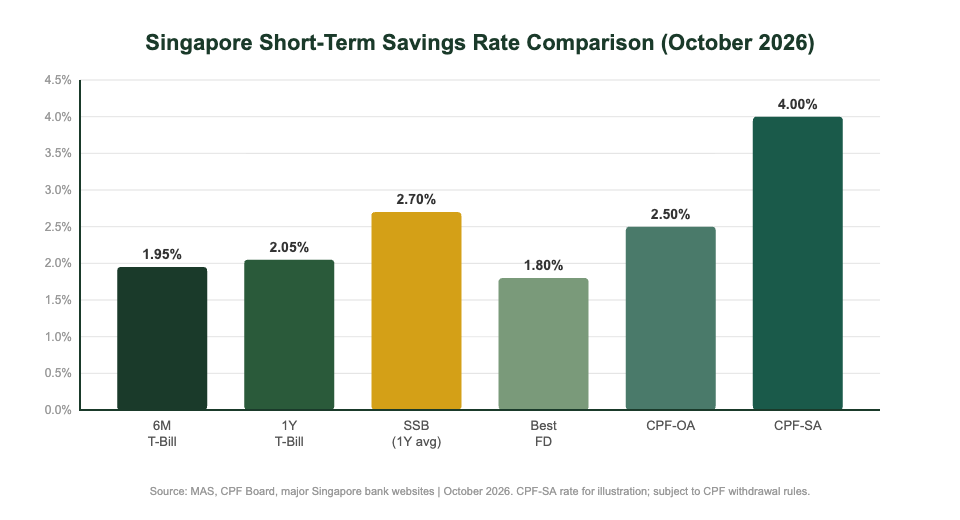
Before deciding what to do with your maturing T-bill proceeds, it helps to compare the current yield environment across Singapore’s main short-term savings instruments. The table below summarises the key rates as at October 2026.
| Instrument | Rate (p.a.) | Tenure | Lock-in | Tax-Free? |
|---|---|---|---|---|
| 6-Month T-Bill | ~1.95% | 6 months | No secondary market exit possible | Yes |
| 1-Year T-Bill | ~2.05% | 12 months | Can sell on SGX | Yes |
| SSB (1-Year avg) | ~2.70% | Up to 10 years | None (redeem anytime) | Yes |
| Best Fixed Deposit | ~1.80% | 3–12 months | Penalty for early break | Yes |
| CPF-OA | 2.50% | Ongoing | CPF withdrawal rules apply | Yes |
Source: MAS, CPF Board, major Singapore bank websites. Rates as at October 2026. T-bill rates are indicative based on recent auction cut-off yields.
Should You Reinvest in Another T-Bill?
Reinvesting in another T-bill makes sense in specific circumstances. The primary advantage of T-bills over SSBs and fixed deposits is their auction-based flexibility — you can apply through DBS/OCBC/UOB, via internet banking with your CPF-OA funds, or through your SRS account. However, at current October 2026 yields, T-bills at ~1.95% are not the highest-yielding liquid option available for free cash.
Reinvest in T-bills if:
- You want a fixed 6-month window to reassess your financial plans (salary bonus incoming, BTO payment, insurance renewal, etc.)
- You are investing through CPF-OA and the T-bill cut-off yield is expected to consistently exceed 2.5% — the current CPF-OA baseline
- You prefer the simplicity and government backing of T-bills with no application admin for SSBs
- You already have your SSB allocation maxed out at the SGD 200,000 personal limit
Skip the T-bill reinvestment if:
- Current cut-off yields are below 2.5% — at this point, leaving the money in CPF-OA earns the same or more with zero opportunity cost
- You have headroom in your SSB allocation and the SSB rate significantly exceeds T-bill yields (as is currently the case)
- The money is needed within 4 weeks — T-bill applications close 1–2 weeks before the auction date
To stay on top of upcoming T-bill auction dates and cut-off yield history, bookmark the Singapore T-bills 2026 guide which tracks each tranche.
T-Bill vs Singapore Savings Bonds (SSB) 2026
The Singapore Savings Bond is issued monthly by MAS and offers step-up interest that increases year-on-year. For most retail investors in October 2026, the SSB is the better alternative when your T-bill matures — here’s why:
The key advantage SSBs have over T-bills right now: SSB 1-year average rates (~2.70%) meaningfully exceed T-bill 6-month yields (~1.95%). If you have available SSB allocation (individual limit: SGD 200,000; household limit: SGD 400,000), switching from T-bills to SSBs on maturity gives you roughly 75 basis points more return per year.
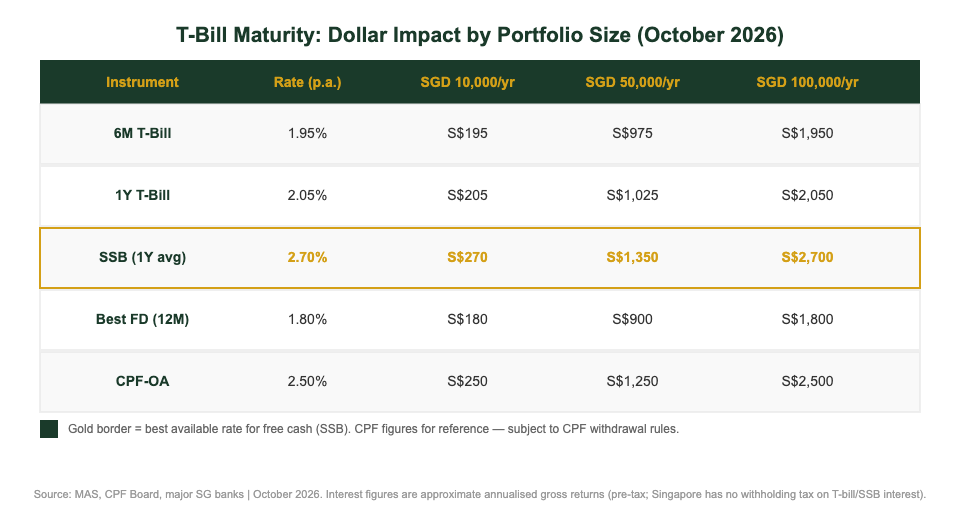
On a SGD 50,000 portfolio, that differential is approximately SGD 375 extra per year (SGD 1,350 in SSB vs SGD 975 in 6M T-bill).
The other critical advantage: SSBs can be redeemed any month with no penalty, typically with proceeds credited within 2 business days. This makes them more liquid than fixed deposits and as flexible as T-bills for practical purposes. For more on SSB mechanics, see the Singapore Savings Bonds guide.
When T-bills still win over SSBs:
- Your SSB personal limit (SGD 200,000) is fully utilised
- T-bill yields spike above SSB rates during market stress periods (this happened briefly in 2023)
- You want CPF-OA investment (SSBs cannot be purchased with CPF-OA funds — only T-bills and SGS bonds can)
T-Bill vs Fixed Deposits 2026 Comparison
Fixed deposits are the traditional alternative, but in today’s rate environment they sit below both T-bills and SSBs for most tenures. The best 12-month fixed deposit rates from major Singapore banks hover around 1.70–1.85% in October 2026 — lower than the 6-month T-bill rate of ~1.95%.
There are two scenarios where fixed deposits still make sense on T-bill maturity:
- Promotional rates: Occasionally, banks offer short-term FD promotions (e.g. 2.5% for a 3-month tranche for new-to-bank funds) that beat T-bill yields. These typically require fresh-fund conditions. Watch for these on GoBear or bank apps.
- Convenience: If you are not already set up for T-bill applications and don’t want to manage SSB applications, a standard FD is still better than leaving cash in a savings account earning 0.05%.
What CPF-OA T-Bill Investors Should Do
If you purchased T-bills using your CPF Ordinary Account funds, the maturity decision is slightly different. CPF-OA earns a guaranteed 2.5% p.a. — the government-mandated floor rate. This is also the hurdle rate that your T-bill investment must beat to justify the transfer.
At current T-bill yields of ~1.95% for 6-month bills, you are actually earning less than if you had left the money in CPF-OA. The math:
- SGD 50,000 in CPF-OA at 2.5% = SGD 1,250 per year
- SGD 50,000 in 6M T-bill at 1.95% = SGD 975 (annualised equivalent)
- Difference: SGD 275 less per year in T-bills
The CPF-OA T-bill strategy made strong sense in 2023 when T-bill yields exceeded 3.8%. At current 2026 yields, the optimal move when your CPF-OA T-bill matures is to not reinvest — simply let the proceeds return to CPF-OA and earn the guaranteed 2.5% until yields recover above 2.5%.
For a broader view of how to optimise your CPF allocation, see our CPF investment strategy Singapore guide, which covers the CPF-SA shielding strategy, CPFIS-eligible unit trusts, and the CPF 1M65 milestone framework.
How to Reinvest Your T-Bill Proceeds Step-by-Step
Whichever option you choose, here’s how to act quickly when your T-bill proceeds land.
Option A: Buy the Next T-Bill (Cash)
- Log into your DBS/POSB iBanking → Invest → Bonds & T-Bills → Apply for T-bill
- Check the upcoming auction date on the MAS website (auctions are typically every 2–3 weeks)
- Submit a competitive or non-competitive bid by the application deadline (usually 9pm on the business day before auction)
- Results are announced the next business day; allotment credited within 2 days
Option B: Switch to Singapore Savings Bonds
- Applications open on the 1st of each month and close around the 26th
- Apply via DBS/OCBC/UOB iBanking → Investments → Singapore Savings Bonds
- Minimum application: SGD 500; increments of SGD 500; maximum SGD 200,000 per person
- Interest is paid every 6 months directly to your bank account
Option C: Open a Fixed Deposit
- Compare rates on bank apps or GoBear — check promotional rates for new-to-bank funds
- Use FSMOne for access to multi-bank FD rates through a single platform (see our FSMOne referral code for a sign-up bonus)
- Note the maturity date carefully and set a calendar reminder to roll over or redeploy
Option D: Deploy into Income-Generating Assets
If your T-bill proceeds form part of a larger cash buffer and your emergency fund is already adequate, consider whether redeploying into dividend-paying S-REITs or ETFs makes sense for your financial goals. Use our Singapore retirement calculator to model how different deployment decisions affect your long-term retirement outcomes.
For reference, Singapore’s best S-REITs currently yield 5–7% annually — significantly higher than T-bill rates, though with more volatility and capital risk. This is a separate decision from your cash management strategy and not suitable for funds you may need within 12 months.
Frequently Asked Questions
Can I reinvest my T-bill automatically in Singapore?
No — Singapore T-bills do not auto-renew. When your T-bill matures, the full face value is credited back to your bank account or CPF-OA. You must manually apply for a new T-bill through your bank’s internet banking portal or the SGX mobile app if you want to reinvest.
How long does it take for T-bill maturity proceeds to arrive?
For cash-funded T-bills (DBS/OCBC/UOB), the maturity proceeds are typically credited to your linked bank account within 1–2 business days of the maturity date. For CPF-OA T-bills, the proceeds are credited back to your CPF Ordinary Account on the maturity date itself.
Is the Singapore T-bill interest taxable?
No. Interest earned from Singapore Government T-bills, SGS bonds, and Singapore Savings Bonds is exempt from Singapore income tax. There is no withholding tax on these instruments for Singapore residents. This applies whether the investment was made through cash, CPF-OA, or SRS funds.
Should I buy SSB instead of reinvesting in T-bills right now (October 2026)?
Based on October 2026 rates, SSBs offer a higher first-year return (~2.70%) than 6-month T-bills (~1.95%). If you have available SSB allocation (under the SGD 200,000 personal cap), switching to SSB on T-bill maturity makes financial sense for free cash. The main exception is if you are investing through CPF-OA, which cannot be used to buy SSBs.
What is the maximum I can invest in Singapore Savings Bonds?
Each individual can hold a maximum of SGD 200,000 in SSBs at any one time. The household limit is SGD 400,000 (i.e. SGD 200,000 per person for a two-person household). These limits apply across all SSB tranches combined. If you are at the cap, T-bills and fixed deposits remain your main alternatives.
Can I use my T-bill maturity proceeds to buy more SSBs immediately?
Yes, as long as the SSB application window for that month is still open (typically 1st to 26th of each month). You would need your T-bill proceeds to arrive in your bank account before the SSB application closes. Check your T-bill maturity date and the current SSB calendar on the MAS website to plan this correctly.
At what T-bill yield does it make sense to invest from CPF-OA?
The break-even point for CPF-OA T-bill investment is when the T-bill cut-off yield exceeds 2.5% p.a. — the CPF-OA guaranteed floor rate. At current October 2026 yields of ~1.95%, it does not make financial sense to transfer funds from CPF-OA into T-bills. You would earn more simply leaving the money in CPF-OA.
Disclaimer: This article is for informational and educational purposes only. It does not constitute financial advice or a recommendation to buy or sell any security. All rates cited are indicative as at October 2026 and subject to change. CPF rules and SSB limits are subject to government policy changes. Please consult a licensed financial adviser for advice tailored to your personal circumstances.
This article was researched with the help of AI. While we strive to keep all information accurate and up to date, there may be errors. If you notice any discrepancies, please contact us.