SRS Year-End Deadline 2026: Top Up by 31 December to Cut Your Tax Bill
Retirement Planning · October 2026 · 5 min read
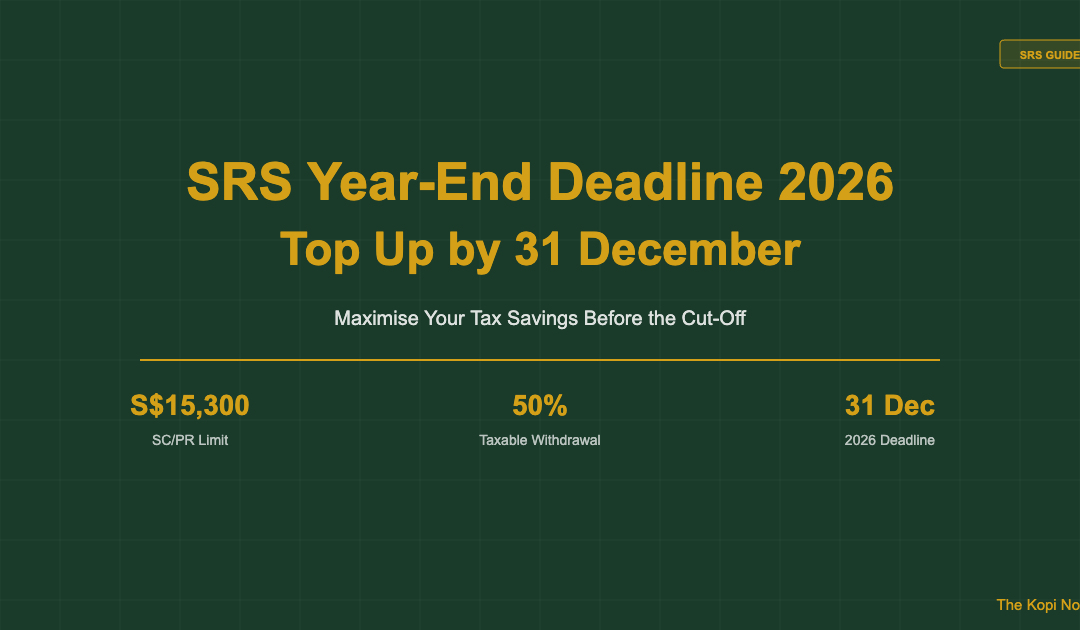
With just over two months left in 2026, Singapore investors have a narrow window to top up their Supplementary Retirement Scheme (SRS) account before 31 December — and claim the tax deduction for Year of Assessment 2027. At a marginal tax rate of 11.5% or higher, a S$15,300 SRS top-up saves you at least S$1,760 in income tax. Here is exactly what to do before the deadline.
Not financial advice. All figures are for educational reference only. Data as at October 2026 unless noted.
Table of Contents
Jump to section
- What is SRS and How Does the Tax Deduction Work?
- SRS Contribution Limits 2026 (SC, PR, Foreigner)
- How Much Tax Can You Actually Save?
- Why the 31 December Deadline Matters
- Step-by-Step: How to Top Up Your SRS Account
- Where to Invest Your SRS Funds After Top-Up
- SRS vs CPF Cash Top-Up: Which Tax Relief Comes First?
- Frequently Asked Questions
What is SRS and How Does the Tax Deduction Work?
The Supplementary Retirement Scheme (SRS) is a voluntary savings programme administered by the Ministry of Finance. Singapore Citizens, Permanent Residents, and foreigners working in Singapore can open an SRS account at DBS, OCBC, or UOB, then invest the funds in a wide range of eligible instruments — unit trusts, stocks, ETFs, Singapore Savings Bonds, and fixed deposits.
The tax mechanics are straightforward: every dollar you contribute to SRS in 2026 is deducted from your assessable income for Year of Assessment 2027 (income earned January–December 2026). If your marginal tax rate is 15%, contributing S$15,300 saves you S$2,295 in tax. You are effectively deferring tax to retirement, when your income — and therefore your tax rate — is likely to be lower.
At withdrawal (from age 62), only 50% of each withdrawal is taxable, and you can spread withdrawals over 10 years to keep each tranche within a low tax band. Read our detailed guide on SRS withdrawal strategy Singapore 2026 for the full playbook on minimising tax at retirement.
The SRS also has a significant compounding advantage: funds invested within the account grow tax-free. Dividends, capital gains, and interest earned inside SRS are not taxed while the money stays in the account — only at withdrawal.
SRS Contribution Limits 2026 (SC, PR, Foreigner)
The annual contribution cap differs depending on your residency status. Importantly, the limit is a ceiling, not a minimum — you can contribute any amount up to the cap. However, contributing less than the maximum means leaving tax relief on the table.
| Account Type | Annual Contribution Cap | Approx. Max Tax Saved (22% rate) |
|---|---|---|
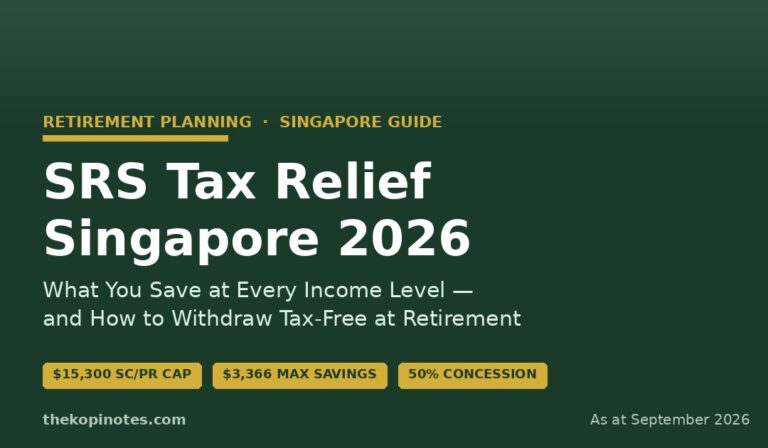
| Singapore Citizen | S$15,300 | ~S$3,366 |
| Permanent Resident | S$15,300 | ~S$3,366 |
| Foreigner (EP/S-Pass holder) | S$35,700 | ~S$7,854 |
Source: CPF Board, SRS Contribution Limits, October 2026
Employers do not contribute to SRS — unlike CPF, this scheme is entirely employee-funded. The SRS contribution cap has remained at these levels for Singapore Citizens and PRs since it was last revised. Foreigners receive a higher cap to account for the absence of CPF savings.
[/et_pb_image alt="SRS contribution limits and year-end checklist Singapore 2026" src="https://thekopinotes.com/wp-content/uploads/2026/10/srs-year-end-deadline-2026-chart-2.png" _builder_version="4.16.0" max_width="100%"][/et_pb_image]How Much Tax Can You Actually Save?
The tax benefit from SRS is a function of your marginal tax rate on the last dollar earned. For a Singapore Citizen earning S$200,000 of assessable income in 2026 and contributing the full S$15,300, the saving is calculated as follows: the S$15,300 contribution reduces taxable income, and the applicable marginal rate on that slice is 18–19%, yielding approximately S$2,754–S$2,907 in tax saved.
The table below uses IRAS personal income tax rates for resident individuals for Year of Assessment 2027:
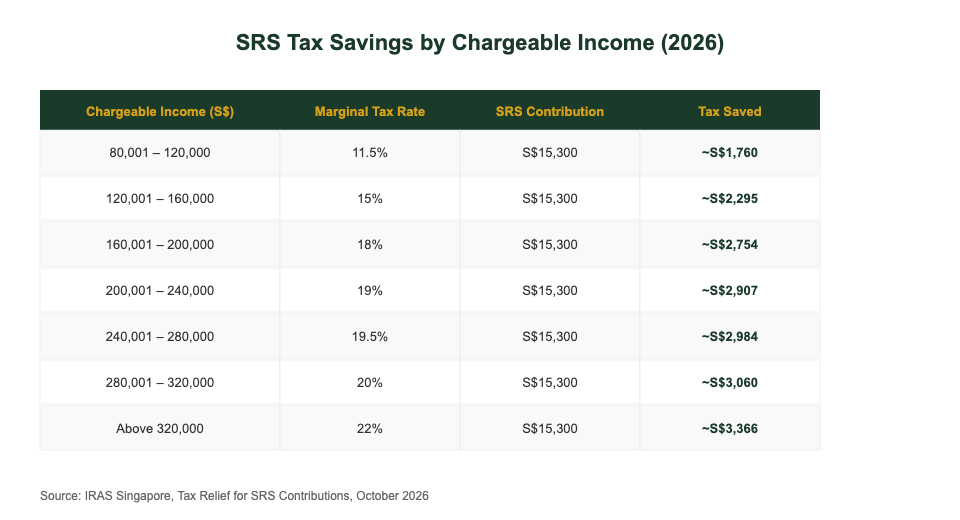
| Chargeable Income (S$) | Marginal Rate | SRS Contribution | Tax Saved |
|---|---|---|---|
| 80,001 – 120,000 | 11.5% | S$15,300 | ~S$1,760 |
| 120,001 – 160,000 | 15% | S$15,300 | ~S$2,295 |
| 160,001 – 200,000 | 18% | S$15,300 | ~S$2,754 |
| 200,001 – 240,000 | 19% | S$15,300 | ~S$2,907 |
| Above 320,000 | 22% | S$15,300 | ~S$3,366 |
Source: IRAS Singapore, Personal Income Tax Rates for Resident Individuals, October 2026
Note that the tax savings are approximate — the actual saving depends on the exact band your S$15,300 falls within. If your income straddles two bands, the saving is calculated proportionally. Use our Singapore retirement calculator to model your specific scenario, including SRS projections over a 20–30 year horizon.
For a complete breakdown of how to calculate your chargeable income and which tax reliefs to claim first, see our evergreen SRS contribution guide Singapore 2026.
Why the 31 December Deadline Matters
Singapore’s personal income tax is assessed on a calendar-year basis: income earned from 1 January to 31 December 2026 is assessed in Year of Assessment 2027 (the IRAS tax filing period in March–April 2027). Any SRS contributions made on or before 31 December 2026 count as a deduction against your 2026 income.
If you miss the cut-off by even one day — contributing S$15,300 on 1 January 2027 — the deduction shifts to YA2028 instead. You do not lose the relief entirely, but you do lose it for this tax year, delaying your tax saving by 12 months and losing the time value of that cash refund.
A few practical deadline notes for 2026:
- DBS/POSB SRS: Online transfers up to 11:59pm on 31 Dec are credited same-day. ATM top-ups before bank cut-off time also count.
- OCBC SRS: Internet banking transfers on 31 Dec are credited same-day (up to 11:55pm). Avoid 31 Dec if possible — system load peaks on year-end.
- UOB SRS: Online top-ups via UOB TMRW or internet banking are processed same-day up to 11:59pm on 31 Dec.
- Cheque deposits: Not recommended near year-end — processing time may push the credit date into January 2027.
Recommendation: Top up your SRS account between now and mid-December to avoid year-end system congestion and processing delays. If your bank account needs topping up first, budget for the transfer well in advance.
Step-by-Step: How to Top Up Your SRS Account
If you already have an SRS account, topping it up takes under five minutes. If you do not have one yet, you need to open an account first — the opening process with DBS, OCBC, or UOB takes 10–15 minutes online and the account is typically activated within one business day.
Topping Up via DBS/POSB
- Log in to DBS iBanking or the DBS digibank app.
- Navigate to Invest > Supplementary Retirement Scheme (SRS).
- Select Top Up SRS and choose your source account.
- Enter the amount (any amount from S$1 up to your remaining annual cap).
- Confirm and save the transaction reference number as proof of contribution.
Topping Up via OCBC
- Log in to OCBC Internet Banking or the OCBC Digital app.
- Go to Invest > SRS Account.
- Select Top Up and your funding account.
- Enter the amount, review the transaction, and confirm.
Topping Up via UOB
- Log in to UOB TMRW or UOB Personal Internet Banking.
- Navigate to Invest > SRS.
- Select Fund SRS Account and enter the contribution amount.
- Authorise with your OTP and save the confirmation.
After topping up, do not leave the funds in the default SRS savings account where they earn negligible interest. Move them into investments immediately. Our guide on SRS account investment options Singapore 2026 covers eligible instruments in detail.
Where to Invest Your SRS Funds After Top-Up
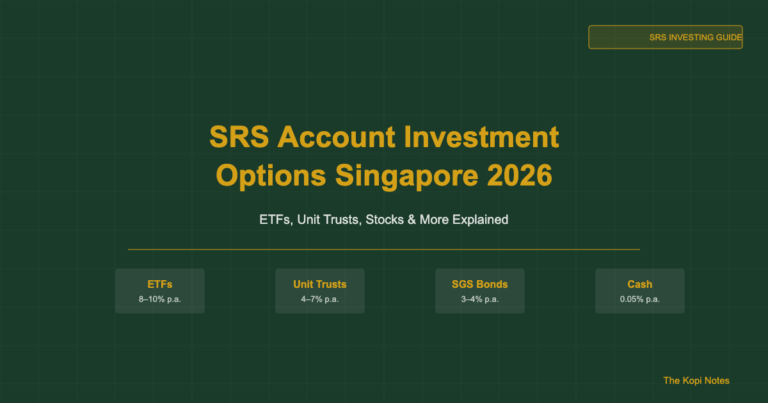
The biggest mistake SRS account holders make is topping up the account and then leaving the money in the default SRS savings deposit, which earns only 0.05% per annum as at October 2026. The SRS savings deposit rate is not a feature — it is a placeholder. Your SRS funds need to be invested to grow over the retirement horizon.
The three most accessible options for Singapore investors to invest SRS funds are:
- Robo-advisors / managed portfolios: Endowus and Syfe both accept SRS funds and invest them in diversified portfolios of unit trusts or ETFs. This is the lowest-effort approach — fund the SRS account, then transfer to the platform. Use our Endowus referral code (2V343) for fee savings, or Syfe referral code (SRPRFFFCD) for cashback on first deposit.
- FSMOne: FSMOne’s Fund Supermart accepts SRS contributions and gives access to hundreds of unit trusts at zero initial sales charge. Use our FSMOne referral code (P0544985) when signing up.
- Direct brokerage: DBS Vickers, OCBC Securities, or UOB Kay Hian allow SRS funds to be invested in SGX-listed stocks, REITs, and ETFs. There is no additional account needed if you use the same bank as your SRS operator.
For a comparison of SRS platform fees, fund selection, and ease of use, see our dedicated article on best SRS platforms 2026.
A diversified approach for most Singapore investors: invest SRS funds in a globally diversified ETF portfolio (e.g. VWRA or CSPX via FSMOne) or a managed income portfolio via Endowus. The SRS horizon is typically 15–30 years from today to retirement, which makes equity exposure appropriate for most working-age contributors.
SRS vs CPF Cash Top-Up: Which Tax Relief Comes First?
Singapore residents have access to two main voluntary retirement savings schemes that offer personal income tax relief: SRS contributions and CPF Cash Top-Up (under the Retirement Sum Topping-Up Scheme, or RSTU). Both are deducted from assessable income, so the question is which to prioritise if you cannot max out both.
| Feature | SRS | CPF Cash Top-Up (RSTU) |
|---|---|---|
| Annual tax relief cap | S$15,300 (SC/PR) | Up to S$8,000 (self + S$8,000 for family) |
| Withdrawal flexibility | From age 62, 50% taxable | CPF Life payouts from 65 |
| Investment options | Stocks, ETFs, unit trusts, SSB, FD | CPF SA earns 4% p.a. (risk-free) |
| Overseas portability | Early withdrawal penalty (5% + full tax) | Limited — CPF rules apply |
Source: CPF Board, MAS Singapore, IRAS October 2026
General guidance: if you are not already earning 4% risk-free on all your CPF SA funds (i.e. if SA is below the Enhanced Retirement Sum), the CPF Cash Top-Up makes sense first — guaranteed 4% beats most conservative investments. Once your CPF SA is funded to your target, redirect cash to SRS for the flexibility of market-linked growth and earlier withdrawal eligibility. For a deeper dive, see our article on CPF investment strategy.
Frequently Asked Questions
What is the SRS contribution deadline for 2026?
How much can I contribute to SRS in 2026?
Can I open a new SRS account and top up in the same year?
What happens if I withdraw SRS funds before age 62?
Does SRS have a total cap or lifetime limit?
Which bank should I open my SRS account with?
Can I top up someone else's SRS account?
This article was researched with the help of AI. While we strive to keep all information accurate and up to date, there may be errors. If you notice any discrepancies, please contact us.