Taiwan ETF Singapore: How to Buy EWT & ITWN for TSMC Exposure (2026 Guide)
A Singapore investor’s guide to the iShares MSCI Taiwan ETF (EWT) and its Ireland-domiciled UCITS sibling — tax treatment, costs, concentration risk, and step-by-step buying instructions for 2026.
A Taiwan ETF gives Singapore investors direct exposure to Taiwan Semiconductor Manufacturing Company (TSMC) and the island’s dominant position in advanced chip-making, which powers the global AI buildout. The main option is the iShares MSCI Taiwan ETF (EWT), listed on NYSE Arca with a 0.59% TER. Singapore investors who prefer an Ireland-domiciled, tax-efficient structure can instead buy the iShares MSCI Taiwan UCITS ETF (ITWN/IDTW) on the London Stock Exchange at a 0.74% TER, which avoids US estate tax exposure.
Not financial advice. All figures are for educational reference only. Data verified as at October 2026 unless otherwise noted.
What Is a Taiwan ETF?
A Taiwan ETF tracks an index of companies listed on the Taiwan Stock Exchange, giving investors single-country exposure to one of the world’s most important technology economies. The flagship fund is the iShares MSCI Taiwan ETF (EWT), which tracks the MSCI Taiwan 25/50 Index — a benchmark of large and mid-cap Taiwanese equities, capped so no single stock exceeds 25% and the combined weight of stocks above 5% stays under 50%. EWT launched on 20 June 2000, trades on NYSE Arca, and holds around 85-95 stocks (iShares EWT factsheet, October 2026).
For Singapore investors, the fund’s drawing power is almost entirely one name: Taiwan Semiconductor Manufacturing Company (TSMC), which typically makes up roughly 22-25% of the index. TSMC manufactures the advanced chips that power Nvidia GPUs, Apple devices, and the data centres behind the current AI infrastructure build-out — the same theme driving demand for Singapore-listed data centre REITs like Keppel DC REIT. A Taiwan ETF is, in effect, concentrated exposure to the hardware layer of the global AI supply chain.
Why Taiwan ETFs Are Trending in 2026
Three forces have pushed Taiwan ETFs back into Singapore investor conversations through 2026. First, AI capital expenditure from US hyperscalers (Microsoft, Amazon, Google, Meta) continues to flow directly into TSMC’s order book for advanced-node chips, lifting both TSMC’s earnings and the broader Taiwanese tech supply chain of component makers and assemblers. Second, the MSCI Taiwan Index has become one of the most AI-sensitive single-country benchmarks available to retail investors, more concentrated in semiconductors than even the Nasdaq-100. Third, geopolitical risk premium has kept valuations from running too far ahead of earnings, creating periodic entry points for investors comfortable with the underlying cross-strait risk.
For a Singapore investor holding SGD 50,000 across a core-satellite portfolio, a 5-10% Taiwan ETF allocation functions as a higher-conviction, higher-volatility complement to a broad-market core like VWRA, rather than a replacement for it — Taiwan already sits inside VWRA’s emerging-markets sleeve, so adding EWT or ITWN is a deliberate overweight, not new diversification.
Best Taiwan ETFs for Singapore Investors
Singapore investors have three realistic routes to Taiwan exposure, each with a different domicile, tax treatment and listing venue. The table below compares them on the metrics that matter most for a Singapore-based investor.
| ETF | Exchange | TER | Domicile | TSMC Weight | Best For |
|---|---|---|---|---|---|
| EWT (iShares MSCI Taiwan ETF) | NYSE Arca | 0.59% | USA | ~22-25% | Deepest liquidity, lowest spread |
| ITWN / IDTW (iShares MSCI Taiwan UCITS ETF) | London Stock Exchange | 0.74% | Ireland | ~22-25% | Tax efficiency, no US estate tax |
| iShares Core MSCI Taiwan ETF (09074) | Hong Kong Exchange | 0.59% | Ireland | ~22-25% | Asia-hours trading, HKD/USD counters |
Source: iShares product pages for EWT and ITWN/IDTW; BlackRock Hong Kong fund page for 09074. Data as at October 2026 — TER and holdings figures vary slightly by date and third-party aggregator; always confirm on the live factsheet before trading.
Tax, Costs & the LSE UCITS Alternative
The single biggest decision for a Singapore investor buying Taiwan exposure is not which index to track — all three options above track the same MSCI Taiwan benchmark family — but which domicile to hold it in. This is the same calculation Singapore investors already make when choosing CSPX over VOO, and it applies just as directly here.
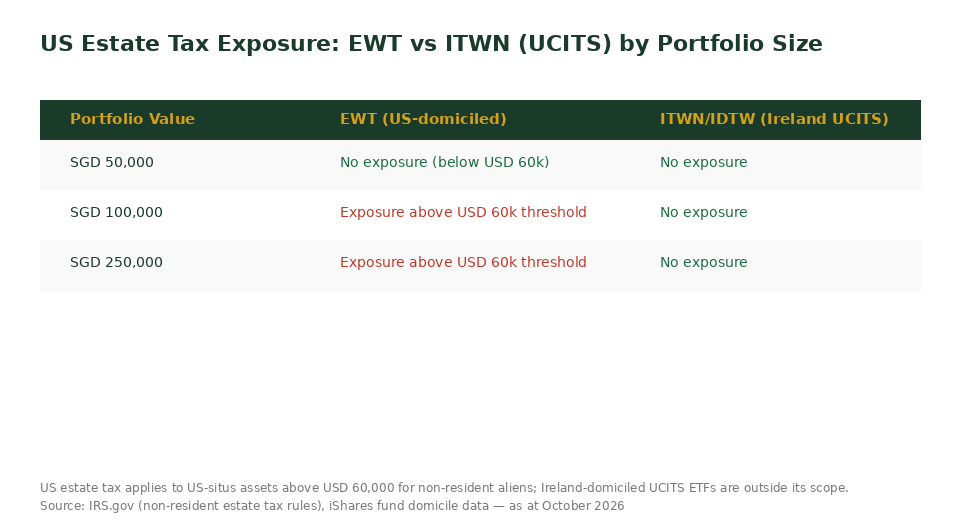
EWT is a US-domiciled fund. As a non-US person, a Singapore investor holding EWT is exposed to US estate tax on US-situs assets above USD 60,000 — a threshold that a growing EWT position can cross well before a Singapore investor expects it to, especially once combined with other US-listed holdings. ITWN/IDTW, by contrast, is domiciled in Ireland under UCITS rules. Ireland-domiciled funds are not US-situs assets, so they fall outside the scope of US estate tax regardless of position size (IRS non-resident estate tax guidance).
On dividend withholding tax, the picture is closer but still favours the UCITS route for other reasons. Taiwan itself withholds tax at source on dividends paid by Taiwanese companies into the fund — this applies before the ETF is even packaged, and both EWT and ITWN are subject to it, so there is no withholding-tax advantage either way here. The US estate tax point remains the decisive one.
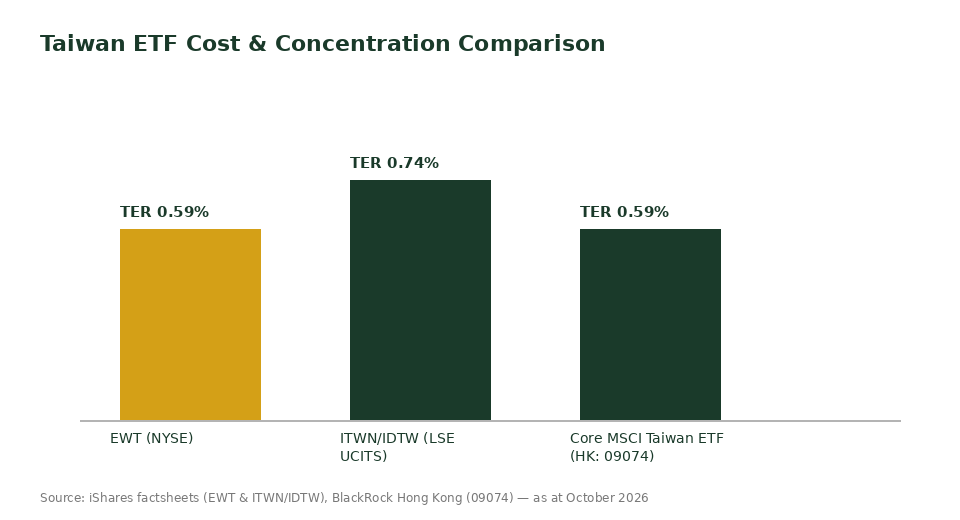
On cost: EWT’s 0.59% TER is noticeably cheaper than ITWN/IDTW’s 0.74%. For a SGD 50,000 position, that is a difference of roughly SGD 75 per year in fund-level fees — EWT costs about SGD 295/year, ITWN about SGD 370/year. Whether that SGD 75/year is worth paying to remove US estate tax exposure depends on position size: for a sub-SGD 30,000 Taiwan allocation, EWT’s lower TER and tighter bid-ask spread on NYSE Arca likely wins; for a larger, long-term allocation, ITWN’s estate tax protection becomes the more important factor.
How to Buy a Taiwan ETF in Singapore
Singapore investors can access either listing through most major brokers, but not every broker covers both exchanges equally well.
Interactive Brokers (IBKR): Covers both NYSE Arca (EWT) and the London Stock Exchange (ITWN/IDTW) with low commissions and tight FX spreads — the most cost-effective route for larger allocations or investors who want to compare both listings side by side.
Saxo Markets: Also supports both US and LSE listings, with a broader selection of currency-denominated share classes for ITWN/IDTW.
MooMoo Singapore: Strong for EWT given its US market access and competitive US trading commissions, but more limited for LSE-listed UCITS funds — check current coverage before assuming ITWN is tradable.
Syfe Brokerage: A simpler starting point for beginners who want US market access without managing multiple currency accounts; useful for EWT specifically.
In each case, the process is the same: fund your brokerage account, search for the ticker (EWT, ITWN, or IDTW), confirm you have selected the correct exchange — the same ticker root can occasionally clash across venues — and place a limit order rather than a market order, since Taiwan ETFs can see wider spreads outside their home market’s trading hours.
Note on CPF and SRS: Taiwan ETFs listed on NYSE Arca or the LSE are not CPF-investable, but SRS funds can be used through SRS-linked brokerage accounts at eligible providers. For a full breakdown of which accounts to use for different ETF types, see our guide to CPF investment strategy and use the Singapore retirement calculator to model how a Taiwan allocation fits a long-term retirement plan.
Risks to Consider
A Taiwan ETF is one of the more concentrated single-country bets available to Singapore retail investors, and the risks are correspondingly specific rather than generic market risk.
Concentration risk: With TSMC alone typically around a quarter of the index, and the next largest holdings also semiconductor-adjacent (component suppliers, assemblers, and electronics manufacturers), a Taiwan ETF behaves more like a sector bet on advanced semiconductors than a diversified country fund. A slowdown in AI-related chip demand, an inventory correction, or a TSMC-specific setback (yield issues, capacity delays) would disproportionately hit the whole fund.
Geopolitical / cross-strait risk: Taiwan’s relationship with mainland China is the risk every Taiwan ETF investor must price in deliberately. Escalation scenarios — even well short of conflict, such as expanded military exercises, trade restrictions, or diplomatic pressure — have historically triggered sharp, fast drawdowns in Taiwanese equities. This is not a tail risk to dismiss; it is a recurring feature of the asset class that distinguishes it from, say, a Korea or Japan ETF.
Currency risk: EWT and IDTW are both USD-denominated (ITWN is GBP-quoted but the underlying exposure is USD/TWD), so Singapore investors carry SGD/USD currency risk on top of the equity risk.
Liquidity risk on the LSE line: ITWN/IDTW trades with meaningfully lower daily volume than EWT on NYSE Arca. For larger orders, this can mean wider effective spreads — another reason IBKR or Saxo, which let you compare live quotes across both venues before placing an order, are preferable to brokers offering only one listing.
Given these risks, most of the discussion in this guide should be read as how to size and structure a satellite allocation, not as a case for overweighting Taiwan as a core holding. A 5-10% allocation alongside a broad-market core like VWRA or CSPX is a more defensible starting point than a large standalone position.
Frequently Asked Questions
What is the best Taiwan ETF for Singapore investors?
For most Singapore investors, the choice comes down to EWT (iShares MSCI Taiwan ETF, NYSE Arca, 0.59% TER) for lower cost and deeper liquidity, or ITWN/IDTW (iShares MSCI Taiwan UCITS ETF, London Stock Exchange, 0.74% TER) for Ireland-domiciled tax efficiency and no US estate tax exposure. Larger, longer-term positions tend to favour the UCITS route; smaller or more tactical positions often favour EWT.
Is a Taiwan ETF the same as investing directly in TSMC?
No, but it is heavily influenced by TSMC. TSMC typically makes up around 22-25% of the MSCI Taiwan Index, so a Taiwan ETF’s performance is closely tied to TSMC, but the remaining 75-78% is spread across dozens of other Taiwanese companies in electronics, financials, and materials. Investors who want pure TSMC exposure can buy TSMC’s ADR directly on the NYSE instead.
Can I buy a Taiwan ETF with CPF or SRS funds in Singapore?
Taiwan ETFs listed on NYSE Arca (EWT) or the London Stock Exchange (ITWN/IDTW) are not CPF-investable, since CPFIS has a narrower approved list focused mostly on Singapore-domiciled or SGX-listed products. SRS funds can be used, but only through an SRS-linked brokerage account at a provider that supports it — check with your broker before assuming SRS compatibility.
Which broker is best for buying EWT or ITWN in Singapore?
Interactive Brokers and Saxo Markets both support NYSE Arca and the London Stock Exchange, letting you access EWT and ITWN/IDTW from a single account and compare pricing across venues. MooMoo Singapore is a solid option specifically for EWT given its US market focus, while brokers with narrower international coverage may not offer the LSE-listed UCITS line at all.
Is a Taiwan ETF safe? What are the main risks?
A Taiwan ETF carries three main risks: heavy concentration in TSMC and the semiconductor sector (roughly a quarter of the fund in one stock), geopolitical risk from cross-strait tensions with mainland China, and USD/SGD currency risk. It is not a “safe” diversified holding — it behaves more like a leveraged bet on AI-chip demand and Taiwan-specific political stability than a broad country fund.
How much should I allocate to a Taiwan ETF?
Most Singapore investors treat a Taiwan ETF as a satellite position of roughly 5-10% of their equity portfolio, layered on top of a broad-market core like VWRA or CSPX — both of which already include Taiwan within their emerging-markets or world allocations. Treating a Taiwan ETF as a core holding on its own concentrates single-country and single-stock risk more than most retirement-focused portfolios should carry.
Ready to Start Investing in ETFs?
Open a brokerage account and buy your first ETF today. Use our referral links for exclusive sign-up bonuses.
This article was researched with the help of AI. While we strive to keep all information accurate and up to date, there may be errors. If you notice any discrepancies, please contact us.