Critical Illness Insurance Premium by Age in Singapore (2026): What Will You Pay?
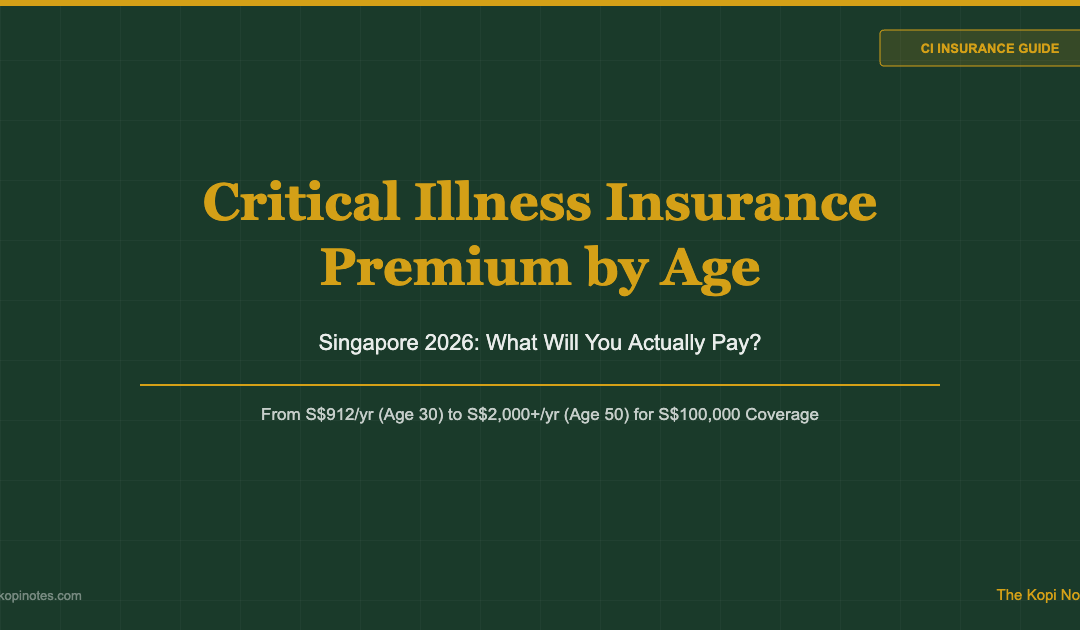
Verified annual premiums from S$912 to S$3,100+ for S$100,000 sum assured — here’s exactly what age, plan type, and gender mean for your CI budget. Get a Free CI QuoteCritical illness insurance premiums in Singapore range from approximately S$912 to over S$3,100 per year for a 30-year-old male non-smoker with S$100,000 sum assured — with the wide range explained by plan type, not just insurer. Standard CI covers late-stage diagnoses; multi-pay and early CI plans add coverage for earlier stages and multiple claims, pushing premiums 30–70% higher. Under the LIA CI Framework 2024, all insurers now standardise 37 critical illness definitions effective 1 October 2025.
Not financial advice. All figures are for educational reference only. Premium data sourced from Dollar Bureau comparison tool (March 2026) and industry benchmarks. Consult a MAS-licensed financial adviser for a personalised quote.
Table of Contents
Jump to a Section
- What Determines Your CI Insurance Premium?
- Verified CI Premiums — Age 30 Male Non-Smoker (2026)
- Traditional CI vs Multi-Pay CI: Premium Comparison
- How CI Premiums Scale With Age
- How Much CI Coverage Do You Actually Need?
- Key CI Plan Types: Which Is Right for You?
- 7 Tips to Get a More Affordable CI Premium
- Frequently Asked Questions
What Determines Your CI Insurance Premium?
Your critical illness insurance premium is not a fixed cost — it is calculated by the insurer based on several risk variables. Understanding these factors helps you shop smarter and avoid overpaying for coverage you do not need.
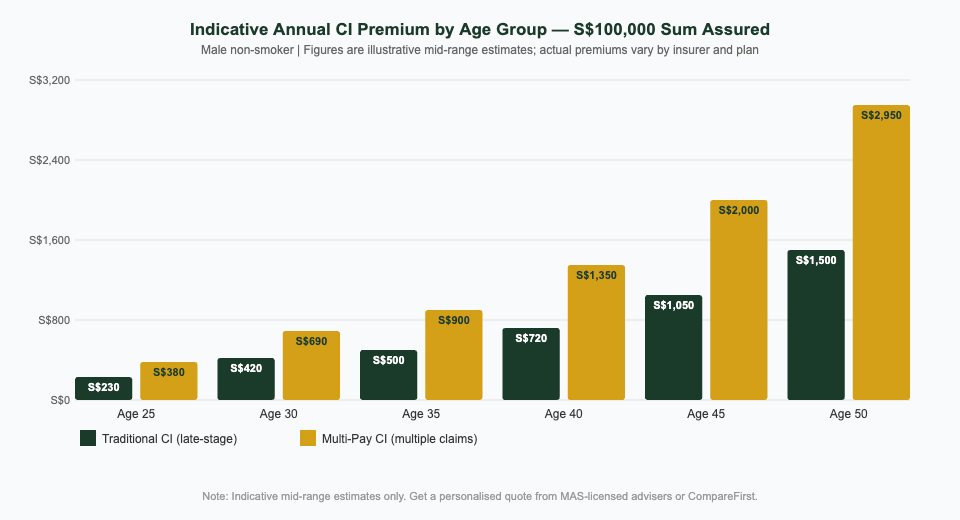
Age at entry: This is the single biggest driver. The older you are when you first purchase CI coverage, the higher your premium for the same sum assured. A 25-year-old might pay S$230/year for a traditional CI plan; by age 50, the equivalent policy can cost S$1,500/year or more. Premiums also tend to step up every five years as you renew, so locking in earlier matters.
Gender: Females generally pay lower premiums for CI plans that exclude gender-specific cancers, but can pay more for plans with comprehensive female cancer coverage (breast, cervical, ovarian). For standard plans, male non-smokers at age 30 typically pay about 5–15% more than equivalent females.
Smoker status: Smokers pay substantially more — often 50–100% above non-smoker rates — due to significantly elevated cancer, cardiac, and lung disease risk. If you quit smoking for 12+ months, most insurers allow you to reclassify as a non-smoker, which may reduce your premium.
Sum assured: Premiums scale roughly proportionally with your coverage amount. A S$200,000 CI plan costs approximately twice as much as a S$100,000 plan, holding all other variables constant.
Plan type: This is often the biggest source of confusion. Traditional CI plans (covering late-stage only), Early CI plans (covering early + late stage), and Multi-Pay CI plans (allowing multiple claims across different conditions) have very different cost structures. See the comparison table below for a full breakdown.
Policy term: Premiums differ between plans that run to a fixed age (e.g., age 75) versus whole-of-life plans. A whole-of-life CI plan has higher premiums but remains in force indefinitely, whereas a term-to-age-75 plan is lower-cost but leaves you uninsured after 75.
Additional riders: Attaching CI riders to a base life policy (e.g., an early-stage CI rider to a term life plan) can be more cost-efficient than a standalone CI plan, but comes with restrictions on portability. For the Singapore context, most financial advisers recommend standalone CI plans for flexibility in switching insurers.
Verified CI Premiums — Age 30 Male Non-Smoker (2026)
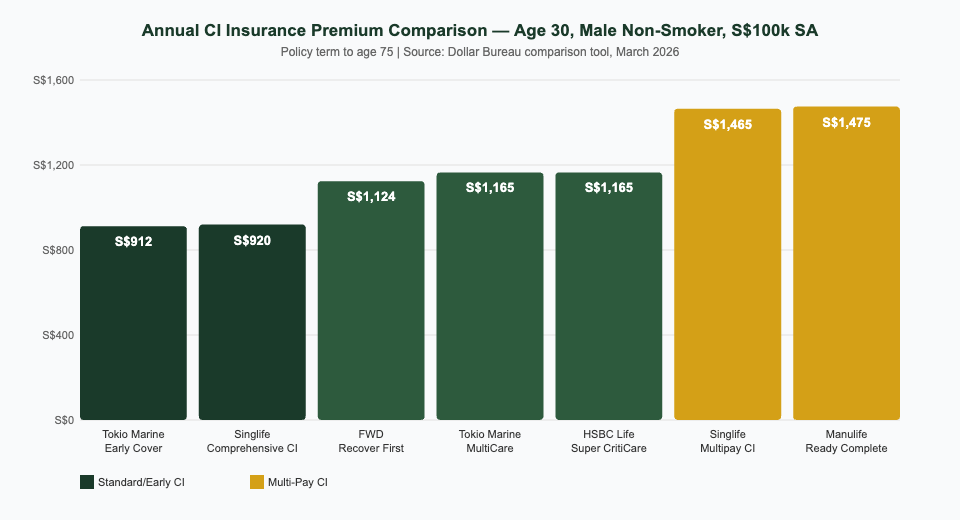
The table below shows verified annual premiums for a 30-year-old male non-smoker with S$100,000 sum assured, policy running to age 75. These figures are sourced from the Dollar Bureau insurer comparison platform (March 2026 update) and represent actual market pricing as at that date.
| Plan Name | Insurer | Plan Type | Annual Premium |
|---|---|---|---|
| Early Cover | Tokio Marine | Early CI | S$912 |
| Comprehensive Critical Illness | Singlife | Early CI | S$920 |
| Recover First | FWD | Early CI | S$1,124 |
| MultiCare | Tokio Marine | Multi-Pay CI | S$1,165 |
| Super CritiCare | HSBC Life | Multi-Pay CI | S$1,165 |
| Multipay Critical Illness | Singlife | Multi-Pay CI | S$1,465 |
| Ready Complete Care | Manulife | Multi-Pay CI | S$1,475 |
Source: Dollar Bureau insurer comparison tool, March 2026. Age 30 male non-smoker, S$100,000 sum assured, policy term to age 75. Premiums are rounded to nearest dollar for illustration. AIA Beyond Critical Care (with ECI rider) also compared at S$3,104.80/year. Verify current rates directly with insurers before purchasing.
The key takeaway: early CI plans (covering early + late stage) start at just S$912–$920/year for a 30-year-old, while multi-pay plans — which allow multiple claims across different conditions — run S$1,100–$1,500/year for equivalent coverage. To learn more about what these coverage tiers include, read our guide on how much CI coverage you need in Singapore.
Traditional CI vs Multi-Pay CI: Premium Comparison
The choice between plan types is often more important than the choice of insurer. Here is a side-by-side breakdown to help you understand what you are paying for at each tier — and whether the higher premium for a multi-pay plan is justified for your situation.
| Feature | Traditional CI | Early CI | Multi-Pay CI |
|---|---|---|---|
| Covers late-stage conditions | ✅ Yes | ✅ Yes | ✅ Yes |
| Covers early-stage conditions | ❌ No | ✅ Yes | ✅ Yes |
| Multiple claims allowed | ❌ No | ❌ Usually No | ✅ Yes |
| Indicative premium (Age 30, S$100k SA) | ~S$400–600/yr | ~S$912–1,124/yr | ~S$1,165–1,475/yr |
| LIA 37-CI conditions covered | ✅ Yes (late-stage) | ✅ Yes (all stages) | ✅ Yes (all stages) |
| Survival period (typical) | 14–30 days | 7–30 days | 7–30 days |
| Best for | Budget-conscious, younger buyers | Early detection benefit | Maximum protection |
Source: TKN analysis based on Dollar Bureau (March 2026) and LIA CI Framework 2024. Traditional CI premiums are indicative mid-range estimates; verify current rates with insurers.
For most Singaporeans in their 30s, a quality early CI plan in the S$900–$1,100/year range offers the best balance of coverage breadth and cost. The jump to multi-pay (which adds multiple-claim benefits) adds around 20–40% to premiums but is particularly valuable for conditions with high recurrence risk, such as some cancers.
How CI Premiums Scale With Age
Age is the most powerful lever in CI pricing. As you age, your statistical risk of claiming rises sharply — and insurers price this in from day one. The table below shows indicative mid-range annual premium ranges for a male non-smoker at different age entry points, with S$100,000 sum assured on an early CI plan:
| Age at Entry | Traditional CI (indicative) | Early CI (indicative) | Multi-Pay CI (indicative) |
|---|---|---|---|
| Age 25 | ~S$200–300 | ~S$300–500 | ~S$400–700 |
| Age 30 | ~S$400–600 | S$912–1,124* | S$1,165–1,475* |
| Age 35 | ~S$500–700 | ~S$900–1,300 | ~S$1,300–1,900 |
| Age 40 | ~S$700–1,000 | ~S$1,300–1,800 | ~S$1,800–2,500 |
| Age 45 | ~S$1,000–1,400 | ~S$1,800–2,500 | ~S$2,500–3,500 |
| Age 50 | ~S$1,400–2,000 | ~S$2,500–3,500 | ~S$3,500–5,000+ |
* Verified figures for age 30. All other rows are indicative mid-range estimates for male non-smoker, S$100,000 SA, policy to age 75 or age 65. Actual premiums vary by insurer, underwriting, and policy specifics. Use MAS CompareFirst or a licensed adviser for accurate quotes.
Notice how premiums roughly double from age 25 to age 40, and can triple or more by age 50. This is why the number one piece of advice from financial planners is: buy CI coverage early. Every year you delay locking in coverage costs you more in the long run, particularly for multi-pay plans where the premium differential compounds over a long policy term.
Cancer accounts for over 50% of all CI claims in Singapore, according to industry data. Given that cancer incidence rises sharply after age 40, the premium jump in the 40–50 age band reflects genuine actuarial risk — insurers are not simply raising prices arbitrarily.
How Much CI Coverage Do You Actually Need?
The most widely cited benchmark in Singapore — endorsed by both the Life Insurance Association (LIA) and CPF Board guidance — is 4 times your annual income as a baseline for critical illness coverage. Here is why this figure makes practical sense:
A CI diagnosis does not just mean medical bills. It typically means a reduction in income — either from time off work for treatment, or from reduced working capacity during recovery. For many Singaporeans, the recovery from a major cancer treatment like chemotherapy or a cardiac surgery can take 1–3 years before full return-to-work. Four years of salary replacement gives you a financial buffer to cover both medical costs and living expenses without depleting your savings.
For a Singaporean earning S$60,000 per year, this means targeting at least S$240,000 in CI coverage. Against a typical early CI premium of S$912–$1,124/year per S$100,000, that translates to approximately S$2,200–$2,700 per year — or roughly 3.7–4.5% of income. This is affordable for most working adults in Singapore.
To see how this fits into your overall retirement and protection planning, use our Singapore retirement planning calculator which factors in CI coverage costs alongside CPF projections and investment returns.
Note that your existing Medishield Life coverage from CPF provides hospital bill coverage but does NOT pay a lump sum on CI diagnosis. CI insurance fills this critical gap — it pays you directly upon diagnosis, giving you the cash to cover treatment, income replacement, and lifestyle costs during recovery.
Key CI Plan Types: Which Is Right for You?
Traditional (Late-Stage Only) CI Plans: These cover the 37 standard conditions under the LIA CI Framework 2024, but only when diagnosed at a late stage (e.g., Stage 3 or 4 cancer, severe heart attack requiring surgical intervention). They are the lowest-cost option and suitable for those on tighter budgets who want baseline protection. The limitation: by the time you claim, you may already face significant medical costs or be in a critical health state.
Early Critical Illness (ECI) Plans: These expand coverage to earlier-stage diagnoses — for example, early-stage cancers that are surgically removed, or coronary artery disease diagnosed before a major cardiac event. A claim at early stage gives you cash to cover treatment, recuperation, and income loss before the condition worsens. Early CI plans cost 30–50% more than traditional CI for the same sum assured, but many financial planners consider this the minimum adequate level of coverage for working-age Singaporeans.
Multi-Pay / Multi-Claim CI Plans: These allow you to claim multiple times for different conditions across your lifetime. For example, if you survive cancer and later develop a heart condition, a multi-pay plan can pay out again for the heart condition — up to the plan’s aggregate benefit limit. They are the most expensive tier but offer the strongest protection. Good choices include Singlife Multipay CI, HSBC Life Super CritiCare, and Tokio Marine MultiCare.
If you are considering managing your CI premiums alongside a broader investment strategy, Endowus and Syfe offer fee-efficient CPF and SRS investment platforms that can help grow the savings you use to fund protection premiums. For CPF optimisation options that complement your CI strategy, see our CPF investment strategy guide.
7 Tips to Get a More Affordable CI Premium
1. Buy early. The single most effective way to lock in a lower premium is to buy CI coverage in your 20s or early 30s. Premiums at age 25 are roughly 40–60% lower than at age 40 for equivalent coverage.
2. Start with an early CI plan rather than multi-pay. If budget is the primary concern, a quality early CI plan (covering early + late stage) in the S$900–$1,200/year range offers significantly better value than a traditional plan for only ~30–40% more premium. You can upgrade to multi-pay later if income grows.
3. Compare at least three to five insurers. As the verified benchmarks above show, premiums for similar coverage can range from S$912 to over S$1,475 among reputable insurers. Use MAS CompareFirst as a starting point for unbiased comparison.
4. Be a non-smoker. If you smoke, quitting for at least 12 months and having it certified medically can reduce your CI premium by 30–60%. The long-term saving over a 30–40 year policy term can amount to tens of thousands of dollars.
5. Review your coverage sum regularly. Over time, your income, dependants, and lifestyle costs change. A CI sum assured that was adequate at 25 may be insufficient at 40. Review annually and top up if needed — but do so before any health conditions arise that could complicate underwriting.
6. Consider a riders-plus-base approach for specific needs. Attaching an early CI rider to a term life policy can sometimes be cheaper than a standalone early CI plan for equivalent coverage. However, confirm the standalone benefit and whether the rider can be kept if you lapse the base policy.
7. Use SRS or supplement via investment income to fund premiums. CI premiums are not tax-deductible in Singapore, but building a dedicated savings or investment account (e.g., via Syfe Income+ or Core) to cover annual premium costs is a strategy many Singaporeans use to make protection more sustainable long-term.
Frequently Asked Questions: CI Insurance Premiums Singapore
How much does critical illness insurance cost per month in Singapore?
For a 30-year-old male non-smoker with S$100,000 sum assured, monthly premiums range from approximately S$76/month (early CI, Tokio Marine) to S$123/month (multi-pay CI, Manulife), based on March 2026 market data. This translates to S$912–S$1,475/year. Traditional CI plans (late-stage only) for the same profile are typically S$400–600/year (S$33–50/month). Premiums increase significantly with age — a 40-year-old can expect to pay approximately 50–80% more than a 30-year-old for equivalent coverage.
What is the difference between critical illness insurance and Medishield Life?
MediShield Life covers inpatient hospital bills — it reimburses part of your hospitalisation and treatment costs according to claim limits. Critical illness insurance pays a lump sum directly to you upon diagnosis of a covered condition, regardless of hospitalisation. The lump sum can be used for any purpose: medical bills above MediShield Life limits, income replacement, home modifications, or living expenses during recovery. Both serve different purposes and ideally complement each other as part of a comprehensive protection plan.
What are the 37 critical illness conditions covered under LIA Singapore 2024?
Under the LIA Critical Illness Framework 2024 (effective 1 October 2025), all Singapore CI policies standardise 37 critical illness definitions. The major categories include: cancers (all types), heart attack, stroke, kidney failure, coronary artery bypass surgery, heart valve surgery, major organ transplant (kidney, liver, heart, lung, pancreas, bone marrow), blindness, deafness, loss of speech, major burns, coma, terminal illness, Alzheimer’s Disease / severe dementia, Parkinson’s Disease, motor neurone disease, and other severe neurological conditions. The standardisation ensures that claim definitions are consistent across all Singapore insurers, making it easier to compare plans.
At what age should I buy critical illness insurance in Singapore?
The earlier the better — ideally in your 20s or early 30s. Premiums at age 25 can be 40–60% lower than at age 40 for equivalent coverage, and you are more likely to be in good health so underwriting is simpler. Financial planners generally recommend buying CI coverage before 35 to lock in lower premiums and secure insurability before any health conditions might complicate your application. That said, buying at 40 or 45 is better than not buying at all — you will pay more, but CI coverage remains valuable at any age when your income and dependants are still a factor.
How much critical illness coverage do I need in Singapore?
The LIA and CPF Board recommend a baseline of 4 times your annual income in CI coverage. For a Singaporean earning S$60,000/year, this means a target of S$240,000 in CI sum assured. This benchmark accounts for approximately 2 years of direct medical and ancillary treatment costs, plus 2 years of income replacement during recovery. Your actual needs may be higher if you have significant financial commitments (mortgage, dependants) or lower if you have substantial liquid savings already set aside. Review your coverage annually and after major life events.
Can I claim critical illness insurance from my CPF?
You cannot directly pay CI insurance premiums using your CPF Ordinary Account (OA) funds, as CI insurance is not classified under CPF’s approved insurance schemes. However, you can invest CPF OA funds via the CPF Investment Scheme (CPFIS) to grow your savings, and separately use cash savings to pay CI premiums. Medishield Life premiums are deducted from your MediSave automatically. If you wish to use SRS funds for investment to supplement your protection premium budget, platforms like Endowus and Syfe allow SRS-funded investments, which may help free up cash flow for insurance premiums.
Is critical illness insurance worth it for young Singaporeans?
Yes, and especially for young working adults. At age 25–35, premiums are at their lowest, you are most likely to qualify without exclusions, and the coverage provides decades of protection at a locked-in cost. Cancer — accounting for over 50% of CI claims in Singapore — is not exclusively an older person’s disease; diagnosis rates in the 30–45 age group have risen. A S$200,000 early CI plan bought at 28 might cost S$1,800–2,200/year — roughly the same as a mobile phone subscription and streaming services combined. The financial protection it provides against a life-altering diagnosis is substantially more valuable.
Get Free Insurance Advice
Speak with a licensed insurance advisor. No obligation, no cost.
By submitting this form, you agree to our Privacy Policy.
This article was researched with the help of AI. While we strive to keep all information accurate and up to date, there may be errors. If you notice any discrepancies, please contact us.