How to Invest in Singapore: Building Passive Income with ETFs in 2026
A complete guide to earning quarterly dividend income from LSE-listed ETFs — VWRD, tax advantages, broker selection, and realistic SGD income scenarios.
Singapore investors who want passive income from ETFs typically turn to VWRD — the Vanguard FTSE All-World UCITS ETF (Distributing), listed on the London Stock Exchange. VWRD pays quarterly dividends at approximately 1.7% gross yield annually and is Ireland-domiciled, meaning Singapore investors benefit from a reduced 15% US dividend withholding tax rate (versus 30% for US-domiciled ETFs) and face no US estate tax exposure. Singapore levies no dividend or capital gains tax on individual investors, making distributing ETFs highly tax-efficient here.
Not financial advice. All figures are for educational reference only. Data verified as at October 2026.
Table of Contents
Contents — Click to expand
- Why Build Passive Income Through ETFs in Singapore?
- How Distributing ETFs Generate Income
- Singapore Tax Advantage: Why LSE-Listed ETFs Win
- VWRD: Key Facts and Income Data
- VWRD vs VWRA: Which Is Right for You?
- Realistic Passive Income Scenarios by Portfolio Size
- Best Brokers for Distributing ETF Income Investing
- Step-by-Step: Setting Up Your Passive Income ETF Portfolio
- Risks and Limitations to Consider
- Frequently Asked Questions
Why Build Passive Income Through ETFs in Singapore?
Most Singapore investors start their passive income journey by looking at passive income strategies in Singapore — which often leads them to S-REITs, dividend stocks, or fixed income instruments like T-bills and Singapore Savings Bonds. Each of these has its place. But ETFs offer something few other instruments do: global diversification with quarterly income and minimal management overhead.
1. No dividend tax, no capital gains tax. Singapore does not tax dividend income or capital gains for individual investors. Every dollar of quarterly distribution you receive from a distributing ETF like VWRD is entirely yours — no filing required, no withholding at source by IRAS.
2. Instant global diversification. A single share of VWRD gives exposure to over 3,600 companies across 50+ countries. Contrast this with owning 5–10 individual dividend stocks, where a single company cut can devastate your income. ETF dividends are pooled from thousands of companies — far more resilient.
3. Lower volatility than single-stock dividends. During 2022’s market correction, VWRD continued paying quarterly distributions even as its price fell. The aggregate dividend yield tends to be more stable than relying on a handful of local REITs or dividend stocks.
4. Inflation hedge. Unlike fixed-income instruments (T-bills, SSBs), ETF dividends tend to grow over time alongside corporate earnings and inflation. A 1.7% yield today is not fixed — the absolute dollar amount paid per share historically grows as companies raise dividends. See the Singapore Savings Bonds guide for a capital-protected comparison.
How Distributing ETFs Generate Income
A distributing ETF collects all dividends paid by its underlying holdings and passes them through to shareholders on a quarterly basis. The mechanics are straightforward:
- Dividend collection period: The ETF manager collects dividends from all underlying companies during the quarter.
- Withholding tax deduction: For US stocks (roughly 60% of VWRD), a 15% US dividend withholding tax is deducted at the ETF fund level under the Ireland-US tax treaty — before you receive anything.
- Distribution to shareholders: The remaining dividends are distributed proportionally to all shareholders on the ex-dividend date.
- Payment to your brokerage account: Dividends typically hit your brokerage account within 2–4 weeks of the ex-dividend date.
For VWRD specifically, distributions occur four times a year — typically in late March, June, September, and December. The June 2026 distribution was USD 0.906 per share; the March 2026 distribution was USD 0.458 per share (source: Vanguard VWRD product page, accessed October 2026).
Singapore Tax Advantage: Why LSE-Listed ETFs Win
Where you buy your ETF — which exchange, which domicile country — determines how much withholding tax is deducted before dividends reach your account. The table below compares the tax treatment for Singapore investors across common approaches:
| Approach | US Dividend WHT | US Estate Tax | SG Dividend Tax | Best For |
|---|---|---|---|---|
| VWRD / VWRA (LSE, Ireland) | 15% | None | None | Most SG investors |
| VT / VYM (NYSE, USA) | 30% | Yes (above USD 60k) | None | Not recommended for SG |
| S-REIT ETFs (SGX-listed) | N/A | None | None | SG-focused income investors |
Source: IRS (US estate tax threshold), Ireland-US tax treaty, IRAS (SG tax rules), as at October 2026
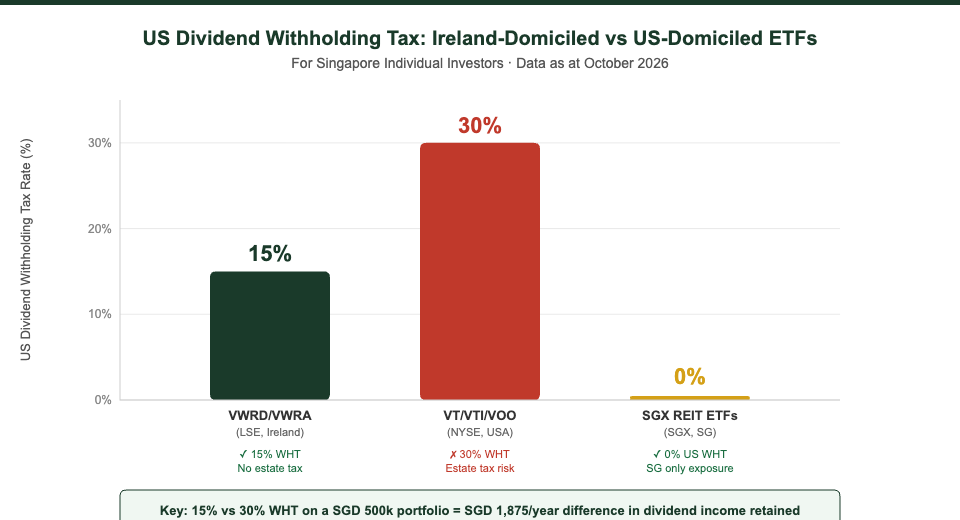
The 15-percentage-point difference in US dividend WHT compounds significantly. On a SGD 500,000 portfolio generating 2.5% gross US dividends, the difference between 15% WHT and 30% WHT is SGD 1,875 in additional taxes per year. Singapore investors holding US-domiciled ETFs above USD 60,000 also face US estate tax risk upon death — Ireland-domiciled ETFs carry no such risk. For Singapore-specific tax strategy see the CPF investment strategy guide.
VWRD: Key Facts and Income Data
VWRD (ticker: VWRD on the London Stock Exchange) is the distributing share class of the Vanguard FTSE All-World UCITS ETF, tracking the FTSE All-World Index with approximately 3,600+ large- and mid-cap companies across developed and emerging markets.
| Metric | Detail |
|---|---|
| Full Name | Vanguard FTSE All-World UCITS ETF (Distributing) |
| Ticker (LSE) | VWRD |
| Index | FTSE All-World (~3,600+ holdings) |
| Domicile | Ireland (UCITS) |
| Structure | Distributing — pays quarterly dividends |
| TER | 0.22% p.a. |
| AUM | USD 8.2 billion (Q1 2026) |
| Gross Dividend Yield (TTM) | ~1.7% (trailing 12 months) |
| Net Yield After 15% US WHT | ~1.5% (estimated) |
| Distribution Frequency | Quarterly (Mar, Jun, Sep, Dec) |
| Currency | USD |
Source: Vanguard VWRD product page; stockanalysis.com dividend data, October 2026
Not all of VWRD’s holdings are US stocks. The FTSE All-World Index is approximately 60–65% US equities; the remainder spans Europe, Japan, China, and other markets. US stocks attract the 15% WHT; non-US stocks may have their own withholding at different rates. The ~1.5% net yield estimate applies the 15% WHT to the US portion and is a reasonable approximation, not an exact figure.
VWRD vs VWRA: Which Is Right for You?
VWRD and VWRA track the exact same index (FTSE All-World), have the same TER (0.22%), and are both Ireland-domiciled. The only difference is how dividends are handled.
| Feature | VWRD (Distributing) | VWRA (Accumulating) |
|---|---|---|
| TER | 0.22% p.a. | 0.22% p.a. |
| Dividends | Paid out quarterly (cash to you) | Reinvested automatically |
| AUM | USD 8.2 billion | USD 48.6 billion |
| Best For | Passive income, retirees, FI/RE | Long-term accumulators |
| Compounding | Lower (reinvest manually) | Higher (automatic, no friction) |
Source: Vanguard product pages (VWRD, VWRA), Q1 2026
Choose VWRD if you need regular income — in retirement, for living expenses, or a recurring financial goal. Quarterly cash distributions go straight to your brokerage account automatically. Singapore has no dividend tax, so there is no tax penalty for receiving distributions versus accumulating — unlike in the UK or USA. The choice comes down entirely to whether you need the income now. For more, see our guide on passive income in Singapore.
Realistic Passive Income Scenarios by Portfolio Size
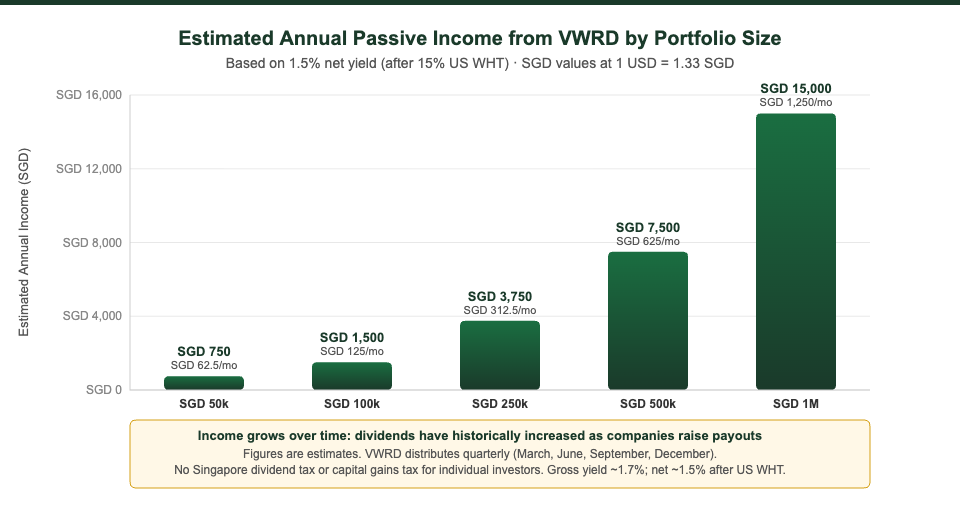
The table below shows estimated annual and monthly passive income from a VWRD portfolio at different sizes, using a conservative net yield of 1.5% (after US WHT, before Singapore tax which is zero).
| Portfolio (SGD) | Est. Annual Income | Est. Monthly | Est. Quarterly Distribution |
|---|---|---|---|
| SGD 50,000 | SGD 750 | SGD 62.50 | SGD 187.50 |
| SGD 100,000 | SGD 1,500 | SGD 125 | SGD 375 |
| SGD 250,000 | SGD 3,750 | SGD 312.50 | SGD 937.50 |
| SGD 500,000 | SGD 7,500 | SGD 625 | SGD 1,875 |
| SGD 1,000,000 | SGD 15,000 | SGD 1,250 | SGD 3,750 |
Estimates at 1.5% net yield. Currency at 1 USD = 1.33 SGD. Actual distributions vary. Not guaranteed.
These numbers show that ETF passive income is not a “retire tomorrow” strategy at smaller portfolio sizes — but compounded with regular contributions over 15–20 years, even a SGD 50,000 starting portfolio can grow to generate meaningful quarterly income. Use our Singapore retirement calculator to model your specific scenario.
Best Brokers for Distributing ETF Income Investing
To buy VWRD in Singapore, you need a brokerage account with London Stock Exchange (LSE) access. Not all Singapore brokers offer this — here are the main options compared. For a full comparison, see our moomoo Singapore review.
| Broker | Commission on VWRD | FX Spread | SRS Access | Best For |
|---|---|---|---|---|
| Interactive Brokers (IBKR) | USD 1.70/trade | ~0.1–0.2 bps | Yes | Larger portfolios (>SGD 50k) |
| Saxo Markets | USD 5–8/trade | ~0.25% | Yes | SRS-focused investors |
| moomoo Singapore | ~USD 1–2/trade | ~0.2% | No | Beginners, mobile-first |
| FSMOne RSP | 0.08% (min SGD 1) | ~0.3–0.5% | Yes (SRS RSP) | Regular monthly investors |
| Syfe Brokerage | Zero (promotional) | ~0.3% | No | Beginners, small portfolios |
Source: Official broker pricing pages, October 2026. Promotional rates may change.
Recommendation: IBKR is the lowest-cost option for buying VWRD in size — at USD 1.70/trade, a SGD 5,000 purchase costs approximately SGD 2.30 in commission (0.046%). Use our FSMOne referral code for the Regular Savings Plan (RSP) model — ideal for monthly automated investing from SGD 50. For SRS investing: both IBKR and Saxo allow VWRD via SRS funds, with SRS contributions reducing taxable income by up to SGD 15,300/year. See the Endowus referral for a managed SRS ETF option.
Step-by-Step: Setting Up Your Passive Income ETF Portfolio
Step 1: Define your income target. How much monthly passive income do you need? SGD 500/month requires approximately SGD 400,000 in VWRD at 1.5% net yield. Work backwards from your target using the Singapore retirement calculator.
Step 2: Choose your broker. For most investors, IBKR gives the lowest commission. Open an account at interactivebrokers.com.sg (referral code: jianxiong368). For SRS investing, Saxo Markets is a solid alternative.
Step 3: Fund your account in USD. VWRD trades in USD on the LSE. Transfer SGD to your brokerage then convert to USD — IBKR has some of the lowest FX spreads available to retail investors.
Step 4: Search for VWRD on the LSE. In IBKR, search “VWRD” and select the London Stock Exchange listing in USD. Confirm the ISIN: IE00B3RBWM25 — the distributing share class. Double-check before placing your order.
Step 5: Place a limit order. Never use market orders for LSE ETFs — spreads can be wide at open. Use a limit order at or slightly above the current mid-price. A position of 10 shares at approximately USD 100+ per share is roughly SGD 1,330.
Step 6: Set up a regular contribution plan. Commit to monthly buys — via IBKR’s scheduled auto-invest or FSMOne’s RSP. Even SGD 500/month builds a meaningful income-generating position over 10–15 years through compounding.
Step 7: Decide on dividend reinvestment. Quarterly USD distributions hit your IBKR cash balance. You can: (a) withdraw to your bank account, (b) reinvest manually by buying more VWRD, or (c) let it accumulate for a lump-sum purchase to avoid minimum commission drag on tiny amounts.
Risks and Limitations to Consider
1. Portfolio value can fall significantly. During the 2022 bear market, VWRD fell over 20%. While distributions continued, capital was eroded. VWRD is appropriate for investors with a long time horizon who can tolerate market volatility — unlike a Singapore Savings Bond or CPF, capital is not protected. For capital-protected alternatives, see the Singapore T-bills 2026 guide.
2. Dividend income is variable. VWRD’s quarterly distributions vary with global corporate earnings. In recessions, companies cut dividends and the ETF distribution falls. The 1.7% yield is a trailing figure — future yields may be higher or lower.
3. Currency risk. VWRD is denominated in USD. If SGD strengthens against USD (as it has historically tended to), your SGD returns are reduced. A 5% SGD appreciation roughly offsets 3 years of dividend income at 1.5% net yield.
4. Transaction costs erode small portfolios. IBKR’s USD 1.70 minimum per trade represents 0.85% on a SGD 200 monthly investment — significant drag. For small regular investments, FSMOne RSP (0.08%, min SGD 1) is more cost-efficient below approximately SGD 2,000/trade.
5. Not CPF-eligible. VWRD and VWRA are listed on the LSE, not SGX. They cannot be purchased using CPF Investment Scheme (CPFIS) funds. For CPF-eligible alternatives, see the CPF investment strategy guide.
Not financial advice. Always consult a licensed financial adviser for personalised guidance. Data verified as at October 2026.
Frequently Asked Questions
What is the dividend yield of VWRD for Singapore investors?
VWRD’s trailing 12-month gross dividend yield is approximately 1.7–1.9%. After accounting for the 15% US dividend withholding tax applied at the Ireland ETF fund level (under the Ireland-US tax treaty), Singapore investors receive approximately 1.5–1.7% net yield. Singapore levies no additional dividend or capital gains tax on individuals, so what your broker pays is what you keep.
How often does VWRD pay dividends?
VWRD pays dividends quarterly, typically with ex-dividend dates in March, June, September, and December. The distribution is paid approximately 2 weeks after the ex-dividend date. The June 2026 ex-dividend date was 18 June 2026, with payment on 1 July 2026. Check Vanguard’s official VWRD product page or your broker for upcoming ex-dividend dates.
Is VWRD better than VWRA for passive income in Singapore?
For passive income investors who want cash distributions, yes — VWRD is the right choice. VWRD pays quarterly dividends to your brokerage account; VWRA automatically reinvests dividends within the fund. Both track the same FTSE All-World Index at the same 0.22% TER. Singapore has no dividend tax, so receiving VWRD’s distribution does not trigger a tax event. The choice comes down to whether you need income now (VWRD) or prefer hands-off compounding for long-term wealth building (VWRA).
Can I invest in VWRD using CPF or SRS funds?
VWRD cannot be purchased using CPF Investment Scheme (CPFIS) funds, as it lists on the London Stock Exchange rather than SGX. For SRS funds, VWRD can be purchased through SRS-eligible brokers including Interactive Brokers and Saxo Markets. SRS contributions reduce your taxable income by up to SGD 15,300/year (citizens and PRs), making SRS-to-VWRD a tax-efficient strategy for income-focused retirement savers.
How much money do I need to earn SGD 1,000/month from VWRD?
At a conservative 1.5% net annual yield, generating SGD 1,000/month (SGD 12,000/year) requires approximately SGD 800,000 in VWRD. At 1.7% gross yield it would require approximately SGD 706,000. These are substantial figures — more realistic for retirees or those in the FI/RE phase. A blended strategy combining VWRD with higher-yield S-REITs can help bridge the income gap earlier. See the best S-REITs in Singapore 2026 for REITs that complement an ETF income portfolio.
What is the minimum investment to buy VWRD in Singapore?
VWRD trades at approximately USD 100+ per share on the LSE (as at mid-2026), roughly SGD 130–140 per share. There is no minimum investment other than one share. However, to make trading costs worthwhile, a minimum purchase of 5–10 shares (SGD 700–1,400) is recommended when using IBKR at USD 1.70/trade. FSMOne’s RSP allows smaller monthly contributions from SGD 50 per transaction.
Is VWRD safe? What are the risks for Singapore investors?
VWRD is a UCITS-regulated fund managed by Vanguard with USD 8.2 billion in AUM (Q1 2026), regulated in Ireland under EU UCITS rules with investor protections including asset segregation. However, VWRD is an equity fund — its price fluctuates with global stock markets. During the 2022 bear market, VWRD fell over 20%. Quarterly income distributions are not guaranteed and can fall in recessions. VWRD is appropriate for investors with a long time horizon who can tolerate market volatility.
Ready to Start Building Passive Income with ETFs?
Open a brokerage account and buy your first VWRD share. Use our referral links for sign-up bonuses.
This article was researched with the help of AI. While we strive to keep all information accurate and up to date, there may be errors. If you notice any discrepancies, please contact us.