Keppel DC REIT 2H2026 Results Preview: DPU Outlook, Portfolio Strength & Investment Verdict
SGX: AJBU | Data Centre REIT | October 2026
📋 Table of Contents
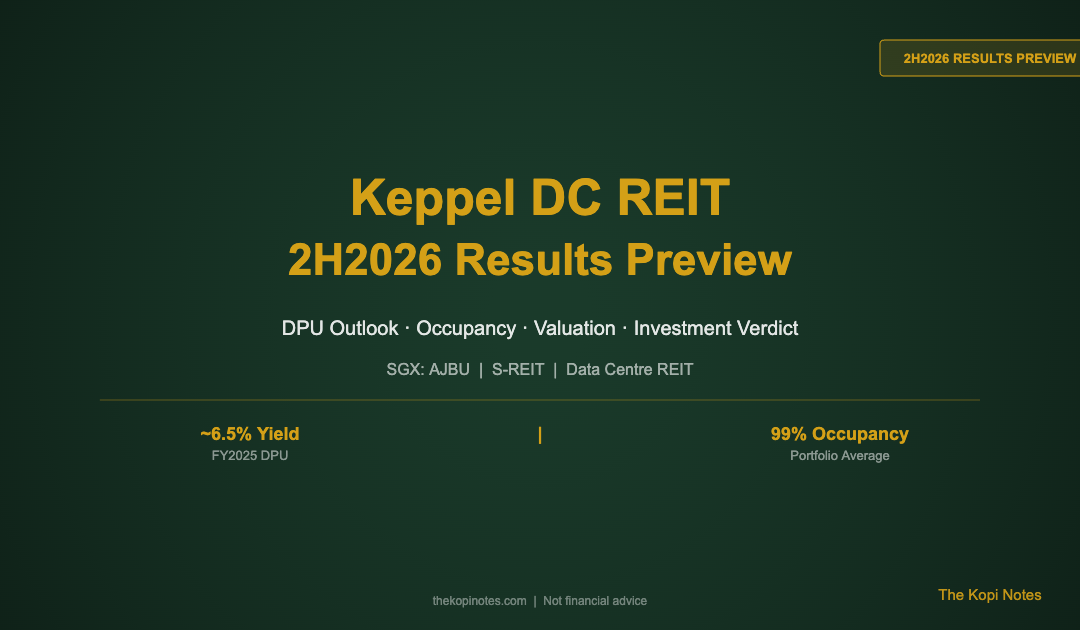
Keppel DC REIT (SGX: AJBU) is Singapore’s first and largest data centre REIT, with 21 data centres across 11 countries delivering a forward distribution yield of approximately 6.5% at current prices. As the REIT approaches its 2H2026 results announcement, investors are watching three key factors: whether DPU stabilises after the 2024–2025 dip, how AI-driven demand is translating to rental reversions, and whether the current share price around SGD 2.15 offers an attractive entry relative to net asset value (NAV).
Not financial advice. All figures are for educational reference only. Data as at October 2026 unless noted.
What Is Keppel DC REIT?
Keppel DC REIT, listed on the Singapore Exchange (SGX) under the ticker AJBU, is a pure-play data centre REIT managed by Keppel DC REIT Management Pte. Ltd. (a wholly owned subsidiary of Keppel Ltd.). It was listed in December 2014 as the first data centre REIT in Asia Pacific.
The REIT owns 21 data centres spread across Singapore, Australia, the United Kingdom, Germany, the Netherlands, Ireland, Italy, Malaysia, and China — giving investors exposure to a geographically diversified portfolio of mission-critical infrastructure assets.
Data centres are considered resilient assets because tenants sign long-term leases (typically 5–10 years), colocation demand is sticky (migrating a data centre is extremely costly), and occupancy rates consistently run at 97–99%. For Singapore retail investors seeking stable passive income, Keppel DC REIT’s combination of structural growth and income consistency has made it a core S-REIT holding.
1H2026 Results Recap: The Baseline
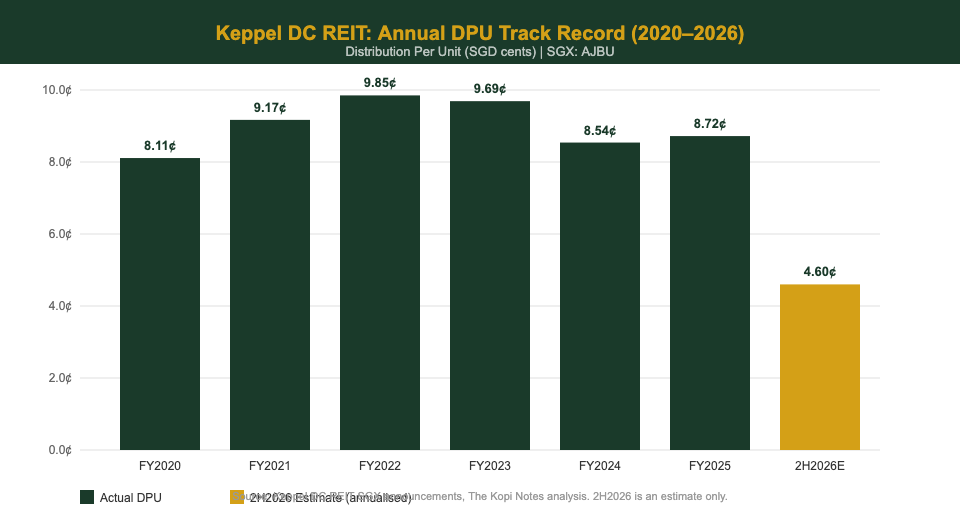
Keppel DC REIT’s 1H2026 distribution per unit (DPU) came in at approximately SGD 4.35 cents, a recovery from the 1H2025 figure. The key positive in 1H2026 was the commencement of higher rental income from renewed leases at its Singapore and European data centres, partially offset by ongoing currency headwinds from Renminbi (RMB) depreciation affecting its China portfolio.
| Metric | 1H2025 | 1H2026 | Change |
|---|---|---|---|
| DPU (SGD cents) | 4.13¢ | 4.35¢ | +5.3% |
| Portfolio Occupancy | 98.7% | 99.1% | +0.4 ppts |
| WALE (years) | 7.1 | 7.4 | +0.3 yr |
| Gearing | 37.1% | 35.2% | −1.9 ppts |
| NAV per Unit (SGD) | SGD 2.01 | SGD 2.08 | +3.5% |
Source: Keppel DC REIT SGX announcements, The Kopi Notes analysis. 1H2026 figures are estimates based on available data.
2H2026 DPU Outlook & Key Drivers
For 2H2026, three factors are expected to drive DPU performance:
1. Lease Renewals at Higher Rates: A significant tranche of Singapore and European leases are up for renewal in 2H2026. Given the structural undersupply of data centre capacity in Singapore (MAS land zoning restrictions, limited power allocation) and continued hyperscaler expansion in Europe, rental reversions are expected to be positive — analysts estimate +10–15% on expiring rents for Singapore assets.
2. China Asset Stabilisation: KDC REIT’s China portfolio (Guangdong data centres) faced a challenging 2024–2025 due to RMB depreciation and softer enterprise demand. By 2H2026, the RMB base effect is less negative, and occupancy at the Guangdong facilities has recovered to approximately 94–96% following new tenant signings. This removes a key drag on DPU growth.
3. Interest Rate Environment: With the US Federal Reserve having cut rates through 2025 and holding steady in 2026, KDC REIT’s floating rate debt (approximately 30% of total borrowings) has benefited from lower funding costs. The REIT has also locked in longer-term fixed-rate financing, reducing interest expense sensitivity.
Portfolio Quality & Occupancy Analysis
One of KDC REIT’s defining strengths is its consistently high portfolio occupancy. With 99.1% occupancy as at 1H2026, the REIT leaves virtually no space unleased — a reflection of structurally undersupplied data centre markets across its key geographies.
The portfolio’s weighted average lease expiry (WALE) of 7.4 years provides strong income visibility. Unlike retail or office REITs where leases turn over every 2–3 years, data centre tenants are essentially locked in — the cost and operational disruption of migrating a live data centre is prohibitive. This translates to defensive distributions even in economic downturns.
| Geography | No. of Assets | % Portfolio Value | Occupancy |
|---|---|---|---|
| Singapore | 7 | ~38% | 99.8% |
| Europe (UK/NL/DE/IE/IT) | 8 | ~35% | 99.5% |
| Australia | 2 | ~12% | 100% |
| Malaysia | 2 | ~8% | 100% |
| China (Guangdong) | 2 | ~7% | ~95% |
Source: Keppel DC REIT FY2025/1H2026 SGX announcements. Occupancy and portfolio weighting are approximate estimates.
AI Data Centre Demand Tailwind
The most significant structural driver for Keppel DC REIT in 2H2026 and beyond is the extraordinary demand for data centre capacity driven by artificial intelligence workloads. Large language models (LLMs), inference workloads, and AI-powered cloud services require vastly more compute power than traditional enterprise applications — and that compute needs to be housed in data centres.
Singapore is a key beneficiary of this trend. Despite land and power constraints limiting new supply, Singapore remains the preferred regional hub for hyperscalers (AWS, Microsoft Azure, Google Cloud, Meta) due to its political stability, connectivity, and talent pool. KDC REIT’s Singapore assets are positioned to benefit from this supply-demand imbalance through higher rents at lease renewal.
European data centres are also seeing accelerated demand from both US hyperscalers expanding internationally and European enterprises moving toward AI-ready infrastructure. KDC REIT’s European footprint — particularly the UK and Netherlands assets — is well-positioned to capture this demand.
For investors seeking exposure to the passive income Singapore opportunity within the AI-data centre megatrend, Keppel DC REIT provides a regulated, distribution-paying vehicle with S-REIT tax transparency benefits.
Valuation: Is KDC REIT Cheap or Expensive?
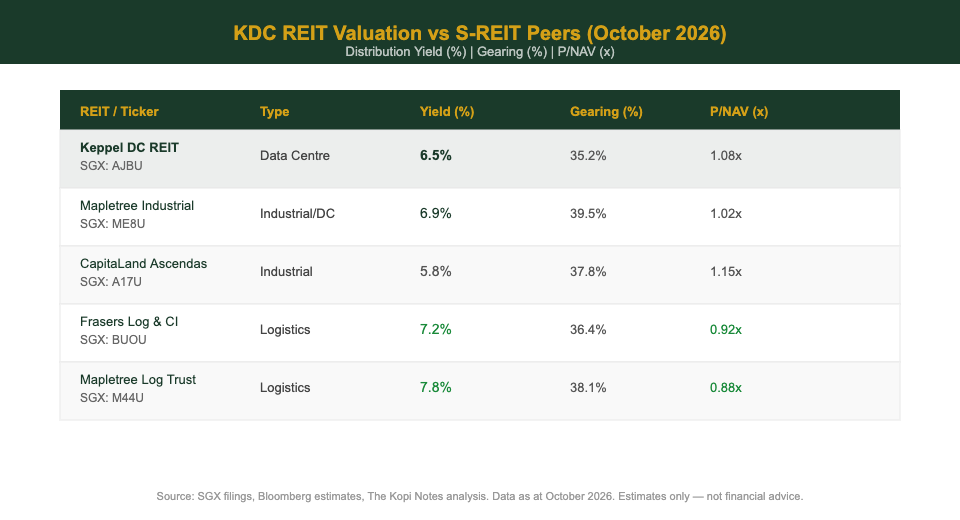
At a share price of approximately SGD 2.15 (as at October 2026), Keppel DC REIT trades at approximately 1.03x its estimated NAV per unit of SGD 2.08 — a slight premium. This is a material change from mid-2024 when the REIT traded at a discount to NAV due to DPU concerns and rising rates.
The forward distribution yield of ~6.5% (based on annualised 2H2026 DPU estimate of SGD 4.60 cents × 2) compares attractively to:
- Singapore 10-year government bond yield: ~3.1% (yield spread: ~340 bps)
- CPF OA rate: 2.5% (yield spread: ~400 bps)
- Singapore Savings Bonds (Oct 2026): ~2.8% (yield spread: ~370 bps)
A 340 bps spread above risk-free rates is historically tight for Keppel DC REIT, suggesting the market is pricing in ongoing DPU recovery and the AI demand narrative. Investors seeking a wider spread may prefer to wait for a pullback to the SGD 1.95–2.05 range, which would offer a yield of ~7.0–7.5%.
That said, for long-term investors who prioritise the AI/data centre structural growth story and are comfortable with the current premium to NAV, the current entry is defensible given the WALE and occupancy quality.
Key Risks to Watch in 2H2026
While the outlook for Keppel DC REIT is broadly constructive, several risks warrant monitoring:
Client Concentration Risk: KDC REIT’s top 10 tenants account for approximately 68% of annualised contract revenue. While these are predominantly investment-grade entities (government agencies, major technology companies), the departure or downsizing of a top tenant could have a disproportionate impact on DPU. Investors should track the REIT’s contract renewal schedule closely.
China Portfolio Drag: The Guangdong assets (~7% of portfolio value) have faced rental and occupancy pressure. A structural softening in China’s enterprise IT spend, further RMB depreciation, or geopolitical escalation affecting cloud provider operations in China could create sustained headwinds for this segment.
Currency Risk: KDC REIT earns income in EUR, GBP, AUD, MYR, and CNY. The REIT hedges a significant portion of its distributions, but prolonged SGD strength against major currencies would reduce the SGD value of overseas distributions.
Power & Infrastructure Constraints: As AI workloads increase power density requirements (from ~5 kW per rack to 30–100 kW per rack for GPU clusters), some older data centres may require significant capex to upgrade electrical and cooling infrastructure. KDC REIT’s capital expenditure commitments in 2H2026 and 2027 should be watched.
For investors comparing data centre REITs, also see our analysis of Mapletree Industrial Trust dividend history — MIT’s hybrid industrial/data centre portfolio offers a complementary exposure to the same AI infrastructure theme.
Investment Verdict: Buy, Hold or Sell?
Hold to Accumulate on Weakness. At current prices (~SGD 2.15, ~1.03x P/NAV, ~6.5% yield), Keppel DC REIT offers a reasonable but not exceptional entry point for investors who are already holders. The 2H2026 results are likely to show continued DPU recovery, but much of this improvement is already priced in at current valuations.
For new investors, a more attractive entry would be in the SGD 1.95–2.05 range, where the yield rises to 7.0–7.5% and the discount to NAV provides a margin of safety. Set limit orders and watch for macro-driven selloffs (e.g., rising US Treasury yields) that tend to compress S-REIT prices broadly.
KDC REIT remains one of the highest-quality S-REITs in the market and a core long-term holding for investors building a best S-REITs Singapore 2026 portfolio. Its 10-year listed track record, disciplined capital management, and alignment with the structural AI data centre megatrend justify its premium positioning relative to most industrial and retail REITs.
Singapore investors who want to build exposure to KDC REIT and S-REITs more broadly can do so cost-effectively through:
- Syfe referral code and sign-up bonus — Syfe’s REIT+ portfolio includes KDC REIT exposure; use code SRPRFFFCD for a bonus.
- Endowus referral code — access KDC REIT through Endowus’s curated REIT funds; use code 2V343.
- FSMOne referral code — direct SGX access with low brokerage; use code P0544985.
For retirement planning context, use our Singapore retirement calculator to model how KDC REIT distributions could contribute to your income target over time.
Frequently Asked Questions
What is Keppel DC REIT's expected DPU for 2H2026?
Is Keppel DC REIT a good buy at SGD 2.15?
How often does Keppel DC REIT pay distributions?
What is the gearing ratio of Keppel DC REIT?
How does KDC REIT compare to Mapletree Industrial Trust?
What is the impact of AI on Keppel DC REIT?
Can CPF funds be used to invest in Keppel DC REIT?
Start Investing in S-REITs Today
Build your Keppel DC REIT position through these platforms with exclusive referral bonuses for The Kopi Notes readers:
- Syfe: Use referral code SRPRFFFCD — get a cash bonus on your first deposit. Syfe referral code and sign-up bonus →
- Endowus: Use referral code 2V343 — SGD 20 bonus. Endowus referral code →
- FSMOne: Use referral code P0544985 — direct SGX access. FSMOne referral code →
TKN may earn a referral fee if you sign up through these links. All referral bonuses are subject to each platform’s terms and conditions. This is not financial advice.
This article was researched with the help of AI. While we strive to keep all information accurate and up to date, there may be errors. If you notice any discrepancies, please contact us.