Critical Illness Insurance vs Disability Income Insurance Singapore: Which Protection Do You Need? (2026)
Critical illness (CI) insurance pays a tax-free lump sum when you are diagnosed with one of 37 LIA-standardised conditions — covering treatment and recovery costs. Disability income (DI) insurance pays up to 75% of your monthly salary (MAS cap) when illness or injury stops you from working. Most Singaporeans need both: CI for the diagnosis shock, DI for the ongoing income loss. Data verified as at 14 October 2026.
Not financial advice. All figures are for educational reference only. Speak to a licensed financial advisor for personalised recommendations.
Table of Contents
Show Table of Contents
- What Is Critical Illness Insurance in Singapore?
- What Is Disability Income Insurance?
- Critical Illness vs Disability Income: 7 Key Differences
- When Critical Illness Insurance Is the Right Choice
- When Disability Income Insurance Fills the Gap
- Should You Hold Both Policies?
- Cost Guide: Premiums and Coverage Benchmarks
- Real-World Scenarios for Singapore Workers
- FAQ
What Is Critical Illness Insurance in Singapore?
Critical illness insurance pays a one-time lump sum when you are diagnosed with a covered serious medical condition. In Singapore, the Life Insurance Association (LIA) standardises definitions for 37 severe-stage conditions across all insurers, making it easier to compare policies and reducing disputes at claims time.
As of 1 October 2025, all new CI policies must follow the LIA 2024 CI Framework (replacing the 2019 version). Seven condition definitions were revised, including Major Cancer, Coma, Deafness, and Terminal Illness. Policies issued before October 2025 retain their original definitions.
What the 37 conditions cover
The LIA list includes conditions across major health risk categories:
| Category | Examples |
|---|---|
| Cancer & Tumours | Major Cancer (most Stage 3–4), Brain Tumour |
| Heart & Circulatory | Heart Attack, Stroke, Coronary Artery Bypass |
| Organ Failure | End Stage Kidney, Liver, and Lung Disease |
| Neurological | Coma, Paralysis, Persistent Vegetative State |
| Other | Loss of Independent Existence, Terminal Illness |
Source: LIA Singapore CI Framework 2024 | Mandatory for new policies from 1 October 2025
The lump sum is yours to use however you choose: paying hospital bills, covering lost income during recovery, or funding rehabilitation. There is a standard 30-day survival period — you must survive 30 days after diagnosis before the claim pays out (some policies differ; check your contract).
The LIA and financial advisors generally recommend holding 4 to 5 times your annual income in CI coverage. For a Singapore professional earning SGD 60,000 per year, that means SGD 240,000–300,000 in CI cover.
For a detailed breakdown of what triggers a claim and how to file one, see our guide on how to make a CI insurance claim in Singapore.
What Is Disability Income Insurance?
Disability income (DI) insurance replaces a portion of your monthly salary if illness or injury leaves you unable to work. Unlike CI insurance, it does not require a specific diagnosis — the trigger is your inability to perform work duties, regardless of the medical cause.
In Singapore, DI policies are classified as long-term Accident & Health (A&H) policies regulated by the Monetary Authority of Singapore (MAS). A key MAS rule caps your total DI benefit across all policies at 75% of gross monthly salary — you cannot insure 100% of your income.
Key DI policy features
Definition of disability: Policies use either “own occupation” (cannot do your specific job) or “any occupation” (cannot do any work suited to your training). Own-occupation policies are easier to claim on and typically cost 20–30% more in premiums.
Waiting period (elimination period): Most policies have a 30, 60, 90, or 180-day waiting period before payments begin. A longer wait means lower premiums but a longer gap you need to fund yourself — most advisors recommend keeping 3–6 months of emergency savings to bridge this gap.
Benefit period: Options typically include 2 years, 5 years, or until age 60 or 65. A longer benefit period is more expensive but provides protection for extended disability lasting years.
Tax treatment: Monthly DI payouts are entirely tax-free under Singapore law — IRAS does not treat DI benefit payments as taxable income.
Critical Illness vs Disability Income Insurance: 7 Key Differences
Here is how the two products compare across the dimensions that matter most for Singapore policyholders:
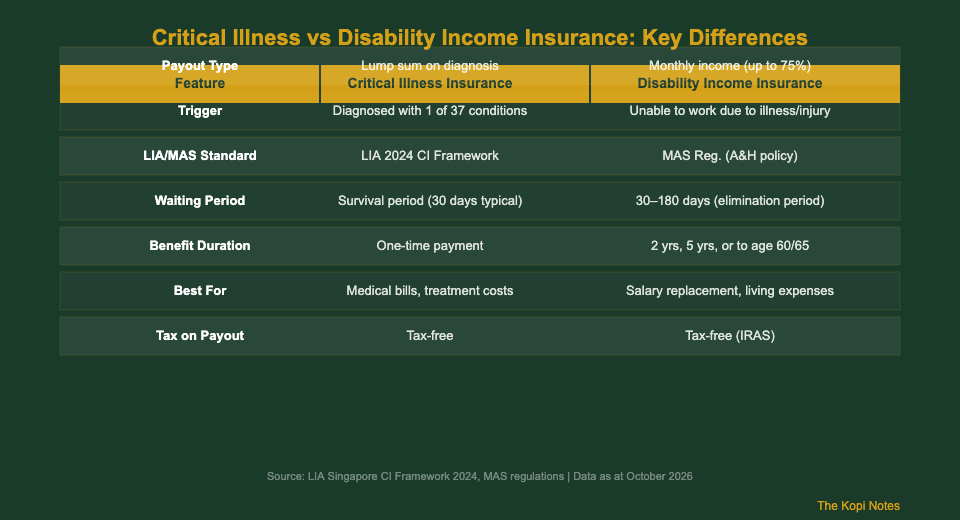
Source: LIA Singapore CI Framework 2024; MAS Accident & Health regulations | October 2026
The most important distinction: CI pays once, after diagnosis. DI pays monthly, for as long as you remain unable to work (up to the benefit period). A person who suffers a heart attack may recover fully in 6 months — CI handles the upfront medical costs. A person with a spinal injury who cannot return to work for 3 years needs the ongoing monthly income that DI provides.
When Critical Illness Insurance Is the Right Choice
CI insurance is particularly valuable in three situations:
1. You face a diagnosis that disrupts your finances, not your ability to work long-term. Many CI conditions — including early-stage cancer — allow for full or near-full recovery. A lump sum lets you cover treatment costs, take unpaid leave, or pay off your mortgage without touching savings. For someone earning SGD 8,000/month and diagnosed with cancer, a SGD 400,000 CI payout could fund 2–3 years of private-hospital treatment and living expenses.
2. You have dependants who rely on your income. A critical illness can sideline a breadwinner for months. The CI lump sum bridges that gap for the family without requiring a formal “unable to work” assessment.
3. You are building coverage early. CI premiums increase sharply with age. A 30-year-old can typically secure SGD 300,000 in CI coverage for a far lower annual premium than a 45-year-old. Starting early locks in lower rates and longer coverage. See our guide on critical illness insurance for young adults in Singapore for a detailed cost breakdown.
CI insurance does not help if the illness does not appear on the 37-condition list — a broken leg, back pain, or a mental health condition that prevents work are generally not covered by a standard CI plan.
When Disability Income Insurance Fills the Gap
DI insurance is the better product in situations where ongoing income replacement matters more than a one-time payout:
1. Your disability does not match CI conditions. A software engineer who develops severe repetitive strain injury and cannot type cannot claim on a standard CI policy. DI with an own-occupation definition would pay monthly because she cannot perform her specific role.
2. You are self-employed or a freelancer. Without employer sick leave or group insurance, a 3-month disability could wipe out your savings. DI replaces up to 75% of your declared income monthly, keeping your household running. Our guide on term life insurance for the self-employed covers how to build a full protection plan if you freelance.
3. Your disability is expected to last years, not months. A road accident resulting in paralysis, or a progressive neurological condition — these scenarios produce years of lost income. A CI lump sum of SGD 300,000 covers roughly 3–5 years at a professional income level. DI paid to age 65 would cover the remaining decades of working life.
4. You want to maintain your mortgage payments. Banks do not pause your HDB or private property loan because you are ill. A monthly DI payout ensures your mortgage, utilities, and childcare expenses are covered regardless of how long the disability lasts.
Should You Hold Both Policies?
For most working Singaporeans with dependants or a mortgage, the answer is yes. Here is why the two products complement rather than overlap each other:
CI insurance handles the diagnosis event: the shock, the immediate treatment bills, the surgeries, and the first months of recovery. DI insurance handles the ongoing income loss: the months or years you cannot return to work while living expenses continue. Using CI insurance to fund a 2-year recovery, then relying on DI for extended disability thereafter, is a common and effective structure.
A practical example: a 38-year-old Singapore civil servant earning SGD 6,000/month is diagnosed with a major cancer. The CI policy pays a SGD 300,000 lump sum — funding SGD 8,000/month in private hospital treatment for 3 years while she recovers. After the CI funds are used, if she still cannot return to work due to lasting side effects, her DI policy (paying SGD 4,500/month at the 75% MAS cap) continues to cover her household costs until her benefit period ends.
To compare your CI insurance options against our referral partners, you can explore platforms like Endowus (referral code 2V343) for fee-transparent financial planning, which includes insurance term comparisons.
Also see our comparison of CI insurance vs personal accident insurance if you are deciding between those two instead.
Cost Guide: Premiums and Coverage Benchmarks
Premium costs vary by age, health, occupation class, and coverage amount. The chart below illustrates the relationship between income level, the maximum monthly DI benefit (MAS 75% rule), and the recommended CI lump sum (LIA 5x annual income guideline):
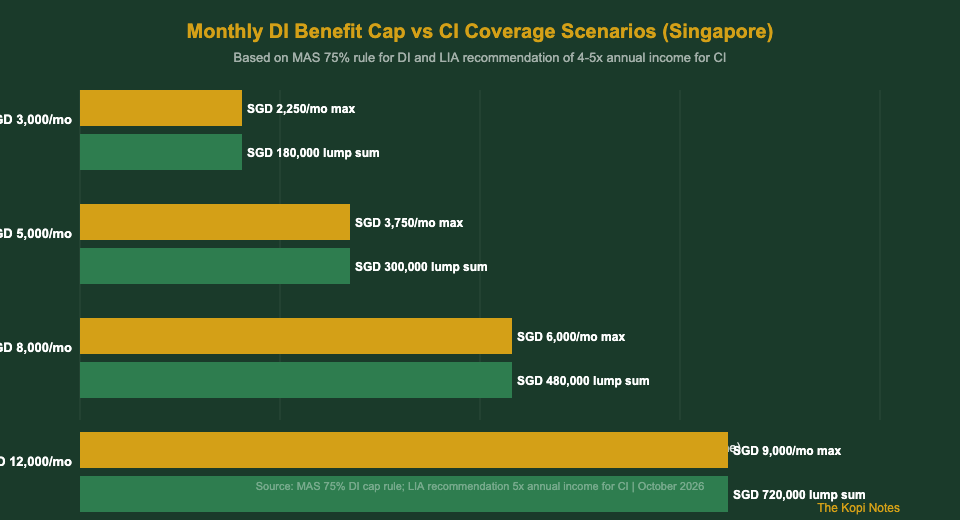
Source: MAS 75% DI monthly benefit cap rule; LIA recommendation 5x annual income for CI | October 2026
| Policy Feature | Typical Range (2026) | What Affects Premium |
|---|---|---|
| CI Insurance (SGD 300k sum assured) | SGD 400–1,800/yr (age 25–45) | Age at entry, health, smoker status, plan type |
| DI Insurance (Own-occupation, to age 65) | 1–3% of annual income/yr | Occupation class, waiting period, benefit period |
| DI Own-occ vs Any-occ premium difference | 20–30% higher for own-occupation | Definition used; own-occ is easier to claim |
| DI Waiting Period Impact | 30-day vs 90-day = ~15% premium saving | Longer wait = lower premium; gap self-funded |
Note: Premium ranges are illustrative. Get personalised quotes from a licensed financial advisor or insurer.
For retirement planning context, use our Singapore retirement calculator to see how disability coverage integrates with your long-term financial plan.
Real-World Scenarios for Singapore Workers
Scenario 1: The PMET who survives cancer
David, 42, is a project manager earning SGD 7,500/month with a young family and an HDB loan. He is diagnosed with Stage 3 colon cancer in 2026. His CI policy (SGD 375,000 sum assured, 5x annual income) pays out immediately after his 30-day survival period. He uses the lump sum to fund 18 months of chemotherapy at a private hospital, cover his mortgage for 2 years, and maintain his family lifestyle while he cannot work. When he returns to work 20 months later, he has approximately SGD 150,000 remaining from the CI payout as a recovery buffer. His DI policy was not triggered — he was medically fit to return to work.
Scenario 2: The freelancer with a chronic spine condition
Sarah, 35, is a self-employed graphic designer earning SGD 5,000/month. She develops severe cervical spondylosis and cannot use a computer for more than 30 minutes without acute pain. Her condition does not appear on the LIA 37-condition CI list — no CI payout. However, her DI policy (own-occupation definition, 60-day waiting period, benefit to age 65) pays SGD 3,750/month (75% of her declared income) once the waiting period passes. Over 3 years while she undergoes physio and retraining, she receives SGD 135,000 in tax-free monthly DI benefits. This scenario also illustrates why self-employed individuals like Sarah need DI — there is no employer sick leave or CPF contributions as a buffer. For how DPS insurance differs for salaried employees, see our comparison of DPS insurance vs term life.
Frequently Asked Questions
What is the difference between critical illness insurance and disability income insurance?
Do I need both CI and disability income insurance in Singapore?
How much critical illness insurance do I need?
What is the MAS 75% rule for disability income insurance?
Is the disability income insurance payout taxable?
What is the difference between own-occupation and any-occupation DI insurance?
Bottom Line: Which Do You Need?
If you can only choose one, prioritise based on your biggest risk gap:
- Buy CI insurance first if you have dependants, a mortgage, and no existing serious illness coverage. The lump sum provides flexibility and handles the most statistically common risk (cancer and heart disease account for over 60% of CI claims in Singapore).
- Add DI insurance once CI is in place, especially if you are self-employed, in a specialised profession, or your income is critical to household survival for years at a time.
- Hold both for comprehensive coverage — most financial planners recommend this for anyone with a working income and financial dependants.
Speak to a licensed financial advisor (MAS-regulated) to get personalised quotes that account for your health, occupation, and existing employer benefits.
Get Free Insurance Advice
Speak with a licensed insurance advisor. No obligation, no cost.
By submitting this form, you agree to our Privacy Policy.
This article was researched with the help of AI. While we strive to keep all information accurate and up to date, there may be errors. If you notice any discrepancies, please contact us.