MediSave Low Balance Before Hospitalisation: What Singapore Families Must Know (2026 Guide)
Your complete guide to understanding withdrawal limits, covering shortfalls, and protecting your family when MediSave runs low.
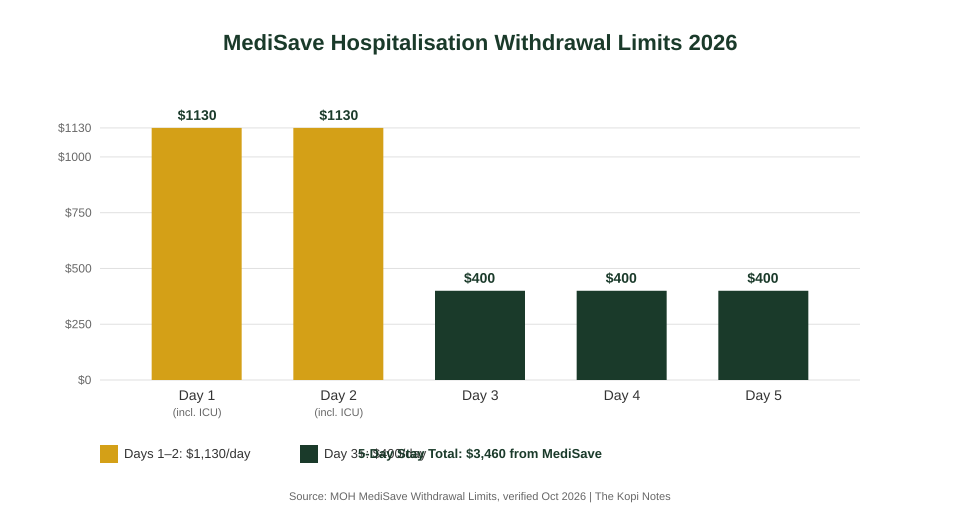
MediSave is Singapore’s national healthcare savings account, but it has strict daily withdrawal limits — $1,130 for days 1-2 and $400 from day 3 onwards. If your MediSave balance is low, you risk a cash shortfall on top of your hospital bill. This guide explains exactly how much MediSave you need before a hospitalisation, what happens when it runs out, and the four options that can cover the gap — from a family member’s account to MediFund.
Not financial advice. All figures are for educational reference only. Data verified as at 11 October 2026 unless noted.
Table of Contents
Contents - Click to expand
- What Counts as a Low MediSave Balance?
- How Much MediSave Do You Actually Need?
- MediSave Hospitalisation Withdrawal Limits 2026
- The Sequence: What Gets Deducted From MediSave First
- What Happens When MediSave Runs Out
- Your 4 Options to Cover the Shortfall
- How ISP Riders Reduce Your MediSave Dependency (2026)
- How to Top Up MediSave Before a Planned Procedure
- Frequently Asked Questions
What Counts as a “Low” MediSave Balance?
There is no official government definition of a “low” MediSave balance, but in practice, financial advisers and hospital medical social workers use two informal thresholds:
- Under $3,000: Critically low. A single 3-day hospitalisation in a B2 ward could exhaust your account without touching day surgery or surgical procedure costs.
- $3,000-$10,000: Tight. Enough to cover one standard hospitalisation but not a second one in the same year, and may not cover your Integrated Shield Plan (ISP) annual premium renewal.
The groups most likely to face a low MediSave balance in Singapore are:
- Young adults (22-30) who have just entered the workforce and have not had time to accumulate MediSave contributions
- Self-employed individuals with irregular MediSave contributions (voluntary contributions only, no employer CPF)
- Retirees who have been drawing down MediSave for ISP premiums for many years
- Individuals who recently had an expensive hospitalisation that drew heavily from their account
The good news: understanding your withdrawal limits – and the four options available when MediSave runs low – means you can plan ahead rather than scramble during a medical emergency. Read our full MediSave hospitalisation step-by-step guide 2026 for the complete claim process.
How Much MediSave Do You Actually Need?
The amount of MediSave you need depends on your ward class, the length of your stay, and whether you have an ISP. Here is a worked example comparing two scenarios for a 5-day hospitalisation:
| Scenario | Ward Class | MediSave Drawn | Cash Out-of-Pocket |
|---|---|---|---|
| No ISP, 5-day B2 | B2 (subsidised) | ~$3,460 | ~$1,500-$3,000 |
| With ISP rider, 5-day A | Class A (private) | ~$3,460 (deductible from MediSave) | 5% co-pay, capped at $6,000/year |
| No ISP, 2-day day surgery | Any | $300 + surgical TOSP limit | Remaining bill after MediShield Life |
| ICU, 3 days | ICU | $1,130 x 2 + $400 = $2,660 | Significant – ISP highly recommended |
Source: MOH MediSave Withdrawal Limits 2026, TKN calculations, verified Oct 2026
The key takeaway: even a straightforward 5-day hospitalisation in a subsidised ward will draw approximately $3,460 from MediSave (using daily limits only, before surgical TOSP charges). If your balance is under $3,460, you will face a cash shortfall – and that is before your ISP annual premium deduction.
MediSave Hospitalisation Withdrawal Limits 2026
MediSave withdrawal limits for hospitalisation are set by the Ministry of Health (MOH) and reviewed periodically. The limits cap how much can be drawn per day of inpatient care – not the total bill. Anything above the MediSave limit must be funded by MediShield Life payouts, your ISP, or cash.
For 2026, the key limits are:
| Item | MediSave Limit | Notes |
|---|---|---|
| Inpatient – Days 1 & 2 | $1,130 per day | Applies to all ward classes including ICU |
| Inpatient – Day 3 Onwards | $400 per day | Drop in limit from Day 3 – a common planning blind spot |
| Day Surgery / Short Stay | $300 per admission | Plus the applicable surgical TOSP limit below |
| Surgical Procedures (TOSP) | $250 – $7,550 | Varies by surgical complexity; Table of Surgical Procedures (TOSP) |
| Basic Healthcare Sum (BHS) 2026 | $79,000 | Maximum MediSave balance – excess contributions are refunded to OA |
Source: MOH MediSave Withdrawal Limits, CPF Board 2026 | verified Oct 2026
A critical planning point: many Singaporeans budget based on the Day 1-2 limit of $1,130/day, not realising the limit drops sharply to $400/day from Day 3. For a 10-day hospitalisation (common after major surgery), MediSave covers $1,130 + $1,130 + (8 x $400) = $5,460 in daily charges – but the total bill could be much higher.
For detailed claim steps and worked examples, see our MediSave hospitalisation claim limits 2026 guide.
The Sequence: What Gets Deducted From MediSave First
When you are hospitalised, MediSave is not the first payer – it works alongside MediShield Life and any ISP you hold. Understanding the deduction sequence helps you calculate exactly how much MediSave you need:
- ISP annual base premium – Your ISP base premium is deducted from MediSave when it falls due (monthly or annually). If hospitalisation coincides with your renewal date, this could reduce your available balance by $200-$600+ depending on your age.
- ISP deductible – Under the April 2026 rider rules, new ISP riders have a minimum deductible of $1,500-$3,500 per policy year (by ward class). Many policyholders pay this deductible using MediSave.
- MediSave daily ward charges – After the deductible is met, MediSave is drawn to cover daily ward charges up to the $1,130 / $400 limits described above.
- MediShield Life and ISP rider payouts – Your insurer pays the bulk of eligible hospitalisation costs above the deductible.
- Cash co-payment (5% minimum) – Under the new April 2026 rider rules, you pay at least 5% of eligible claims out-of-pocket, capped at $6,000 per policy year (up from $3,000 for pre-April 2026 legacy riders).
What this means in practice: if you have a low MediSave balance and have not yet paid your annual ISP deductible this policy year, your hospitalisation could trigger both the deductible payment and the daily ward charge deductions simultaneously – potentially drawing $4,000-$6,000 from MediSave in a single admission.
For the full breakdown of how the new ISP rider co-payment structure affects your wallet, see New ISP Rider 2026: Your Real Out-of-Pocket Costs vs Legacy Rider.
What Happens When MediSave Runs Out
If your MediSave balance reaches zero during a hospitalisation, the hospital will not turn you away – but you will need to arrange alternative payment quickly. Here is what happens:
- The hospital’s finance department is notified that MediSave deductions can no longer proceed.
- You (or a family member) will be asked to arrange payment – either by designating another family member’s MediSave account, paying in cash or NETS, or applying for financial assistance.
- MediShield Life and ISP payouts continue regardless of your MediSave balance – your insurer pays its portion of the claim directly to the hospital.
- Outstanding bills become your cash liability – the hospital will typically agree to a payment arrangement if you cannot settle in full immediately.
This situation is more common than most people realise. According to financial planners, Singaporeans aged 25-35 often have MediSave balances of $3,000-$8,000 – enough for one hospitalisation, but not for complex or prolonged admissions. Understanding how hospitalisation works without a strong ISP is an important planning step for this group.
Your 4 Options to Cover the Shortfall
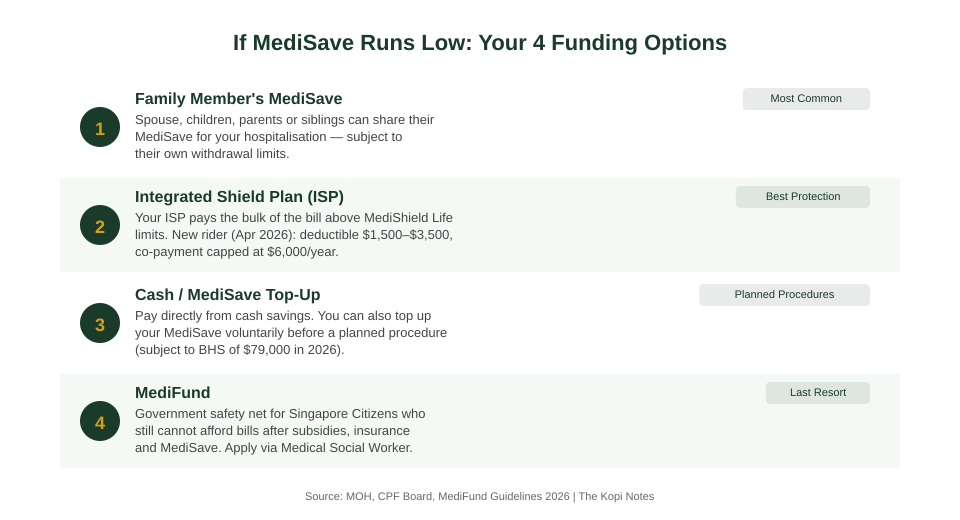
If your MediSave runs out during hospitalisation, or you know your balance is too low before a planned procedure, you have four main options:
Option 1: Designate a Family Member’s MediSave
You can use the MediSave accounts of your immediate family members – spouse, parents, children, or siblings – to pay for your hospitalisation charges. This is the most commonly used option. Each family member has their own withdrawal limits applied, so if you need $10,000 in total MediSave coverage, you may need to draw from two or more accounts. The designation is done through the hospital’s admissions counter or online via the CPF portal.
Option 2: Your Integrated Shield Plan (ISP) Pays the Bulk
If you hold an ISP with a rider, your insurer pays the majority of eligible hospitalisation costs above the MediShield Life payout – potentially leaving only your 5% co-payment and deductible for you to fund. This is why ISP coverage is considered essential: it dramatically reduces the cash amount you need to have in MediSave. See how the MediSave limit affects your ISP deductible in 2026.
Option 3: Pay Cash and Top Up MediSave Later
For planned procedures, you can top up your MediSave before admission (subject to the Basic Healthcare Sum of $79,000 in 2026). The MediSave top-up earns up to 5% p.a. interest and also qualifies for tax relief of up to $8,000 per calendar year (for self and family). Read our full guide on how to top up your MediSave in 2026.
Option 4: Apply for MediFund
MediFund is the Government’s safety net endowment fund for Singapore Citizens who genuinely cannot pay their medical bills after subsidies, MediShield Life, and MediSave. It is administered through Medical Social Workers at public hospitals and polyclinics, not by MOH directly. MediFund is not means-tested on a fixed income threshold – applications are reviewed holistically, and the amount of assistance varies. To apply, contact the Medical Social Worker at the treating institution as soon as possible. This option should be considered a last resort, but it is available and well-resourced.
How ISP Riders Reduce Your MediSave Dependency (2026)
Since April 2026, all new ISP riders must comply with MOH’s strengthened requirements. The key changes and their impact on MediSave dependency:
| Feature | Pre-April 2026 Legacy Rider | New Rider (From April 2026) |
|---|---|---|
| Annual Co-Payment Cap | $3,000 | $6,000 (minimum) |
| Minimum Co-Payment | 5% of eligible bill | 5% of eligible bill (unchanged) |
| Deductible (Class A / Private) | ~$0 (full-rider covered) | $1,500-$3,500 per policy year |
| Premium Cost | Higher | ~30% lower on average |
| Impact on MediSave Needs | Lower deductible drawn from MediSave | Higher deductible = more MediSave needed at admission |
Source: MOH ISP Rider Requirements (effective 1 April 2026), Rajah & Tann Singapore analysis, verified Oct 2026
The practical implication: if you have a new ISP rider from April 2026 and a private hospital stay, expect to draw up to $3,500 from MediSave for the deductible alone, on top of the daily ward charge deductions. This raises the minimum “safe” MediSave balance to approximately $6,000-$8,000 for Class A or private ward users.
How to Top Up MediSave Before a Planned Procedure
If you have a planned hospitalisation (elective surgery, maternity, etc.) and your MediSave balance is low, here is the recommended preparation checklist:
- Check your current balance via the CPF mobile app or my CPF portal. Note also when your next ISP premium deduction falls due.
- Calculate your expected MediSave draw: days 1-2 x $1,130 + remaining days x $400 + estimated surgical TOSP limit + deductible (if applicable).
- Top up the shortfall voluntarily – you can make a cash top-up to MediSave at any CPF Service Centre, online, or via PayNow. The top-up earns up to 5% p.a. interest. Tax relief is available on top-ups for self and family (up to $8,000 per year combined).
- Pre-authorise a family member’s MediSave – contact the hospital’s admissions team before your admission to designate additional MediSave accounts.
- Notify your ISP insurer – if you have an ISP, obtain a Letter of Guarantee (LOG) from your insurer before admission so the hospital can confirm coverage directly.
For a full explanation of the MediSave top-up process, tax relief calculations, and the BHS ceiling, read our dedicated guide on how to top up MediSave in 2026.
Important: MediSave balances above the Basic Healthcare Sum (BHS) of $79,000 in 2026 are automatically transferred to your Ordinary Account (OA). If your balance is already close to BHS, voluntary top-ups will overflow into OA, not MediSave – plan accordingly.
Frequently Asked Questions
What is the minimum MediSave balance I should keep for hospitalisation in 2026?
A practical minimum is $5,000-$8,000 if you have an ISP rider (to cover the new deductible of $1,500-$3,500 plus daily ward charges for a 5-day stay), or at least $3,500 if you are relying on subsidised C/B2 wards without a full-rider ISP. Self-employed individuals and retirees who pay their own MediShield Life premiums from MediSave should add another $1,000-$2,000 buffer on top.
Can I use my spouse's or children's MediSave to pay my hospital bill?
Yes. Immediate family members – spouse, parents, children, and siblings – can use their MediSave accounts to help pay for your hospitalisation. Each person’s account is subject to the same withdrawal limits ($1,130/day for days 1-2, $400/day from day 3 onwards). To designate a family member’s account, inform the hospital’s admissions or finance department during or before admission.
Does MediFund require me to be a Singaporean citizen?
Yes – MediFund is available only to Singapore Citizens. Permanent Residents and foreigners are not eligible. However, PRs may qualify for other forms of financial assistance at public hospitals – speak with the Medical Social Worker at your treating institution, who can advise on all available schemes.
Will my ISP still pay out if my MediSave is at zero?
Yes. Your ISP and MediShield Life payouts are not conditional on your MediSave balance. The insurer pays its portion of the claim directly to the hospital based on the bill submitted. The MediSave balance only affects how much you can draw to cover the portion not paid by MediShield Life and your ISP (your deductible and co-payment), plus daily ward charges.
How does the new ISP rider deductible affect how much MediSave I need?
Under new ISP riders effective April 2026, there is a minimum deductible of $1,500-$3,500 per policy year, depending on ward class. Most policyholders pay this deductible using MediSave. This means your MediSave needs to cover the deductible first, before the daily ward charge deductions begin. For a Class A or private hospital admission with a new rider, you should expect to use at least $3,500 from MediSave for the deductible alone.
Can I top up my MediSave just before I go to the hospital?
Yes – voluntary MediSave top-ups take effect almost immediately when done online via my CPF or by PayNow to CPF. For urgent admissions, cash top-up at a CPF Service Centre is also an option. However, voluntary top-ups are subject to the Basic Healthcare Sum (BHS) ceiling of $79,000 in 2026 – excess funds are redirected to your OA. Tax relief of up to $8,000 per year applies for self and family top-ups.
What is the difference between MediFund, MediShield Life, and MediSave?
MediSave is your personal healthcare savings account (CPF); MediShield Life is the national health insurance scheme that all Singaporeans are enrolled in automatically; and MediFund is the Government’s safety net endowment fund for citizens who cannot afford their medical bills even after using MediSave and MediShield Life. They work in layers – MediSave and MediShield Life are used first, and MediFund fills remaining gaps for eligible individuals.
Make Sure Your ISP Covers More – So MediSave Covers Less
A well-structured ISP rider significantly reduces how much MediSave you need in a medical emergency. Review your coverage today.
Get Free Insurance Advice
Speak with a licensed insurance advisor. No obligation, no cost.
By submitting this form, you agree to our Privacy Policy.
This article was researched with the help of AI. While we strive to keep all information accurate and up to date, there may be errors. If you notice any discrepancies, please contact us.