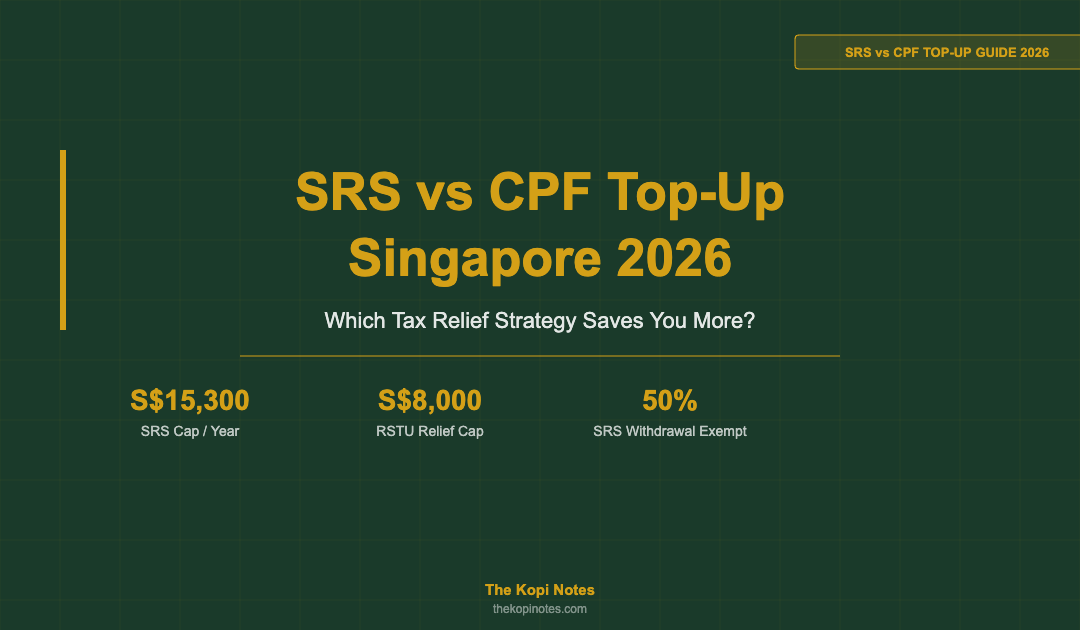
SRS vs CPF Top-Up Singapore 2026: Which Tax Relief Strategy Saves You More?
Retirement Planning · Updated October 2026
Table of Contents
The Supplementary Retirement Scheme (SRS) and the CPF Retirement Sum Top-Up Scheme (RSTU) are both powerful tax relief tools for Singapore residents — but they work very differently. SRS lets you contribute up to S$15,300 a year (Singaporeans and PRs) and invest freely in stocks, ETFs and T-bills, while RSTU delivers up to S$8,000 in annual CPF relief but locks funds into CPF LIFE. Here is how to choose — and why many investors use both.
Not financial advice. All figures are for educational reference only. Data as at October 2026 unless noted.
What Is an SRS Account?
The Supplementary Retirement Scheme (SRS) is a voluntary savings scheme administered by the Ministry of Finance. You open an SRS account at one of the three participating banks — DBS, OCBC, or UOB — and make voluntary cash contributions, which are then deducted from your chargeable income for that Year of Assessment.
Key SRS facts for 2026:
- Annual contribution cap: S$15,300 for Singapore Citizens and PRs; S$35,700 for foreigners.
- Tax relief: Equal to the amount contributed — deposit S$15,300, reduce taxable income by S$15,300.
- Investment flexibility: Funds can be deployed into SGX-listed stocks, unit trusts, ETFs (via a Syfe referral code and sign-up bonus), Singapore T-bills, Singapore Savings Bonds, endowment plans, and ILPs.
- Penalty-free withdrawal age: 62 years old. Withdrawing before 62 incurs a 5% penalty and 100% of the amount is taxable as income.
- Withdrawal tax advantage: From age 62, only 50% of each withdrawal is included in your taxable income. Spread withdrawals over 10 years for maximum tax efficiency.
- Closure: If you never withdraw, your SRS balance is taxed in full at the end of the statutory withdrawal period (10 years after your first withdrawal).
The SRS is particularly attractive because the combination of a tax deduction on the way in, tax-free growth inside, and only 50% taxability on the way out creates a triple tax advantage that few other vehicles in Singapore can match. For more on CPF investment strategy, see our in-depth guide.
What Is CPF RSTU and MA Top-Up?
CPF offers two voluntary top-up routes that come with tax relief. These are separate from the mandatory CPF contributions employers and employees make.
1. Retirement Sum Top-Up Scheme (RSTU)
The RSTU lets you voluntarily top up your CPF Special Account (SA) if you are below 55, or your Retirement Account (RA) if you are 55 and above, to earn an enhanced 4% p.a. interest. The tax relief rules are:
- Self top-up: Up to S$8,000 per calendar year in tax relief.
- Family members: An additional S$8,000 relief for topping up a spouse, siblings, parents, or grandparents — making the combined maximum S$16,000.
- Conversion: Funds in the SA/RA ultimately flow into CPF LIFE, providing monthly payouts from age 65 onwards. You cannot withdraw RSTU funds as a lump sum.
2. MediSave (MA) Voluntary Top-Up
You can also top up your MediSave Account up to the Basic Healthcare Sum (BHS), which is S$75,500 in 2026. The full amount contributed qualifies for tax relief, but the funds are restricted to MediShield Life premiums, approved treatments, and certain hospitalisation expenses. MediSave is not investable.
Note: Since January 2025, CPF SA is closed for new members. Existing members above 55 can still top up the RA.
SRS vs CPF Top-Up: Full Feature Comparison
The table below compares all three voluntary top-up options side by side.
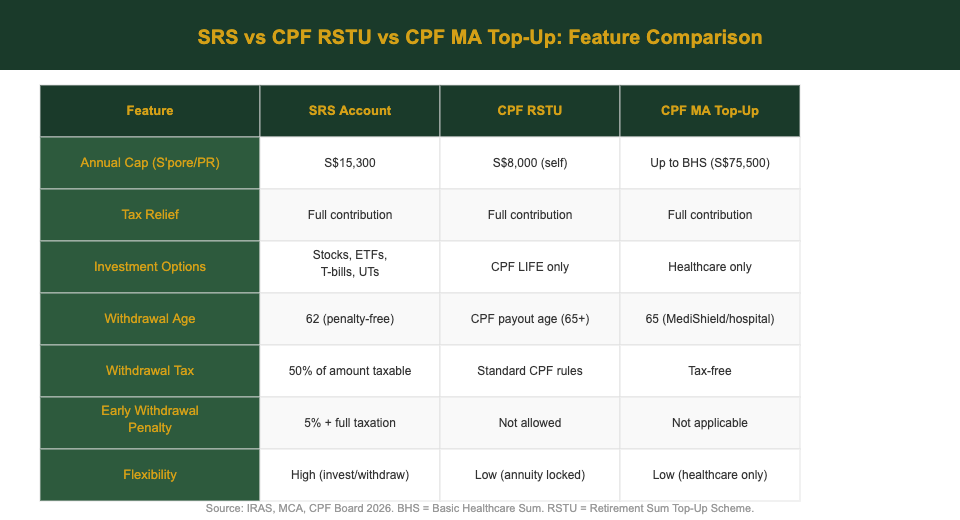
| Feature | SRS Account | CPF RSTU | CPF MA Top-Up |
|---|---|---|---|
| Annual Cap (S/PR) | S$15,300 | S$8,000 (self) + S$8,000 (family) | Up to BHS (S$75,500) |
| Interest / Returns | Market-linked (invest yourself) | 4% p.a. (SA/RA) | 4% p.a. (MA) |
| Investment Options | Stocks, ETFs, T-bills, UTs, SSB, endowments | CPF LIFE only (annuity) | Healthcare use only |
| Cash Withdrawal | Yes — from age 62 (penalty-free) | No — monthly CPF LIFE payouts only | Healthcare claims only |
| Withdrawal Tax | 50% of withdrawal is taxable | Standard CPF payout rules (mostly tax-free) | Tax-free |
| Early Penalty | 5% penalty + 100% taxable if before 62 | No early withdrawal allowed | N/A |
| Best For | Investors who want flexibility + market returns | Those who want guaranteed monthly income at 65 | Those with a MediSave shortfall or high healthcare costs |
Source: CPF Board, IRAS, Ministry of Finance Singapore. Data as at October 2026.
Tax Savings: Worked Examples at Different Income Levels
The tax relief from both schemes is deducted from your assessable income before tax is applied. The actual savings depend on your marginal tax rate. Here are worked examples for common Singapore income levels in 2026.
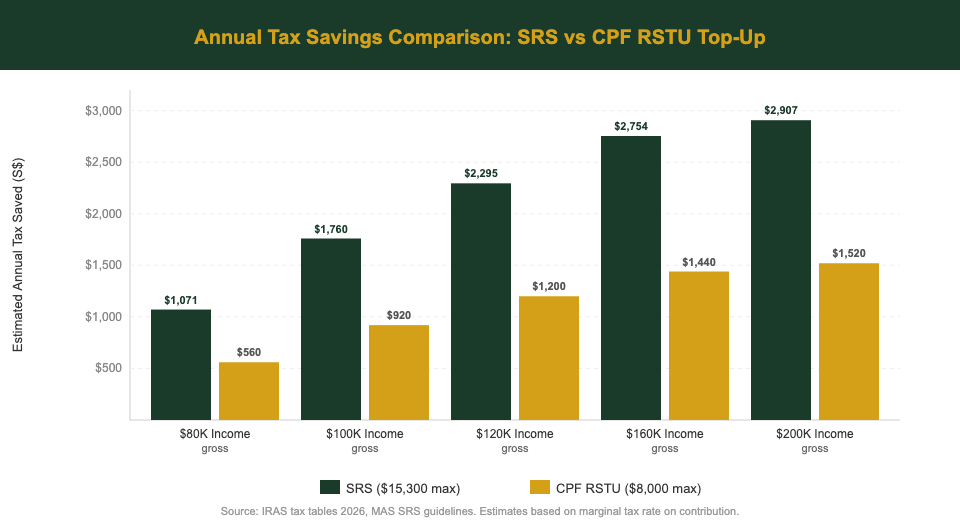
| Annual Income | Marginal Rate | SRS Tax Saved ($15,300) | RSTU Tax Saved ($8,000) | Combined Both |
|---|---|---|---|---|
| S$80,000 | 7% | ~S$1,071 | ~S$560 | ~S$1,631 |
| S$100,000 | 11.5% | ~S$1,760 | ~S$920 | ~S$2,680 |
| S$120,000 | 15% | ~S$2,295 | ~S$1,200 | ~S$3,495 |
| S$160,000 | 18% | ~S$2,754 | ~S$1,440 | ~S$4,194 |
| S$200,000 | 19% | ~S$2,907 | ~S$1,520 | ~S$4,427 |
Source: IRAS tax table 2026. Figures are estimates based on marginal rate on contribution amount. Actual savings depend on total chargeable income after all reliefs.
Worked example — S$120,000 income: Ravi earns S$120,000 annually. He contributes S$15,300 to SRS and tops up S$8,000 via RSTU. His total tax relief from these two moves alone is S$23,300, reducing his chargeable income by that amount and saving approximately S$3,495 in income tax for the year. He can use our Singapore retirement calculator to project how this compounds over time.
Who Should Prioritise SRS?
SRS is the better-first choice in most of the following situations:
- You are a high-income earner (above S$80K) who already hits the RSTU cap. Since RSTU self-relief caps at S$8,000, SRS gives you an additional S$15,300 in deductions — nearly double the relief amount.
- You want investment flexibility. SRS funds can be invested in ETFs on the London Stock Exchange through platforms like FSMOne or unit trusts via Endowus referral code, potentially earning market returns far above the 4% CPF guaranteed rate.
- You may need the capital before 65. While there is a 5% early withdrawal penalty, SRS funds are technically accessible before 62 (with penalty), unlike RSTU funds which are locked until CPF payout age.
- You are a foreigner in Singapore. Your SRS cap is S$35,700 — significantly higher — making it an even more powerful tool.
- You are below 40 and have decades for compounding. Investing SRS funds in low-cost global ETFs over 20+ years can significantly outperform the guaranteed 4% from RSTU.
Who Should Prioritise CPF RSTU?
CPF RSTU is the stronger priority in these circumstances:
- You want guaranteed income in retirement. RSTU tops up your CPF balance, which earns a risk-free 4% p.a. and ultimately converts into guaranteed CPF LIFE monthly payouts.
- Your CPF balance is far below the Full Retirement Sum. Topping up to the FRS ensures you qualify for higher CPF LIFE payouts at 65. For more details on CPF investment strategy and FRS planning, see our dedicated guide.
- You have a spouse or parents with low retirement savings. You can top up a family member’s CPF SA/RA and claim an additional S$8,000 in relief — a strategy not available with SRS.
- You are close to 55 and want to lock in 4% on a lump sum. CPF SA earns 4% p.a. risk-free, which is competitive versus Singapore T-bills and SSB in 2026.
- You have already maximised SRS and want more relief. Stack RSTU on top of SRS to increase total tax deductions.
Can You Use Both SRS and CPF Top-Up in the Same Year?
Yes — and this is often the optimal strategy. SRS and RSTU are completely separate schemes. Contributing to one does not affect your eligibility or cap for the other. Many Singapore investors routinely do both:
- Max SRS at S$15,300 → invest in a diversified ETF portfolio for market-linked growth.
- Top up CPF RA at S$8,000 → earn guaranteed 4% p.a. and build CPF LIFE payouts.
- Top up MediSave to BHS → earn 4% p.a. on healthcare reserves with additional relief.
- Top up a spouse’s CPF RA → claim the additional S$8,000 family relief.
Note that IRAS imposes an overall cap on personal income tax reliefs of S$80,000 per year for Singapore tax residents. If your total reliefs already approach this cap, additional contributions beyond that threshold provide no further tax benefit for that year — but the money still grows tax-free inside the scheme.
For our year-end top-up checklist, see our SRS year-end top-up guide Singapore 2026.
Step-by-Step Action Plan for 2026
Use this framework to decide your top-up order before December 31, 2026:
- Check your total tax relief position. Log in to IRAS myTax Portal and calculate your projected chargeable income for YA2027.
- Open an SRS account if you have not already. Visit DBS, OCBC, or UOB — you can open SRS online in 10 minutes. Deposit before December 31.
- Contribute to SRS up to S$15,300. If you are in the 11.5% bracket or above, this single move saves you at least S$1,760 annually.
- Check your CPF SA/RA balance against the Full Retirement Sum. If you are below the FRS (S$213,000 in 2026), topping up via RSTU up to S$8,000 gives you both the guaranteed 4% and a tax deduction.
- Check your MediSave balance against the BHS. If below S$75,500, top up to the BHS for additional 4% returns and tax relief.
- Consider topping up a spouse’s or parent’s CPF RA for the additional S$8,000 family RSTU relief.
- Invest your SRS funds. Do not leave SRS cash idle at the default 0.05% bank rate. Transfer into a brokerage account (via Syfe Trade) and invest in a globally diversified ETF portfolio.
Frequently Asked Questions
What is the SRS contribution limit for 2026?
Can I top up both SRS and CPF RSTU in the same year?
What happens to my SRS money if I withdraw before age 62?
Is SRS or CPF RSTU better for tax savings?
What can I invest my SRS funds in?
Can foreigners open an SRS account in Singapore?
This article was researched with the help of AI. While we strive to keep all information accurate and up to date, there may be errors. If you notice any discrepancies, please contact us.