Endowment Plan vs Unit Trust Singapore 2026: Which Grows Your Money Faster?
Endowment plans guarantee you 2.5–4.25% p.a. in Singapore (2026), while unit trusts offer higher historical returns of 6–12% p.a. but with full market risk and no capital protection. If you need certainty — a child’s education fund, a wedding, or a retirement date — endowment plans win. If you have a 10+ year horizon and can stomach volatility, equity unit trusts have historically grown more. This guide breaks down every key difference so you can choose the right vehicle for your goal.
Data verified as at 7 October 2026. Not financial advice. Always consult a licensed financial adviser before purchasing any financial product.
What Is an Endowment Plan?
An endowment plan is a life insurance savings product that combines protection with a guaranteed savings element. You pay premiums for a fixed term — typically 2 to 25 years — and at maturity, you receive a guaranteed lump sum payout. Some endowment plans also include a non-guaranteed bonus (par plans), while others are 100% guaranteed (non-par plans).
In Singapore, endowment plans are regulated by the Monetary Authority of Singapore (MAS) and sold by licensed insurers including AIA, Great Eastern, NTUC Income, Manulife, Prudential, and others. They are a popular choice for Singaporeans with a specific savings goal and a defined timeline — for example, building a university fund for a child due to matriculate in five years, or accumulating a renovation fund before a BTO handover.
Key characteristics of endowment plans:
- Guaranteed maturity payout (principal + guaranteed interest)
- Optional non-guaranteed bonuses (par fund plans)
- Capital protection at maturity (you get at least what you put in, plus guaranteed returns)
- Surrender penalty if you exit before maturity
- Life insurance coverage included (usually minimal)
What Is a Unit Trust?
A unit trust (also called a mutual fund) is a professionally managed collective investment scheme. When you invest, your money is pooled with other investors and managed by a fund manager who invests across a basket of assets — equities, bonds, REITs, or a mix. Your investment is divided into units, and the value of those units fluctuates daily based on the underlying assets.
In Singapore, unit trusts are sold through platforms like FSMOne, Endowus, and Syfe. FSMOne alone offers access to over 2,400 funds across more than 100 fund managers. Unlike endowment plans, unit trusts have no fixed maturity date — you can sell (redeem) your units on any business day at the prevailing net asset value (NAV).
Key characteristics of unit trusts:
- No guaranteed returns — performance depends on market conditions
- Daily liquidity (redeem at NAV on any business day)
- Wide choice of strategies (equity, fixed income, balanced, sector)
- Ongoing fees: total expense ratio (TER) typically 0.5–2.5% p.a.
- No lock-in period, but short-term redemption may incur charges
- Eligible for CPF OA/SA investment (CPFIS), SRS accounts
Endowment Plan vs Unit Trust: Side-by-Side Comparison
Here is a complete feature-by-feature breakdown to help you decide at a glance.
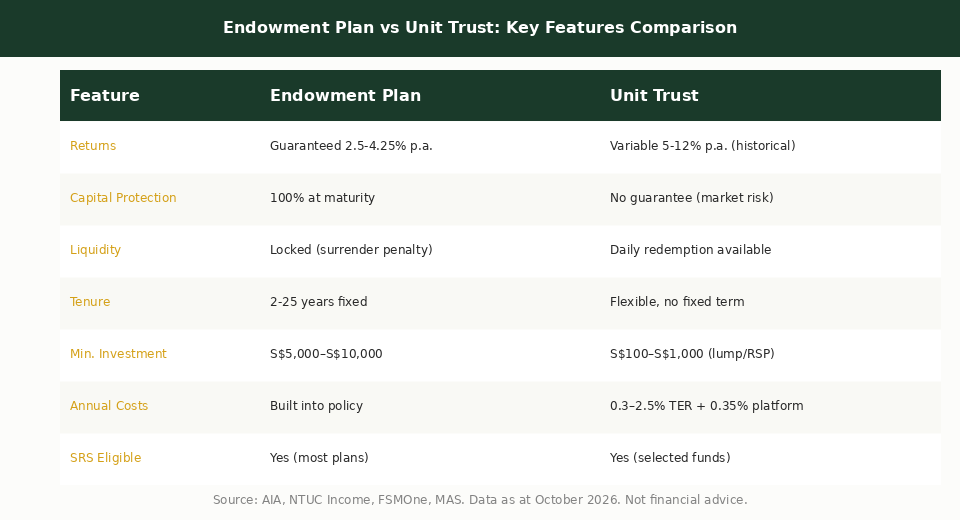
| Feature | Endowment Plan | Unit Trust |
|---|---|---|
| Returns | Guaranteed 2.5–4.25% p.a. (Oct 2026) | Variable; equity funds ~6–12% p.a. historically (not guaranteed) |
| Capital Protection | 100% capital protected at maturity | No protection — NAV can fall below invested amount |
| Liquidity | Locked — surrender penalty applies if you exit early | Daily redemption at NAV (highly liquid) |
| Minimum Investment | S$5,000–S$15,000 (most plans) | From S$100 (RSP) or S$1,000 (lump sum) |
| Fixed Tenure | Yes (2–25 years) | No fixed term — invest as long as you want |
| Annual Charges | Built into policy (not shown separately) | TER 0.5–2.5% p.a. + platform fee ~0.35% p.a. |
| Insurance Coverage | Yes (basic sum assured) | None |
| SRS / CPF Eligible | SRS: Yes. CPF: No (not CPFIS-included) | SRS: Yes. CPF OA/SA: Yes (selected CPFIS-approved funds) |
| Best For | Fixed-goal savers who want certainty | Growth investors with a 10+ year horizon |
Source: AIA, NTUC Income, Great Eastern, FSMOne. Data as at October 2026.
Returns: What You Actually Earn in Singapore (2026)
This is the most important factor for most investors. The numbers differ substantially depending on whether you prioritise certainty or growth potential.
Current Endowment Plan Returns (October 2026)
Endowment plans in Singapore currently offer the following guaranteed returns on single-premium plans (where you invest a lump sum once):
| Plan | Insurer | Tenor | Guaranteed Returns |
|---|---|---|---|
| AIA #Wealth Savvy (III) | AIA | 2 years | 3.38% p.a. |
| AIA #Wealth Savvy (IV) | AIA | 3 years | 2.80% p.a. |
| Gro Capital Ease | NTUC Income | 2–3 years | Up to 3.38% p.a. |
| GREATLife Endowment 3 | Great Eastern | 3 years | Up to 3.58% p.a. illustrated (par fund) |
| Market range (2–5 year plans) | Various | 2–5 years | 2.5–4.25% p.a. |
Source: AIA, NTUC Income, Great Eastern as at October 2026. Rates subject to change. Par fund illustrated returns include non-guaranteed bonuses.
Unit Trust Historical Returns in Singapore
Unit trusts don’t offer guaranteed returns, but historical data gives us a useful reference. Equity funds investing in diversified global or Asia-Pacific indices have historically returned 6–12% p.a. over 10-year periods, depending on market conditions. However, returns can be sharply negative in down years — the MSCI World fell around 18% in 2022, for example.
Over the 12 months to May 2026, FSMOne Malaysia clients’ unit trust portfolios averaged 18.8% — but this benefited from an exceptional market run and should not be taken as a forward expectation. Singapore-listed unit trust investors saw similar variations, with equity funds delivering strong returns in 2025–2026 after global tech and Asia re-rating.
Returns Scenario: SGD 50,000 Invested
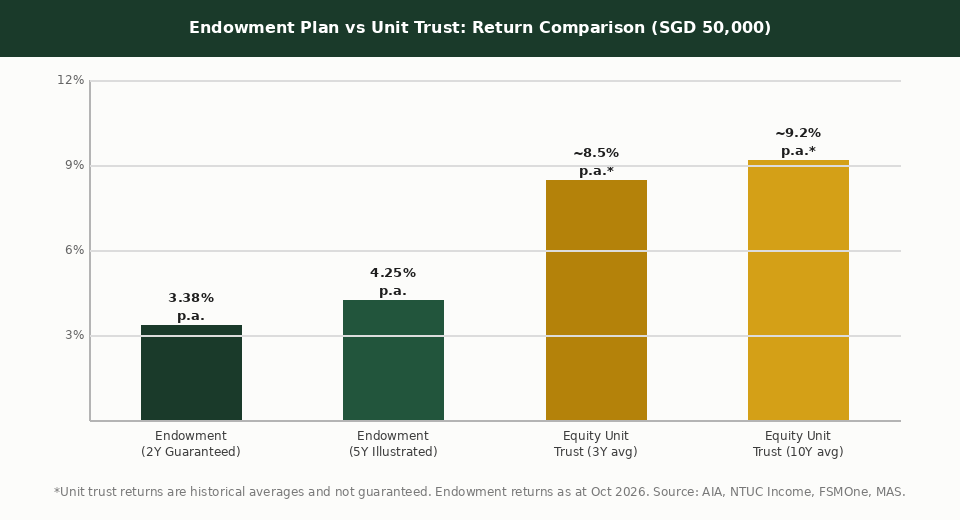
| Scenario | Return Assumption | SGD 50,000 after 3 years | SGD 50,000 after 10 years |
|---|---|---|---|
| Endowment (2Y, 3.38%) | 3.38% p.a. guaranteed | S$55,186 | N/A (2Y product) |
| Endowment (5Y, 4.25%) | 4.25% p.a. guaranteed | S$56,631 | S$74,964 |
| Equity Unit Trust (Conservative) | 6% p.a. (historical lower bound) | S$59,551 | S$89,542 |
| Equity Unit Trust (Average) | 9% p.a. (historical average) | S$64,778 | S$118,368 |
Figures are compound growth estimates for illustration purposes only. Unit trust returns are historical and not guaranteed. Past performance is not indicative of future results. Endowment returns based on current market rates (Oct 2026).
The table shows that if a unit trust can consistently deliver 9% p.a. over 10 years, it would grow S$50,000 to S$118,368 — nearly double what an endowment plan generates. But that’s a big “if.” In a bad 3-year period, your unit trust could be worth S$40,000 or less. An endowment plan at 3.38% will return exactly S$55,186 regardless of what markets do.
Risk and Capital Protection
Endowment plans offer something no unit trust can: capital protection at maturity. As long as you hold the plan to its maturity date and pay all premiums, you are guaranteed to receive at least the sum of your premiums plus the guaranteed interest component. Your capital is not at risk from market movements.
Unit trusts carry full market risk. In a significant market downturn, your portfolio can lose 20–40% of its value. Investors who bought equity funds in early 2022 saw 15–25% drawdowns before recovery. This is not necessarily a reason to avoid them — over 10+ years, market risk has historically been rewarded — but it means unit trusts are unsuitable for goals with hard deadlines (e.g. paying school fees in 3 years).
Key risk question to ask yourself: “If my investment is worth 30% less when I need it, can I wait longer?” If yes, a unit trust may work. If no, an endowment plan is likely safer for that specific goal.
For a broader approach to managing investment risk across different asset classes, our Singapore retirement planning calculator can help you model how different return assumptions affect your long-term outcome.
Liquidity and Flexibility
This is one of the starkest differences between the two products.
Endowment plans have very low liquidity. If you need to exit before maturity, you’ll receive the surrender value — which is typically less than your total premiums paid in the early years. For a 5-year plan, you might only recover 70–85% of your premiums if you surrender in year 1 or 2. This makes endowment plans unsuitable as emergency funds or for goals where your timeline might shift.
Unit trusts offer daily liquidity. You can redeem your units on any Singapore business day at the current NAV. There is usually no penalty for redemption (though some platforms have exit fees if you sell within a short period). This flexibility makes unit trusts far better suited to investors who want the option to change plans, respond to life events, or rebalance their portfolio.
If you want the capital protection of an endowment plan but with more liquidity than a 5-year lockup, consider a 2-year plan (like AIA #Wealth Savvy III at 3.38% p.a.) — a shorter tenor means less liquidity risk while still earning a guaranteed return above typical fixed deposit rates.
For comparison, you can also explore how savings plan laddering works to manage liquidity while maximising guaranteed returns.
Costs and Charges: What You’re Actually Paying
Costs matter enormously in long-term investing — a 1% annual fee difference compounds to a 10% difference over 10 years.
Endowment Plan Costs
Endowment plans don’t show you their costs explicitly — they are embedded in the pricing of the guaranteed returns and the non-guaranteed bonus calculations. However, you can estimate them by comparing what a policyholder gets vs what the insurer earns from the same assets. In practice, par fund endowment plans typically carry all-in costs of 1.5–2.5% p.a., while single-premium non-par plans have lower implicit costs given the shorter tenor and simple guarantee structure.
There are no separate platform fees if you buy directly from an insurer. However, buying through a financial adviser may result in the adviser receiving a commission embedded in the policy structure.
Unit Trust Costs
Unit trust costs are more transparent thanks to MAS disclosure requirements:
- Total Expense Ratio (TER): 0.5–2.5% p.a. depending on fund type (index funds lower, active equity funds higher)
- Platform fee: FSMOne charges 0.35% p.a. for the first S$300,000 under management
- Sales charge: FSMOne charges 0% online (was historically 3–5%)
- Redemption fee: typically nil for most retail funds on major platforms
For an actively managed Singapore equity fund with a 1.5% TER and 0.35% platform fee, your total annual cost is 1.85% p.a. — meaning the fund needs to return at least 1.85% just to break even. This is why low-cost index-tracking unit trusts (TER ~0.5–0.8%) often outperform active funds net of fees over the long term.
You can use referral codes when signing up for investment platforms. For FSMOne, use the FSMOne referral code P0544985. For robo-advisors that also offer unit trust portfolios, the Syfe referral code SRPRFFFCD and Endowus referral code 2V343 offer sign-up bonuses.
CPF, SRS and Tax Angles for Singapore Investors
Both endowment plans and unit trusts can be held within a Supplementary Retirement Scheme (SRS) account, giving you a tax deduction on your SRS contributions. Neither generates taxable income in Singapore — there is no capital gains tax and no withholding tax on insurance payouts or unit trust redemptions for Singapore residents.
SRS Strategy
Using SRS money (which otherwise earns just 0.05% p.a. in the SRS holding account) to buy either an endowment plan or a unit trust is a sensible tax-efficiency move. For an endowment plan inside SRS, the guaranteed return of 3%+ is dramatically better than the 0.05% default. For unit trusts, SRS investors have access to the same fund universe as cash investors.
CPF Investment Scheme (CPFIS)
Endowment plans are generally not available under the CPF Investment Scheme (CPFIS). However, many unit trusts are CPFIS-approved and can be purchased with CPF OA or SA funds. This makes unit trusts more useful for CPF investors who want to potentially earn more than the base CPF OA rate of 2.5% p.a. For more on this, see our guide to CPF investment strategy in Singapore.
Which Should You Choose?
The right answer depends on your specific goal, timeline, and risk tolerance. Here is a practical decision framework:
| Your Situation | Better Choice |
|---|---|
| Fixed goal in 2–5 years (renovation, education, wedding) | Endowment Plan |
| Long-term wealth building (10+ years, retirement) | Unit Trust (especially equity) |
| Emergency fund / high liquidity needs | Unit Trust (money market fund) or savings account |
| SRS account maximisation | Either — endowment for guaranteed, unit trust for growth |
| Hate volatility, need to sleep at night | Endowment Plan |
| CPFIS investing with CPF OA/SA funds | Unit Trust (CPFIS-approved funds only) |
Many Singaporeans hold both — a short-term endowment plan for a fixed goal like a flat downpayment, and a long-term unit trust portfolio invested in global equity index funds for retirement. This “barbell” approach uses each product for what it does best.
Frequently Asked Questions
Is an endowment plan better than a unit trust?
Neither is universally better — they serve different purposes. An endowment plan is better when you need guaranteed returns, capital protection, or have a specific savings goal with a defined timeline (2–5 years). A unit trust is better when you have a long investment horizon (10+ years), are comfortable with market volatility, and want the potential for higher growth. Many Singapore investors use both simultaneously for different financial goals.
Can I lose money in an endowment plan?
If you hold the plan to maturity, you receive the guaranteed maturity value — you will not lose money on the guaranteed portion. However, if you surrender the policy early (before maturity), you may receive less than the total premiums paid, especially in the first 1–3 years. The surrender value in early years is often significantly lower than your paid-in premiums. Non-guaranteed bonuses (in par plans) are not confirmed and could also be lower than illustrated.
What is the average return on unit trusts in Singapore?
There is no single average — returns vary widely by fund type. Singapore equity and REIT funds have historically returned 5–8% p.a. over 10-year periods. Global equity index-tracking unit trusts (e.g. those tracking MSCI World or S&P 500) have delivered 8–12% p.a. historically over 10-year periods, though returns are not guaranteed and can be negative in any given year. Money market unit trusts return 2–4% p.a. with very low risk. Always check the fund’s 3-year and 10-year annualised returns on MAS-approved factsheets or platforms like FSMOne.
Can I use CPF to buy an endowment plan?
Generally, no. Most endowment plans in Singapore are not approved under the CPF Investment Scheme (CPFIS), so they cannot be purchased with CPF OA or SA funds. Unit trusts that are CPFIS-approved can be bought with CPF OA funds (and some with CPF SA). However, both endowment plans and unit trusts can be purchased using SRS (Supplementary Retirement Scheme) funds, which gives you an income tax deduction on the SRS contribution.
Are unit trust returns taxable in Singapore?
No. Singapore does not impose capital gains tax, so any profit from selling unit trust units is tax-free. Dividends and distributions from unit trusts may be subject to withholding tax depending on the underlying assets (e.g. US equities carry a 30% dividend withholding tax), but this is deducted at the fund level before distributions are paid. For Singapore resident investors, there is no additional income tax on unit trust distributions or redemption proceeds.
What is the minimum investment for an endowment plan in Singapore?
Most single-premium endowment plans in Singapore require a minimum investment of S$5,000 to S$15,000. For example, AIA #Wealth Savvy (III) has a minimum of S$10,000. Regular-premium plans (where you pay monthly or annually) may have lower entry points — some start at S$100–S$500 per month — but these involve a longer commitment and higher surrender risk. Unit trusts, by comparison, often allow investments from S$100 via a Regular Savings Plan (RSP).
Disclaimer: This article is for educational purposes only and does not constitute financial advice. Endowment plan rates and unit trust returns are subject to change — always verify current rates directly with insurers or fund platforms. Endowment plan par fund illustrated returns include non-guaranteed bonuses and may differ from actual payouts. Unit trust past performance is not indicative of future results. The Kopi Notes may earn referral fees from links to FSMOne, Syfe, and Endowus. Data as at 7 October 2026.
Get Free Insurance Advice
Speak with a licensed insurance advisor. No obligation, no cost.
By submitting this form, you agree to our Privacy Policy.
This article was researched with the help of AI. While we strive to keep all information accurate and up to date, there may be errors. If you notice any discrepancies, please contact us.