CPF LIFE Payout: Start at 65 or Defer to 70?
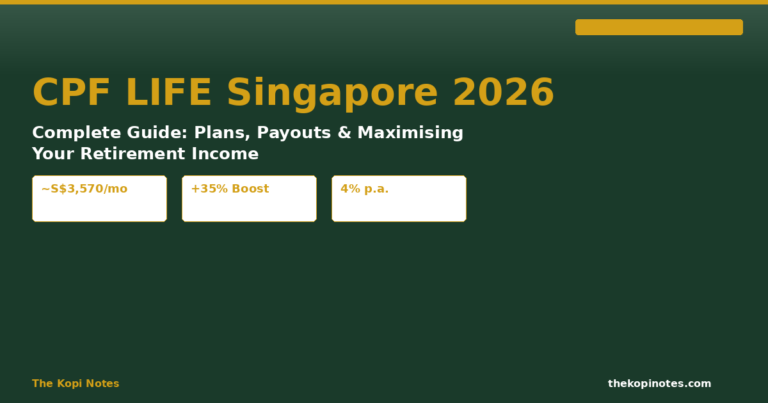
Singapore Guide (2026)CPF LIFE (Lifelong Income For the Elderly) gives every eligible Singaporean a monthly payout for life, but you control when it starts: age 65 (the earliest) or deferred up to age 70 for a significantly higher monthly amount. Starting at 65 on the Full Retirement Sum (FRS) Standard Plan pays approximately SGD 1,630/month; deferring to 70 raises that to about SGD 2,195/month — a 35% increase. Whether that extra monthly payout justifies waiting 5 years depends on your health, expenses, and other income sources.
Not financial advice. All figures are CPF Board estimates as at October 2026. Actual payouts depend on your CPF LIFE plan, prevailing interest rates, and exact savings at 55.
CPF LIFE Monthly Payouts: Exact Amounts at Age 65 vs 70 (2026)
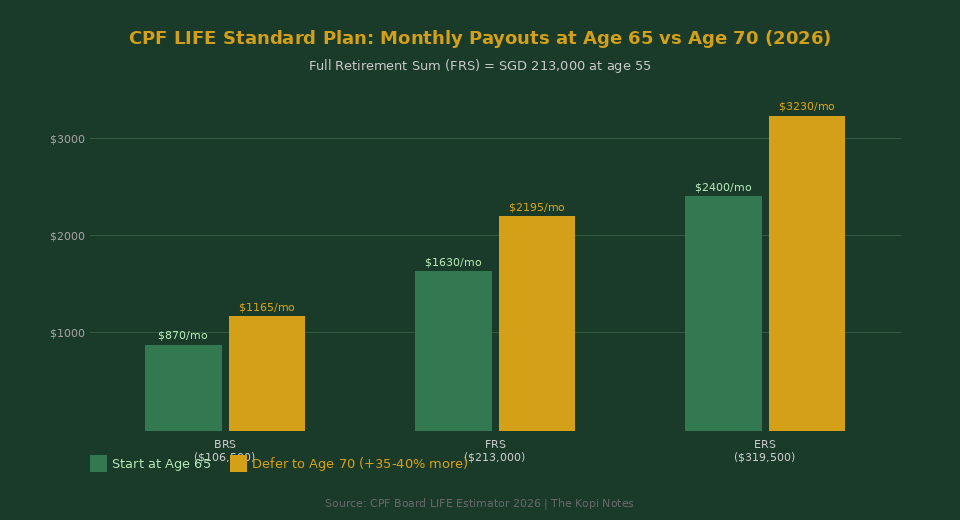
The table below shows CPF Board’s estimated monthly payouts under the Standard Plan for each Retirement Sum option. These are the figures you should base your decision on.
| Retirement Sum | Amount at 55 | Payout from Age 65 | Payout from Age 70 | Increase |
|---|---|---|---|---|
| Basic Retirement Sum (BRS) | SGD 106,500 | ~SGD 870/mo | ~SGD 1,165/mo | +34% |
| Full Retirement Sum (FRS) | SGD 213,000 | ~SGD 1,630/mo | ~SGD 2,195/mo | +35% |
| Enhanced Retirement Sum (ERS) | SGD 319,500 | ~SGD 2,400/mo | ~SGD 3,230/mo | +35% |
Source: CPF Board LIFE Estimator, October 2026. ERS = 1.5x FRS from 2025. Values are estimates for illustration; actual payouts vary.
A key note: the BRS, FRS, and ERS are the amounts you need in your Retirement Account at age 55. Whatever you have above BRS by age 55 is locked into your RA and earns 4% p.a. guaranteed — so deferring payout from 65 to 70 means those funds keep compounding at 4% for 5 more years, which is why the 70-start payout is higher.
Break-Even Analysis: When Does Deferring to 70 Pay Off?
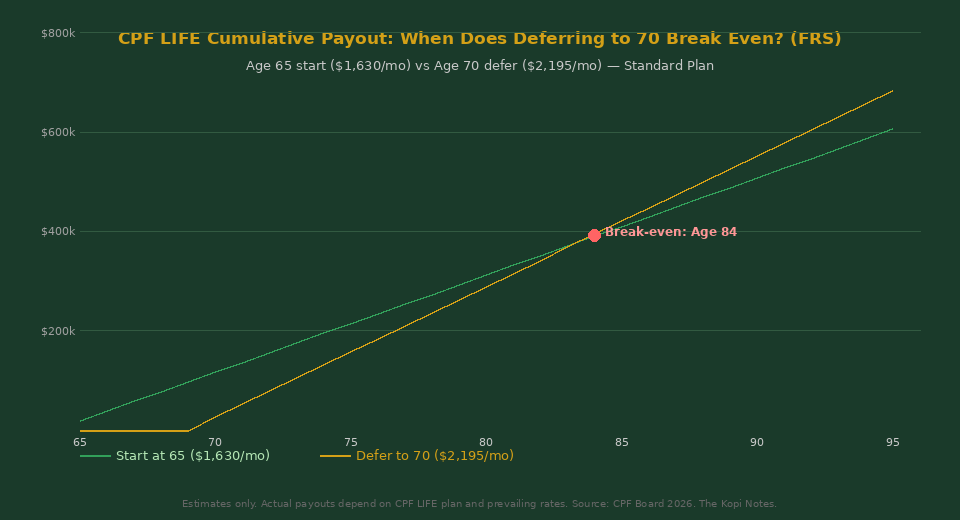
This is the core question. If you start at 65, you receive 5 extra years of payouts before the 70-deferrer catches up. The break-even point is when the total cumulative payout from deferring equals (and then exceeds) the total from starting early.
For FRS Standard Plan (SGD 1,630/mo at 65 vs SGD 2,195/mo at 70):
- By age 70: Start-at-65 group has received 5 years × 12 months × SGD 1,630 = SGD 97,800 total
- The 70-deferrer starts receiving SGD 2,195/mo
- Monthly difference in favour of 70-deferrer: SGD 2,195 − SGD 1,630 = SGD 565/mo more
- Break-even calculation: SGD 97,800 ÷ SGD 565/mo = 173 months = ~14.4 years after age 70 = approximately age 84
If you live past age 84, the 70-deferment strategy delivers more total lifetime income. If you pass away before 84, starting at 65 would have paid out more in total. This is the actuarial core of the decision.
Life expectancy context for Singapore males is ~82.3 years; for females ~86.1 years (Dept. of Statistics, 2024). Women, on average, benefit more from deferring to 70.
Who Should Consider Deferring CPF LIFE to Age 70?
Deferring your CPF LIFE payout to age 70 makes financial sense in specific circumstances:
| Profile | Why Deferring to 70 Works |
|---|---|
| Good health, family longevity | If you expect to live well past 84, higher monthly payouts from 70 mean more lifetime income |
| Still working at 65 | Employment income covers expenses from 65–70; CPF LIFE becomes a top-up you don’t need yet |
| Other retirement income (SRS, dividends, rental) | Can sustain lifestyle 65–70 without CPF LIFE; 4% compound growth on RA gives you “free” upside |
| Spouse is younger / financially dependent | Higher payout from 70 protects the surviving spouse’s income if you outlive them |
Who Should Start CPF LIFE at Age 65?
Starting at 65 is the right default for most Singaporeans — and certainly for those in these situations:
| Profile | Why Starting at 65 Makes Sense |
|---|---|
| Health concerns or chronic illness | Shorter life expectancy means break-even at 84 may never be reached; take the money early |
| No other income at 65 | If CPF LIFE is your primary income, deferring creates a 5-year gap — a serious cash-flow risk |
| BRS / low RA balance | SGD 870/mo from BRS at 65 vs SGD 1,165/mo at 70 — the absolute increase is smaller; less incentive to defer |
| Want certainty and simplicity | If the prospect of waiting stresses you or disrupts your retirement planning, start at 65 and invest the surplus |
You can also start at any age from 65 to 70 — it does not have to be exactly 65 or 70. Each year of deferral adds roughly 6–7% to your monthly payout. Starting at 67 is a valid middle ground.
How to Elect Your CPF LIFE Payout Start Age
CPF Board does not automatically start your payouts at 65. You need to apply. Here is the process:
- Login to my.cpf.gov.sg with your SingPass approximately 6 months before your desired start date
- Navigate to My Retirement → CPF LIFE → Apply for Payout
- Choose your plan (Standard or Basic) and select a start month between age 65 and 70
- Confirm your bank account for GIRO payout — CPF pays directly to your bank on the last working day of each month
- You will receive a CPF LIFE Notice of Award confirming your monthly payout amount
Critical deadline: If you do not apply by age 70, CPF Board will auto-enrol you and start payouts at 70. You cannot defer beyond 70. If you want to start earlier (at 65–69), you must actively apply — silence means deferral until 70.
To plan your retirement income around CPF LIFE payouts, try the Singapore retirement planning calculator to see how CPF LIFE integrates with your overall retirement picture. For growing your CPF OA balance to maximise your RA at 55, read our guide on CPF OA top-up strategies for 2026. If you are building passive income alongside CPF LIFE, explore passive income sources in Singapore for 2026.
For Singaporeans investing beyond CPF, platforms like Endowus (referral code 2V343) and Syfe (referral code SRPRFFFCD) offer CPF-investing features that can complement your CPF LIFE strategy.
Frequently Asked Questions
What happens to my CPF LIFE if I die before receiving my payouts?
If you die before your CPF LIFE payouts cover the amount you put into the scheme, the remaining balance (the “bequest”) is refunded to your nominated beneficiaries or CPF estate. This protects your savings — CPF LIFE is not a “lose it if you die early” scheme. The Basic Plan refunds more of the unused principal; the Standard Plan refunds less but pays a higher monthly payout while alive.
Can I switch from Basic Plan to Standard Plan (or vice versa) after starting payouts?
No. Once your CPF LIFE payouts begin, your plan selection (Basic vs Standard) is locked. This is why the plan choice — made when you apply for payouts — is a permanent decision. Standard Plan gives higher monthly payouts; Basic Plan gives lower payouts but retains more for your estate. Most financial advisers in Singapore recommend the Standard Plan unless you have strong estate-planning reasons for Basic.
How does deferring CPF LIFE affect the 4% interest on my Retirement Account?
Your Retirement Account earns 4% p.a. guaranteed (and the first SGD 30,000 earns 5%) whether you are drawing payouts or not. When you defer payout from 65 to 70, your RA balance keeps compounding at 4% for those 5 extra years. This compounding is exactly why the payout at 70 is 35% higher than at 65 — the actuarial calculation reflects the extra 4% interest earned during the deferral period.
Can I use my SRS funds to top up my CPF LIFE or Retirement Account?
No, SRS (Supplementary Retirement Scheme) funds cannot be used to top up your CPF RA or fund CPF LIFE directly. SRS is a separate scheme invested through banks (DBS, OCBC, UOB). However, both schemes serve a similar retirement purpose and work well together: CPF LIFE provides a guaranteed income floor, while SRS investments (ETFs, unit trusts, bonds) can provide growth and supplementary income. Read our guide on CPF investment strategy to see how they fit together.
What is the CPF LIFE Escalating Plan and should I choose it?
The CPF LIFE Escalating Plan was introduced in 2025. It starts with a lower initial payout (about 20% less than Standard Plan) but increases by 2% per year to keep pace with inflation. It suits people worried about purchasing power erosion over a long retirement. Most Singaporeans still choose the Standard Plan for its higher initial certainty, but if you defer to 70 and live to 90+, the Escalating Plan’s inflation protection could be valuable. Check the CPF Board LIFE Estimator at cpf.gov.sg for a personalised comparison.
What if I have much more than the ERS in my Retirement Account at 55?
As of 2025, the ERS cap (1.5x FRS = SGD 319,500) is the maximum that can remain in your RA for CPF LIFE purposes. Any excess above ERS is automatically transferred to your OA at age 55. The OA earns only 2.5% (vs 4% in RA), so maximising your RA to the ERS and investing OA surplus strategically is the standard playbook for higher-income CPF members.
This article was researched with the help of AI. While we strive to keep all information accurate and up to date, there may be errors. If you notice any discrepancies, please contact us.