LGI-iFAST Trigger Point Investment Strategy: What Singapore Investors Should Know (2026)
A neutral, fact-based explainer of the WAP and TOP plans — how the trigger points work, who manages it, backtested data, fees, and the DIY alternative.
The LGI-iFAST Trigger Point Investment Strategy (LTP) is a rules-based discretionary portfolio service jointly managed by Lion Global Investors (sub-adviser) and iFAST Financial (portfolio execution). It uses quantitative triggers — Price-to-Book ratios for the Wealth Accumulation Plan (WAP) and technical buy/sell targets for the Tactical Opportunities Plan (TOP) — to automate equity allocation decisions. The strategy is available to Singapore investors through iFAST-licensed financial advisers.
This article is for educational purposes only and does not constitute financial advice. All figures are for reference only and do not guarantee future results. Data as at October 2026 unless noted. Past performance, including backtested performance, does not guarantee future results.
Table of Contents
Contents — Click to expand
- What Is the LGI-iFAST Trigger Point Strategy?
- Who Manages It — Lion Global Investors & iFAST Financial
- How the Wealth Accumulation Plan (WAP) Works
- How the Tactical Opportunities Plan (TOP) Works
- WAP vs TOP — Comparison Table
- Portfolio Allocation & Funds Used
- Backtested & Actual Performance Data
- Fees and Minimum Investment
- Who Is This Strategy For?
- How to Access the LTP Strategy
- DIY Alternative — Buy the Underlying Funds Yourself
- Pros and Cons — Honest Assessment
- Frequently Asked Questions
What Is the LGI-iFAST Trigger Point Strategy?
The LGI-iFAST Trigger Point Investment Strategy (commonly shortened to LTP) is a quantitative, rules-based discretionary portfolio management service designed for Singapore investors. Unlike traditional advisory where a financial adviser picks stocks or funds based on personal judgement, the LTP relies on predefined mathematical triggers to decide when to buy, sell, and rebalance.
The strategy is structured around two distinct plans, each with a different investment methodology. The Wealth Accumulation Plan (WAP), launched in January 2024, uses Price-to-Book (P/B) valuation signals to adjust equity exposure. The Tactical Opportunities Plan (TOP), launched in March 2025, uses technical buy and sell targets to capture short-term market opportunities across 44 investment themes.
Both plans remove emotion from the investment process. The triggers are preset — when market conditions hit a specific threshold, the portfolio adjusts automatically. This is the core appeal: you do not need to decide when to buy or sell, because the rules do it for you.
The LTP is distributed exclusively through iFAST-licensed financial advisers in Singapore. It is not available for direct purchase on FSMOne (iFAST’s retail platform), though the underlying funds used in the strategy can be purchased independently there — more on that in the DIY section below.
Who Manages It — Lion Global Investors & iFAST Financial
The LTP involves two Singapore-based financial institutions working in tandem:
Lion Global Investors (LGI) serves as the sub-adviser, responsible for the quantitative strategy design, trigger point calibration, and investment research. LGI is one of Singapore’s largest homegrown asset managers with approximately S$70 billion in assets under advisory (AUA) and 38 years of track record. It is backed by OCBC Bank and Great Eastern Holdings. LGI is regulated by the Monetary Authority of Singapore (MAS).
Meanwhile, iFAST Financial Pte Ltd handles portfolio execution, trade settlement, and custody. iFAST Corporation (SGX: AIY) is a SGX-listed fintech company with approximately S$25 billion in AUA and over 25 years of operating history. iFAST Financial holds a MAS Capital Markets Services (CMS) licence and a Financial Adviser licence, and is registered as a CPFIS intermediary.
This dual-manager structure means that the investment brain (LGI) is separate from the execution and custody infrastructure (iFAST). Both are MAS-regulated, and client assets are held separately from the companies’ own funds — a standard regulatory safeguard in Singapore. Investors looking for context on how iFAST works as an investment platform can refer to our FSMOne referral code page for more on the iFAST ecosystem.
How the Wealth Accumulation Plan (WAP) Works
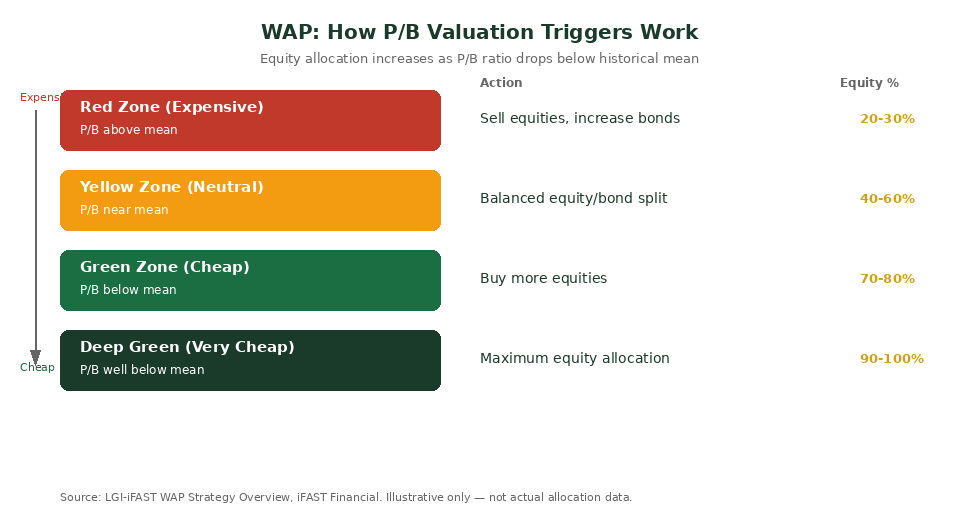
The WAP is the flagship plan of the LTP, and it is built on a concept that most value investors will find intuitive: buy more when markets are cheap, sell when they are expensive. The twist is that WAP automates this process using Price-to-Book (P/B) ratio percentiles as the trigger mechanism.
The P/B Valuation Trigger Explained
Price-to-Book ratio measures a stock market index’s market price relative to the book value (net assets) of its constituent companies. When the P/B ratio is below its historical mean, the market is considered relatively cheap — the WAP responds by increasing equity allocation. When the P/B ratio is above its historical mean, the market is considered expensive — the WAP reduces equity exposure and shifts to fixed income.
The strategy uses 10 trigger percentiles (10th to 100th) to create a graduated allocation scale rather than a simple binary switch. This means the portfolio does not go from 100% equities to 0% overnight. Instead, it gradually adjusts in steps — if the market becomes slightly expensive (say, at the 40th percentile), equities might reduce from 80% to 60%, rather than being sold entirely.
The Four Regional Pockets
WAP operates across 9 portfolios grouped into 4 regional pockets, each tracking a different MSCI index:
| Index Tracked | Primary Exposure | |
|---|---|---|
| America | MSCI World | US equities (dominant) |
| China | MSCI AC Asia Pacific ex-Japan | Greater China & Asia ex-Japan |
| Developed Markets | MSCI World + MSCI Europe | Developed markets incl. Europe |
| Backup | Various | Deploys extra equity at 80th percentile drops |
Source: LGI-iFAST WAP Strategy materials, iFAST Financial, 2026
The Backup pocket is a distinctive feature. It holds reserves that are only deployed when an index drops to the 80th percentile trigger — essentially a “war chest” that adds extra equity exposure during significant market corrections. This means WAP does not just passively rebalance; it actively increases its bet during deep downturns.
For investors building a broader Singapore portfolio alongside a strategy like WAP, tools like the Singapore retirement calculator can help frame how this fits within your overall retirement timeline.
How the Tactical Opportunities Plan (TOP) Works
The TOP takes a fundamentally different approach from WAP. Where WAP is valuation-driven and long-term, TOP is technically driven and opportunistic. It was launched in March 2025 — roughly 14 months after WAP — and targets investors who want exposure to short-to-medium-term tactical plays on top of a core global equity allocation.
Portfolio Structure
TOP runs a single portfolio split into two buckets:
Core Allocation (55%): 33% in World Equities and 22% in Emerging Markets Equities. This portion remains relatively stable and provides the baseline global diversification.
Tactical Allocation (45%): This is where TOP becomes interesting. The 45% tactical sleeve can be invested across 44 distinct investment ideas (39 for SRS accounts) spanning specific countries and sectors. Think: Turkey, Gold, Philippines, Brazil, Malaysia, Thailand, and other themes that are selected based on technical analysis of their price movements.
When no tactical opportunities meet the buy criteria, this 45% sits in fixed income as a holding position — earning some yield while waiting for the next trigger.
How Buy and Sell Targets Work
TOP’s buy targets are calculated by analysing historical market drawdowns. The strategy looks at five historical correction periods for each investment idea to determine what constitutes an attractive entry price. When the price of a sector or country ETF drops to that level, it triggers a buy.
Sell targets are triggered by any one of four conditions:
| Sell Trigger | Description |
|---|---|
| Return to Previous Peak +10% | The investment recovers to its previous high and exceeds it by 10% |
| 100% Profit | The position has doubled from the buy price |
| 7-Year Holding Period | Maximum hold time to prevent capital being locked indefinitely |
| Early Take Profit | Triggered when a better reallocation opportunity arises |
Source: LGI-iFAST TOP Strategy Overview, iFAST Financial, 2026
This structure means TOP is designed to capture mean-reversion opportunities — buying during downturns and selling during recoveries. It is more active than WAP and involves more frequent portfolio adjustments.
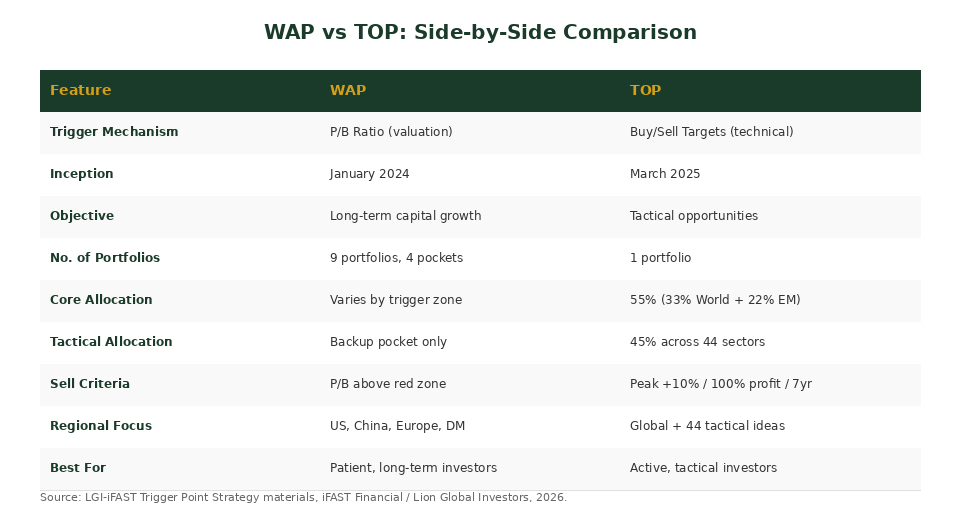
WAP vs TOP — Comparison Table
The two plans serve different investor profiles. Here is a side-by-side comparison to help you evaluate which — if either — suits your investment approach:
Portfolio Allocation & Funds Used
Both WAP and TOP invest primarily in index-tracking unit trust funds available on the iFAST platform. The underlying indices include:
| Index | Used In | Exposure |
|---|---|---|
| MSCI World | WAP (America + DM pockets), TOP (core) | ~1,500 large/mid-cap stocks across 23 developed markets |
| MSCI Europe | WAP (DM pocket) | ~400 European large/mid-cap stocks |
| MSCI AC Asia Pacific ex-Japan | WAP (China pocket) | China, Hong Kong, Korea, India, ASEAN |
| MSCI Emerging Markets | TOP (core) | ~1,400 stocks across 24 emerging markets |
| Various sector/country indices | TOP (tactical sleeve) | 44 investment ideas: Turkey, Gold, Philippines, Brazil, etc. |
Source: LGI-iFAST Strategy materials, iFAST Financial / Lion Global Investors, 2026
When the strategy shifts to defensive mode — i.e., when valuation triggers signal expensive markets (WAP) or no buy targets are met (TOP) — the equity allocation reduces and the proceeds move into fixed income funds (bond funds or money market funds) held on the same iFAST platform.
Backtested & Actual Performance Data
Important disclaimer: The backtested returns below are hypothetical. They were calculated by applying the WAP trigger rules retroactively to historical data (January 2001 to December 2023). The strategy did not actually exist during this period. Backtested results are inherently limited — they do not account for real-world execution costs, slippage, or the impact of actual capital flows. They should be viewed as illustrative of the strategy’s logic, not as a prediction of future performance.
WAP Backtested Returns (January 2001 – December 2023)
| Holding Period | Best Return (p.a.) | Worst Return (p.a.) |
|---|---|---|
| 1 Year | +58.98% | -36.03% |
| 3 Years | +20.81% | -11.83% |
| 5 Years | +17.05% | -3.85% |
| 10 Years | +12.12% | +3.91% |
| 15 Years | +9.80% | +4.68% |
Source: Bloomberg, iFAST Financial. Backtested data, Jan 2001 – Dec 2023. Past performance does not guarantee future results. These are HYPOTHETICAL returns — the strategy did not exist during this period.
A few things stand out from the backtested data. At shorter horizons (1 year), the range is wide — you could see +59% or -36% in any given year. But as the holding period extends, the worst-case scenarios improve materially. At 10 years, even the worst-case backtested return was positive at +3.91% p.a., and at 15 years it was +4.68% p.a. This is consistent with the general principle that time in the market reduces the probability of negative returns, though it does not eliminate risk entirely.
Since WAP only launched in January 2024, it has approximately 2 years of actual track record as at October 2026. For actual performance data, investors should request the latest WAP factsheet directly from their iFAST financial adviser, as official factsheets are not publicly available online.
Fees and Minimum Investment
The LTP is accessed through iFAST’s wrap account structure. Fees are not standardised — they can vary depending on the financial adviser you work with. However, typical fee ranges for iFAST wrap accounts in Singapore are:
| Fee Type | Typical Range | Notes |
|---|---|---|
| Wrap / Advisory Fee | 0.5% – 1.5% p.a. | Paid to FA + iFAST platform; accrues daily, billed quarterly |
| Fund-Level TER | 0.20% – 1.50% p.a. | Depends on underlying funds used; deducted from NAV |
| Sales Charge | 0% – 3% | Upfront fee per transaction; many FAs waive this for wrap accounts |
| CPFIS Wrap Cap | Max 0.40% p.a. | Regulatory cap for CPF-invested funds (effective Oct 2020) |
| Switching Fee | Typically 0% | Rebalancing within the wrap account is usually fee-free |
Source: iFAST Financial Pte Ltd, Dollar Bureau, industry estimates, October 2026. Actual fees vary by financial adviser. Confirm with your FA before investing.
Minimum investment: Minimums also vary by financial adviser, but typically range from S$10,000 to S$50,000 for initial investment, with subsequent top-ups possible at lower thresholds. Some advisers allow SRS funds to be invested through the LTP as well. These are estimates — confirm the exact minimum with your financial adviser.
One important consideration: because the LTP involves both a wrap fee and underlying fund fees, the total cost drag can add up. If your wrap fee is 1% p.a. and the underlying fund TER is 0.5%, you are paying 1.5% annually before any returns. For context, a self-directed investor buying a low-cost global ETF like CSPX or VWRA on the London Stock Exchange would pay approximately 0.07%–0.22% in TER with no wrap fee.
Who Is This Strategy For?
The LTP may suit you if:
You want a rules-based, disciplined investment approach but do not have the time or inclination to monitor markets and rebalance yourself. You are comfortable with a medium-to-long-term horizon (5+ years for WAP, shorter for TOP). You want professional portfolio management without the lock-in periods of investment-linked policies (ILPs). You prefer an approach backed by quantitative triggers over purely discretionary fund-picking by an adviser.
The LTP may not suit you if:
You are a confident DIY investor who already manages your own portfolio through low-cost ETFs or index funds. You are fee-sensitive and want to minimise the total expense ratio on your investments. You want full control over which specific funds or ETFs you hold and when you buy or sell. You have a small portfolio (under S$10,000) where the wrap fee becomes a proportionally larger drag on returns.
Investors who already have a CPF investment strategy in place should also consider how the LTP fits — or does not fit — alongside their existing CPF allocations.
How to Access the LTP Strategy
The LGI-iFAST Trigger Point Strategy is not available for direct purchase. You cannot sign up on FSMOne or any online brokerage to access it. It is distributed exclusively through iFAST-licensed financial advisers — representatives from financial advisory firms (such as Financial Alliance, IPP Financial Advisers, Promiseland, etc.) who use the iFAST platform.
To access the strategy, you would need to engage a financial adviser who offers it. They will open an iFAST wrap account for you, conduct a fact-find and risk assessment, and then onboard you into the WAP, TOP, or both depending on your risk profile and investment objectives.
iFAST Financial and Lion Global Investors periodically run educational seminars about the LTP strategy — both online and at their offices at Ocean Financial Centre in Singapore. These are free to attend and provide a useful opportunity to ask questions before committing.
DIY Alternative — Buy the Underlying Funds Yourself
If you prefer a hands-on approach, you can buy the same underlying index funds that the LTP strategy uses directly through FSMOne (iFAST’s retail platform, referral code: P0544985). The core indices — MSCI World, MSCI Europe, MSCI AC Asia Pacific ex-Japan, and MSCI Emerging Markets — are all available as unit trusts or ETFs on FSMOne.
You can also access these indices through ETFs on the London Stock Exchange (e.g., iShares Core MSCI World UCITS ETF, Vanguard FTSE Developed Europe UCITS ETF) via brokers like Interactive Brokers, Saxo Markets, or moomoo Singapore.
What you gain with DIY: Significantly lower fees — no wrap or advisory fee, just the fund-level TER (as low as 0.07% for CSPX). Full control over when you buy and sell. No minimum investment requirements (beyond the broker’s own minimums).
What you lose with DIY: The automatic trigger-based rebalancing. You would need to monitor P/B ratios yourself, calculate your own trigger percentiles, and execute the trades manually. The behavioural discipline that the rules-based system enforces — many investors struggle to buy during market crashes when the strategy demands it. The tactical sleeve of TOP (with its 44 investment ideas across specific countries and sectors) would be very difficult to replicate independently.
For investors already comfortable with self-directed investing, building a passive income portfolio in Singapore using low-cost index ETFs may be a simpler and more cost-effective path to the same underlying exposures.
Pros and Cons — Honest Assessment
| Pros | Cons |
|---|---|
| Rules-based — removes emotional decision-making from investing | Higher total costs than DIY ETF investing (wrap fee + fund TER) |
| Managed by established Singapore institutions (LGI + iFAST) | Limited actual track record — WAP launched Jan 2024, TOP Mar 2025 |
| Automatic rebalancing without needing to monitor markets | Backtested returns are hypothetical — may not reflect real-world results |
| No lock-in period (unlike ILPs) | Only accessible through financial advisers — not available for direct purchase |
| WAP’s backup pocket adds extra equity during deep corrections | P/B ratio may not capture all forms of market mispricing (growth stocks, tech) |
| Two strategies (WAP + TOP) for different risk profiles | Fees vary by FA — no standardised pricing, requires negotiation |
Assessment by The Kopi Notes, October 2026. This is an editorial opinion, not financial advice.
Disclaimer: This article is for educational and informational purposes only. It does not constitute financial advice, a product recommendation, or an endorsement of the LGI-iFAST Trigger Point Investment Strategy. The Kopi Notes is not affiliated with iFAST Financial or Lion Global Investors. Always consult a licensed financial adviser before making investment decisions. Past performance — including backtested performance — does not guarantee future results.
MAS Disclaimer: This article has not been reviewed by the Monetary Authority of Singapore.
AI Disclosure: This article was researched and drafted with the assistance of AI tools, then reviewed for accuracy. All data was sourced from publicly available materials published by iFAST Financial, Lion Global Investors, and third-party sources as cited.
Frequently Asked Questions
What is the LGI-iFAST Trigger Point Investment Strategy?
The LGI-iFAST Trigger Point Investment Strategy (LTP) is a rules-based discretionary portfolio management service managed jointly by Lion Global Investors (strategy design) and iFAST Financial (execution and custody). It uses quantitative triggers — Price-to-Book ratios for the Wealth Accumulation Plan and technical buy/sell targets for the Tactical Opportunities Plan — to make automated buy, sell, and rebalancing decisions for investors’ portfolios.
How is the LGI-iFAST Trigger Point Strategy different from a robo-adviser?
While both use systematic rules, the LTP is a discretionary portfolio service managed by professional asset managers (Lion Global Investors), not an algorithm-only platform. It uses specific P/B valuation or technical triggers rather than generic risk-profiling. Additionally, the LTP is accessed through a human financial adviser, whereas most robo-advisers in Singapore (like Syfe or Endowus) are direct-to-consumer platforms with lower fees but less tactical flexibility.
Can I invest in the LGI-iFAST Trigger Point Strategy using CPF or SRS?
SRS funds can generally be used for iFAST wrap accounts, including the LTP strategy, subject to your financial adviser confirming eligibility. For CPF-OA funds, the MAS-imposed 0.40% cap on wrap fees applies. Not all funds within the strategy may be CPFIS-approved, so CPF investability depends on the specific fund selection. Confirm with your financial adviser whether your CPF or SRS funds qualify.
What is the minimum investment for the LGI-iFAST Trigger Point Strategy?
Minimum investment amounts vary by financial adviser, but typically range from S$10,000 to S$50,000 for the initial investment. Subsequent top-ups are usually allowed at lower thresholds. There is no single published minimum — it depends on your adviser’s terms and the specific plan (WAP or TOP) you select.
Are the backtested returns of the WAP strategy reliable?
Backtested returns are hypothetical — they were calculated by applying the WAP trigger rules retroactively to historical data from January 2001 to December 2023. The strategy did not actually exist during this period. Backtested results do not account for real execution costs, slippage, or behavioural factors. They are useful for understanding the strategy’s logic and historical context, but should not be treated as a reliable predictor of future performance.
Can I buy the same funds used in the LTP strategy on my own through FSMOne?
Yes. The underlying index funds tracking MSCI World, MSCI Europe, MSCI AC Asia Pacific ex-Japan, and MSCI Emerging Markets are available on FSMOne (iFAST’s retail platform). You can buy them directly with a FSMOne account (referral code: P0544985). However, doing so means you lose the automated trigger-based rebalancing — you would need to monitor P/B ratios and execute trades yourself.
What are the total fees for the LGI-iFAST Trigger Point Strategy?
Total fees include the wrap/advisory fee (typically 0.5%–1.5% p.a.) plus the underlying fund-level TER (0.20%–1.50% p.a.). Sales charges may or may not apply depending on your financial adviser. Rebalancing within the wrap account is usually fee-free. Total all-in costs typically range from 0.7% to 2.5% p.a. depending on the funds used and your adviser’s fee structure.
Is the LGI-iFAST Trigger Point Strategy safe? What are the risks?
The strategy invests in equity and bond markets, which carry inherent market risk. Short-term losses are possible — the backtested data shows a worst-case 1-year return of -36.03%. The P/B ratio trigger mechanism may not capture all forms of market mispricing, particularly in growth-heavy markets where book value is less relevant. Currency risk also applies since the underlying funds are denominated in foreign currencies. However, both iFAST Financial and Lion Global Investors are MAS-regulated, and client assets are held separately from the companies’ own funds.
Prefer to Invest on Your Own?
Buy the underlying MSCI index funds directly through FSMOne and manage your own portfolio.
This article was researched with the help of AI. While we strive to keep all information accurate and up to date, there may be errors. If you notice any discrepancies, please contact us.