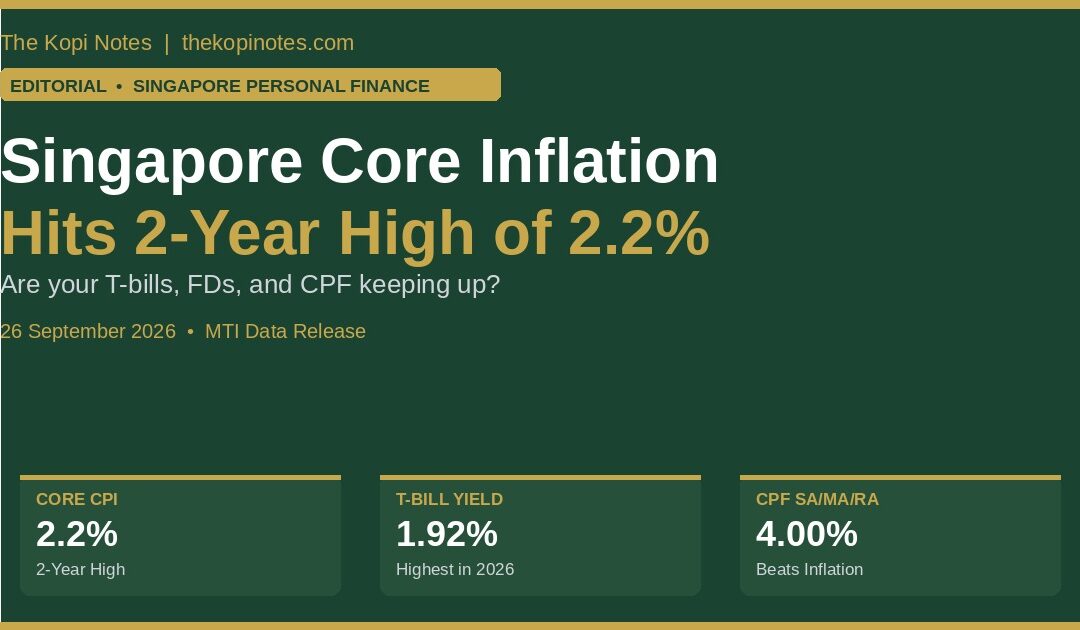
Singapore’s core inflation jumped to 2.2% year-on-year in August 2026, its highest reading in nearly two years, driven by higher costs in services, food, electricity, and retail goods. With the 6-month T-bill yielding 1.92% and the best fixed deposit rates capped at 2.00%, the uncomfortable truth is this: most common savings instruments are now delivering negative real returns for Singapore retail investors. Here’s what the numbers mean and what you should be doing.
This is an editorial analysis. Not financial advice. Data verified as at 26 September 2026.
What Just Happened: Singapore Core Inflation Hits 2.2% in August 2026
On 23 September 2026, the Ministry of Trade and Industry (MTI) and the Monetary Authority of Singapore (MAS) jointly released the Consumer Price Developments report for August 2026. The headline numbers were striking.
MAS Core Inflation — the measure that strips out accommodation costs and private transport to give a cleaner read on underlying price pressures — rose to 2.2% year-on-year, up from 2.0% in July. On a month-on-month basis, core prices climbed 0.3% in August alone.
The broader headline CPI (All Items) came in at 2.3% year-on-year, up from 2.2% in July, and rose 0.6% month-on-month.
This 2.2% core reading is the highest in approximately two years and sits firmly at the top of the government’s 2026 full-year forecast range of 1.5–2.5%. With the Fed having just raised rates for the first time in three years and global supply chains under fresh strain, this uptick is not going away quickly. MAS and MTI have explicitly warned that core inflation is expected to “remain elevated into next year before moderating from around mid-2027.”
What’s Driving Prices Higher?
The August 2026 report identifies four main culprits pushing prices up, each relevant in different ways to Singapore households and investors.
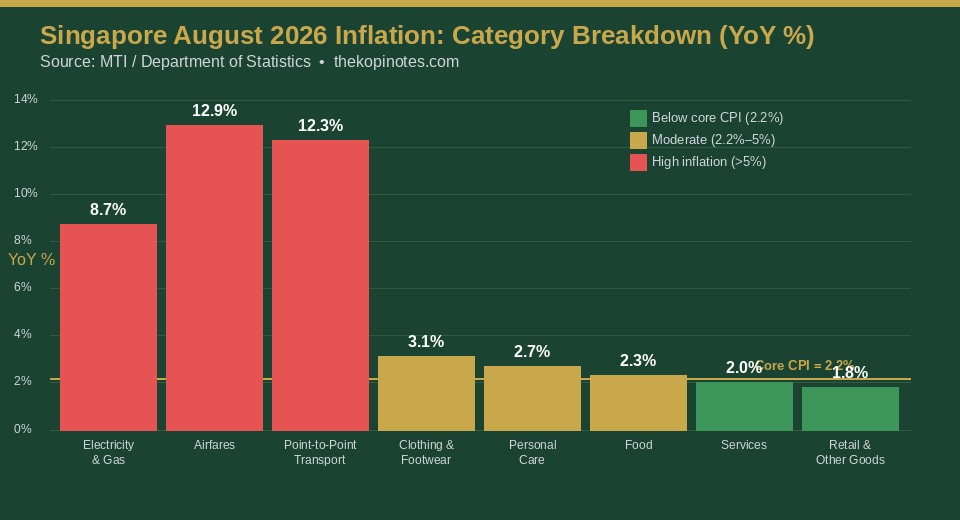
Services inflation (2.0% YoY, up from 1.7%) is driven by food services — restaurant meals, hawker centre food, delivery costs — alongside higher airfares (up a startling 12.9% YoY). Point-to-point transport services such as ride-hailing surged 12.3% YoY, reflecting higher fuel pass-through costs and driver pay adjustments.
Electricity and Gas (8.7% YoY) remains the single largest contributor by magnitude. Electricity tariffs for household consumers were revised upward in July 2026 and those increases are now fully flowing into the CPI basket. Singapore imports virtually all its energy, making this component highly sensitive to global LNG prices.
Food inflation (2.3% YoY, up from 2.2%) is ticking higher, driven by imported food costs. With Singapore sourcing over 90% of its food from abroad, any disruption to regional supply chains — whether from weather events, trade frictions, or currency movements — feeds quickly into the supermarket bill.
Retail and Other Goods (1.8% YoY, up from 1.4%) showed the sharpest acceleration relative to its recent trend. Clothing and footwear prices rose 3.1% YoY and personal care products gained 2.7% YoY, reflecting a blend of imported inflation and resilient domestic consumer demand.
MAS and MTI cautioned that “renewed disruptions in global energy supplies or worse-than-expected weather conditions could raise Singapore’s imported costs by more than anticipated.” With the full-year 2026 range pegged at 1.5–2.5%, there is meaningful risk of a print above 2.5% before year-end if energy prices don’t soften.
The Real Returns Crisis: How Your Savings Stack Up Against 2.2% Inflation
This is the number that should matter most to every Singapore retail investor. When inflation runs at 2.2%, a savings instrument needs to return more than 2.2% just to preserve your purchasing power. Here is how the current landscape looks.
| Savings Instrument | Current Rate | Real Return vs 2.2% Core Inflation | Notes |
|---|---|---|---|
| 6-Month T-Bill (Sep 24 Auction) | 1.92% p.a. | –0.28% | Highest T-bill yield in 2026; still negative real |
| Best FD Rate (6-Month, Citibank) | 2.00% p.a. | –0.20% | Eligible customers only; min. S$5,000 |
| SSB October 2026 (Year 1) | 1.65% p.a. | –0.55% | Very liquid; but worst real return in table |
| SSB October 2026 (10-Year Avg) | 2.32% p.a. | +0.12% | Marginally positive; only if held 10 years |
| CPF Ordinary Account (OA) | 2.50% p.a. | +0.30% | Guaranteed; slim but positive buffer |
| CPF OA (first S$20K, aged <55) | 3.50% p.a.* | +1.30% | *Includes extra 1% government interest |
| CPF Special / MediSave / Retirement | 4.00% p.a. | +1.80% | Floor extended to end-2027; strong real return |
Rates as at 26 September 2026. T-bill yield from MAS Sep 24 auction. FD rates from major bank promotions. CPF rates from CPFB official announcement. Real return = nominal rate minus 2.2% MAS Core CPI.
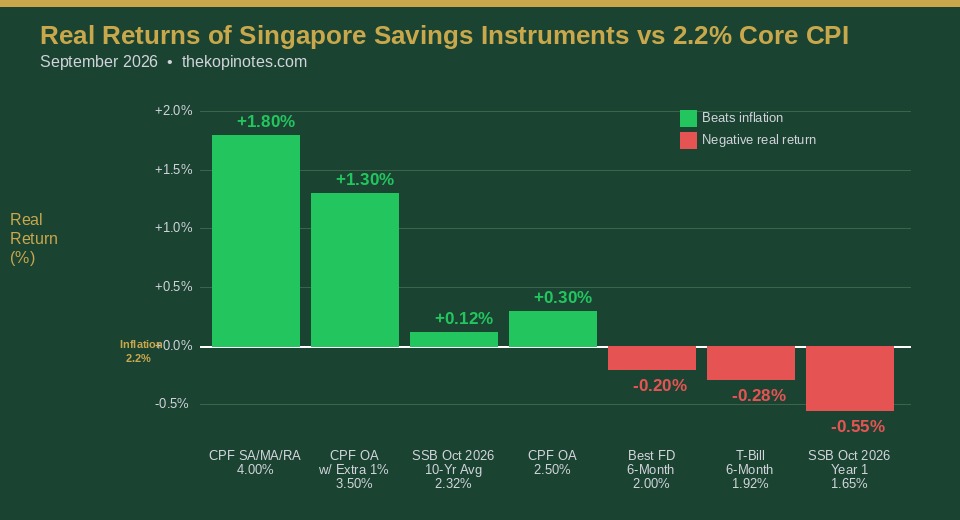
The table tells a stark story. If you parked cash in a T-bill after the September 24 auction — the highest-yielding T-bill of 2026 — you are still losing 0.28 percentage points of purchasing power every year. The best FD rate from a major bank (2.00% from Citibank, for eligible customers) also fails to keep pace. And if you’re holding the SSB in its first year at 1.65%, you’re losing more than half a percentage point in real terms annually.
You can learn more about T-bill mechanics and how to participate in upcoming auctions in our Singapore T-Bill 2026 Complete Guide. For SSB details and the October 2026 issuance, see our SSB October 2026 analysis.
The Winners: Which Accounts Still Beat Inflation?
In an environment of 2.2% core inflation, genuine purchasing power preservation comes from only a handful of sources available to the typical Singapore retail investor.
CPF Special, MediSave and Retirement Accounts at 4.0% p.a. are the clearest winners, offering a real return of approximately 1.8 percentage points above current core inflation. Critically, this 4% floor has been extended by the government to the end of 2027, providing a locked-in, government-guaranteed edge over every bank product on the market right now. For details on what CPF Q4 2026 rates mean for your retirement planning, see our CPF Interest Rates Q4 2026 guide. You can also model your exact returns using our CPF Interest Calculator.
CPF Ordinary Account for younger members is more nuanced. The base rate of 2.50% gives a slim positive real return of 0.30%. But members aged below 55 who keep their first S$20,000 in CPF OA (capped) receive an additional 1% interest from the government, boosting the effective OA yield on that tranche to 3.50% — a 1.30% real return. For those aged 55 and above, the extra 2% on the first S$30,000 combined balance pushes it even higher.
SSB held to a full 10-year term offers a 2.32% average annual return on the October 2026 issuance — technically beating 2.2% inflation by 0.12 percentage points. However, this marginal positive real return assumes inflation averages exactly 2.2% for the full decade, which is a bold assumption given the MAS projection of elevated inflation extending into 2027 and beyond.
For investors seeking equity-based inflation hedges, the picture is more complex. Singapore bank stocks — DBS, OCBC, and UOB — have posted record highs in 2026 as rate expectations shifted, but they now face the dual headwind of compressed net interest margins (if rates eventually fall) and potential credit quality deterioration if the economy slows. We covered this dynamic in detail in our Singapore Bank Stocks after the Fed Rate Hike analysis.
How Does Rising Inflation Affect S-REITs and the STI?
For REIT investors, the 2.2% core inflation print is a double-edged development. On one hand, REITs holding retail or industrial properties may benefit if rental reversions track inflation, partially insulating distributions. On the other hand, the key risk driver for S-REITs in the current environment is not inflation itself, but the interaction between inflation and interest rates.
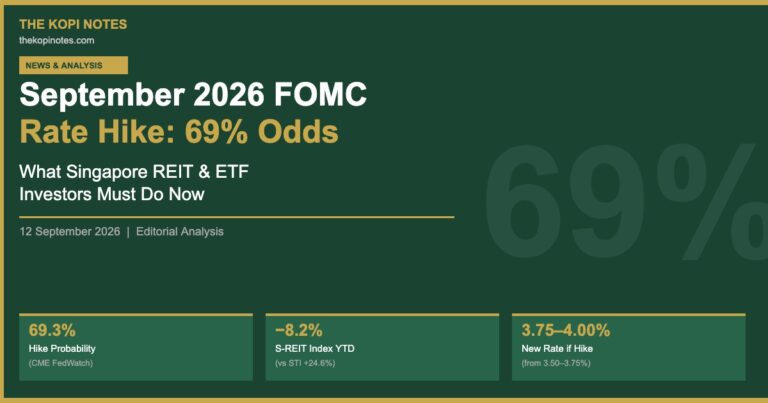
With the Fed having hiked rates for the first time in three years in September 2026, S-REITs face higher refinancing costs on existing debt and a less attractive yield spread versus the risk-free rate. The FTSE ST REIT index is down approximately 8.2% in 2026, reflecting this repricing. For investors considering whether current REIT prices represent value, our full S-REIT Outlook 2026 analysis covers yield spreads, gearing levels, and our top picks.
The broader STI, by contrast, has outperformed, hitting record highs above 5,800 in September 2026 driven by the banking heavyweights. This divergence — banks up, REITs down — reflects the market’s view that higher rates hurt leveraged property vehicles more than they help asset-light financial businesses. This is relevant context for any investor trying to determine whether the current rotation makes sense for their portfolio.
MAS/MTI Outlook: When Does Inflation Moderate?
The most important forward-looking signal from the August 2026 CPI release is the phrase buried in the joint MAS-MTI statement: core inflation is expected to “remain elevated into next year before moderating from around mid-2027.”
This means Singapore investors should not expect a swift return to sub-2% core inflation. At a minimum, the 2.2% reading may persist through Q4 2026 and much of H1 2027, before global energy price normalisation and easing demand pressures pull it lower. The official 2026 forecast range of 1.5–2.5% for both core and headline inflation is broad enough to accommodate further upside surprises without requiring a policy response.
MAS manages Singapore’s monetary policy through the SGD exchange rate rather than interest rates, and the statement did not signal any shift to the slope, band, or centre of the Singapore Dollar Nominal Effective Exchange Rate (S$NEER) policy band. This means Singaporeans cannot rely on currency appreciation to reduce imported inflation meaningfully in the near term.
For practical planning purposes, retail investors should assume that negative real returns on T-bills and FDs are the baseline scenario through at least H1 2027, not a temporary blip.
Bottom Line for SG Investors
Singapore’s core inflation at 2.2% has redrawn the personal finance landscape in a way that many retail investors have not yet fully priced into their cash management decisions. The key takeaways are:
- Most bank products now give negative real returns. T-bills at 1.92%, FDs at up to 2.00%, and SSB Year 1 at 1.65% all fail to keep pace with 2.2% core inflation. These instruments are still valuable for liquidity and capital preservation, but do not confuse “low risk” with “preserving purchasing power.”
- CPF is your best guaranteed inflation hedge right now. The SA/MA/RA at 4% and OA with extra interest at 3.5% (on the first S$20K) are the only mainstream, government-backed options delivering meaningfully positive real returns. For long-term retirement money, the case for maximising CPF contributions has strengthened with each 0.1% rise in inflation.
- For investable assets beyond cash, diversification matters more than ever. With returns on cash instruments compressed by inflation and S-REITs under pressure from rising rates, the case for a balanced portfolio across equities, dividend-paying blue chips, and CPF is more compelling than a heavy cash position.
- Reassess any lazy FD ladder or SSB holding. If you set up a fixed deposit ladder or SSB holding when inflation was 1.5% or below, your real returns have just turned negative. This is the time to review whether rolling those funds is still the right strategy.
Inflation at 2.2% is not catastrophic by global standards. But in Singapore’s historically low-inflation context, it materially changes the calculation for every cash management decision — from emergency fund placement to CPF top-up timing. The investors who recognise this shift now will be better positioned than those who notice it only when they look at their bank statement six months from now.
Frequently Asked Questions
What is Singapore’s core inflation rate in August 2026?
Singapore’s MAS Core Inflation rose to 2.2% year-on-year in August 2026, up from 2.0% in July. This is the highest reading in approximately two years. Headline CPI (All Items) came in at 2.3% YoY. The data was released by the Ministry of Trade and Industry (MTI) and MAS on 23 September 2026.
What is driving Singapore’s higher inflation in 2026?
The key drivers in August 2026 are: (1) Electricity and Gas costs up 8.7% YoY following higher tariffs from July; (2) Services inflation at 2.0% YoY, driven by airfares (+12.9%), ride-hailing (+12.3%), and food services; (3) Food at 2.3% YoY; and (4) Retail and Other Goods rising 1.8% YoY from higher clothing and personal care prices.
Are Singapore T-bills and fixed deposits keeping up with inflation?
No. The most recent 6-month T-bill yielded 1.92% (September 24, 2026 auction), while the best FD rate is 2.00% (Citibank, eligible customers). Both are below the 2.2% core inflation rate, meaning they deliver negative real returns. Your money is technically losing purchasing power even in these “safe” instruments.
Which savings accounts in Singapore actually beat inflation right now?
Currently, CPF accounts offer the strongest inflation-beating returns. CPF Special, MediSave, and Retirement Accounts earn 4.0% p.a. (floor extended to end-2027) — a real return of approximately +1.8% above the 2.2% core CPI. CPF OA earns 2.5% (base) and up to 3.5% for the first S$20,000 for members below 55 with the extra government interest. The SSB October 2026 10-year average of 2.32% marginally beats inflation if held to term.
Will Singapore inflation stay high in 2027?
MAS and MTI have projected that core inflation will “remain elevated into next year before moderating from around mid-2027.” The full-year 2026 forecast for both core and headline inflation is 1.5–2.5%. There are upside risks from global energy disruptions and weather events that could push prints above 2.5% before conditions stabilise. Investors should plan for continued above-2% inflation through at least H1 2027.
What should Singapore retail investors do given 2.2% inflation?
Key action steps: (1) Maximise CPF voluntary top-ups to SA/RA which earn 4% — the only mainstream guaranteed option with meaningful positive real returns; (2) Do not over-allocate to T-bills or SSBs as your primary “savings” vehicle if beating inflation is a goal; (3) Consider whether your emergency fund (typically 6 months of expenses) earns enough to justify the negative real return, or if CPF OA top-ups make sense for the portion you won’t need urgently; (4) Review S-REIT exposure carefully given the higher-for-longer rate environment. This is not financial advice — consult a licensed financial adviser for personalised guidance.
This article was researched with the help of AI. While we strive to keep all information accurate and up to date, there may be errors. If you notice any discrepancies, please contact us.