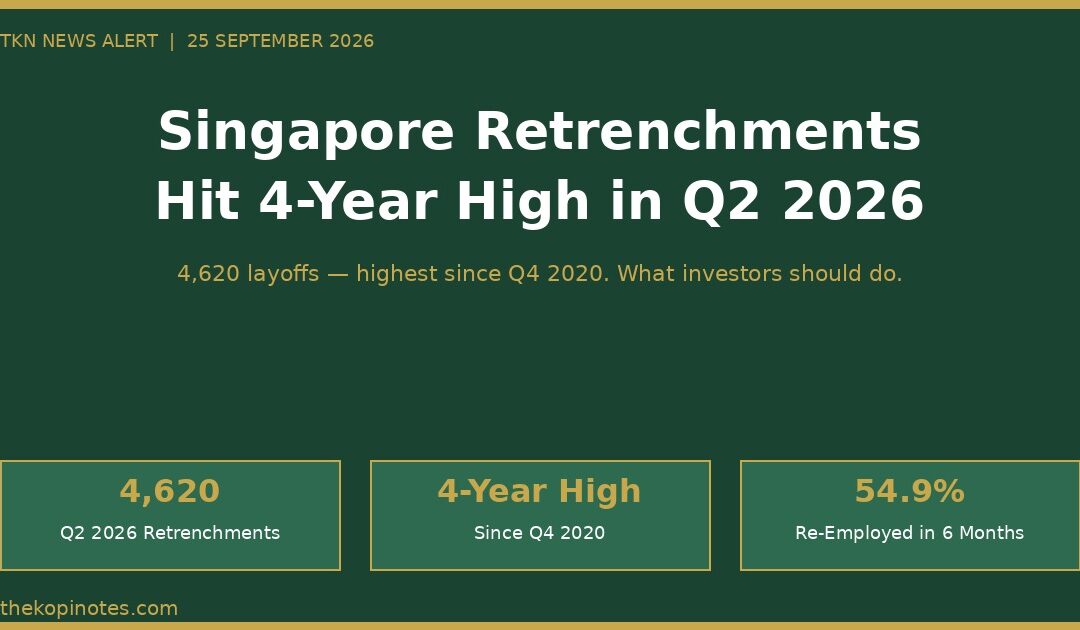
Singapore’s retrenchment numbers surged to 4,620 in Q2 2026 — a four-year high not seen since the COVID-19 disruptions of 2020. Driven by business restructuring in Manufacturing, Information & Communications and Financial Services, the spike signals a labour market under pressure even as GDP expands at 5.9%. Here’s what the numbers mean for your job and your portfolio.
Disclosure: This article is for informational and educational purposes only and does not constitute financial or career advice. Statistics are sourced from the Ministry of Manpower (MOM) Labour Market Report Q2 2026, published 21 September 2026. Readers should consult qualified professionals before making investment or career decisions.
Retrenchments Jump to 4,620 in Q2 2026
Singapore’s labour market delivered a jarring headline in September 2026: retrenchments climbed from 3,830 in Q1 2026 to 4,620 in Q2 2026 — the highest quarterly figure since Q4 2020, when COVID-19 was still disrupting the economy. The retrenchment incidence also rose, from 1.6 retrenched per 1,000 employees in Q1 to 2.0 per 1,000 in Q2.
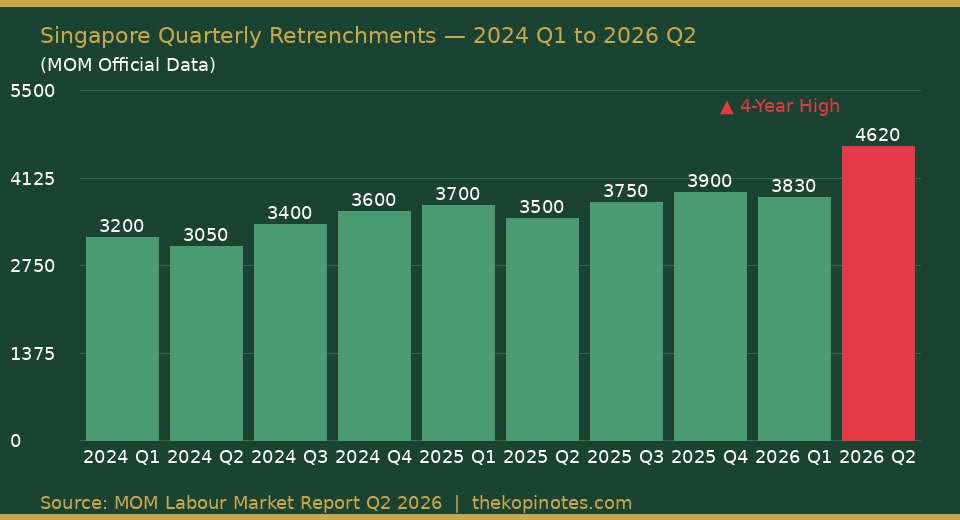
The increase was concentrated in outward-oriented sectors — those most exposed to global trade and external demand. Manufacturing saw layoffs tied to slowing export orders, while Information & Communications firms restructured amid a cooling tech cycle. Financial Services, grappling with leaner deal flows and tighter global credit conditions, also contributed significantly to the quarterly spike.
It is important to note that the broader labour market remains resilient: total employment still grew by 11,400 in Q2 2026 — the nineteenth consecutive quarter of positive employment growth. The overall unemployment rate held steady at 1.9%, with resident unemployment at 2.9% and citizen unemployment at 3.0%. Job vacancies remained elevated at 68,600 in June 2026, translating to 1.48 vacancies per unemployed person. So while retrenchments are rising, the economy is not shedding jobs in aggregate.
Re-Employment Rate Drops — But the 12-Month Picture Holds
Beyond the headline retrenchment number, a more nuanced concern emerged in Q2 2026: the six-month re-employment rate fell from 60.7% in Q1 2026 to 54.9% in Q2 2026. This means that of all retrenched residents, just over half found new employment within six months of losing their jobs — a meaningful drop from the previous quarter.
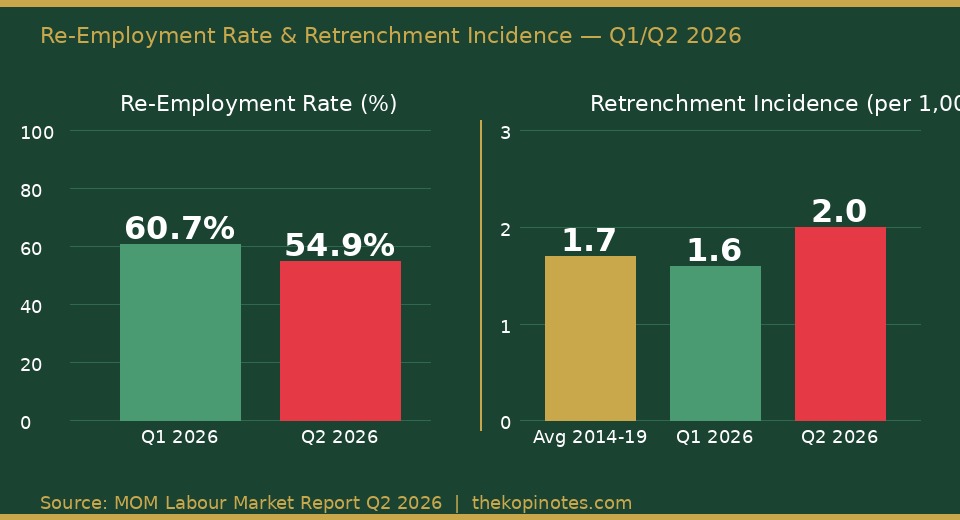
The silver lining: MOM’s data shows the 12-month re-entry rate remained broadly stable, rising slightly from 69.4% to 69.8%. This suggests that retrenched workers are finding jobs eventually — just taking longer to do so. MOM’s interpretation is that workers are “taking longer to secure new employment,” not that the labour market has permanently deteriorated.
For individuals affected by retrenchment, that extra time matters enormously. If you’re worried about your own financial runway, make sure your Singapore T-bill holdings and liquid savings can cover at least 6–12 months of expenses — and consider whether your emergency fund is keeping pace with Singapore’s current interest rate environment.
Key Q2 2026 Labour Market Statistics at a Glance
| Indicator | Q1 2026 | Q2 2026 | Change |
|---|---|---|---|
| Total Retrenchments | 3,830 | 4,620 | ▲ 20.6% |
| Retrenchment Incidence (per 1,000) | 1.6 | 2.0 | ▲ 25.0% |
| 6-Month Re-Employment Rate | 60.7% | 54.9% | ▼ 5.8pp |
| 12-Month Re-Employment Rate | 69.4% | 69.8% | ▲ 0.4pp |
| Overall Unemployment Rate (Jun) | 1.8% | 1.9% | ▲ 0.1pp |
| Resident Unemployment Rate (Jun) | 2.8% | 2.9% | ▲ 0.1pp |
| Job Vacancies (Jun) | 73,300 | 68,600 | ▼ 6.4% |
| Vacancies per Unemployed Person | 1.46 | 1.48 | ▲ 0.02 |
| GDP Growth (YoY) | 6.3% | 5.9% | ▼ 0.4pp |
Sources: MOM Labour Market Report Q2 2026; MTI Economic Survey of Singapore Q2 2026.
Which Sectors Are Most Exposed?
MOM’s Q2 2026 report specifically called out three outward-oriented sectors driving the retrenchment wave:
Manufacturing — Export-oriented manufacturers felt the pinch of moderating global demand. With the global semiconductor and electronics cycle still finding its footing, Singapore’s manufacturing PMI has been signalling contraction territory. Workers in precision engineering, electronics assembly and chemicals are most at risk.
Information & Communications — The global tech correction has extended to Singapore. Several multinational technology firms have announced Asia-Pacific restructurings in 2026, with Singapore operations bearing a share of those job cuts. The reduction in PMET vacancies in Financial Services and ICT noted by MOM reflects this cooling.
Financial Services — This one is closely tied to global interest rate dynamics. With the US Fed resuming rate hikes, deal flow across investment banking, private equity and wealth management has slowed. Singapore, as a major financial hub, is not immune. That said, the local bank stocks (DBS, OCBC, UOB) are net beneficiaries of higher rates through widened net interest margins.
Government Support: What’s Available for Retrenched Workers
If you or someone you know has been retrenched, Singapore’s support ecosystem is broad. Here are the key programmes:
SkillsFuture Jobseeker Support — Eligible involuntarily unemployed individuals can receive up to $6,000 in financial support over six months while actively job-seeking. This is a critical safety net for residents who find themselves in the 45.1% who haven’t re-entered employment within six months.
Career Health SG — Provides career coaching, job matching, and guidance services through the Skills and Workforce Development Agency (SWDA) and NTUC’s Employment and Employability Institute (e2i). SkillsFuture Credit can also offset course fees for approved training programmes.
Mid-Career Pathways Programme and Career Conversion Programmes — For those needing to pivot industries, these employer-supported programmes facilitate structured transitions into new roles. The SkillsFuture Level-Up Programme provides enhanced course fee subsidies and training allowances specifically for mid-career Singaporeans.
GRaduate Industry Traineeships (GRIT) — Aimed at 2026 fresh graduates who face a tighter job market, GRIT offers an alternative entry point with structured industry exposure. Applications are open via MyCareersFuture and Careers@Gov.
For investors following the S-REIT market, it’s worth noting that higher retrenchment rates historically correlate with softer commercial real estate demand — something to factor into your REIT thesis for 2026. However, the still-tight vacancy ratio (1.48 jobs per unemployed) means office space demand isn’t collapsing.
What Does This Mean for Your CPF and Savings?
A retrenchment immediately interrupts CPF contributions — both from the employer and the employee. For residents who lose their jobs, CPF interest rates for Q4 2026 still apply on existing balances, but the forced pause on contributions can set back your retirement planning meaningfully if the job search extends beyond 6 months.
Practically, this is a reminder to:
- Keep 6–12 months of expenses in liquid, high-yield instruments (Singapore T-bills are yielding competitively post-rate-hike)
- Avoid over-concentrating your portfolio in sectors facing restructuring — ICT and Financial Services equities warrant a re-evaluation in this environment
- Review your voluntary CPF top-up strategy if your income is at risk — front-loading contributions earlier in the year provides a buffer
Bottom Line for SG Investors
1. The headline is bad, but the underlying labour market is not broken. 4,620 retrenchments is the highest in four years, but employment is still growing and there are 1.48 jobs per unemployed person. Singapore is not in a labour market crisis — it is in a period of adjustment.
2. Sector selection matters more than ever. ICT, Manufacturing and Financial Services are under pressure. Domestic-oriented sectors — Transport & Storage, Healthcare, Public Administration — are holding up. This bifurcation should inform your equity and REIT positioning.
3. The 6-month re-employment dip is a planning signal, not a panic signal. At 54.9%, the majority of retrenched residents still find employment within six months. But the drop from 60.7% means your personal emergency fund and SkillsFuture readiness need to be in order before a restructuring catches you off-guard.
4. Watch the outlook data, not just the rearview mirror. MOM’s July 2026 business polls show 48.7% of firms intend to hire in the next three months — up from 43.9% in June. If this hiring intention converts to actual placements in Q3 2026, retrenchment numbers may stabilise. The full Labour Market Report Q2 2026 is available at stats.mom.gov.sg.
Frequently Asked Questions
How many workers were retrenched in Q2 2026 in Singapore?
According to MOM’s Labour Market Report Q2 2026, 4,620 workers were retrenched in Q2 2026 (April to June 2026). This is up from 3,830 in Q1 2026, representing a 20.6% quarter-on-quarter increase and the highest quarterly retrenchment figure since Q4 2020.
What does “retrenchment incidence of 2.0 per 1,000” mean?
The retrenchment incidence measures the number of workers retrenched per 1,000 employees. An incidence of 2.0 in Q2 2026 means for every 1,000 people employed in Singapore, approximately 2 were retrenched during that quarter. This is up from 1.6 per 1,000 in Q1 2026 and above the pre-COVID long-run average of about 1.7 per 1,000 (2014–2019 average).
Which industries had the most retrenchments in Q2 2026?
MOM identified Manufacturing, Information & Communications, and Financial Services as the primary sectors driving Q2 2026 retrenchments. These are outward-oriented sectors most exposed to global demand fluctuations. The retrenchments were largely attributed to business reorganisation and restructuring.
What proportion of retrenched workers found new jobs within 6 months?
In Q2 2026, 54.9% of retrenched residents re-entered employment within 6 months of their retrenchment. This fell from 60.7% in Q1 2026. However, the 12-month re-entry rate was broadly stable at 69.8% (vs 69.4% in Q1), suggesting that while it takes longer, most workers do eventually find new employment.
What government support is available for retrenched workers in Singapore?
Retrenched workers in Singapore can access: (1) SkillsFuture Jobseeker Support — up to $6,000 over 6 months for involuntarily unemployed residents; (2) Career Health SG coaching and job matching via SWDA and e2i; (3) SkillsFuture Credit for approved training courses; (4) Career Conversion Programmes for industry pivots; and (5) SkillsFuture Level-Up Programme for mid-career workers.
Is Singapore’s unemployment rate rising because of the Q2 2026 retrenchments?
Not significantly. Despite elevated retrenchments, Singapore’s overall unemployment rate remained low at 1.9% in June 2026 (resident: 2.9%, citizen: 3.0%). Job vacancies stood at 68,600 with 1.48 vacancies per unemployed person — meaning the labour market remains relatively tight. The resident long-term unemployment rate edged up slightly to 1.0% from 0.9%, but this is still historically low.
Should investors be worried about Singapore bank stocks given the retrenchment data?
Retrenchments are typically a lagging indicator, and Singapore banks (DBS, OCBC, UOB) have historically managed credit quality through moderate downturns well. The current cycle’s retrenchments are concentrated in specific sectors, not system-wide. Additionally, with the Fed rate hike environment, Singapore banks continue to benefit from wider net interest margins, which partially offsets any deterioration in loan quality from retrenched borrowers.
This article was researched with the help of AI. While we strive to keep all information accurate and up to date, there may be errors. If you notice any discrepancies, please contact us.