How to Invest in Singapore for Beginners: Step-by-Step Guide (2026)
The complete starter guide — platforms, tax strategies, and your first investment
📋 Table of Contents
- Why Singapore is Great for Investing
- Step 1: Set Your Financial Goals
- Step 2: Build Your Emergency Fund
- Step 3: Understand Your Investment Options
- Step 4: Choose the Right Platform
- Step 5: Use SRS & CPF Tax Advantages
- Step 6: Start Investing with DCA
- Step 7: Monitor & Rebalance
- Common Beginner Mistakes
- Frequently Asked Questions
To invest in Singapore, you need three things: a brokerage account, a clear strategy, and as little as S$100 to get started. Most beginners go wrong by trying to time the market or picking individual stocks. The simplest, most tax-efficient approach is to invest regularly into a low-cost global index ETF — like CSPX or VWRA on the London Stock Exchange — through a platform like IBKR, Syfe, or Endowus. Singapore also has 0% capital gains tax, making it one of the best places in the world to build wealth.
Not financial advice. All figures are for educational reference only. Data verified as at 25 September 2026 unless noted.
- Singapore has 0% capital gains tax — your profits from ETFs and stocks are entirely tax-free
- The easiest beginner approach: invest monthly into a low-cost index ETF (VWRA or CSPX) via dollar-cost averaging
- Use SRS to cut your income tax bill by up to S$3,366/year, and consider CPF-OA investing for guaranteed 2.5% returns
Why Singapore is Actually Great for Investing
Let’s start with the good news. Singapore is one of the most investor-friendly countries in the world. Here’s why that matters for you:
- 0% capital gains tax. Your profits from selling stocks or ETFs go entirely into your pocket — not the taxman’s.
- 0% dividend withholding tax on Singapore-listed assets. Dividends from S-REITs and SGX-listed stocks aren’t taxed at source.
- CPF and SRS. Two government-backed schemes that let you invest and reduce your income tax at the same time — a combination most countries don’t offer.
- Easy access to global markets. You can buy UCITS ETFs on the London Stock Exchange (like CSPX and VWRA) in GBP, avoiding US estate tax exposure that hits US-domiciled ETFs above USD 60,000.
Many Singaporeans don’t realise how good they have it compared to investors in the US, UK, or Australia. Take full advantage of every one of these structural benefits.
Step 1: Set Your Financial Goals
Before you invest a single dollar, you need to know what you’re investing for. Your goal determines your time horizon. Your time horizon determines how much risk you can afford. Here’s a quick framework:
| Goal | Time Horizon | Suggested Approach |
|---|---|---|
| Build retirement wealth | 20–40 years | Global index ETFs (VWRA / CSPX) |
| Save for a home | 3–7 years | T-bills + SSBs + some equity ETFs |
| Generate passive income | 10+ years | S-REITs + dividend ETFs |
| Children’s education fund | 10–18 years | Index ETFs via SRS or regular brokerage |
Source: TKN editorial framework, September 2026
Be specific. “I want to retire at 62 with S$1.2 million” is more useful than “I want to grow my money.” A concrete goal keeps you invested during market dips — because you can see exactly what you’re working towards.
Step 2: Build Your Emergency Fund First
This is the step most beginners skip — and then regret. You need 3 to 6 months of living expenses in cash or near-cash before you invest anything in the stock market.
Here’s why. Markets can fall 30–50% during recessions. If you invest all your savings and then lose your job, you’ll be forced to sell your investments at the worst possible time — locking in permanent losses. An emergency fund prevents that.
Where to park your emergency fund in Singapore right now:
- High-yield savings accounts — OCBC 360, UOB One, DBS Multiplier (2–3% p.a. with bonus conditions)
- Singapore Savings Bonds (SSBs) — ~2.25% average yield over 10 years, redeemable any month with no penalty. See our Singapore Savings Bonds guide for step-by-step instructions.
- T-bills (6-month tenor) — ~1.70% p.a., near risk-free, auctioned fortnightly. Full walkthrough in our Singapore T-bills 2026 guide.
Think of your emergency fund as the shock absorber that lets your investments grow undisturbed. Without it, every market dip becomes a personal financial crisis.
Step 3: Understand Your Investment Options
Singapore beginners have more choices than they realise. Here’s a plain-language breakdown of the main asset classes and what makes each relevant for you:
| Asset Class | What It Is | Risk | Tax-Efficient in SG? |
|---|---|---|---|
| Global Index ETFs (CSPX / VWRA) | Basket of global stocks via LSE | Medium–High | ✅ 0% capital gains |
| Singapore REITs (S-REITs) | SG-listed property trusts | Medium | ✅ 0% dividend WHT |
| Singapore Savings Bonds | Government bonds, step-up interest | Very Low | ✅ Interest tax-free |
| T-bills (6-month) | Short-term government debt | Very Low | ✅ Interest tax-free |
| CPF-OA | Government-guaranteed savings | Zero | ✅ 2.5% p.a. guaranteed |
| Unit Trusts / Active Funds | Actively managed fund portfolios | Medium | ⚠️ Yes, but high fees |
Source: MAS, CPF Board, SGX — September 2026
For most beginners, the starting playbook is simple: put your emergency fund in SSBs or T-bills, then start buying a global index ETF for your long-term wealth. Add the SRS layer once you’re comfortable — it’s the tax advantage most Singaporeans never use.
If you’re interested in building passive income Singapore-style, S-REITs paired with a global ETF is a classic combination.
Step 4: Choose the Right Investment Platform
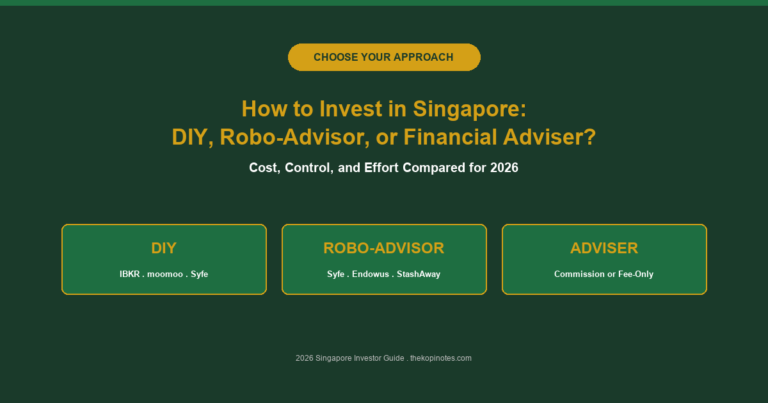
Your platform choice depends on one question: how hands-on do you want to be?
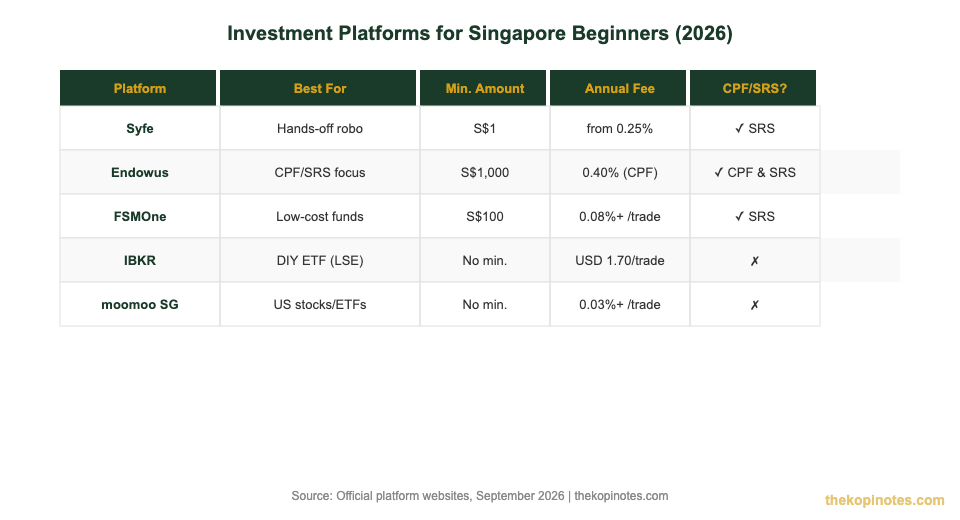
Option A — Robo-advisors (hands-off, beginner-friendly):
- Syfe — fees from 0.25% p.a., minimum S$1, SRS-eligible. Portfolios built around low-cost ETFs. Use our Syfe referral code and sign-up bonus (code: SRPRFFFCD) for a cash reward when you sign up.
- Endowus — 0.40% p.a. for CPF/SRS investing, minimum S$1,000. The best option if you want to invest your CPF-OA savings. Use our Endowus referral code (2V343) for a fee waiver on your first S$10,000.
Option B — DIY platforms (lower fees, more control):
- IBKR (Interactive Brokers) — USD 1.70/trade for LSE-listed ETFs like CSPX and VWRA. No account minimum. Best for larger lump-sum purchases where the fixed fee is small relative to your trade size. Use referral code jianxiong368 when signing up.
- FSMOne — 0.08% per trade with a Regular Savings Plan (RSP) from S$50/month. Good for investors who want automated monthly investing in unit trusts and ETFs. Use FSMOne referral code P0544985.
Step 5: Use Singapore’s Tax Advantages — SRS and CPF
This step separates smart Singapore investors from the rest. Two government schemes can legally reduce your tax bill while growing your wealth. Most beginners never use them.
The Supplementary Retirement Scheme (SRS)
SRS lets you contribute pre-tax income, reducing your taxable income dollar-for-dollar. Your money is then invested and grows tax-free until you withdraw it at or after your statutory retirement age (currently 63).
Key numbers you need to know:
- Annual contribution cap (Singaporeans/PRs): S$15,300
- Tax relief: Full deduction up to the S$80,000 personal income tax relief cap
- Withdrawal: Only 50% of withdrawals are taxable — and you spread them over 10 years at a low rate
- Investment options: Stocks, ETFs, unit trusts, insurance products via approved SRS banks (DBS, OCBC, UOB)
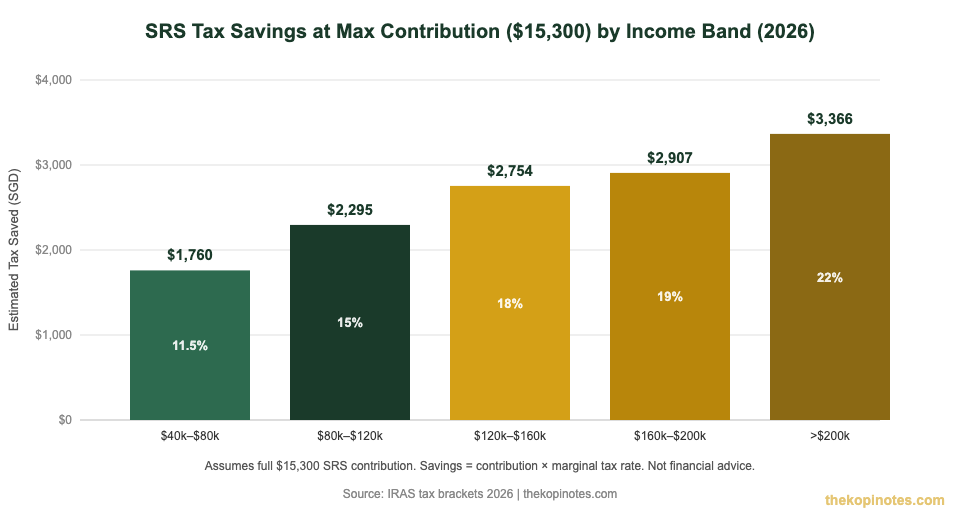
The maths is compelling. If you’re in the 15% tax bracket and contribute the full S$15,300, you save S$2,295 in taxes this year — money that would otherwise go to IRAS. See the chart below for how much you save at each income band.
CPF Ordinary Account (CPF-OA) Investing
Your CPF-OA earns a guaranteed 2.5% p.a. Your CPF-SA earns 4% p.a. — with the 4% floor extended by the government through 31 December 2026.
You can invest CPF-OA savings above your housing needs via the CPF Investment Scheme (CPFIS). But here’s the honest trade-off: any investment via CPFIS must beat 2.5% after fees to justify the switch. That’s why most experts only recommend CPFIS for low-cost index funds.
Endowus is the only robo-advisor in Singapore that lets you invest both CPF-OA and CPF-SA funds. Their portfolios use institutional-class unit trusts with expense ratios as low as 0.15%. For a deep dive, see our guide on CPF investment strategy.
Step 6: Start Investing with Dollar-Cost Averaging
Dollar-cost averaging (DCA) means investing a fixed amount at regular intervals — for example, S$300 every month — regardless of whether markets are up or down. It’s the most beginner-friendly strategy in the world, and it works.
Why DCA works better than trying to time the market:
- You remove emotion. You buy more units when prices are low and fewer when they’re high — automatically.
- You don’t need to predict anything. No professional can consistently call market tops and bottoms. Neither can you. DCA makes this irrelevant.
- It builds a habit. Monthly investing becomes as automatic as paying a utility bill.
A simple DCA setup for a Singapore beginner:
- Set up a monthly standing instruction from your bank to your Syfe / Endowus / FSMOne account
- On the same date each month, your investment is executed automatically
- Review your portfolio quarterly, not daily — set a calendar reminder and close the app in between
For a full breakdown of DCA strategies, contribution amounts, and platform setups, see our dedicated guide: Dollar-Cost Averaging (DCA) Complete Guide 2026.
Step 7: Monitor, Rebalance, and Resist Panic
Investing is a long game. The biggest risk for beginners isn’t market volatility — it’s making emotional decisions during volatility.
Do this:
- Review your portfolio once per quarter — pick a date (e.g. first Saturday of January, April, July, October)
- Rebalance once a year if your asset mix has drifted more than 10 percentage points from your target
- Treat market dips as sale prices — if you were going to buy VWRA at S$120, you should be even more excited to buy it at S$95
- Increase your monthly DCA when you get a salary increment — even S$50 more per month compounds significantly over 20 years
Don’t do this:
- Check your portfolio daily — it increases anxiety without adding value
- Sell during a downturn — you crystallise a paper loss into a real, permanent one
- Chase last year’s top-performing asset — by the time retail investors pile in, the rally is usually over
- Compare your returns to friends — everyone has different goals, timelines, and risk tolerance
Want to know how much you need for retirement? Use our Singapore retirement calculator to set a concrete target and work backwards to your monthly investment amount.
6 Common Beginner Investing Mistakes in Singapore
Most beginners make at least one of these. Knowing them in advance saves you years of frustration.
- Investing before building an emergency fund. Markets can drop 30–50% in a recession. Without a cash buffer, you’re forced to sell at the worst time. Build your emergency fund first — no exceptions.
- Picking individual stocks too early. Stock-picking requires deep research and diversification across many positions. A single global index ETF like VWRA gives you exposure to 3,500+ companies in one trade. Start there.
- Ignoring ongoing fees. A 1.5% annual fee vs 0.07% (CSPX’s expense ratio) on a S$100,000 portfolio over 20 years costs you over S$200,000 in lost compounding. Fee drag is silent but devastating.
- Trying to time the market. Studies consistently show that time in the market beats timing the market for retail investors. Missing just the 10 best trading days in a decade can halve your returns.
- Skipping SRS contributions. If your marginal tax rate is above 11.5%, you’re leaving thousands of dollars on the table every year. SRS is the single most underused tax tool for Singapore investors.
- Keeping short-term savings in a 0.05% account. With T-bills at ~1.70% and SSBs at ~2.25%, there’s no excuse to let your emergency fund earn next to nothing. Opportunity cost compounds too.
Our full guide on Singapore REIT ETF guide covers how to add S-REITs to your beginner portfolio for income diversification.
Frequently Asked Questions
How much money do I need to start investing in Singapore?
You can start with as little as S$1 with robo-advisors like Syfe. FSMOne’s Regular Savings Plan starts at S$50/month. For self-directed ETF investing via IBKR, there’s no minimum account balance — you just need enough to cover one trade (typically S$500–S$2,000 for a meaningful LSE ETF purchase). Most financial planners suggest having at least 3 months of emergency savings before you invest anything.
Is it safe to invest in Singapore as a beginner?
Investing always carries risk — the value of your investments can go down as well as up. However, Singapore has a strong regulatory framework through MAS (Monetary Authority of Singapore), and platforms like Syfe, Endowus, and IBKR are MAS-regulated. The safest approach for beginners is to diversify through a global index ETF rather than individual stocks, invest consistently via DCA, and maintain a cash emergency fund so you don’t need to sell during downturns.
What's the best investment for beginners in Singapore?
For most beginners, a global index ETF like VWRA (Vanguard FTSE All-World, LSE) or CSPX (iShares Core S&P 500, LSE) is the best starting point. Both are low-cost (TER 0.22% and 0.07% respectively), broadly diversified, and accessible via platforms like IBKR, Syfe, or FSMOne. The LSE listing avoids US estate tax exposure on holdings above USD 60,000.
How does SRS work for investing in Singapore?
SRS (Supplementary Retirement Scheme) is a voluntary tax scheme where you deposit pre-tax money into an SRS account (at DBS, OCBC, or UOB) and invest it in eligible securities including ETFs, stocks, and unit trusts. Your contribution reduces your taxable income by the same amount — up to S$15,300/year for Singaporeans and PRs. Your investments grow tax-free. At withdrawal (at or after statutory retirement age of 63), only 50% of the withdrawal is taxable. It’s one of the most powerful, underused tax tools available to Singapore residents.
Should I use a robo-advisor or manage my own investments?
It depends on your knowledge, interest, and portfolio size. Robo-advisors (Syfe, Endowus, StashAway) handle everything for you — they’re ideal for beginners who don’t want to think about portfolio construction, rebalancing, or platform mechanics. The trade-off is a higher ongoing fee (0.25%–0.60% p.a.). DIY investing via IBKR costs a flat USD 1.70 per LSE ETF trade — much cheaper at scale, but requires you to make your own investment decisions and handle rebalancing manually. Many investors start with a robo-advisor and shift to DIY as their confidence grows.
Can foreigners invest in Singapore?
Yes — foreigners on EP, SP, or DP passes can open brokerage accounts and invest in most Singapore and international markets. One key benefit foreigners can access is the SRS scheme (contribution cap S$35,700/year for foreigners vs S$15,300 for Singaporeans/PRs). Foreigners cannot access CPF contributions unless they are Singapore PRs or citizens. LSE-listed ETFs like CSPX and VWRA are fully accessible regardless of nationality.
This article was researched with the help of AI. While we strive to keep all information accurate and up to date, there may be errors. If you notice any discrepancies, please contact us.