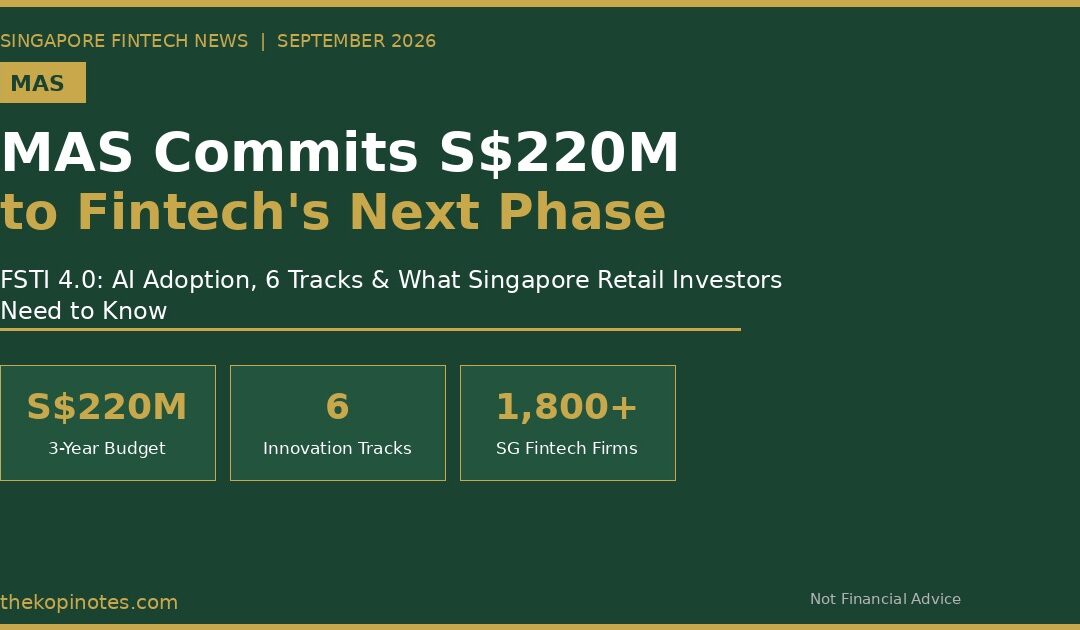
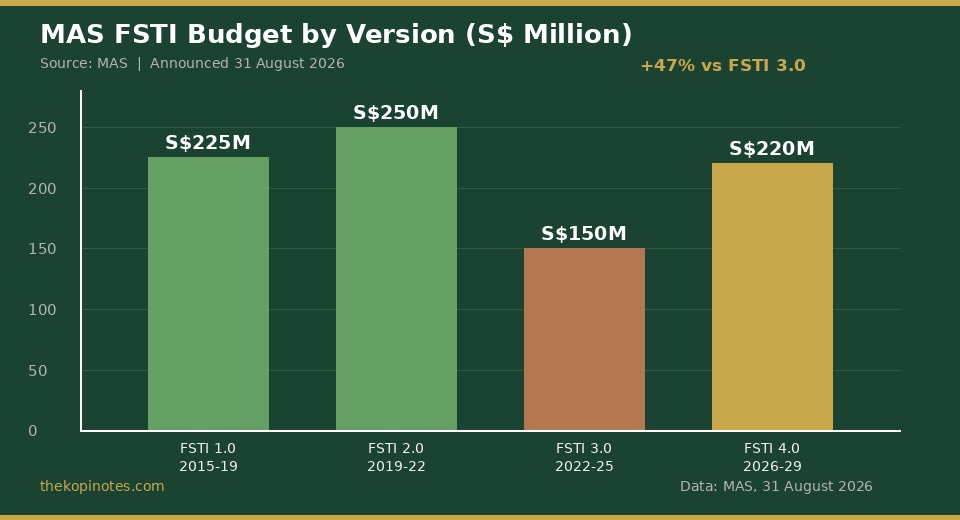
Singapore’s central bank, the Monetary Authority of Singapore (MAS), committed S$220 million on 31 August 2026 to its fourth Financial Sector Technology and Innovation Scheme (FSTI 4.0) — a 47% increase from FSTI 3.0’s S$150 million budget. The three-year programme funds six tracks ranging from AI adoption to talent development, and signals where Singapore’s financial sector is heading. Here’s what it means for you as a retail investor or personal finance reader.
This is an editorial analysis. Not financial advice. Data verified as at 20 September 2026.
What Is FSTI 4.0 and Why Does It Matter?
The Financial Sector Technology and Innovation (FSTI) Scheme is MAS’s primary tool for co-funding technology development in Singapore’s financial sector. Since its launch in 2015 under FSTI 1.0, the scheme has catalysed digital transformation across banks, insurers, asset managers, and fintech startups alike.
FSTI 4.0, running from 2026 to 2029, is the biggest upgrade yet. The S$220 million commitment reflects Singapore’s strategic intent to remain Asia’s leading financial hub as AI and frontier technologies reshape global finance. MAS Deputy Managing Director Leong Sing Chiong said the scheme will “anchor and scale innovation activities in Singapore” and “accelerate the development, adoption, and deployment of financial technologies.”
For retail investors, FSTI 4.0 matters for three reasons. First, it means the digital banking and fintech products you use — GXS, MariBank, Trust Bank, and others — will continue improving, with better yields, smarter features, and lower costs. Second, it creates a tailwind for Singapore-listed financial institutions (DBS, OCBC, UOB) that are scaling AI investments. Third, it positions Singapore’s fintech sector — now home to more than 1,800 firms employing close to 10,000 professionals — as a growth story with long-term structural support.
The Six Tracks Explained
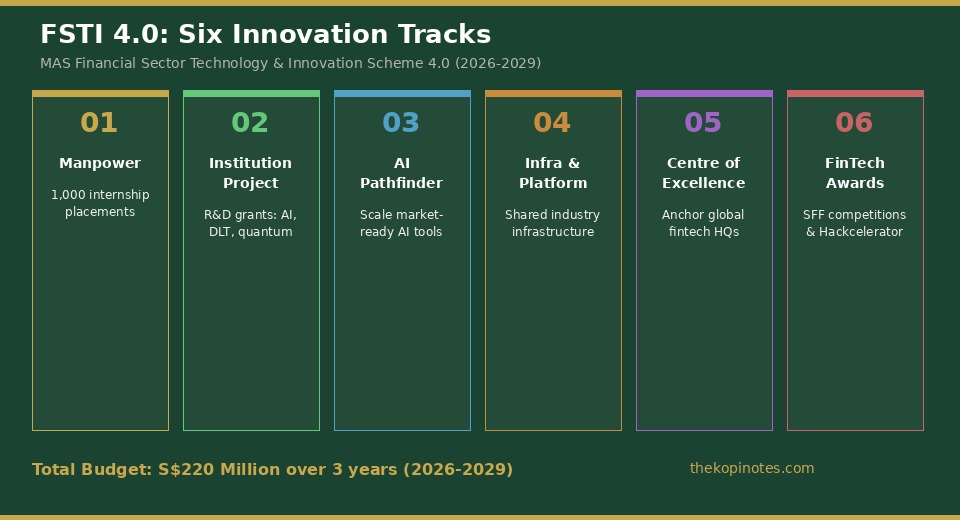
FSTI 4.0 is structured around six operational tracks, each targeting a different layer of the fintech ecosystem:
1. Manpower Track
MAS co-funds internship stipends for students from Institutes of Higher Learning (IHLs), aiming to support at least 1,000 fintech internship placements over the three-year duration. This is Singapore’s talent pipeline play — building the next generation of fintech professionals who will eventually power the products consumers and investors use daily.
2. Institution Project Track
Grants are available to Singapore-based financial institutions and fintech firms developing and deploying solutions in frontier areas including AI, distributed ledger technology (DLT), and quantum computing. This is the main engine for product innovation — banks and fintechs apply for co-funding to build new tools, platforms, and services.
3. AI Pathfinder Track
The newest addition under FSTI 4.0, this track specifically targets the scaling and adoption of market-ready AI solutions across the sector. Unlike the Institution Project Track (which funds development), the AI Pathfinder Track focuses on helping firms deploy AI at scale. Think AI-powered credit scoring, robo-advisory enhancements, and real-time fraud detection — improvements that benefit consumers directly.
4. Infrastructure and Platform Track
This track supports industry-wide shared infrastructure designed to improve efficiency and reduce costs across the sector. Shared payment rails, data exchange platforms, and API frameworks fall under this category. When banks and fintechs share infrastructure costs, savings can be passed on to consumers through better rates and lower fees.
5. Centre of Excellence Track
This track aims to anchor “innovative functions” of global financial institutions and fintech firms in Singapore, bringing together specialised talent and expertise in emerging technologies including AI, quantum computing, and digital assets. Essentially, Singapore wants to be the HQ — not just the regional office — for frontier financial innovation.
6. MAS FinTech Awards Track
This track references the Singapore FinTech Festival’s prestigious FinTech Excellence Awards and the Global FinTech Hackcelerator (GFH), which crowdsource solutions to financial sector problems. The GFH alone has delivered more than 50 solutions deployed commercially in Singapore and across the region since 2016.
FSTI Scheme Comparison: 1.0 to 4.0
| Version | Period | Budget | Key Focus |
|---|---|---|---|
| FSTI 1.0 | 2015–2019 | S$225 million | Digitisation, FinTech ecosystem building |
| FSTI 2.0 | 2019–2022 | S$250 million | Cloud, API, regtech adoption |
| FSTI 3.0 | 2023–2026 | S$150 million | Post-pandemic recovery, green fintech, quantum |
| FSTI 4.0 | 2026–2029 | S$220 million | AI, quantum computing, digital assets, talent |
The SAFR Whitepaper: MAS Gets Ahead of AI Agents in Finance
Alongside FSTI 4.0, MAS and industry partners published a landmark white paper in July 2026: “Safeguards for Agentic Finance at Runtime” (SAFR). This addresses one of the most important emerging risks in financial services — autonomous AI agents that can take actions on your behalf, such as rebalancing your investment portfolio, paying bills, or executing trades.
The SAFR framework proposes a set of governance checkpoints that verify and record an AI agent’s proposed actions before execution. In plain English: before an AI agent moves your money or makes a financial decision for you, there must be a system in place to check that the action is authorised, appropriate, and logged for accountability.
The paper was developed under MAS’s BuildFin.ai initiative — a collaborative effort bringing together financial institutions, technology providers, and research institutes. Participating organisations include major banks, global tech firms, and Singapore-based fintechs.
For retail investors, the SAFR framework matters because it sets the ground rules for how AI-powered financial tools will operate safely. As robo-advisors, AI-driven CPF investment tools, and autonomous wealth management platforms become mainstream, frameworks like SAFR ensure your money isn’t exposed to unchecked algorithmic decisions.
It’s also worth noting that SAFR is not yet regulatory guidance — it’s an industry framework. But MAS has a track record of turning industry frameworks into formal regulations (as seen with digital banking licences, stablecoin regulations, and open banking APIs). Expect SAFR to become more formal in 2027–2028.
For more on Singapore’s digital bank landscape, see our complete guide to Singapore’s digital banks, and for the latest on MAS’s regulatory stance toward crypto and digital assets, read our MAS stablecoin regulations explainer.
What FSTI 4.0 Means for Singapore Retail Investors
MAS policy announcements can feel abstract, but FSTI 4.0 will have concrete effects on products and services that retail investors in Singapore use every day. Here’s how each track is likely to affect your personal finance:
Better Digital Banking Products
The Institution Project Track funds banks and fintechs to develop new AI-powered tools. Expect smarter savings features, personalised investment recommendations, and better in-app financial planning tools from Trust Bank, GXS, MariBank, and the three local banks. OCBC is already investing more than S$1 billion annually in AI infrastructure and technology and plans to hire 600 additional relationship managers to complement its AI-native platform.
More Competitive Financial Products
The Infrastructure and Platform Track funds shared infrastructure. When banks and fintechs share backend costs, competitive pressure increases and consumers benefit through better savings rates, lower transaction fees, and more efficient FX conversions. This is especially relevant for investors who use platforms like FSMOne, Interactive Brokers, or Tiger Brokers for their SGX and global ETF investments.
Singapore Banks as AI Beneficiaries
DBS, OCBC, and UOB are direct beneficiaries of FSTI 4.0 through the Institution Project and AI Pathfinder tracks. DBS has already embedded AI across its wealth management, SME lending, and treasury operations. In the first half of 2026, all three banks outperformed the STI, with OCBC leading at a 28.2% total return. The FSTI 4.0 tailwind should support continued AI investment momentum into 2027–2028. For a deep dive into the big three, see our Singapore banks outlook for Q4 2026.
A Stronger Fintech Ecosystem = More Investment Options
Singapore’s fintech ecosystem now has 3,955 active startups (24.4% growth year-over-year) and 19 unicorns. FSTI 4.0’s Centre of Excellence track will attract more global fintech firms to anchor operations in Singapore. This creates a richer ecosystem of financial products, more IPO candidates on SGX, and a broader range of investment platforms for retail investors. For investors who prefer broad market exposure, the best investments in Singapore for 2026 guide covers all major asset classes.
Singapore FinTech Festival 2026: What to Watch
The Singapore FinTech Festival (SFF) 2026 will take place from 18 to 20 November 2026 at the Singapore EXPO Convention and Exhibition Centre. It is the world’s largest fintech festival, drawing delegates from over 100 countries.
Key themes to watch at SFF 2026 include:
Agentic Finance: Following the SAFR whitepaper, expect major announcements around AI agents that can autonomously manage financial tasks — from rebalancing investment portfolios to processing claims. MAS is likely to launch public consultation on SAFR-related guidelines at or around SFF 2026.
Digital Assets and Tokenisation: MAS has been piloting Project Guardian (tokenised financial assets) and Project Mariana (wholesale CBDC). SFF 2026 will likely feature updates on commercial deployments of tokenised bonds, funds, and settlement infrastructure.
Quantum Computing in Finance: The Centre of Excellence track specifically mentions quantum computing. Expect the first public demonstrations of quantum-safe encryption for financial data — a critical issue as quantum computers threaten current cryptographic standards.
Global Fintech Hackcelerator (GFH) Winners: The 2026 GFH problem statements centred around sustainable finance, AI risk management, and retail investor protection. The winners, announced at SFF, will demonstrate the next generation of tools that could make it into your banking app within 12–18 months.
For retail investors, SFF 2026 is worth monitoring — not to attend, but to track product announcements from Singapore’s major financial institutions. What gets showcased on November 18–20 often reaches consumers in 2027.
Should You Invest in Singapore Fintech Exposure?
FSTI 4.0 is a positive structural catalyst, but it doesn’t mean you should rush to buy fintech stocks. Most Singapore-listed pure-play fintechs are not publicly traded, so the cleanest way to gain exposure is through:
Singapore bank stocks (DBS, OCBC, UOB): All three banks are significant beneficiaries of AI adoption and the broader fintech ecosystem. They are direct FSTI 4.0 grant applicants and already investing billions in technology. The STI’s 58.3% weighting in financials means any STI ETF already provides this exposure. For a rate-sensitive analysis, our banks post-rate-hike guide covers what to expect in Q4 2026.
Technology-tilted ETFs: The semiconductor ETF guide covers AI infrastructure plays available to Singapore investors. Globally, AI beneficiaries like NVIDIA, Microsoft, and Alphabet are accessible through CSPX (S&P 500 ETF) or IWDA (global developed market ETF).
The New Q50 ETF (SGX: Q50): The newly listed CGS Fullgoal Singapore Next 50 Active ETF includes significant REIT and mid-cap SGX exposure. Real estate and REITs make up 39.4% of the Next 50 Index — less directly linked to fintech, but the broader SGX ecosystem benefits from a stronger fintech hub that attracts more global capital to Singapore.
What to Avoid: Be cautious of unlisted “fintech” investment schemes or platforms that claim to be beneficiaries of FSTI 4.0 without verifiable MAS licensing. Singapore’s digital bank licence framework is strict — only MAS-licensed entities are eligible for FSTI grants, and the MAS FinTech Regulatory Sandbox requires rigorous approval. Always check the MAS Financial Institutions Directory before investing in any financial product.
Bottom Line for SG Investors
MAS’s S$220 million FSTI 4.0 commitment is the largest fintech policy signal of 2026. The 47% budget increase from FSTI 3.0 tells you that Singapore is doubling down on AI and frontier tech as the next structural wave in finance — not pulling back.
For retail investors, the immediate implications are subtle but compounding: better digital banking products, smarter investment tools, more competitive financial services, and Singapore-listed banks with strong AI momentum heading into 2027. The SAFR framework adds a layer of consumer protection as AI agents become more powerful and autonomous.
The Singapore FinTech Festival on November 18–20 will be the next major catalyst. Watch for product announcements from DBS, OCBC, UOB, and Singapore’s digital banks — these often signal where your banking experience and investment options are headed next year.
As always, the best way for most Singapore retail investors to capture this trend is through low-cost, diversified exposure — a STI ETF for Singapore bank exposure, and a broad global ETF like VWRA or CSPX for international tech and AI exposure. For more on building a resilient Singapore investment portfolio, read our best investments in Singapore 2026 guide and our bond ETF guide for balancing your portfolio in a higher-rate environment.
Frequently Asked Questions
What is the MAS FSTI 4.0 scheme?
FSTI 4.0 (Financial Sector Technology and Innovation Scheme 4.0) is a three-year, S$220 million programme by the Monetary Authority of Singapore (MAS) to co-fund technology development, AI adoption, talent development, and infrastructure projects in Singapore’s financial sector. It was announced on 31 August 2026 and runs from 2026 to 2029.
How much is the FSTI 4.0 budget and who benefits?
The FSTI 4.0 budget is S$220 million over three years — a 47% increase from FSTI 3.0’s S$150 million. Beneficiaries include Singapore-based financial institutions (banks, insurers, asset managers), fintech firms, and students from Institutes of Higher Learning who secure fintech internship placements.
What are the six tracks under FSTI 4.0?
The six tracks are: (1) Manpower — internship grants; (2) Institution Project — R&D co-funding for AI, DLT, quantum; (3) AI Pathfinder — scaling market-ready AI solutions; (4) Infrastructure and Platform — shared industry infrastructure; (5) Centre of Excellence — anchoring global fintech HQs in Singapore; and (6) MAS FinTech Awards — supporting the Singapore FinTech Festival’s competitions.
What is the SAFR framework and why does it matter?
SAFR (Safeguards for Agentic Finance at Runtime) is an industry white paper published by MAS in July 2026 setting governance checkpoints for AI agents in financial services. It matters because as AI tools become able to autonomously manage your investments, pay bills, or execute trades, SAFR ensures these actions are verified, logged, and auditable — protecting consumers from unchecked AI decisions.
How does FSTI 4.0 affect Singapore retail investors directly?
While FSTI 4.0 doesn’t pay you directly, its effects flow through better digital banking products, smarter investment tools from DBS/OCBC/UOB and digital banks (GXS, MariBank, Trust Bank), more competitive financial product pricing, and a stronger ecosystem of fintech platforms that offer better investment access for retail investors.
When is the Singapore FinTech Festival 2026?
The Singapore FinTech Festival (SFF) 2026 is scheduled for 18 to 20 November 2026 at Singapore EXPO. It is the world’s largest fintech festival. Key themes in 2026 include agentic AI in finance, digital assets, tokenisation, and quantum computing in financial services.
Should I invest in Singapore fintech stocks because of FSTI 4.0?
FSTI 4.0 is a positive structural catalyst for Singapore’s financial sector, but most pure-play Singapore fintechs are not publicly listed. The best way for retail investors to benefit is through STI ETFs (which have ~58% weighting in Singapore banks) and global ETFs like CSPX or VWRA for international AI/tech exposure. Always invest based on your financial goals and risk tolerance, not policy announcements alone.
This article was researched with the help of AI. While we strive to keep all information accurate and up to date, there may be errors. If you notice any discrepancies, please contact us.