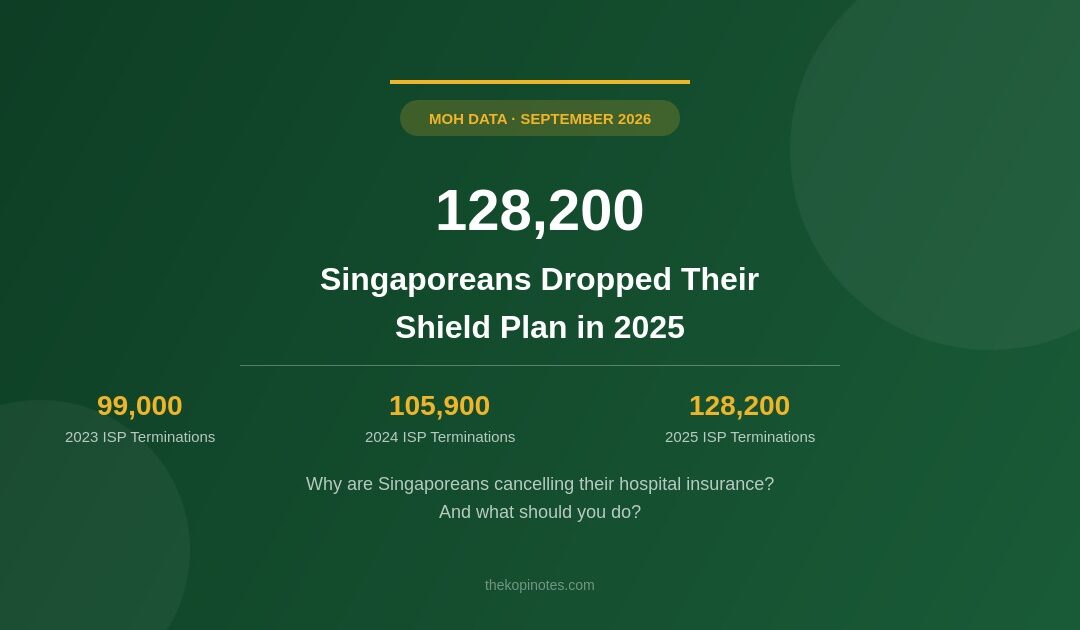
MOH Data · September 2026
128,000 Singaporeans Dropped Their Shield Plan in 2025 — What the MOH Data Tells Us
A parliamentary question answered on 9 September 2026 reveals a sharp rise in Integrated Shield Plan cancellations. Here is what the numbers mean — and what you should do.
This article is for general information only and is not financial or insurance advice. Please consult a licensed financial adviser before making changes to your insurance coverage. Data verified as at 18 September 2026.
What the MOH Data Shows
On 9 September 2026, a parliamentary question tabled by Mr Saktiandi Supaat (MP for Bishan-Toa Payoh GRC) asked the Ministry of Health whether it tracks the number of policyholders who have downgraded or discontinued their Integrated Shield Plans (ISPs) due to affordability concerns — and what trends have been observed over the past three years.
The response from MOH was sobering. As ISP and IP rider premiums continue to rise, many policyholders have downgraded or discontinued their plans, and the numbers have increased over the past three years.
Annual ISP and Rider Downgrades and Discontinuations (CY 2023 to 2025)
| Category | 2023 | 2024 | 2025 | Change (2023–2025) |
|---|---|---|---|---|
| ISP (Hospital Plan) | 99,000 | 105,900 | 128,200 | +29.5% |
| ISP Riders | 84,800 | 103,400 | 181,800 | +114.4% |
Source: MOH Parliamentary QA, 9 September 2026 (Notice Paper No. 1117, Question No. 1773)
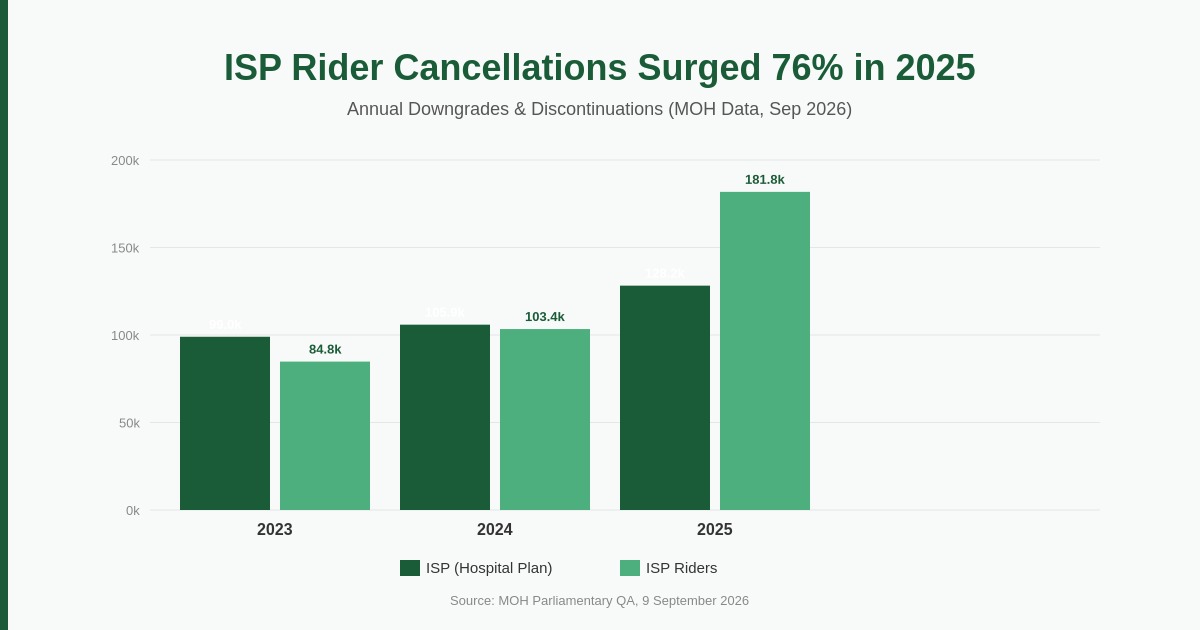
Two trends stand out immediately:
- ISP hospital plan terminations rose 29.5% from 99,000 in 2023 to 128,200 in 2025 — a steady climb driven by rising premiums making coverage unaffordable for some households.
- ISP rider cancellations more than doubled, surging from 84,800 to 181,800 — a 114% jump over two years, with a particularly sharp spike in 2025.
MOH noted it does not track the specific reasons policyholders choose to downgrade or discontinue. However, it acknowledged that “affordability concerns” are among the likely drivers, along with policyholders choosing to “right-size coverage based on their needs and circumstances.”
Why ISP Rider Cancellations Surged 76% in 2025
The most striking figure is the jump in rider cancellations in 2025 — from 103,400 in 2024 to 181,800 in 2025, a 76% increase in a single year. This is not simply an affordability story. It is largely the result of the April 2026 ISP rider policy changes implemented by MOH.
What Changed From 1 April 2026
Effective 1 April 2026, MOH implemented new rules for ISP riders sold from that date onwards:
- New riders can no longer cover the minimum IP deductible — previously, policyholders with comprehensive riders paid $0 out of pocket for most hospital bills. Under the new rules, policyholders must absorb the deductible themselves.
- The co-payment cap was raised to $6,000 per year (up from $3,000). This applies to all co-payments above the minimum deductible.
- Premiums for new riders are about 30% lower on average compared to existing legacy comprehensive riders, reflecting the reduced coverage.
Because of these changes, many policyholders who held existing legacy riders (purchased before 1 April 2026) faced a decision point ahead of the rule change: keep the old, more comprehensive rider (which retained its original terms) or switch to a new, cheaper but less protective rider.
Many chose to cancel their legacy rider altogether — particularly those who were already considering a downgrade due to rising premiums. The April 2026 deadline created a mass rationalization event, which explains why 2025 saw such a dramatic spike in rider cancellations ahead of the new rules taking effect.
Why ISP Hospital Plan Downgrades Are Rising
While rider cancellations have a specific policy-driven explanation, the rising number of ISP hospital plan downgrades and terminations reflects a broader challenge: ISP premiums have been rising faster than many Singaporeans can absorb.
An Integrated Shield Plan is a private health insurance plan that sits on top of MediShield Life. It extends coverage to higher ward classes — such as Class A wards or private hospitals — that MediShield Life alone does not fully cover. Seven private insurers in Singapore are MOH-approved to offer ISPs.
Premium increases are common across all insurers, driven by rising medical costs, longer hospital stays, and utilisation trends. For policyholders in their 50s and 60s, annual premiums for a private hospital ISP plus rider can run into several thousand dollars per year — a meaningful sum that some households are choosing to reduce or eliminate.
What “Downgrade” vs “Discontinue” Means
The MOH data combines two types of action:
- Downgrade: Switching to a lower-tier ISP — for example, from a Private Hospital plan to a Class A Ward plan. This reduces the premium but also reduces coverage.
- Discontinue: Cancelling the ISP entirely and relying solely on MediShield Life for hospitalisation coverage. This leaves the policyholder with only B2/C ward coverage at restructured hospitals.
MOH does not separate these two actions in its published data, so the 128,200 figure for 2025 includes both types of changes.
Should You Downgrade Your Integrated Shield Plan?
The rising downgrade numbers do not mean that downgrading is the right choice for everyone. Whether to keep, downgrade, or cancel your ISP depends on your personal health situation, family circumstances, and financial position. Here are the key factors to consider:
Downgrading May Make Sense If:
- You are genuinely comfortable being treated at Class A or B1 wards at restructured hospitals rather than private hospitals
- You have no significant pre-existing conditions that would make reapplying for higher coverage later difficult
- The premium savings are meaningful to your household budget and you have explored all other options first
- You are younger and in good health — re-upgrading in the future may still be possible, subject to underwriting
Think Carefully Before Downgrading If:
- You have or are likely to develop pre-existing conditions — once downgraded, upgrading again will require fresh underwriting and may result in exclusions on those conditions
- You have dependants (children, elderly parents) on plans linked to yours
- You are approaching your 60s or 70s — reinstating comprehensive coverage later will be significantly more expensive
- Your current premiums are partly or fully Medisave-funded — the cash out-of-pocket impact may be lower than the premium figure suggests
Avoid Cancelling Entirely Unless:
- You are in retirement with significant savings and are genuinely comfortable with B2/C ward care under MediShield Life alone
- You have factored in that private hospital bills in Singapore can run into tens of thousands of dollars and you have a clear plan to fund that gap from savings
What To Do Before Making Any Changes
Before you downgrade or cancel your ISP, take these steps first:
- Review your current plan coverage in detail. Know exactly what your ISP covers — ward class, panel hospitals, daily room limits — and what your rider covers, including deductible and co-insurance terms.
- Get a premium quote at the lower tier. Ask your insurer or financial adviser how much you would save by downgrading from Private to Class A, or Class A to B1. Sometimes the difference is smaller than expected.
- Check how much of your premium is Medisave-funded. ISP premiums (not riders) can be paid using Medisave up to the Additional Withdrawal Limits (AWL). If your current premiums are Medisave-funded, the cash out-of-pocket impact of keeping the plan may be lower than you think.
- Assess your health history carefully. Speak to your GP about whether any current or family history conditions could make future underwriting difficult if you chose to upgrade later.
- Consult a licensed financial adviser. Insurance decisions have long-term consequences that are difficult to reverse. A licensed FA can model out the scenarios specific to your age, health, and budget — and help you make the decision with full information.
Frequently Asked Questions
How many Singaporeans dropped their Integrated Shield Plan in 2025?
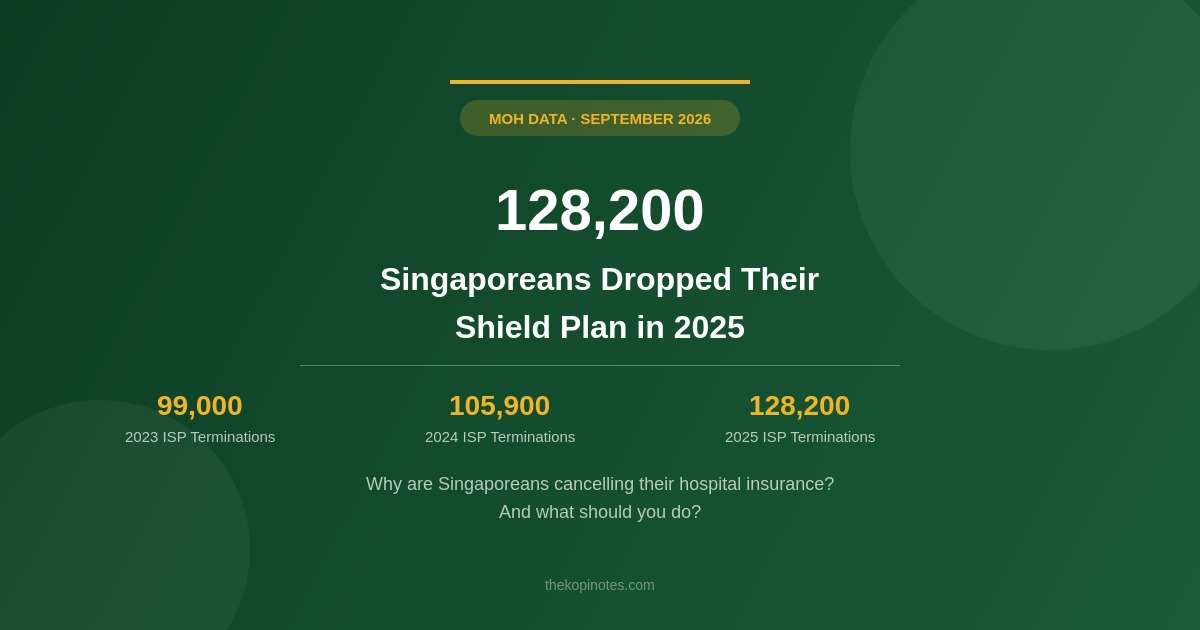
According to MOH data released in a parliamentary reply on 9 September 2026, 128,200 Singaporeans downgraded or discontinued their ISP hospital plan in 2025. This is up from 99,000 in 2023 — a 29.5% increase over two years.
Why did ISP rider cancellations surge so sharply in 2025?
ISP rider cancellations jumped from 103,400 in 2024 to 181,800 in 2025 — a 76% increase — primarily because of the April 2026 rider rule changes announced by MOH. Many policyholders reviewed their legacy riders ahead of those changes and chose to cancel rather than continue paying for coverage that would become less comprehensive for new policyholders anyway. The new rules require riders to no longer cover the minimum deductible and raise the co-payment cap to $6,000 per year.
What happens to my MediShield Life if I cancel my ISP?
MediShield Life is mandatory and continues regardless of whether you have an ISP. If you cancel your ISP, you still have MediShield Life coverage, which covers hospitalisation at B2 and C wards at restructured hospitals. However, you lose coverage for higher ward classes (A, B1, and private hospitals), and any bills above MediShield Life limits become your out-of-pocket responsibility.
Can I upgrade my ISP again after downgrading?
Yes, but you will need to go through fresh medical underwriting. If your health status has changed since you first took out the plan, the insurer may impose exclusions on pre-existing conditions or decline the application. This is one of the key risks of downgrading — the ability to reinstate comprehensive coverage later is not guaranteed.
Are ISP premiums going up in 2026?
Many ISP insurers have adjusted premiums in recent years due to rising medical costs and claims. Premium increases vary by insurer and age band. You can compare plans using MOH’s published comparison tools at moh.gov.sg. If you find your current premium unaffordable, speak to a licensed financial adviser before cancelling.
Does Medisave pay for ISP premiums?
Yes. ISP premiums (but not riders) can be paid using Medisave, subject to the Additional Withdrawal Limits (AWL) set by CPF. The AWL varies by age — for example, individuals aged 40–49 can use up to $1,530 per year from Medisave for ISP premiums. This means the cash out-of-pocket cost of maintaining an ISP may be lower than the full premium figure suggests.
Get Free Insurance Advice
Speak with a licensed insurance advisor. No obligation, no cost.
By submitting this form, you agree to our Privacy Policy.
This article was researched with the help of AI. While we strive to keep all information accurate and up to date, there may be errors. If you notice any discrepancies, please contact us.