Your Hospital Bill Decoded: What MediShield Life, Your ISP and You Each Pay (2026)
Singapore’s 3-layer healthcare system explained — deductibles, co-insurance, and how the April 2026 rider changes affect your wallet.
When you’re hospitalised in Singapore, your bill is split across three layers: MediShield Life (the government base plan), your Integrated Shield Plan (ISP), and your own pocket. MediShield Life pays first — but only after you clear the annual deductible ($1,500–$2,500 depending on ward class) and a co-insurance of 3–10%. Your ISP then covers what MediShield Life doesn’t. From 1 April 2026, new ISP riders can no longer cover your deductible, changing what you’ll actually pay out of pocket.
Not financial advice. All figures are for educational reference only. Data verified as at 18 September 2026.
- Your hospital bill goes through 3 layers: MediShield Life base then ISP top-up then you pay the remainder.
- You always pay the annual deductible first ($1,500–$2,500). From April 2026, new riders can’t cover this.
- Co-insurance is 3–10% of your claimable amount — riders can cover this, but the cap doubled to $6,000/year.
Table of Contents
Contents — Click to expand
- How Singapore’s 3-Layer Hospital Bill System Works
- Layer 1: What MediShield Life Covers
- The Deductible: What You Pay First
- Co-Insurance: Your Percentage Share
- Layer 2: How Your ISP Tops Up the Bill
- Layer 3: Riders and the April 2026 Changes
- Worked Example: $20,000 Private Hospital Bill
- How to Reduce Your Out-of-Pocket
- Frequently Asked Questions
How Singapore’s 3-Layer Hospital Bill System Works
Most Singaporeans know they have MediShield Life and an ISP. But when a hospital bill lands, the actual split can be confusing. Here’s the simple version.
Think of your hospital bill as a waterfall. The water flows through three pools in order: your deductible (you absorb the first chunk from MediSave), MediShield Life (the government’s base plan kicks in next), your ISP (your private insurer covers what MediShield Life misses), you again with co-insurance (you pay a small percentage of the claimable amount), and your rider (if you have one, it covers the co-insurance — and until April 2026, the deductible too).
Once you understand the order, you can plan exactly how much you’ll pay for any hospitalisation. To understand which ward class you should target with your ISP, read our guide to MediSave ward classes and ISP rider claims.
Layer 1: What MediShield Life Covers
MediShield Life is the compulsory base insurance that every Singapore Citizen and Permanent Resident has. You pay premiums every year — from your MediSave — and it covers large hospitalisation bills at public hospitals (Class B2/C subsidised rates).
For Class A wards, private hospitals, and non-subsidised treatments, MediShield Life still pays — but the payout is pro-rated based on the equivalent subsidised cost. That’s why you need an ISP to bridge the gap.
Key limits effective from 1 June 2026 (per CPF Board):
| Benefit | Claim Limit |
|---|---|
| Normal ward (per day) | $830/day + $800/day bonus for first 2 days |
| ICU ward (per day) | $5,140/day |
| Surgical procedures | $240–$3,900 depending on complexity |
| Implants | $7,000 per treatment |
| Annual claim limit | $200,000 per policy year (no lifetime limit) |
Source: CPF Board MediShield Life Claim Limits, effective 1 June 2026.
The $200,000 annual limit is generous for most hospitalisation scenarios. Where MediShield Life falls short is the rate it pays — not the total cap. Private hospital bills per day can far exceed the $830/day ward limit, and that gap is where your ISP steps in.
The Deductible: What You Pay First
The deductible is the fixed amount you must pay first, before MediShield Life or your ISP starts paying. Good news: you only pay this once per policy year. If you’re hospitalised twice in the same year, the second admission has no deductible.
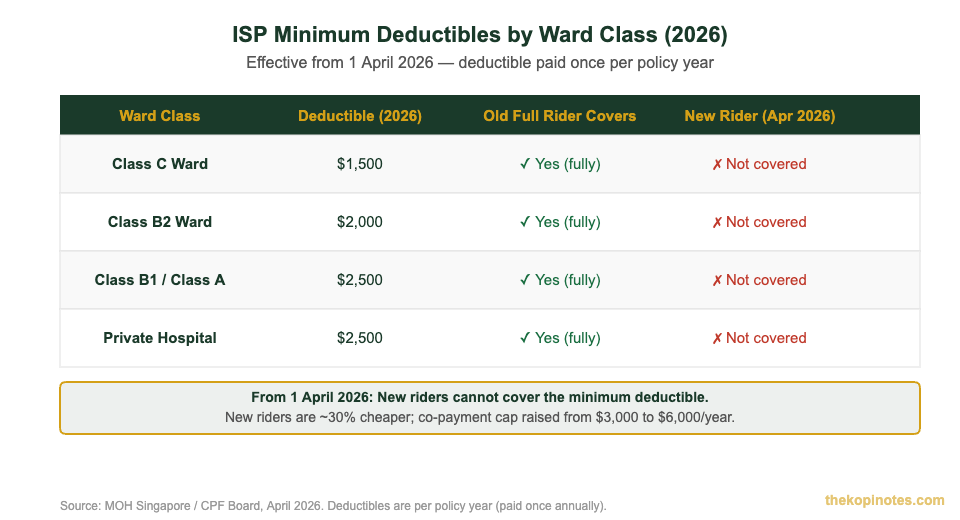
The deductible amount depends on the ward class you’re admitted to:
| Ward Class | Minimum Deductible (2026) | Who Pays |
|---|---|---|
| Class C | $1,500 | You (from MediSave or cash) |
| Class B2 | $2,000 | You (from MediSave or cash) |
| Class B1 / Class A | $2,500 | You (from MediSave or cash) |
| Private Hospital | $2,500 | You (from MediSave or cash) |
Source: MOH Singapore / CPF Board, April 2026. These are MOH minimum deductibles for ISPs.
You can pay the deductible from your MediSave account. Most people don’t need to use cash. If you have an old full-coverage rider, your rider used to absorb this — but that’s changed since April 2026.
Co-Insurance: Your Percentage Share
After you’ve paid the deductible, co-insurance kicks in. This is a percentage of the remaining claimable amount that you still have to pay.
MediShield Life uses a tiered co-insurance rate. It starts at 10% for smaller bills and decreases to 3% for larger bills, as the claimable amount increases. The more expensive your hospitalisation, the smaller your percentage share gets — this protects you from catastrophic costs.
On a $10,000 claimable amount (after deductible), you might pay roughly 5–8% as co-insurance. For a $50,000 claimable amount, your co-insurance percentage may drop to 3–5%. The exact tiers depend on your specific bill composition.
For a full explanation of what an Integrated Shield Plan is and how it layers on top of MediShield Life, see our complete ISP guide.
Layer 2: How Your ISP Tops Up the Bill
Once MediShield Life has paid its portion, your ISP covers the rest — up to its own policy limits. The ISP does two things: it fills the gap between MediShield Life’s limits and your actual hospital bill (especially for private hospitals where the daily ward rate vastly exceeds MSL’s $830/day limit), and it extends coverage to Class A wards and private hospitals, which MediShield Life only partially subsidises.
Your ISP premium depends on the plan tier and your age. Check our guide to ISP premiums by age in 2026 to see what you’re paying for each tier. To understand the current best plans, see our best Integrated Shield Plan Singapore comparison.
The ISP doesn’t replace MediShield Life — it works on top of it. Think of MediShield Life as your foundation and the ISP as the upgrade that makes private hospital stays affordable.
Layer 3: Riders and the April 2026 Changes
A rider is an optional add-on to your ISP that reduces your out-of-pocket costs. Old-school riders (before April 2026) covered everything — the deductible, the co-insurance, the lot. You’d check out of hospital paying exactly $0 in cash or MediSave.
That changed on 1 April 2026. MOH required all insurers to update new riders sold from that date. Here’s what’s different:
| Feature | Old Rider (pre-2026) | New Rider (from Apr 2026) |
|---|---|---|
| Covers deductible? | Yes | No |
| Covers co-insurance? | Yes (fully) | Yes — above cap |
| Co-payment cap | $3,000/year | $6,000/year |
| Rider premium | Higher | ~30% lower |
| Max annual out-of-pocket | $0 | $2,500 + up to $6k co-pay cap |
Source: MOH Singapore, April 2026 ISP rider reforms.
If you bought your rider before 1 April 2026, you’re grandfathered in — your old terms continue until your next policy renewal after 1 April 2028. After that renewal, you’ll transition to the new terms.
So if you’re on an old full-coverage rider right now, enjoy it while it lasts. When renewal comes, you’ll need to decide: take the new (cheaper) rider and accept $2,500+ out-of-pocket risk, or reduce your ISP to a lower ward class where the deductible is smaller.
For a complete breakdown of all ISP rider changes, see our full guide to the medisave hospitalisation step-by-step claims process.
Worked Example: $20,000 Private Hospital Bill
Let’s make this concrete. Suppose you have a 5-day stay at a private hospital. Your total bill comes to $20,000. You have an ISP covering private hospital wards. Here’s how the bill splits:
| Bill Component | Amount | Who Pays |
|---|---|---|
| Total hospital bill | $20,000 | — |
| Deductible (private hospital) | $2,500 | YOU (from MediSave) |
| MediShield Life pays (up to its limits) | ~$7,000–9,000 | MediShield Life |
| ISP covers remaining balance | ~$7,000–9,000 | Your ISP |
| Co-insurance (3–10% of claimable) | ~$1,000–1,500 | YOU (or rider) |
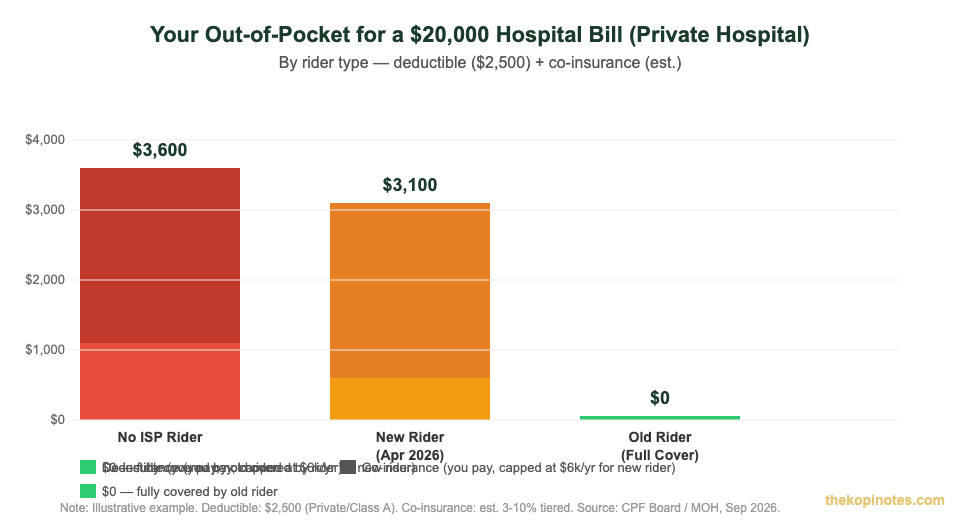
| Your total — NO rider | ~$3,500–4,000 | YOU |
| Your total — OLD rider | $0 | Rider covers everything |
| Your total — NEW rider (2026) | $2,500 + co-ins up to $6k cap | YOU (deductible mandatory) |
Note: Illustrative example. MediShield Life payout is approximate — actual payout depends on ward type, procedures, and applicable claim limits. Co-insurance based on 3–10% tiered rates.
How to Reduce Your Out-of-Pocket in 2026
1. Choose your ward class wisely. If you don’t need private hospital, stick to Class B1 or B2. The deductible drops from $2,500 to as low as $2,000 (B2) or $1,500 (Class C). Over multiple hospitalisations, that adds up.
2. Use MediSave for the deductible. You don’t need cash for the deductible — it comes straight from your MediSave. Most working Singaporeans have enough. Don’t drain your savings paying hospital bills in cash when MediSave is sitting there.
3. Keep your old rider if you have one. If you bought a full-coverage rider before April 2026, keep it. You’re grandfathered until your next renewal after April 2028. Don’t switch voluntarily to the new rider unless the premium savings genuinely outweigh the deductible risk for you.
4. Build a hospital emergency fund. Even with a new rider, your max out-of-pocket per year is roughly $8,500 (deductible plus co-payment cap). Set aside at least this amount in an accessible savings account. For retirement planning context, use our Singapore retirement calculator to see how healthcare costs fit into your long-term plan.
Data verified as at 18 September 2026. Always check your insurer’s policy documents for exact figures — ISP deductibles and limits may differ slightly by insurer and plan tier.
Frequently Asked Questions
What is the MediShield Life deductible in 2026?
The MediShield Life deductible in 2026 is $1,500 for Class C ward, $2,000 for Class B2, and $2,500 for Class B1, Class A, and private hospitals. You pay this once per policy year — not once per admission. If you’re admitted twice in the same policy year, only your first admission requires the deductible payment.
What is co-insurance and how much do I pay?
Co-insurance is a percentage of your claimable hospital bill that you share with the insurer, after paying your deductible. MediShield Life uses a tiered co-insurance rate that ranges from 10% on smaller claimable amounts down to 3% on larger amounts. This means the bigger your bill, the smaller your percentage share — protecting you from catastrophic costs. For most hospitalisation scenarios, your co-insurance works out to between $500 and $2,000.
What changed with ISP riders from 1 April 2026?
From 1 April 2026, new ISP riders sold in Singapore cannot cover the minimum deductible ($1,500–$2,500 depending on ward class). This means even if you have a rider, you must pay the deductible yourself — from MediSave or cash. The co-payment cap was also raised from $3,000 to $6,000 per year. To balance this, new rider premiums are approximately 30% cheaper than old full-coverage riders.
Does my old ISP rider still cover the deductible?
Yes — for now. If you bought your rider before 1 April 2026, you’re grandfathered under the old terms until your next policy renewal after 1 April 2028. At that renewal, your insurer is required to transition you to a compliant new rider. So you’ll continue to enjoy zero deductible for at least another year or two, but plan for the change before your next renewal.
Can I use MediSave to pay the deductible?
Yes. The deductible can be paid using MediSave. Most Singaporeans have sufficient MediSave balance to cover the $1,500–$2,500 deductible without needing cash. Your MediSave can also be used for ISP premiums — see our guide to the annual MediSave withdrawal limits for more details.
What is the maximum MediShield Life payout I can claim per year?
As of 1 June 2026, the MediShield Life annual claim limit is $200,000 per policy year, with no lifetime limit on total claims. This means even if you make multiple claims over your lifetime, MediShield Life continues to pay — as long as each policy year’s total claims stay within $200,000. For most Singaporeans, this limit is more than sufficient for a single hospitalisation episode.
Does MediShield Life cover private hospital bills in full?
No. MediShield Life is calibrated to cover subsidised bills at public hospitals (Class B2/C ward rates). For private hospital stays, your bill is pro-rated before MediShield Life’s payout is calculated — meaning MediShield Life may only cover a portion of what a private hospital charges. This gap is why you need an ISP covering private hospital wards, and optionally a rider to further reduce your out-of-pocket costs.
Get Free Insurance Advice
Speak with a licensed insurance advisor. No obligation, no cost.
By submitting this form, you agree to our Privacy Policy.
This article was researched with the help of AI. While we strive to keep all information accurate and up to date, there may be errors. If you notice any discrepancies, please contact us.