ISP Co-Payment 2026: New S$6,000 Cap, Deductible Rules & What You Actually Pay
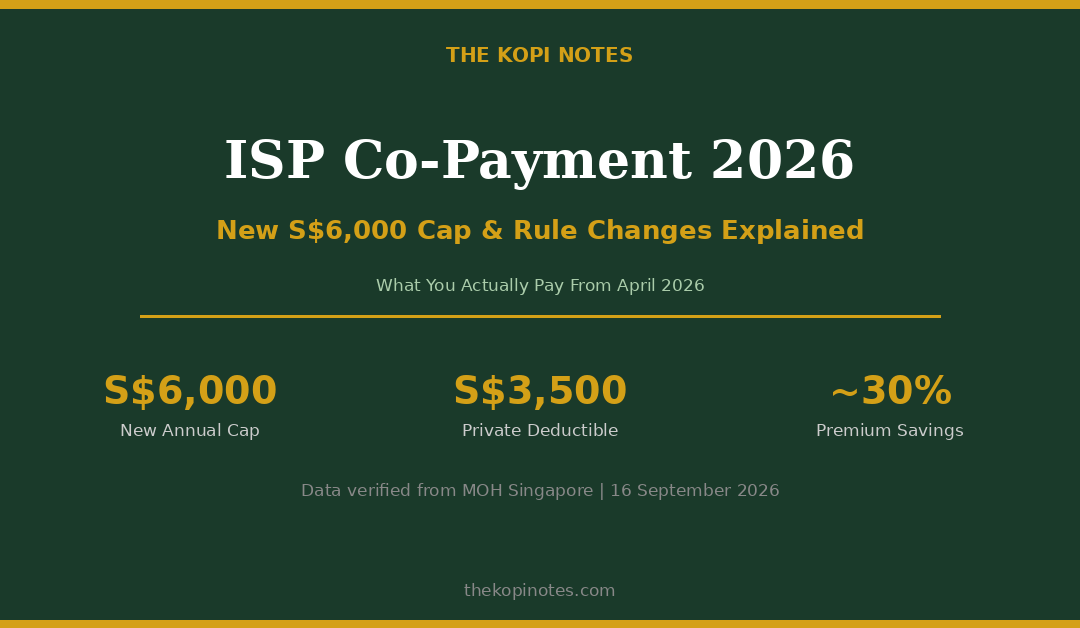
From 1 April 2026, Integrated Shield Plan (ISP) riders in Singapore changed significantly. New riders can no longer cover your minimum IP deductible, and the annual co-payment cap doubled from S$3,000 to S$6,000. In exchange, premiums dropped by about 30%. If you hold an ISP rider — or are considering one — here is exactly what the new rules mean for your wallet.
Not financial advice. All figures are for educational reference only. Data verified as at 16 September 2026 from MOH Singapore official sources.
- New ISP riders from 1 April 2026 no longer cover the minimum deductible (up to S$3,500 for private wards)
- The annual co-payment cap (excluding deductible) rose from S$3,000 to S$6,000
- Minimum 5% co-insurance is unchanged
- New rider premiums are roughly 30% cheaper — saving S$600/year on average for private hospital policyholders
- If you bought your rider before 27 November 2025, you are grandfathered and not immediately affected
What Is the ISP Co-Payment Cap?
An Integrated Shield Plan tops up your mandatory MediShield Life coverage to cover Class A, B1, or private hospital wards. When you make a claim, you typically pay two things before insurance covers the rest:
- The deductible — a fixed amount you pay at the start of each policy year before insurance kicks in. This ranges from S$1,500 to S$3,500 depending on ward class.
- The co-insurance — a percentage (minimum 5%) of the remaining bill after the deductible.
An ISP rider is a supplementary policy that reduces or caps these out-of-pocket costs. Before April 2026, some riders covered the deductible in full — giving “last dollar” coverage. The co-payment cap was the ceiling beyond which the insurer covered everything. It was set at S$3,000 per year in 2018.
The cap was introduced precisely because without any out-of-pocket cost, policyholders and healthcare providers both had little incentive to keep costs down. MOH data shows that private hospital policyholders with riders are 1.4 times as likely to make a claim — with claims averaging 1.4 times larger than those without riders.
What Changed in April 2026?
MOH announced the new requirements on 26 November 2025 and implemented them from 1 April 2026. There are two core changes:
1. No More Deductible Coverage in New Riders
New IP riders sold from 1 April 2026 onward are not permitted to cover the minimum IP deductible. This means you will always bear the deductible — S$1,500 to S$3,500 depending on which ward you use — before any rider benefit applies. This is a fundamental shift from pre-2026 riders that could absorb your deductible entirely.
2. Co-Payment Cap Raised From S$3,000 to S$6,000
The minimum annual co-payment cap — the most you can pay in co-insurance (5%) before the rider takes over — has been raised from S$3,000 to S$6,000 per year. Importantly, this cap applies to co-payments excluding the minimum IP deductible. The deductible sits on top.
In practice, this means your total maximum out-of-pocket liability under a new private hospital rider could be up to S$3,500 (deductible) + S$6,000 (co-pay cap) = S$9,500 per year, compared to approximately S$3,000 under older riders that covered the deductible.
The co-payment cap only applies to eligible claims — generally panel or pre-authorised claims.
Why the Change?
MOH’s goal is to restore cost discipline. When patients share more of the cost, they are more likely to consider whether a private specialist or private hospital is truly necessary for their condition. Riders that effectively removed all cost-sharing were identified as a key driver of rising healthcare bills and, by extension, rising insurance premiums.
The trade-off: new riders are considerably cheaper. Premium savings average about 30% — or S$600 per year for private hospital rider policyholders and S$200 per year for public hospital rider policyholders. For older policyholders, where premiums are highest, the absolute savings are even more significant.
Minimum Deductibles by Ward Class (April 2026)
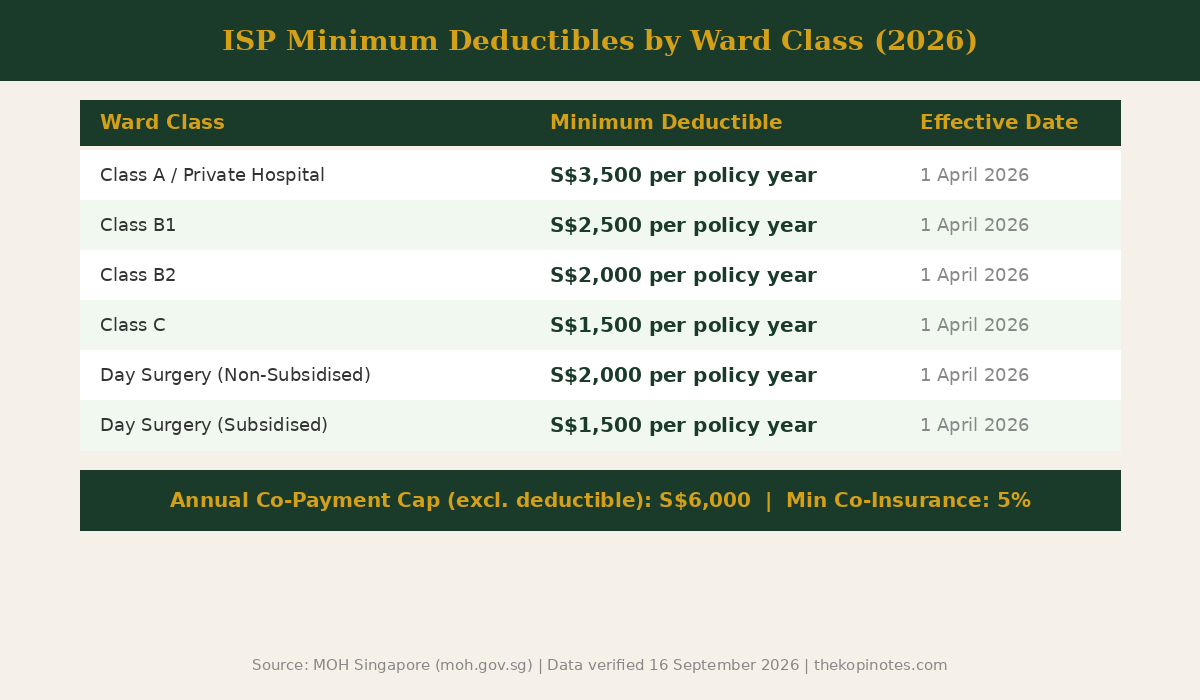
MOH sets the minimum IP deductible that each insurer must impose. The deductible applies once per policy year. Here are the current minimums:
| Ward Class Utilised | Minimum Deductible |
|---|---|
| Class A / Private Hospital | S$3,500 |
| Class B1 | S$2,500 |
| Class B2 | S$2,000 |
| Class C | S$1,500 |
| Day Surgery / Short Stay (Non-Subsidised) | S$2,000 |
| Day Surgery / Short Stay (Subsidised) | S$1,500 |
Note: The applicable deductible is the lower of (a) the deductible for the IP’s targeted ward class, and (b) the deductible for the ward class actually used. Source: MOH Singapore, November 2025.
Worked Examples: What You Actually Pay
Let us trace two scenarios from MOH’s own published illustrations to show how the new rules work in practice.
Example 1: Knee Replacement Surgery (Private Hospital, Age 60)
Mr A, aged 60, holds a private hospital ISP and switches to the new rider in April 2026. He undergoes knee joint replacement surgery with a total bill of S$56,900.
- Deductible: S$3,500 (his responsibility; not covered by new rider)
- Remaining bill: S$56,900 − S$3,500 = S$53,400
- 5% co-insurance: S$2,670
- Total co-payment: S$3,500 + S$2,670 = S$6,170
- This amount is fully coverable by MediSave (subject to withdrawal limits)
Under his old rider, he would have paid approximately S$2,840. The new rider costs him S$3,330 more for this surgery. However, by switching he had already saved S$1,600/year in rider premiums — so after three years the savings would already exceed this extra co-payment.
Example 2: ACL Knee Surgery (Private Hospital, Age 40)
Mrs B, aged 40, adds a new private hospital rider in April 2026. In December 2026, she tears her ACL and incurs a bill of S$38,700.
- Deductible: S$3,500
- Remaining bill: S$38,700 − S$3,500 = S$35,200
- 5% co-insurance: S$1,760
- Total co-payment: S$3,500 + S$1,760 = S$5,260
- Of this, S$3,900 is coverable by MediSave; S$1,360 cash out-of-pocket
Without a rider, her out-of-pocket cash would have been S$3,120. The rider reduced her cash outlay from S$3,120 to S$1,360 — a saving of S$1,760 — while also giving her the S$6,000 co-pay cap protection for the rest of the year.
Who Is Affected? The Grandfathering Rules
Not everyone is affected by the April 2026 changes immediately. The key dates to know:
- Before 27 November 2025: Existing rider policyholders are not immediately affected. Your current rider terms remain in force. You are not required to switch.
- 27 November 2025 – 31 March 2026: Riders sold during this window must notify new policyholders that they will transition to the new compliant rider design no later than the next renewal after 1 April 2028.
- From 1 April 2026: Only new-design riders can be sold. Old non-compliant riders ceased sales on 31 March 2026.
If you bought your ISP rider before 27 November 2025 and have not changed it, you remain on your existing terms. However, MOH notes that insurers are individually determining how they will handle existing rider policyholders over time, and encourages policyholders to speak with their financial advisors to assess whether switching to the new rider design makes financial sense for them.
For a full breakdown of how the rider changes interact with MediSave claim limits, see: MediSave hospitalisation 2026: claim limits and rider changes explained.
Should You Switch to the New Rider?
Whether switching makes financial sense depends on your age, premium, and how often you expect to be hospitalised. The key trade-off:
| Old Rider (Pre-2026) | New Rider (April 2026+) | |
|---|---|---|
| Deductible covered? | Yes (some plans) | No |
| Annual co-pay cap | S$3,000 | S$6,000 |
| Min co-insurance | 5% | 5% (unchanged) |
| Premium saving | — | ~30% cheaper |
| Best for | Frequent hospitalisation, older policyholders with low deductible ability | Those who hospitalise infrequently and prioritise lower premiums |
MOH’s own statistics suggest that an average 40-year-old will be hospitalised about once or twice in the next 20 years, and an average 60-year-old about twice in 10 years. If hospitalisation is infrequent, the cumulative premium savings from the new rider will likely outweigh the higher co-payment for most people.
For most Singaporeans who are relatively healthy, switching to the new rider and banking the ~S$600/year saving is likely to be the better financial decision. Consult a licensed financial advisor for personalised guidance.
See also: Best Integrated Shield Plans in Singapore 2026.
Paying Co-Payments With MediSave
The good news: both the deductible and the co-payment can be paid using MediSave, subject to the prevailing Annual Withdrawal Limits (AWL).
MediSave AWLs for ISP premiums in 2026 are:
- Age 40 and below: S$300/year
- Age 41–70: S$600/year
- Age 71 and above: S$900/year
For hospitalisation co-payments (deductible + co-insurance), you can use MediSave beyond these limits — the AWL above applies only to ISP premiums, not to hospitalisation claims. For hospitalisation claims, MediSave withdrawal is governed by separate MediSave hospitalisation withdrawal limits, which vary by ward class and procedure.
In practice, for most hospitalisation bills, MediSave can cover a significant portion of your deductible and co-payment. The examples above from MOH show that for a S$56,900 private hospital bill, the full S$6,170 co-payment was coverable by MediSave based on applicable withdrawal limits.
For the full MediSave AWL breakdown: MediSave AWL 2026: How Much Can You Use for ISP Premiums?
Frequently Asked Questions
Does the S$6,000 cap include the deductible?
No. The S$6,000 annual co-payment cap applies to co-payments excluding the minimum IP deductible. The deductible is paid separately on top. Your maximum total out-of-pocket before full insurance coverage (for a private hospital claim) is S$3,500 (deductible) + S$6,000 (co-pay cap) = S$9,500 per year.
If I already have an ISP rider, do I need to change it?
No — if you purchased your rider before 27 November 2025, you are grandfathered and your existing terms remain. You are not required to change. If you want to switch to the new cheaper rider, you may do so voluntarily by contacting your insurer or financial advisor.
Is the 5% co-insurance still there?
Yes, the minimum 5% co-insurance is unchanged. All ISP riders must still require you to pay at least 5% of each eligible claim, up to the S$6,000 cap per year (excluding deductible).
Can I use MediSave to pay the deductible and co-payment?
Yes. Both the deductible and the co-insurance can be paid from your MediSave account, subject to prevailing MediSave hospitalisation withdrawal limits. ISP premiums (not co-payments) are subject to the AWL, which ranges from S$300 to S$900 per year depending on your age.
Are ISP rider premiums paid from MediSave or cash?
ISP base plan premiums can be paid from MediSave (up to the AWL), and the remaining premium is paid in cash. Rider premiums are paid in cash only — MediSave cannot be used for rider premiums.
Which ISP providers offer the new compliant riders?
All seven MOH-approved ISP insurers — AIA, Great Eastern, HSBC Life, Income Insurance, Prudential, Raffles Health Insurance, and Singlife — launched new-design riders by 1 April 2026. Contact your insurer or a licensed financial advisor for specific plan details and premium quotes.
Where can I compare ISP plans and riders?
MOH maintains a comparison tool for ISP plans. You can also see our full guide: Integrated Shield Plan Singapore 2026.
Get Free Insurance Advice
Speak with a licensed insurance advisor. No obligation, no cost.
By submitting this form, you agree to our Privacy Policy.
This article was researched with the help of AI. While we strive to keep all information accurate and up to date, there may be errors. If you notice any discrepancies, please contact us.