Term Life Insurance Singapore 2026: Key Exclusions You Need to Know Before You Buy
6 clauses that can void your payout — and how to make sure your family is actually protected.
Term life insurance in Singapore pays a lump sum if you die or suffer total and permanent disability (TPD) within the policy term. But not every death or disability triggers a payout. Every policy contains exclusion clauses — specific circumstances under which the insurer will not pay. Knowing these exclusions before you buy is the single most important step you can take to make sure your family actually receives the money you’re paying for.
Not financial advice. All figures are for educational reference only. Data verified as at 16 September 2026.
- Every term life policy in Singapore excludes suicide within the first 12 months, deaths from illegal activities, and war/terrorism.
- Non-disclosure of pre-existing conditions is the most common reason claims are rejected — always declare everything on your proposal form.
- Extreme sports and non-commercial aviation can be covered by optional riders — check if your lifestyle needs one.
Table of Contents
Show Table of Contents
- What Is a Policy Exclusion?
- The Suicide Clause — Singapore’s 12-Month Rule
- Pre-Existing Conditions (The #1 Claim Killer)
- War, Terrorism and Civil Unrest
- Illegal Activities and Criminal Acts
- Other Common Exclusions: Aviation, Sports and Self-Harm
- Full Exclusions Comparison Table
- How to Avoid a Rejected Claim: 5-Step Checklist
- Frequently Asked Questions
What Is a Policy Exclusion?
A policy exclusion is a clause in your insurance contract that removes cover for specific causes of death, disability, or illness. It does not mean your policy is worthless. It means there are defined situations where the insurer will not pay the death benefit.
In Singapore, all life insurance policies must comply with guidelines set by the Life Insurance Association Singapore (LIA) and are regulated by the Monetary Authority of Singapore (MAS). Exclusions are disclosed in your Product Summary and Policy Contract — two documents every buyer must read before signing.
The key point: exclusions are not fine print tricks. They are a fundamental part of how insurance pricing works. Insurers exclude high-risk scenarios that would make cover unaffordable for everyone else. Your job is to understand them so you are not caught off guard.
The Suicide Clause — Singapore’s 12-Month Rule
Every term life policy in Singapore contains a suicide exclusion clause. If the insured person dies by suicide within the first 12 months of the policy, the insurer will not pay the death benefit.
What happens instead? Most policies refund the premiums paid to the nominated beneficiary. So the family is not left with nothing — but they receive only what was paid in, not the sum assured.
After 12 months, this exclusion no longer applies. A death by suicide after the first policy year is generally treated the same as any other death under the policy terms.
A few things to check in your specific policy:
- Some insurers use a 13-month period instead of 12 — read your Product Summary carefully.
- The exclusion restarts if you reinstate a lapsed policy. The 12-month clock resets from the reinstatement date, not the original policy start date.
- The exclusion also applies to Total and Permanent Disability (TPD) claims arising from self-inflicted injury during the exclusion window.
This clause exists because insurers need to prevent adverse selection — situations where a policy is purchased specifically in anticipation of a claim. For the vast majority of policyholders, this clause will never be relevant.
Pre-Existing Conditions (The #1 Claim Killer)
This is the exclusion that causes the most rejected claims in Singapore. A pre-existing condition is any medical condition you already had — whether diagnosed or not — at the time you applied for the policy.
Singapore term life policies are sold on a “utmost good faith” basis. When you fill in the proposal form, you are legally required to disclose everything material to the underwriting decision. This includes:
- Medical conditions you have been diagnosed with (diabetes, hypertension, heart disease, cancer history)
- Conditions you have sought treatment for, even if not formally diagnosed
- Medications you take regularly
- Family history of hereditary conditions if the proposal form asks for it
If you do not disclose a condition and later make a claim, the insurer can investigate your medical history. If they find an undisclosed condition that is material to the risk, they can void the policy entirely — not just exclude that specific claim. That means no payout at all, and premiums may not be refunded.
What happens when you do disclose a condition? The insurer has three options: accept at standard rates, accept with an exclusion for that condition at a higher premium, or decline cover. An exclusion for a specific condition is far better than having your entire policy voided later.
A helpful tip: before applying, get a copy of your medical records from polyclinic or hospital. This gives you a clear reference for what to declare, and removes the “I didn’t know” defence if questions arise at claim time.
If you want to compare policies from MAS-licensed insurers side by side, use CompareFIRST — the government-backed portal for direct comparison of life insurance products.
War, Terrorism and Civil Unrest
All standard term life policies in Singapore exclude deaths caused by war, invasion, acts of foreign enemies, civil war, rebellion, or revolution. Terrorism is also typically excluded under most standard policies.
This exclusion affects a small number of Singaporeans, but it is relevant if you:
- Work in a conflict zone or high-risk country
- Serve in a military or paramilitary capacity
- Travel frequently to regions with active civil unrest
Some insurers offer supplementary riders or endorsements that extend cover to include war or terrorism risk — typically for an additional premium. If your job or lifestyle puts you in these situations, ask your insurer explicitly whether an endorsement is available.
For national servicemen (NSmen) in Singapore, it is worth noting that DPS (Dependants’ Protection Scheme) is a separate group term life insurance administered through CPF and does not exclude NS-related accidents. Your private term life policy’s war exclusion is separate from your DPS coverage.
Illegal Activities and Criminal Acts
If you die while committing an illegal act, most Singapore term life policies will not pay out. This includes deaths while under the influence of drugs or alcohol (where intoxication was a contributing factor), deaths resulting from criminal activity, and deaths arising from reckless disregard of personal safety in a context that constitutes illegal behaviour.
The key phrase in most policy contracts is “engaging in or attempting to commit a criminal act.” The insurer does not need a criminal conviction — they need to demonstrate that the death arose directly from illegal conduct.
In practice, this clause rarely affects ordinary policyholders. However, it is worth understanding in the context of road accidents: if you die in a road accident where you were driving under the influence, this exclusion may apply depending on the specific policy wording and the facts of the case.
Other Common Exclusions: Aviation, Extreme Sports and Self-Harm
Beyond the major exclusions above, several situational exclusions appear in standard Singapore term life policies:
Aviation (Non-Commercial Flights)
If you die while piloting or riding in a non-commercial aircraft — including private planes, helicopters, or gliders — your policy may not cover this. Commercial passenger flights on licensed airlines are always covered.
If you hold a private pilot licence or fly recreationally, you should declare this at the time of application and ask whether an aviation rider is available.
Extreme Sports and Hazardous Activities
Rock climbing, skydiving, scuba diving beyond recreational depths, motor racing, and similar activities may be excluded. The definition of “hazardous activity” varies by insurer — some list specific activities; others use a broader definition.
If you participate in any of these activities, ask your insurer. Most offer a hazardous activities rider for an additional S$10–30 per year, which extends cover to include these pursuits.
Self-Inflicted Injuries (Outside the Suicide Clause)
Even after the 12-month suicide exclusion period, policies typically exclude deaths or disability arising from intentional self-inflicted injury. This is separate from the suicide clause — it covers situations where the intent was injury rather than death.
Full Exclusions Comparison Table
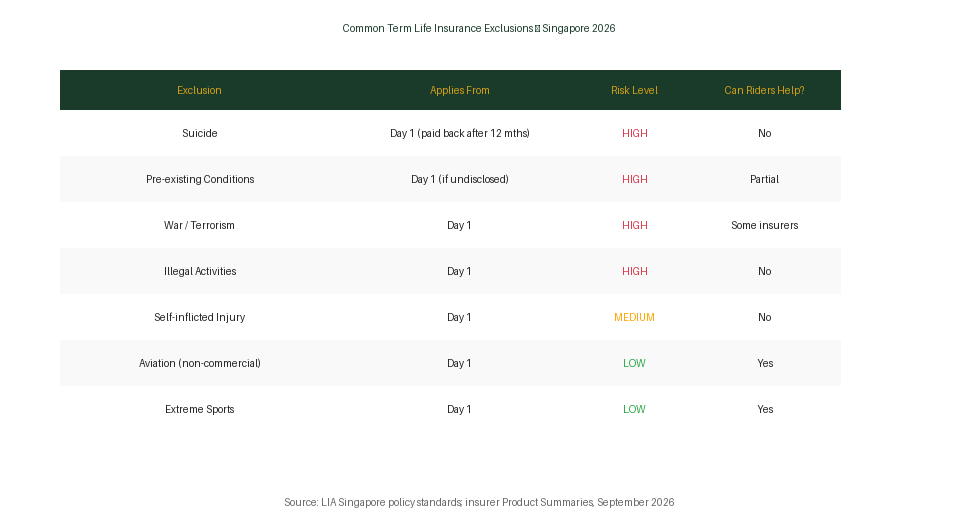
Source: LIA Singapore policy standards; insurer Product Summaries reviewed September 2026. Risk levels are indicative. Read your own policy contract for exact wording.
| Exclusion Type | When It Applies | Rider Available? | Impact if Triggered |
|---|---|---|---|
| Suicide | First 12 months only | No | Premiums refunded; no sum assured |
| Pre-existing conditions (undisclosed) | All times; retroactive | Disclose upfront | Policy voided; no payout |
| War / Terrorism | All times | Some insurers offer endorsements | No payout |
| Illegal activities | All times | No | No payout |
| Aviation (non-commercial) | All times | Yes — aviation rider | No payout (unless rider added) |
| Extreme sports / hazardous activities | All times | Yes — hazardous activity rider | No payout (unless rider added) |
| Self-inflicted injury | All times | No | No payout |
Source: LIA Singapore policy standards; MAS regulations. Individual insurer policies may vary — always read your Product Summary.
How to Avoid a Rejected Claim: 5-Step Checklist
The good news is that most exclusions are avoidable with the right preparation. Here is a practical checklist to give your beneficiaries the best chance of a successful claim.
- Disclose every medical condition. Pull your medical records before applying. List every condition, medication, and treatment. If in doubt, declare it — the worst the insurer can do is add an exclusion or load your premium. A hidden condition can void your entire policy.
- Keep paying your premiums on time. A lapsed policy means no cover. Set up GIRO to automate payments. If you miss a payment, most policies have a 30-day grace period — but don’t rely on it.
- Nominate your beneficiary correctly. In Singapore, you must make a proper MAS-compliant nomination (revocable or trust) for the death benefit to bypass your estate. Without this, the payout goes through probate — potentially taking years and losing part of the amount to estate administration costs.
- Review your policy when your lifestyle changes. If you take up rock climbing or get a private pilot licence, inform your insurer and add the appropriate rider. Failing to update your insurer about material changes in lifestyle can give grounds to reduce or deny a future claim. For a detailed look at which riders are worth adding, see our guide to term life insurance riders Singapore 2026.
- Keep your policy documents somewhere your family can find them. Many claims are not filed because families don’t know a policy exists. Store a copy of your policy summary and the insurer’s claims hotline number with your will, or share it with your executor.
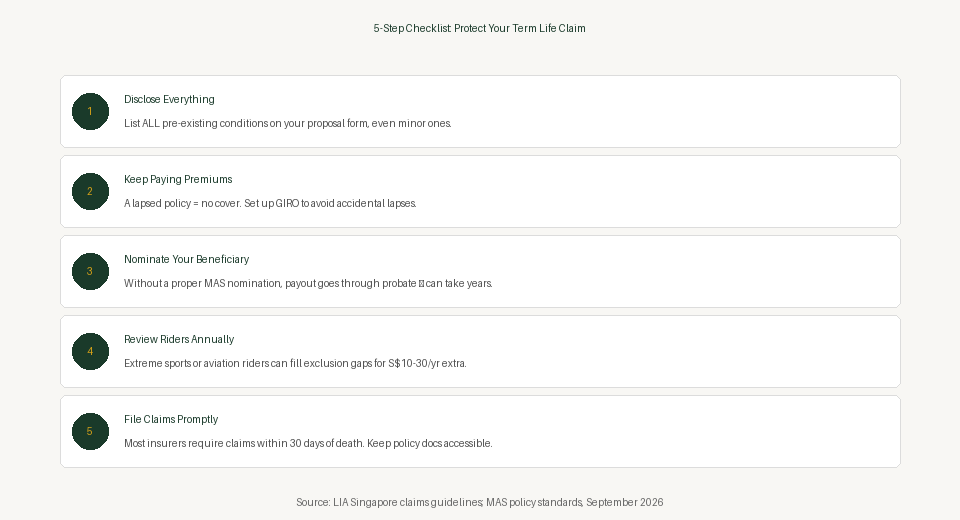
Source: LIA Singapore claims guidelines; MAS policy standards, September 2026.
What Exclusions DON’T Apply To
It is equally important to know what is covered — especially scenarios people sometimes incorrectly assume are excluded.
- Terminal illness: Most term life policies in Singapore include a terminal illness (TI) benefit. If you are diagnosed with a terminal illness with less than 12 months to live, you can claim an advance on the sum assured while still alive.
- Accidental death: If you die in an accident — car crash, fall, drowning — this is covered under standard death benefit. Accidental death is not excluded unless it arose from illegal activity.
- Death overseas: Your cover applies globally. If you die abroad on holiday or a work trip, the standard death benefit still applies (subject to standard exclusions like war zones).
- Natural causes: Cancer, heart attack, stroke — these are all covered under the death benefit, as long as they were not pre-existing undisclosed conditions.
For the full picture on what happens when you need to make a claim, see our step-by-step guide to claiming life insurance in Singapore.
How Exclusions Compare Across Top Singapore Insurers
The core exclusions — suicide (12 months), war, illegal activity, self-inflicted injury — are essentially universal across all LIA member insurers in Singapore. Where insurers differ is in how they handle:
| Insurer | Aviation Rider Available? | Extreme Sports Rider? | Annual Premium (Male 35, S$500k, 30yr, non-smoker) |
|---|---|---|---|
| Great Eastern (GREAT Term 2) | Check with advisor | Yes | ~S$601 |
| AIA (Secure Flexi Term) | Check with advisor | Yes | ~S$706 |
| Singlife / FWD | Limited (direct plans) | Limited | ~S$300–S$420 |
| Prudential (PRUActive Term) | Check with advisor | Yes | ~S$685 |
Source: Insurer Product Summaries; ShopBack Finance comparison data, September 2026. Premiums are indicative — get a personalised quote for accurate figures. Use CompareFIRST for live quotes.
Budget-conscious buyers often go for Singlife or FWD for lower premiums, then separately add a CI insurance policy for comprehensive coverage. For a detailed comparison, see our best term life insurance Singapore 2026 guide.
If you’re also looking at Critical Illness insurance, note that CI policies have their own set of exclusion clauses — sometimes more complex than term life. We cover those separately in our guide to why CI claims get rejected.
Finally, if you’re building a long-term financial plan alongside your insurance — using your Endowus or Syfe account for investments while term life handles protection — check the Singapore retirement planning calculator to model how your insurance coverage aligns with your savings goals. You can also see our Endowus referral code for a cash bonus when you open an account.
Frequently Asked Questions
What is the most common reason term life insurance claims are rejected in Singapore?
Does Singapore term life insurance cover suicide?
Does term life insurance cover accidental death?
Is death overseas covered by Singapore term life insurance?
What happens if I take up rock climbing after buying term life insurance?
How do I check all the exclusions in my policy?
Can I add riders to cover excluded activities?
Get Free Insurance Advice
Speak with a licensed insurance advisor. No obligation, no cost.
By submitting this form, you agree to our Privacy Policy.
This article was researched with the help of AI. While we strive to keep all information accurate and up to date, there may be errors. If you notice any discrepancies, please contact us.