Convertible Term Life Insurance Singapore 2026: How to Switch to Whole Life Without a New Medical Exam
Conversion Privilege Explained, Insurer Comparison & A Worked Example
Convertible term life insurance in Singapore lets you switch a term policy into a whole life or endowment plan without new medical checks, as long as you exercise this “conversion privilege” before a set age (usually 65-70). Great Eastern, AIA and Manulife all offer this on select term plans. Your premium is based on the age you convert at, not your original entry age, so converting earlier is almost always cheaper.
Not financial advice. All figures are for educational reference only. Data verified as at August 2026 unless noted.
- A conversion privilege lets you turn term life cover into permanent (whole life/endowment) cover with zero new health questions — your original underwriting stands.
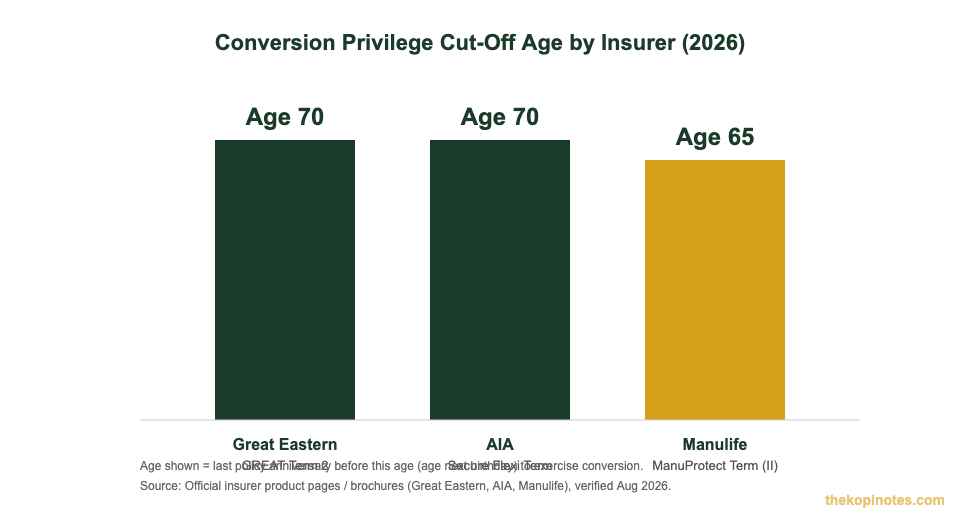
- Great Eastern and AIA let you convert anytime before age 70 (age next birthday). Manulife’s cut-off is age 65.
- Convert earlier if you can afford it. Whole life premiums climb steeply with age, so locking in your younger, healthier rate saves real money over decades.
Table of Contents
Contents
- What Is Convertible Term Life Insurance?
- Why the Conversion Privilege Matters
- How Conversion Works: Great Eastern vs AIA vs Manulife
- Why Converting Early Costs Less: A Worked Illustration
- Should You Actually Convert? Pros and Cons
- Conversion vs Buying a New Whole Life Policy
- Step-by-Step: How to Exercise Your Conversion Privilege
- Common Mistakes to Avoid
- Frequently Asked Questions
What Is Convertible Term Life Insurance?
Term life insurance covers you for a fixed period, usually until age 65 to 85. It is cheap because it has no cash value component. But what happens when you outgrow term cover and want something permanent, like a whole life plan with cash value?
That’s where the conversion privilege comes in. It is a built-in feature on some Singapore term plans. It lets you switch, or “convert”, your policy into a whole life, endowment, or investment-linked plan from the same insurer. You do this without answering new health questions or taking a new medical exam.
Here’s why that matters. Your original health class at the time you first bought the term policy carries over. If you developed diabetes, high blood pressure, or any other condition after buying your term plan, none of that affects your conversion. The insurer treats you as if you were still that healthy 30-year-old from years ago.
This is different from simply buying a fresh whole life policy later in life. A fresh purchase always requires new health declarations, and possibly a medical exam. If your health has changed, you could face higher premiums, exclusions, or even be turned down.
Why the Conversion Privilege Matters
You might not think about this when you first buy term life insurance in Singapore. But insurability is not guaranteed forever. Here’s a scenario many Singaporeans face.
You buy a 30-year term plan at age 30. At age 45, you’re diagnosed with early-stage hypertension. You now want permanent life cover for estate planning or to leave a legacy for your kids. If you apply for a brand new whole life policy today, the insurer will ask about your hypertension. That could mean a premium loading, an exclusion, or a decline.
But if your original term plan has a conversion privilege, none of that matters. You convert at your attained age, using the same health class you locked in at 30. That’s the entire point of this feature: it protects your future insurability, not just your current cover.
Who Should Care About This Feature
You should pay attention to conversion privilege if any of these apply to you:
- You have a family history of illnesses like diabetes, cancer, or heart disease
- You work in a physically demanding or high-risk job that could affect future insurability
- You’re not sure yet whether you’ll need permanent cover, but want to keep the option open
- You want to lock in your current age and health class for a cheaper future whole life premium
How Conversion Works: Great Eastern vs AIA vs Manulife
Not every term plan in Singapore has a conversion privilege, and the rules differ by insurer. Here’s what the three major insurers with a documented conversion feature actually offer, verified directly against their Great Eastern GREAT Term 2 product page, AIA Secure Flexi Term product page and Manulife ManuProtect Term (II) product page.
| Insurer & Plan | Conversion Cut-Off | Convert To | Medical Underwriting |
|---|---|---|---|
| Great Eastern GREAT Term 2 | Before policy anniversary at age 70 (next birthday) | Endowment, whole life, universal life or ILP | None required |
| AIA Secure Flexi Term | Before age 70 | AIA endowment, whole life or ILP | None required |
| Manulife ManuProtect Term (II) | Before policy anniversary at age 65 (next birthday) | Manulife whole life or endowment plans | None required |
Source: Great Eastern GREAT Term 2 product page (updated 1 May 2026), AIA Secure Flexi Term product page and brochure, Manulife ManuProtect Term (II) product page. Verified August 2026.
A few conditions apply across all three insurers. The conversion privilege can usually only be exercised once, whether you convert the full sum assured or just part of it. The new policy’s sum assured cannot exceed your term plan’s original sum assured. And your new premium is calculated using your original entry age and health class, but priced at rates for your current attained age — meaning the earlier you convert, the lower that new premium locks in.
Other insurers, including Income, Singlife, Etiqa, FWD, Prudential and Tokio Marine, may offer similar features on select plans, but the terms are not always published on their public product pages. If you already hold a term policy with one of these insurers, check your policy contract or ask your servicing representative directly whether a conversion privilege applies.
Why Converting Early Costs Less: A Worked Illustration
Whole life premiums are priced mainly on your age at the point of purchase, or in this case, at the point of conversion. The younger you are, the longer the insurer expects to collect premiums before a payout, and the lower your health risk is assumed to be. That means every year you delay converting, your locked-in premium for the same coverage climbs.
Here’s an illustrative example. Say you’re comparing the relative cost of converting the same S$200,000 sum assured into a whole life plan at four different ages. This is not a real insurer quote — think of it as a general pattern seen across most whole life pricing tables in Singapore.
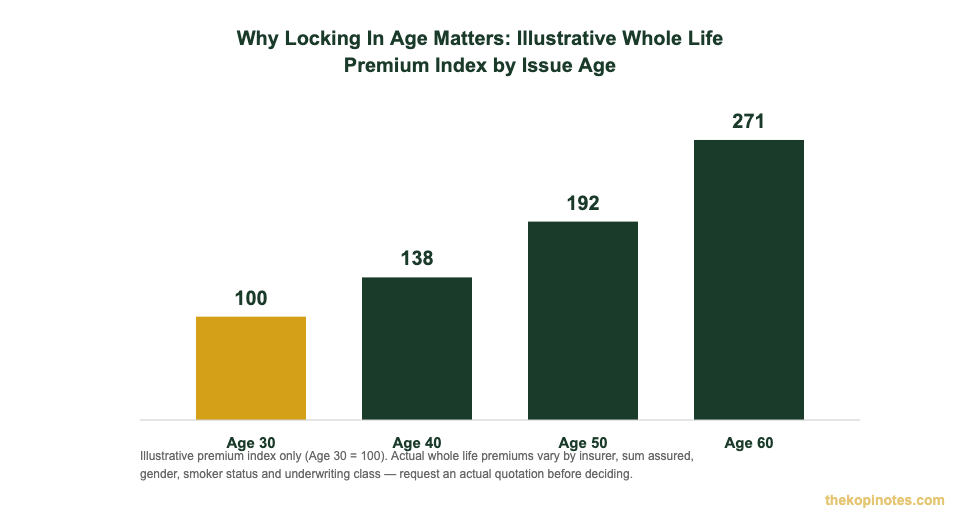
Illustrative index only, Age 30 = 100. Actual premiums depend on insurer, sum assured, gender, smoker status and underwriting class. This is not an insurer quotation.
If you locked in your health class at 30 through a term plan and converted at 40, you might pay a premium roughly in line with an “age 40, healthy non-smoker” rate, even if by then you’ve developed a health condition. If you wait until 60 to convert, or worse, buy fresh at 60 with a new condition on record, your premium could be more than double what it would have been at 40, on top of the risk of exclusions or a decline.
A Singapore investor holding a S$500,000 term policy with a conversion privilege effectively holds an option. Converting sooner locks in a cheaper, cleaner future premium. Waiting keeps your monthly cash flow lower today, but the trade-off compounds the longer you wait.
Should You Actually Convert? Pros and Cons
Converting is not automatically the right move for everyone. Here’s a balanced look before you decide.
When Converting Makes Sense
- Your health has changed since you bought your term plan, and a fresh application would mean higher premiums or exclusions
- You now want permanent, lifelong cover for estate planning, legacy giving, or to leave a payout regardless of when you pass away
- You want a policy with cash value that can support future needs, like supplementing retirement income
- Your term plan is approaching its expiry age and you still want life cover afterwards
When You Might Skip It
- Whole life premiums are meaningfully higher than term. If your budget is tight, converting could strain your cash flow for a benefit you may not need
- You mainly needed cover for a specific period, like your home loan tenure or until your kids are financially independent — term life alone may still suit you
- You’re still in excellent health and could get a competitive quote by shopping the open market instead of converting with just one insurer
However, that said, the “shop the open market” option only works if your health hasn’t changed. If you have any doubt about your future insurability, the conversion privilege is worth protecting, even if you don’t use it right away.
Conversion vs Buying a New Whole Life Policy
Here’s how converting an existing term plan stacks up against buying a fresh whole life policy from scratch.
| Factor | Convert Existing Term Plan | Buy New Whole Life Policy |
|---|---|---|
| Medical underwriting | None — original health class carries over | Full health declaration, possibly a medical exam |
| Insurer choice | Locked to your current term plan’s insurer | Free to compare across all insurers |
| Sum assured | Capped at your term plan’s original sum assured | Any amount you can qualify and pay for |
| Timing | Must convert before the cut-off age (65-70) | No deadline, but premiums rise every year you wait |
| Best for | Anyone whose health has changed, or who wants to lock in certainty | Healthy applicants who want the widest choice of insurers and plans |
Source: The Kopi Notes analysis based on standard Singapore life insurance underwriting practices and insurer product terms, August 2026.
In practice, many financial advisers suggest treating the conversion privilege as insurance for your insurability. You don’t have to use it. But if your health takes a turn, having that option locked in could save you from being declined cover altogether.
Step-by-Step: How to Exercise Your Conversion Privilege
If you already own a term policy with a conversion privilege, here’s how the process generally works in Singapore.
- Check your policy contract. Look for a clause titled “Conversion Privilege” or “Conversion Option”. Your Great Eastern GREAT Term 2, AIA Secure Flexi Term, or Manulife ManuProtect Term (II) policy summary will state whether this applies to your plan.
- Confirm the cut-off age. This is usually the policy anniversary just before you turn 65 or 70. Missing this window means you lose the privilege permanently.
- Choose your target plan. Ask your insurer which whole life, endowment or ILP products are eligible for conversion. Not every product in the insurer’s range may qualify.
- Decide full or partial conversion. You can usually convert your entire sum assured, or just part of it, keeping the remainder as term cover.
- Submit the conversion request. This is done through your financial adviser or the insurer directly. No new health declaration is needed for the eligible portion.
- Review the new premium. Your new premium is calculated using your original age and health class, but priced at current rates for your attained age. Compare this against what a fresh application might cost you today.
Common Mistakes to Avoid
A few slip-ups can cost you the entire benefit of a conversion privilege. Watch out for these.
- Missing the cut-off age. Once you pass the deadline, usually your policy anniversary at age 65 or 70, the privilege disappears for good. Set a reminder years in advance.
- Assuming every term plan has this feature. Not all Singapore term policies include a conversion privilege. If yours doesn’t, this article’s strategy won’t apply to your specific policy — check your contract.
- Forgetting the sum assured cap. You cannot convert to a higher sum assured than your original term plan. If you need more coverage, you’ll need a separate new application for the difference, which does require underwriting.
- Not comparing against a fresh quote if you’re still healthy. If nothing has changed health-wise, it’s still worth getting a quote from other insurers before committing to convert, since you might find a better-value permanent plan elsewhere.
- Overlooking that it’s a one-time option. Most insurers only let you exercise the conversion privilege once. Think carefully about the amount and timing before you use it.
Related Reading
For more on how term life insurance works in Singapore, see our reviews of AIA Secure Flexi Term and Singlife Elite Term II, or read our comparison of MRTA vs term life insurance if you’re deciding how to protect your home loan. To work out how much cover you actually need, try our Singapore retirement calculator.
Frequently Asked Questions
What is a conversion privilege in term life insurance?
Which Singapore insurers offer term life plans with a conversion privilege?
Do I need a medical exam to convert my term policy?
Can I convert only part of my term life policy?
What happens if I miss the conversion cut-off age?
Is converting always cheaper than buying a new whole life policy?
Can I convert to any whole life plan I want?
Disclaimer: This article is for general educational purposes only and does not constitute financial or insurance advice. Conversion privilege terms, cut-off ages and eligible plans can change — always verify current terms directly with your insurer or a licensed financial adviser before making a decision. Data verified as at August 2026.
Get Free Insurance Advice
Speak with a licensed insurance advisor. No obligation, no cost.
By submitting this form, you agree to our Privacy Policy.
This article was researched with the help of AI. While we strive to keep all information accurate and up to date, there may be errors. If you notice any discrepancies, please contact us.