How to Start Investing in Singapore with $100: The 2026 Mini-Portfolio Guide
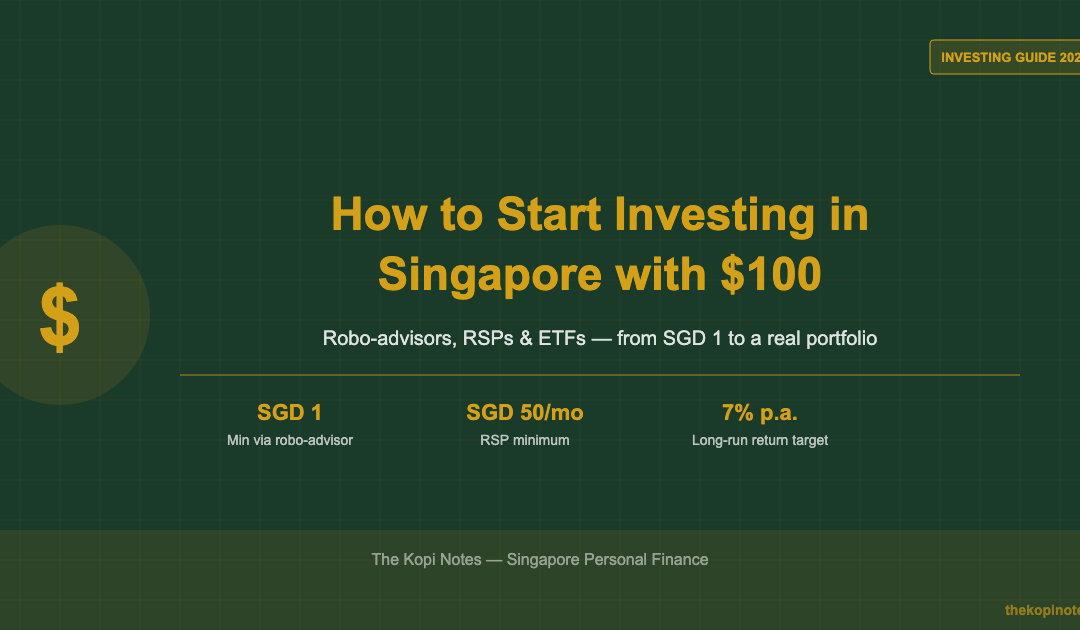
From robo-advisors to regular savings plans — build your first portfolio with as little as SGD 1.
You can start investing in Singapore with as little as SGD 1 through a robo-advisor like Syfe, or SGD 50 a month through FSMOne’s Regular Savings Plan. Direct brokerage platforms like Moomoo let you buy US stocks from just one share. You do not need SGD 10,000 to begin — this guide shows you exactly how to build a real portfolio starting at $100, and what it could grow into over time.
Not financial advice. All figures are for educational reference only. Data verified as at 15 September 2026.
- Syfe and StashAway accept from SGD 1 — the easiest entry point for absolute beginners
- FSMOne RSP lets you invest in ETFs from SGD 50/month with low fees on eligible funds
- SGD 100/month at 7% p.a. grows to over SGD 17,000 in 10 years — start as early as possible
Table of Contents
Contents — Click to expand
- Can You Really Invest With Just $100 in Singapore?
- Platform Comparison: Where to Start
- Regular Savings Plans (RSPs) Explained
- Robo-Advisors for Small Investors
- Direct Brokerage: When to Upgrade
- What SGD 100/Month Grows To
- Step-by-Step: Your First Investment
- Common Mistakes Beginners Make
- Frequently Asked Questions
Can You Really Invest With Just $100 in Singapore?
Yes — and you have more options today than any previous generation of Singapore investors. Ten years ago, buying Singapore stocks required a full board lot of 100 shares. A blue-chip stock at SGD 3 meant SGD 300 minimum just to get started. Many unit trusts carried sales charges of 3–5% on top of that.
Today, three main routes open the door from $100 or less:
- Robo-advisors — Syfe and StashAway both accept from SGD 1. You deposit any amount and they invest it in a diversified portfolio of ETFs automatically.
- Regular Savings Plans (RSPs) — FSMOne and POEMS let you invest a fixed monthly amount from SGD 50 into ETFs with no sales charge on eligible funds.
- Direct brokerage — Moomoo offers 0% lifetime commission on US stocks, where single shares can cost under USD 10 for many blue chips.
The single most important decision is just starting. Even SGD 100 a month, invested consistently, compounds into a meaningful sum over a decade. The growth table in this guide shows you exactly how much.
Platform Comparison: Where to Start
Before choosing a platform, understand what you’re optimising for. For beginners, simplicity and low minimums matter more than maximum flexibility. Here is how the main options stack up for a $100 starting budget.
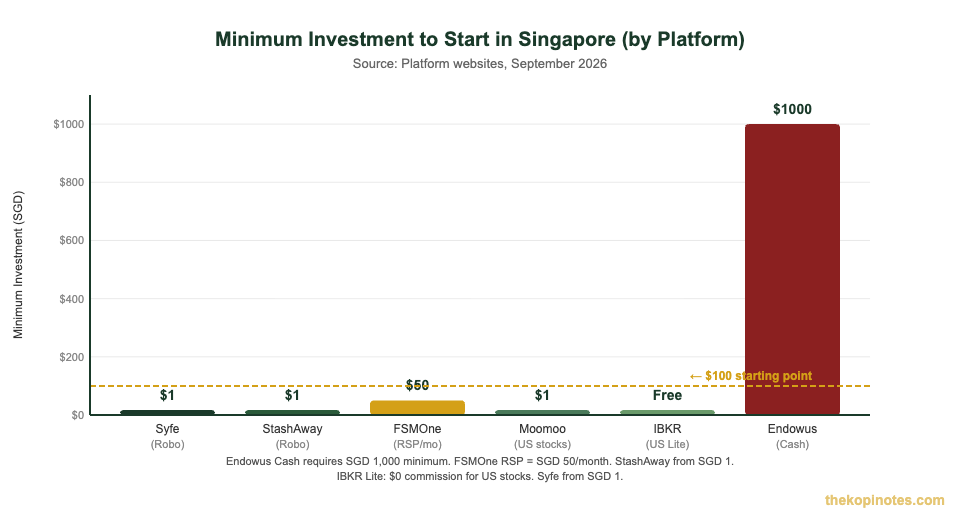
| Platform | Min. Investment | Fees | Best For |
|---|---|---|---|
| Syfe | SGD 1 | 0.25%–0.65% p.a. | Beginners, hands-off investing |
| StashAway | SGD 1 | 0.2%–0.8% p.a. | Risk-managed portfolios |
| FSMOne RSP | SGD 50/month | 0% on eligible ETFs | DIY ETF buyers, self-directed |
| Moomoo | 1 share (US) | 0% US stocks + USD 0.99 platform fee | US stocks, active traders |
| IBKR (Lite) | USD 0 | 0% US stocks; 0.08% SGX (min SGD 2.50) | LSE ETFs, advanced investors |
| Endowus | SGD 1,000 | 0.30%–0.40% p.a. (CPF/SRS) | CPF/SRS investing, fund platform |
Source: Platform websites, September 2026. Fees shown are platform fees excluding fund-level TERs.
Regular Savings Plans (RSPs) Explained
A Regular Savings Plan (RSP) lets you invest a fixed amount each month into an ETF or unit trust automatically. The platform buys units on your chosen date, regardless of price. This is called dollar-cost averaging — you buy more units when prices fall, fewer when they rise, smoothing out volatility over time.
For a deeper look at all RSP providers in Singapore and how to pick one, see our complete guide to Regular Savings Plans in Singapore.
Why FSMOne RSP works well for beginners:
- From SGD 50/month — you can build a real portfolio on a tight budget
- 0% sales charge on eligible ETFs (including the SPDR Straits Times Index ETF — ES3)
- Automated — set it up once and the platform handles the rest
- No need to time the market — monthly automation removes emotion from investing
Other RSP options: POEMS (from SGD 100/month), DBS digiPortfolio, and Maybank (for selected unit trusts). Each has different eligible funds and fee structures. FSMOne is generally most cost-effective for ETF RSPs.
The limitation: RSPs work best with a 1–3 year minimum commitment. If you plan to withdraw within months, the approach loses its dollar-cost-averaging benefit. RSPs are a long-game strategy.
Robo-Advisors for Small Investors
A robo-advisor manages a portfolio of ETFs on your behalf. You answer a short risk profile questionnaire, choose a portfolio, and the platform handles allocation, rebalancing, and dividends automatically. No market knowledge needed.
Syfe (use our Syfe referral code when signing up for a fee waiver period): From SGD 1. Annual fee 0.25%–0.65% depending on portfolio size. Core portfolios include Equity 100, Core Growth, Core Defensive, and Syfe REIT+. Their Cash+ product is a cash management account, not an equity investment.
StashAway: From SGD 1. Annual fee 0.2%–0.8% by portfolio size using a decreasing tiered structure. Their ERAA (Economic Regime-based Asset Allocation) framework adjusts portfolio allocation based on economic conditions — a more active approach vs. simple index tracking.
Endowus (use our Endowus referral code for a fee rebate): SGD 1,000 minimum for Cash portfolios. More suitable once your portfolio has grown. Endowus is particularly strong for CPF and SRS investing at lower fees than typical unit trust platforms.
Which robo-advisor is right for you? If you have SGD 100 to start, Syfe is the most accessible. Once you reach SGD 5,000–10,000, compare all three in detail. See our guide to the best robo-advisors in Singapore for a full fee and portfolio breakdown.
Direct Brokerage: When to Upgrade
Direct brokerage means you buy ETFs or stocks yourself, on an exchange, and hold them in your own account. No platform manages anything for you — which is both the advantage (lower fees at scale, full control) and the disadvantage (requires knowledge, no automation).
For a $100 starting portfolio, direct brokerage is rarely the best first step. However, it becomes increasingly attractive as your portfolio grows past SGD 5,000–10,000 — because robo-advisor fees of 0.25–0.65% p.a. add up significantly on larger sums.
Best brokerages for Singapore investors moving to direct investing:
- Moomoo: 0% commission on US stocks (lifetime for eligible users), plus USD 0.99 platform fee per trade. After year 1 promo, SGX stocks cost 0.03% min SGD 0.99. Great for US stocks and ETFs on US exchanges.
- IBKR (Interactive Brokers): 0% commission for US stocks on IBKR Lite. For SGX stocks: 0.08% min SGD 2.50. For LSE ETFs (like CSPX or VWRA for Ireland-domiciled tax efficiency): flat commissions typically under USD 2 per trade. IBKR is the preferred platform for Singapore investors building an ETF portfolio on the London Stock Exchange. Use referral code jianxiong368 when opening your account.
- FSMOne (brokerage account, not RSP): SGD 10 min commission for SGX stocks, USD 8.80 for US stocks. More expensive per trade, but FSMOne’s FSMOne referral code gives you a cash bonus on sign-up. Strong for Singapore unit trusts and bond funds.
What SGD 100/Month Grows To
This is the number that should inspire you to start immediately. Compounding is the single most powerful force in personal finance — and time is the only ingredient that cannot be bought.
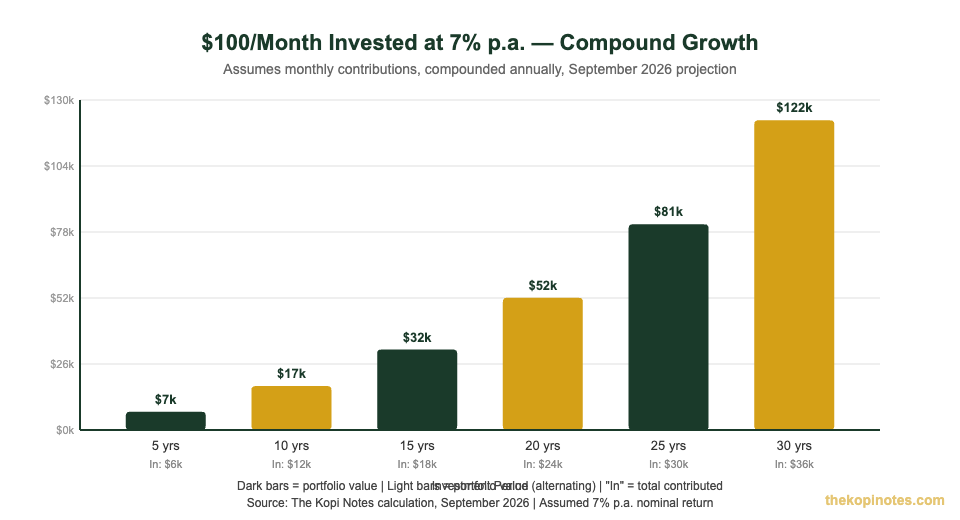
| Years Invested | Total Contributed | Portfolio Value at 7% p.a. | Gain from Compounding |
|---|---|---|---|
| 5 years | SGD 6,000 | SGD 7,159 | SGD 1,159 |
| 10 years | SGD 12,000 | SGD 17,409 | SGD 5,409 |
| 20 years | SGD 24,000 | SGD 52,093 | SGD 28,093 |
| 30 years | SGD 36,000 | SGD 121,997 | SGD 85,997 |
Source: The Kopi Notes calculation, September 2026. Assumes 7% p.a. nominal return, compounded monthly. For illustration only — actual returns vary.
Over 30 years, you contribute SGD 36,000. Your portfolio grows to SGD 121,997. The additional SGD 85,997 is pure compound return — money that your money earned. That is why starting at 25 produces dramatically better outcomes than starting at 35.
Use our Singapore retirement calculator to model your own contribution amounts, return assumptions, and target retirement date.
Step-by-Step: Your First Investment in Singapore
Here is the exact sequence to go from SGD 100 sitting in your bank account to an active investment portfolio.
Step 1: Build your emergency fund first. Before investing any amount, ensure you have 3–6 months of living expenses in a liquid, safe account. High-yield savings accounts like GXS Bank (2.68% p.a. bonus interest as at September 2026) or MariBank serve this purpose. Investing money you might need in an emergency forces you to sell at the worst possible time.
Step 2: Define your investment goal. Is this for retirement? A house downpayment in 5 years? A passive income stream? Your goal sets your time horizon. Retirement in 30 years can tolerate higher equity exposure (more stocks). A house deposit in 3 years needs lower risk (bonds, cash management).
Step 3: Choose your starting platform. For most beginners starting with SGD 100: open a Syfe account. It takes 10 minutes, the minimum is SGD 1, and you can start with a Core Growth or Equity 100 portfolio immediately. If you prefer the RSP route, open an FSMOne account and set up a SGD 50–100/month RSP into an index ETF.
Step 4: Automate your monthly transfer. Set up a recurring GIRO or bank transfer from your salary account to your investment account on the same day each month — ideally 1–3 days after your pay arrives. Automation removes willpower from the equation. Treat your investment like a fixed bill.
Step 5: Review quarterly, not daily. Checking your portfolio daily causes anxiety and often leads to panic decisions. Set a calendar reminder once per quarter to review whether your allocation still matches your goal. Otherwise, leave it alone.
Step 6: Increase contributions when your income grows. Every time you get a pay raise, direct 50% of the increase to your investment account. This approach — known as lifestyle creep prevention — is how ordinary Singaporeans build significant portfolios over time.
For more depth on the CPF dimension: your CPF Ordinary Account (OA) earns a guaranteed 2.5% p.a. and is eligible for investment through CPFIS. Read our CPF investment strategy guide to understand when investing your CPF OA makes sense and when it doesn’t.
And if building passive income in Singapore is your goal, the same $100/month strategy can be directed toward dividend-paying S-REITs or dividend ETFs once your knowledge and portfolio size grow.
Common Mistakes Beginners Make
1. Waiting for the “perfect time to invest”. There is no perfect time. Markets will always seem uncertain. An investor who starts in January and buys at the peak still outperforms the one who never starts, given a 10-year time horizon. Start with SGD 100 this month — not after the next election, rate decision, or market dip.
2. Picking individual stocks instead of ETFs. Most retail investors who pick individual stocks underperform a simple index ETF over 10 years. That is not a personal failure — it is true of 80%+ of professional fund managers too. A diversified ETF like CSPX (S&P 500 UCITS ETF on LSE) or VWRA (FTSE All-World) gives you exposure to hundreds of companies at once for 0.07–0.22% p.a. in fees.
3. Ignoring fees. A 1% annual fee difference sounds negligible. On a SGD 50,000 portfolio held for 20 years at 7% p.a. gross, the fee difference costs you approximately SGD 20,000 in foregone returns. Use low-cost platforms and low-TER ETFs.
4. Panic-selling during market downturns. Every decade includes at least one major market crash. The 2008 Global Financial Crisis, the 2020 COVID crash, the 2022 rate-hike selloff. In each case, the investors who held — and kept buying — recovered fully and went on to new highs. The investors who sold at the bottom locked in losses permanently.
5. Investing before paying high-interest debt. A credit card balance at 24% p.a. interest is a guaranteed negative return. A stock market returning 7% p.a. cannot beat paying off 24% debt. Clear high-interest consumer debt before investing any surplus.
6. Treating crypto and leverage products as “investing”. Crypto, 3x leveraged ETFs, structured products, and CFDs are speculative instruments. They have a role for informed traders who understand the risks. They are not a substitute for a diversified, long-term equity portfolio. Keep your SGD 100/month in boring, globally diversified ETFs.
Frequently Asked Questions
Can I start investing in Singapore with just $100?
Yes. Robo-advisors like Syfe and StashAway accept from SGD 1 — so $100 is more than enough. FSMOne’s Regular Savings Plan starts from SGD 50 per month. For direct brokerage, Moomoo lets you buy single shares of US stocks for as little as USD 5–20. You do not need a large lump sum to begin — consistency matters far more than starting amount.
Which platform is best for investing $100 in Singapore?
For absolute beginners, Syfe is the easiest — SGD 1 minimum, automatic rebalancing, and licensed by MAS. If you prefer to choose your own ETFs and automate monthly purchases, FSMOne’s RSP from SGD 50/month with 0% fees on eligible ETFs is an excellent option. For those comfortable with direct brokerage, Moomoo offers 0% lifetime commission on US stocks plus a USD 0.99 platform fee per trade. There is no single “best” — it depends on how hands-on you want to be.
How much does $100 a month grow to in Singapore?
At a 7% p.a. nominal return (compounded monthly), SGD 100/month grows to approximately SGD 7,159 after 5 years, SGD 17,409 after 10 years, SGD 52,093 after 20 years, and SGD 121,997 after 30 years. Your total cash contributed over 30 years is just SGD 36,000 — the remaining SGD 85,997 is pure compound return. These figures are for illustration; actual returns vary and are not guaranteed.
Can I invest $100 using CPF or SRS?
Your CPF Ordinary Account (OA) earns a guaranteed 2.5% p.a. and you can invest CPF OA via the CPF Investment Scheme (CPFIS) — but only after maintaining a SGD 20,000 balance in your OA. SRS (Supplementary Retirement Scheme) contributions reduce your taxable income and can be invested through platforms like Endowus and FSMOne. For most beginners starting with $100 in cash, a robo-advisor or RSP in your regular bank account is simpler. CPF and SRS investing become more valuable once you understand the tax implications.
Is $100 enough to buy Singapore stocks (SGX)?
Most SGX-listed stocks trade in board lots of 100 shares. A stock priced at SGD 3 costs SGD 300 for one lot — already above $100. SGX also has an odd-lot market where you can buy fewer than 100 shares, but liquidity is low and spreads can be wide. For investors with $100 wanting Singapore equity exposure, an FSMOne RSP into the SPDR Straits Times Index ETF (ES3) or Lion-OCBC Securities Hang Seng Tech ETF is more practical than buying individual SGX stocks in odd lots.
What is the safest way to invest $100 in Singapore?
If capital preservation is your priority, the Singapore Savings Bond (SSB) offers a government-backed return with a SGD 500 minimum per application — just above $100, so this requires slightly more. Singapore T-bills (minimum SGD 1,000) are another capital-safe option. For amounts under $500, a high-yield savings account (GXS, MariBank) or a money market fund via Syfe Cash+ earns 3–4% p.a. with daily liquidity. If you can accept short-term volatility for long-term growth, a diversified equity ETF via a robo-advisor offers higher expected returns over 10+ year horizons.
Ready to Start Investing in Singapore?
Open an account today and put your first $100 to work. Use our referral links for exclusive sign-up bonuses.
This article was researched with the help of AI. While we strive to keep all information accurate and up to date, there may be errors. If you notice any discrepancies, please contact us.