Term Life Insurance Riders Singapore 2026: Which Add-Ons Are Worth It?
Your base term life plan covers death and terminal illness. Riders extend that coverage for a price. Some are worth every cent. Others duplicate what you already have. This guide covers the five most common riders in Singapore and when to add them.
Data verified as at 11 September 2026. This is general information, not financial advice. Speak to a licensed financial adviser before making changes to your policy.
Table of Contents
What Is a Term Life Rider?
A rider is an optional add-on that sits on top of your base term life policy. You pay an extra premium for it. In return, you get coverage for events the base plan does not pay out on: disability, critical illness diagnosis, accidental death, or premium relief during illness.
Not all riders are equal. Some provide genuine protection that you would otherwise need a separate policy for. Others pay out only in narrow circumstances or overlap with government schemes you already have.
The main thing to check: does the rider pay as a standalone benefit, or does it reduce your death sum assured when it pays out?
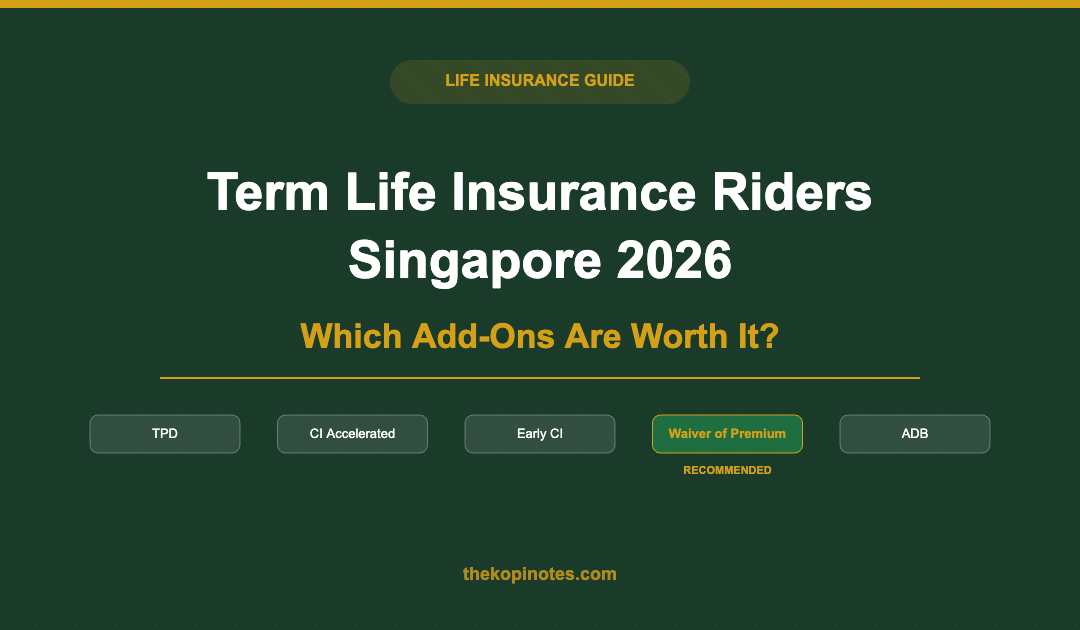
The 5 Main Term Life Riders in Singapore
These are the riders most major insurers — AIA, FWD, Great Eastern, Manulife, Etiqa, Tokio Marine — attach to their term plans.
| Rider | What It Does | Benefit Type |
|---|---|---|
| Total & Permanent Disability (TPD) | Pays out if you become totally and permanently disabled | Accelerated or standalone, depends on plan |
| CI Accelerated | Pays SA on diagnosis of a covered critical illness | Accelerated — reduces death benefit |
| Early CI | Adds early and intermediate stage CI coverage | Standalone or accelerated, depends on insurer |
| Waiver of Premium (WOP) | Waives future premiums if you are disabled or diagnosed with CI | Premium relief — base plan stays active |
| Accidental Death Benefit (ADB) | Pays an additional lump sum if death is accidental | Standalone — stacks on top of death SA |
1. Total and Permanent Disability (TPD) Rider
A TPD rider pays your sum assured if you become totally and permanently disabled before a specified age, usually 65 or 70. Many base term plans include TPD coverage up to age 65 as standard. Check your policy schedule before paying for a separate TPD rider.
The definition matters. “Any occupation” TPD requires you to be unable to perform any paid work at all. “Own occupation” TPD pays out if you cannot return to your specific job — a higher bar that is easier to trigger. Most Singapore term plans use “any occupation,” which is the stricter test.
If your base plan already includes TPD coverage up to the same sum assured and age, the standalone rider adds nothing. If the base plan TPD ends at 65 and you want coverage to 70, the rider may be worth it.
2. Critical Illness Accelerated Rider
This rider pays your sum assured early — on diagnosis of a covered critical illness. The catch: it is accelerated, not standalone. If you claim S$500,000 on a cancer diagnosis, your death benefit drops to zero. Your family gets nothing extra when you die.
The LIA 2024 critical illness framework covers 37 conditions across three severity tiers: early, moderate, and severe. A standard CI accelerated rider typically pays out at the severe tier only. Early and intermediate stage diagnoses are not covered.
If you need separate CI cover that does not erode your life insurance, a standalone CI plan is cleaner. The accelerated rider is most useful when budget is tight and you cannot afford both a full life plan and a standalone CI plan.
3. Early Critical Illness Rider
The early CI rider extends coverage to the early and moderate severity tiers of the LIA framework, not just the severe tier. You can claim at stage 1 cancer, a minor stroke, or an early-stage heart condition, before the disease becomes life-threatening.
Early-stage diagnosis gives you capital to recover before finances deteriorate. Late-stage diagnosis, by contrast, often comes after months of lost income and mounting medical costs. We covered the actual cost gap in our early vs late stage CI guide.
Early CI riders carry a higher premium than standard CI riders — often 20 to 40% more for the same sum assured. Whether that premium is worth it depends on family medical history and how deep your emergency fund is.
4. Waiver of Premium (WOP)
If you are disabled or diagnosed with a covered illness, the WOP rider waives all future premiums on your base plan. Your coverage stays in force without you paying another cent. The rider itself carries a small annual premium, usually under S$100 per year for a healthy applicant in their 30s.
The logic is sound: the moment you need your life insurance most is also the moment your income is most at risk. Without the WOP rider, a disability or serious illness could cause you to lapse your policy exactly when your family depends on it.
This is one of the cheaper riders and one of the more consistently useful ones. Most licensed financial planners recommend it as a default add-on.
5. Accidental Death Benefit (ADB)
The ADB rider pays an additional lump sum — usually equal to your base sum assured — if your death is caused by an accident. A S$500,000 base plan with an ADB rider would pay S$1,000,000 on accidental death but S$500,000 on death by illness.
The problem: it only pays if the cause of death is accidental. In Singapore, the leading causes of death are cancer (26.5%), ischaemic heart disease (19.6%), and pneumonia, based on MOH 2024 data. Accidents account for a much smaller share. You are paying for a benefit that is statistically unlikely to trigger.
If your heirs would need exactly twice the sum assured in accidental scenarios but not in illness scenarios, the ADB rider makes sense. Otherwise, that premium is better spent increasing your base sum assured, which pays regardless of cause of death.
Riders Worth Adding (for Most People)
Waiver of Premium. The cost is low. The protection is concrete. If you are diagnosed with a serious illness or become disabled, the last thing you want to manage is a lapsing life policy. Add it by default unless your insurer includes premium waiver in the base plan.
Early CI rider — if you do not already have a standalone early CI plan. The LIA 2024 framework’s three-tier structure means early-stage diagnoses, which come with their own recovery costs and income disruption, are only covered if you have this rider or a standalone early CI policy. If you already have a separate early CI plan, skip this rider.
TPD rider beyond age 65 — if your base plan’s TPD coverage ends at 65. Most working Singaporeans now plan to work past 65. A disability at 67 or 68 is still a financial catastrophe if your coverage has already ended.
Riders to Question
CI Accelerated rider — if the accelerated payment erodes the death benefit your family depends on, the structure may not fit your plan. A standalone CI policy costs more but keeps both buckets of cover separate and intact. If your total insurance budget is tight, the accelerated rider may be the only option available. That is a real trade-off, not a mistake.
ADB rider — statistical probability of accidental death in Singapore is low. That premium is usually better directed toward a higher base sum assured, which pays regardless of cause of death.
How to Decide: Three Questions
Before adding any rider, ask three things.
First: do you already have this coverage elsewhere? Check existing policies, group insurance from work, and CPF DPS before adding TPD or CI riders.
Second: is this a standalone benefit or accelerated? Accelerated riders reduce your death SA. If your family plan depends on the full death SA, that erosion matters.
Third: what does the trigger actually look like? Read the exact definition, not the marketing summary. “Any occupation” TPD is much harder to trigger than “own occupation.” Knowing what it takes to claim helps you assess the value honestly.
For a detailed breakdown of how much term life coverage you need, start there before deciding which riders to layer on top.
Frequently Asked Questions
Can I add riders to my existing term life plan?
Does a CI rider replace a standalone critical illness plan?
What is the difference between accelerated and standalone rider benefits?
Are term life riders worth it for young adults?
How do I find out if my current plan already includes TPD?
Get Free Insurance Advice
Speak with a licensed insurance advisor. No obligation, no cost.
By submitting this form, you agree to our Privacy Policy.
This article was researched with the help of AI. While we strive to keep all information accurate and up to date, there may be errors. If you notice any discrepancies, please contact us.