SSB October 2026 Hits a 14-Month High at 2.32% — Here Is What It Means for You
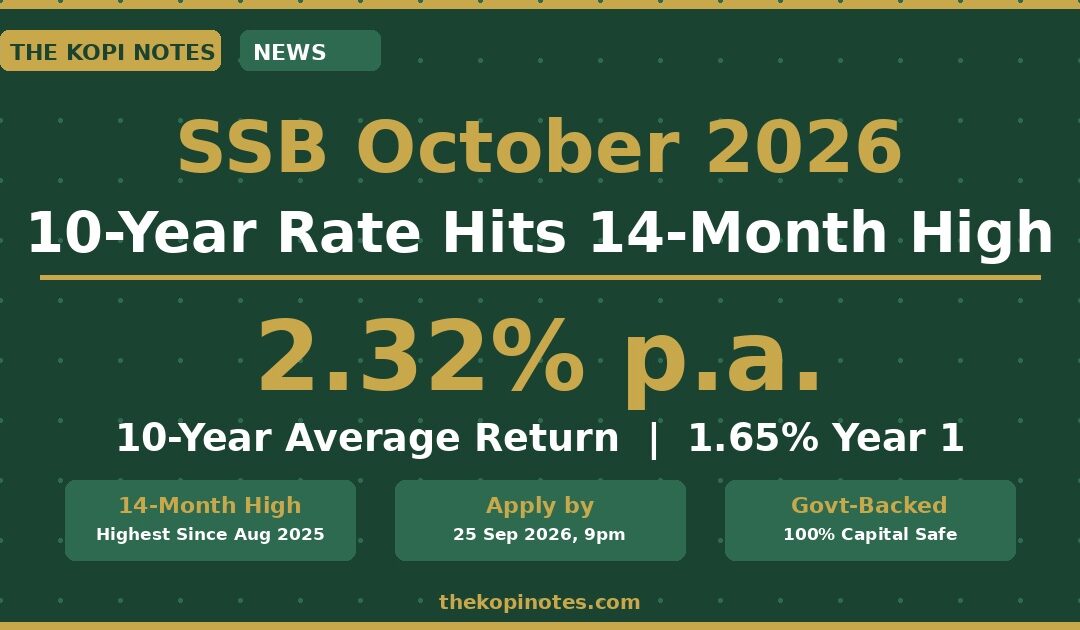
The October 2026 Singapore Savings Bond (SBOCT26) has just hit a 14-month high, offering a 10-year average return of 2.32% p.a. and a first-year rate of 1.65% p.a. — the strongest reading since August 2025. With applications closing 25 September 2026, here is everything Singapore retail investors need to know before deciding whether to apply, skip, or recycle older bonds.
This is an editorial analysis. Not financial advice. Data verified as at 8 September 2026.
What Is SSB October 2026 Offering?
The Monetary Authority of Singapore (MAS) has released the October 2026 Singapore Savings Bond tranche — issue code SBOCT26 (GX26100Z). This is the third consecutive month where SSB yields have climbed, snapping the prolonged low-yield stretch that defined late 2025 and early 2026.
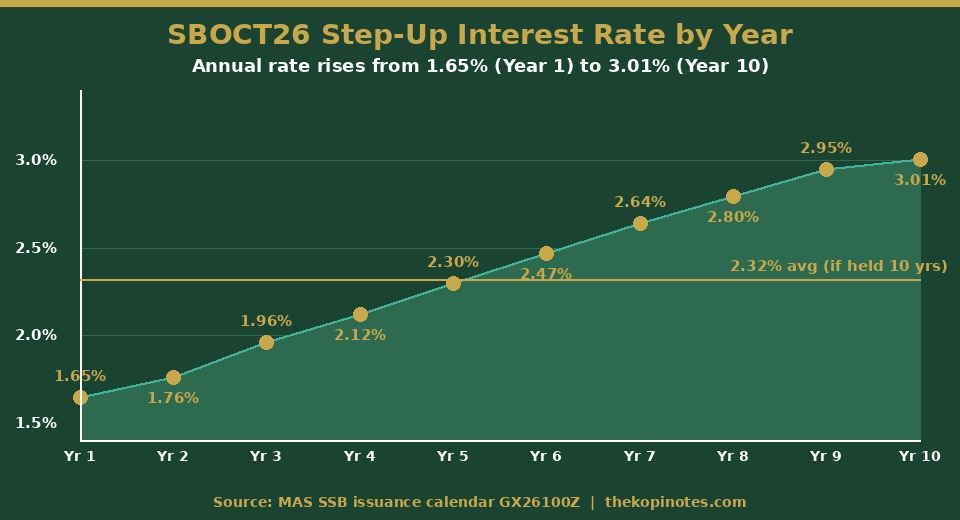
The headline numbers are simple: invest today, earn 1.65% in Year 1, and if you hold for the full 10 years, you average 2.32% p.a. over the entire period. Because SSB uses a step-up coupon structure, your effective annual interest rises each year — starting at 1.65% and climbing to 3.01% by Year 10.
Key application details for SBOCT26:
- Issue code: SBOCT26 / GX26100Z
- Amount offered: S$400 million
- Application opens: 1 September 2026, 6pm
- Application closes: 25 September 2026, 9pm
- Allotment date: 28 September 2026
- Issue (start earning interest): 1 October 2026
- First interest payment: 1 April 2027
- Maturity: 1 October 2036
Applications are via DBS/POSB, OCBC, or UOB internet banking or ATMs, using cash or SRS funds. You can invest from as little as S$500, up to a lifetime individual cap of S$200,000 across all SSB issues. Not sure how SSBs work? Our complete Singapore Savings Bond guide for 2026 covers the full mechanics from application to redemption.
Year-by-Year Step-Up Rates for SBOCT26
One of SSB’s most powerful but underappreciated features is its step-up structure. The longer you hold, the higher your annual interest. Here is exactly how SBOCT26 compounds if you hold it to full maturity:
| Year | Annual Interest (% p.a.) | Cumulative Average Return (% p.a.) |
|---|---|---|
| 1 | 1.65% | 1.65% |
| 2 | 1.76% | 1.71% |
| 3 | 1.96% | 1.79% |
| 4 | 2.12% | 1.87% |
| 5 | 2.30% | 1.96% |
| 6 | 2.47% | 2.04% |
| 7 | 2.64% | 2.13% |
| 8 | 2.80% | 2.21% |
| 9 | 2.95% | 2.29% |
| 10 | 3.01% | 2.32% |
Source: MAS SSB issuance calendar (GX26100Z), compiled September 2026.
Use our SSB interest calculator for Singapore to model exactly how much you will earn based on your investment amount and planned holding period.
The key insight from this table: even if you redeem in Year 5, you lock in a blended 1.96% p.a. — better than most bank fixed deposit rates available today. By Year 7 you are earning 2.64% annually on that tranche. The math strongly rewards patience.
How SBOCT26 Compares to Recent Tranches
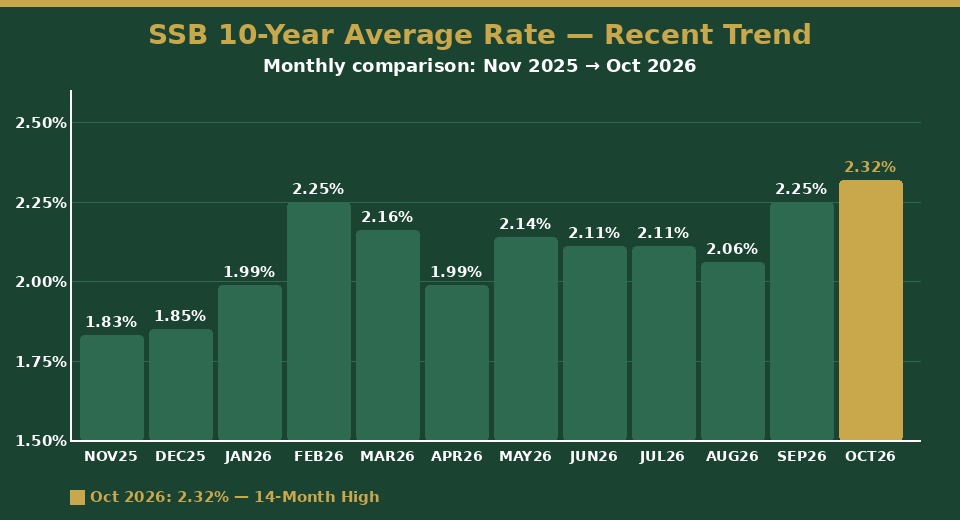
To appreciate just how significant this rate jump is, let us look at the past 14 months of SSB data. The October 2026 issue is the highest 10-year average rate since August 2025 and represents the third straight month of gains after the cycle trough in November 2025.
| Issue | Month | Year-1 Rate | 10-Yr Average | Status |
|---|---|---|---|---|
| SBOCT26 | Oct 2026 | 1.65% | 2.32% | 14-Month High ↑ |
| SBSEP26 | Sep 2026 | 1.52% | 2.25% | Rising ↑ |
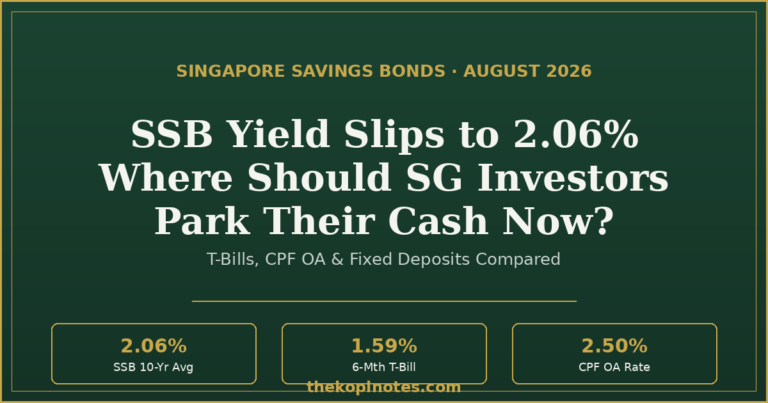
| SBAUG26 | Aug 2026 | 1.46% | 2.06% | Rebounding ↑ |
| SBJUL26 | Jul 2026 | 1.46% | 2.11% | Steady |
| SBJUN26 | Jun 2026 | 1.46% | 2.11% | Flat |
| SBMAY26 | May 2026 | 1.40% | 2.14% | Gradual rise |
| SBFEB26 | Feb 2026 | 1.35% | 2.25% | Temporary spike |
| SBJAN26 | Jan 2026 | 1.33% | 1.99% | Range-bound |
| SBDEC25 | Dec 2025 | 1.35% | 1.85% | Near trough |
| SBNOV25 | Nov 2025 | 1.39% | 1.83% | Cycle Trough ↓ |
| SBOCT25 | Oct 2025 | 1.56% | 1.93% | Declining |
| SBAUG25 | Aug 2025 | 1.82% | 2.29% | Previous High |
Source: MAS SSB issuance data, compiled from multiple verified sources, September 2026.
The 10-year average for October 2026 at 2.32% is now 0.49 percentage points above the November 2025 trough. For reference, we covered the August 2026 issue when yields were still rebounding — you can read that analysis in our Singapore Savings Bond August 2026 article.
Why Are SSB Rates Rising in September 2026?
Singapore Savings Bond interest rates are pegged to the average yields of Singapore Government Securities (SGS) — specifically the 1-year to 10-year benchmark bonds — over the calendar month preceding the application opening. The October 2026 SSB therefore reflects SGS yields from August 2026. Three macro forces drove this upward shift.
1. US Federal Reserve “Higher for Longer” Stance
At its July 2026 FOMC meeting, the Fed held rates steady and adopted a data-driven approach, signalling no imminent cuts. With persistent inflationary pressure from Middle East instability and resilient US services sector demand, market pricing has shifted toward expecting a potential rate hike in 2027 — not the rate cuts investors had hoped for in late 2025. As US Treasury yields rose, Singapore’s open, exchange-rate-based economy meant SGS yields followed suit.
2. Steeper SGS Yield Curve
When the gap between short-term and long-term government bond yields widens — a steepening yield curve — SSB step-up returns also become more attractive. August 2026 saw institutional auction demand for long-dated SGS tighten, pushing benchmark 10-year SGS yields higher. This is directly mechanically linked to the 2.32% average you see in October’s SSB tranche.
3. Declining Bank Deposit Rates Creating Demand
As local banks quietly trimmed their promotional fixed deposit rates over 2025 and 2026, SSB’s guaranteed, government-backed step-up structure became comparatively more compelling. Retail demand for the August and September 2026 tranches was notably higher than the lull of late 2025 — a self-reinforcing signal that retail investors are returning to this asset class.
For broader context on Singapore’s macroeconomic environment and what it means for your portfolio, see our editorial: Singapore GDP 5% in 2026: MAS Tightening Risks for Investors.
SBOCT26 vs. Fixed Deposits and High-Yield Savings — The Full Picture
The real question for Singapore retail investors is not whether SSB rates are higher than last year — they clearly are. The question is: does 1.65% in Year 1 and 2.32% over 10 years beat alternatives available right now?
Here is an honest comparison as at September 2026:
| Product | Rate / Return | Lock-In | Capital Safety | Best For |
|---|---|---|---|---|
| SSB Oct 2026 (SBOCT26) | 1.65% Yr1 / 2.32% avg 10-yr | Flexible — monthly redemption | 100% gov-backed | Medium to long-term parking, SRS |
| Bank Fixed Deposits (12-month) | ~1.5%–2.0% p.a. (promo) | Fixed term, penalty for early break | SDIC-insured up to S$100K | Short-term, specific tenor |
| 6-Month T-Bills | ~2.1%–2.3% p.a. (yield varies) | 6 months, non-liquid | Singapore gov-backed | Short-term, higher near-term yield |
| High-Yield Savings Accounts | ~1.5%–2.5% (with conditions) | None — fully liquid | SDIC-insured up to S$100K | Emergency fund, everyday cash |
| Cash Management Accounts | ~1.8%–2.2% (variable) | None — fully liquid | Unit trust, not insured | Liquidity with slightly better yield |
Source: TKN research, bank websites, MAS data. Rates indicative as at September 2026.
The key differentiator for SSB is its combination of flexibility and rate certainty. T-bills may offer a comparable or marginally higher yield right now, but they require you to commit for 6 months and offer no step-up. High-yield savings accounts can change their rates at any time — your 2.5% today could be 1.5% next quarter. SSB locks in a rising schedule for up to 10 years, while still letting you exit every month with no principal loss and just a S$2 transaction fee.
Four Smart Strategies for Singapore Retail Investors
Strategy 1: Park Your Emergency Fund Tier-2 in SSB
Your Tier-1 emergency fund (1-2 months of expenses) should stay in a high-yield savings account for instant liquidity. Your Tier-2 emergency fund (the remaining 2-4 months) is an ideal candidate for SSB. You can still access it within the month if needed, but your money earns a sovereign-backed guaranteed return instead of sitting idle at 0.05% in a basic savings account.
Strategy 2: Optimise Your SRS Account
Uninvested SRS cash earns just 0.05% p.a. inside most bank SRS accounts. Allocating SRS funds into SSB immediately upgrades that to 1.65% in Year 1, rising to 3.01% by Year 10, with full government backing. This is particularly attractive for those approaching 62 (when SRS withdrawals become eligible) who want capital preservation with guaranteed income rather than stock market volatility. The Budget 2026 cost-of-living adjustments have also highlighted the importance of maximising tax-sheltered savings vehicles — see our guide on the Budget 2026 COL Special Payment.
Strategy 3: Bond Recycling — Upgrade Your Low-Yield Holdings
If you bought SSBs during the November or December 2025 tranche (10-year averages of 1.83% and 1.85% respectively), now is the time to consider a bond recycling strategy. Submit a redemption request for those lower-yield tranches — MAS processes it at full par value, so you lose no principal — and redeploy into SBOCT26 at 2.32%. The execution is free (just a S$2 per-transaction fee) and can meaningfully lift the blended yield on your safe-bucket savings over a 10-year horizon.
Strategy 4: Ladder Your SSB Holdings
Rather than putting all your SSB allocation into one tranche, consider laddering — subscribing to 2-3 consecutive tranches over the next few months. If rates continue rising into November 2026 (the 10-year Singapore government bond yield trend as of late August 2026 pointed upward), a ladder lets you capture higher rates as they materialise while still putting idle cash to work now. Think of it like buying equities in tranches rather than all at once. To model your returns across different scenarios, use our SSB interest calculator.
Bottom Line for SG Investors
The October 2026 Singapore Savings Bond at 2.32% p.a. over 10 years and 1.65% in Year 1 is the strongest SSB offering in 14 months. While it remains below the 3%+ peak yields seen in 2023–2024, the trajectory is unmistakably upward and the structural case for SSB has strengthened.
This issue makes the most sense for investors who:
- Hold uninvested SRS cash earning 0.05% and want a low-risk upgrade
- Are sitting on SBNOV25 or SBDEC25 tranches at 1.83%–1.85% and want to recycle into 2.32%
- Want a sovereign-backed, flexible medium-term savings vehicle with certainty over the next decade
- Are near or in retirement and need capital preservation with a predictable income schedule
If you are a growth investor fully deployed in equities or ETFs like CSPX, VWRA, or IWDA, SSB is likely not where your next dollar goes — your expected long-term equity return is significantly higher. But for the risk-free, liquid portion of your portfolio that was previously doing nothing, October 2026’s SSB is the most compelling option in over a year.
Application closes 25 September 2026, 9pm via DBS/POSB, OCBC, or UOB internet banking or ATM. You need a CDP account linked to one of these banks. For first-timers, our Singapore Savings Bond glossary covers all the key terms you need to know.
Frequently Asked Questions
What is the October 2026 SSB (SBOCT26) interest rate?
The SSB October 2026 (SBOCT26) issue offers a first-year interest rate of 1.65% p.a. and a 10-year average return of 2.32% p.a. if held to full maturity. This is the highest 10-year average rate in 14 months, since August 2025. The annual rate steps up each year, reaching 3.01% in Year 10.
When is the deadline to apply for SSB October 2026?
Applications for SBOCT26 close on 25 September 2026 at 9pm. The bond is issued on 1 October 2026, with the first interest payment on 1 April 2027. You can apply via DBS/POSB, OCBC, or UOB internet banking or ATM, using cash savings or SRS funds.
How much can I invest in the October 2026 SSB?
You can invest a minimum of S$500 and up to a lifetime individual cap of S$200,000 across all SSB issues combined. For SBOCT26 specifically, MAS is offering S$400 million in total. Applications above individual limits after all eligible applications are fulfilled may be partially allotted.
Can I redeem my SSB October 2026 early without penalty?
Yes. One of SSB’s key advantages is flexible, penalty-free redemption in any given month. You simply submit a redemption request through your bank before the last business day of the month, and your principal is returned in full at the beginning of the following month. A transaction fee of S$2 per request applies. You keep all interest accrued up to that point.
Should I use SRS funds to buy SSB October 2026?
For most SRS account holders, yes. Uninvested SRS cash earns just 0.05% p.a. at most banks. Moving it into SBOCT26 immediately lifts your return to 1.65% in Year 1 and 2.32% averaged over 10 years, with full Singapore government backing. This is especially attractive for investors 10+ years away from SRS withdrawal age who want a capital-safe foundation in their retirement savings.
Is the October 2026 SSB better than a 6-month T-bill?
It depends on your goals. The 6-month Singapore T-bill currently offers a yield around 2.1%–2.3% — comparable to SSB’s 10-year average but in a shorter 6-month window. If you need your cash back in 6 months, T-bills may suit better. If you want to lock in a guaranteed rate for up to 10 years with monthly exit flexibility, SSB has the structural advantage. For longer-term strategic allocation, SSB’s step-up to 3.01% in Year 10 is hard to match with any bank product today.
What is SSB bond recycling and should I do it now?
Bond recycling means redeeming an older, lower-yielding SSB tranche and reinvesting into a new, higher-yielding issue. If you hold SBNOV25 (1.83% average) or SBDEC25 (1.85% average), upgrading to SBOCT26 at 2.32% is a straightforward improvement with no capital loss, since SSB always redeems at par. The key consideration is timing: you will forgo one month of interest during the transition. If the yield gap (here, roughly 0.47–0.49%) more than compensates over your remaining holding period, recycling makes mathematical sense.
This article was researched with the help of AI. While we strive to keep all information accurate and up to date, there may be errors. If you notice any discrepancies, please contact us.