Critical Illness Insurance Singapore 2026: LIA 2024 Framework, What’s Covered & What’s Not
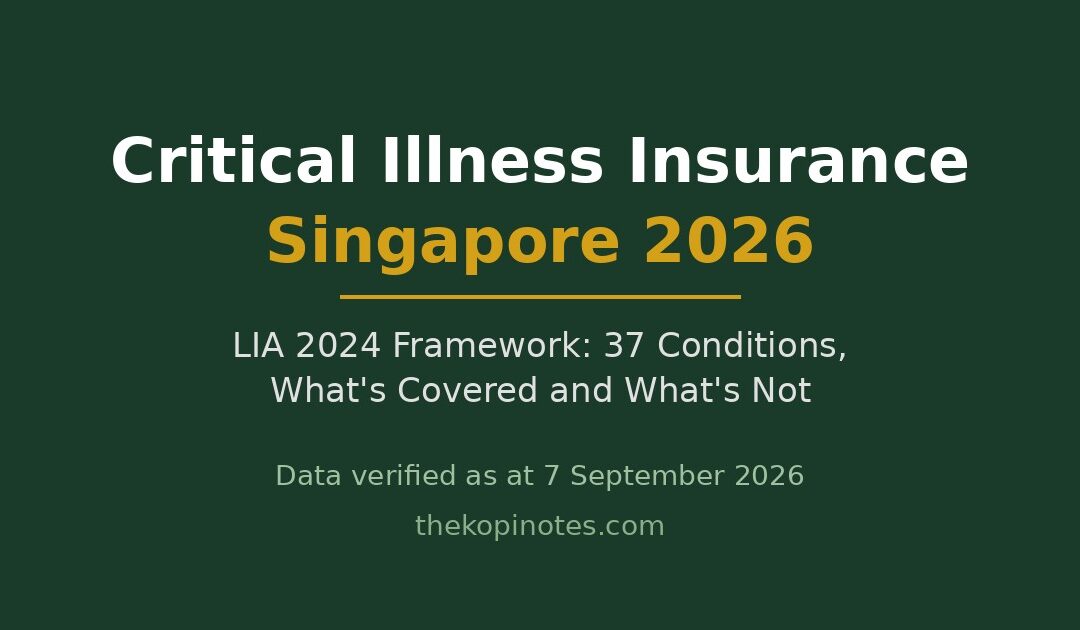
The Life Insurance Association’s updated CI definitions have been in force since 1 October 2025. Here is what the 37 standardised conditions actually require for a payout — and the common reasons claims fail.
Data verified as at 7 September 2026. This article is for educational purposes only and does not constitute financial or insurance advice. Consult a licensed financial adviser for personalised guidance.
Table of Contents
What Is the LIA Critical Illness Framework?
Your CI insurer does not get to decide what counts as cancer or a heart attack. The Life Insurance Association of Singapore (LIA) publishes a Critical Illness Framework that standardises the exact clinical definitions of 37 severe-stage conditions across all member insurers. If your insurer is an LIA member — and virtually all Singapore-licensed life insurers are — their CI policy definitions must meet this minimum standard.
The framework has been updated several times since its introduction: first in 2003, then 2014, then 2019, and most recently the LIA CI Framework 2024, which took effect on 1 October 2025. Any new CI policy sold from that date must use the 2024 definitions. Any policy issued before that date runs on whichever version was current when it was sold.
The framework is reviewed roughly every three years. Its purpose is consistency: the same medical event should not produce wildly different claim outcomes depending on which insurer you chose.
Which 37 Conditions Are Standardised?
The 37 LIA severe-stage conditions span five broad categories. Each has a precise clinical definition — not just a diagnosis label. The categories are:
| Category | Examples |
|---|---|
| Cancers | Major Cancer, Other Serious Coronary Artery Disease |
| Cardiovascular | Heart Attack of Specified Severity, Coronary Artery Bypass Surgery, Open-Heart Heart Valve Surgery, Surgery to Aorta, Primary Pulmonary Arterial Hypertension |
| Neurological | Stroke with Permanent Neurological Deficit, Coma, Persistent Vegetative State, Parkinson’s Disease, Motor Neurone Disease, Multiple Sclerosis, Benign Brain Tumour |
| Organ Failure | Kidney Failure, Chronic Lung Disease, Liver Failure, Major Organ / Bone Marrow Transplantation, Terminal Illness |
| Others | Deafness, Loss of Sight, Loss of Limbs, Severe Burns, Aplastic Anaemia, Fulminant Hepatitis, Muscular Dystrophy, Poliomyelitis, HIV due to Blood Transfusion, and others |
The full list is published by LIA on their website and is worth reading before you buy a CI policy. Two conditions not on the list — early-stage cancer and heart attack at a lower clinical threshold — may be covered under separate early CI riders if your plan includes them. See our guide on multi-pay vs single-pay CI plans for how early and severe stage coverage differs.
What Changed in the LIA 2024 Framework?
Seven definitions were revised and two condition names were reworded. The other 30 carried over unchanged from the 2019 version. Most of the changes widen coverage or improve clarity rather than restrict it.
The seven revised conditions and what changed:
- Major Cancer — pituitary neuroendocrine tumours (PitNET), a WHO-recognised classification since 2022, were added to the exclusion list. This is a clarification, not a coverage cut.
- Coma — a self-inflicted injury exclusion was added, consistent with how every other LIA definition treats self-harm.
- Deafness (Irreversible Loss of Hearing) — audiometric thresholds were reworded for clarity; the thresholds themselves are unchanged.
- Open-Heart Heart Valve Surgery (renamed from “Open Chest Heart Valve Surgery”) — the most consequential change. The definition no longer requires the chest wall itself to be opened, only that a direct incision to the heart is made. Certain newer minimally invasive cardiac techniques can now qualify where the 2019 wording would have led to denial.
- Surgery to Aorta (renamed from “Open Chest Surgery to Aorta”) — name change only; the underlying definition is unchanged.
- Terminal Illness — rewritten to require the treating specialist to document the condition, treatment options considered, and prognosis after treatment before certifying a life expectancy of 12 months or less. Insurers can also appoint an independent specialist to confirm the diagnosis.
- Persistent Vegetative State — removed a redundant requirement that the confirming neurologist hold an appointment at an approved hospital. LIA states this was never intended as a coverage restriction.
- Other Serious Coronary Artery Disease — qualifying stenosis must now be detected in a single invasive angiography report performed in one sitting.
LIA has confirmed this revision is not expected to increase premiums, since the changes clarify scope rather than materially expand it. You can compare which version applies to your policy using the LIA’s published comparison table (Part 3 of the CI Framework 2024 document).
Why a Diagnosis Alone Is Not Enough
Your doctor says you had a heart attack. Your insurer may still deny the claim. This is the most important thing most CI policyholders do not know.
The LIA standard for a heart attack requires elevation of cardiac biomarkers to a specified threshold plus corroborating ECG changes. A mild cardiac event — one your cardiologist describes clinically as a heart attack — may not satisfy the contractual definition. The heart attack definition was untouched by the 2024 revision, so the gap applies to policies under any framework version.
The same logic applies across the 37 conditions. Stroke requires a permanent neurological deficit, not just a transient ischaemic attack or a deficit that resolves. Cancer requires evidence of uncontrolled growth and spread — early-stage presentations with certain histology may be excluded. Organ failure requires specific documented levels of functional loss, not just a transplant or dialysis history.
The practical implication: before a claim event, understand the exact clinical threshold your policy uses. Your policy schedule and the LIA Framework document tell you precisely what is required. Use our CI insurance premium calculator and the insurance gap calculator to size your coverage correctly, keeping the claim thresholds in mind.
Common CI Insurance Exclusions
Even if your diagnosis meets the LIA clinical definition, a claim can still be excluded. The most common standard exclusions in Singapore CI policies are:
- Pre-existing conditions — any condition you were diagnosed with, had symptoms of, or received treatment for before the policy start date. Disclosure is mandatory; non-disclosure voids the policy.
- Self-inflicted injury or suicide attempt — explicitly excluded in most conditions, including the Coma definition added in the 2024 revision.
- HIV/AIDS not from a blood transfusion or occupational exposure — HIV due to blood transfusion is one of the 37 covered conditions; HIV acquired through other means is excluded.
- War, invasion, or acts of foreign enemies — standard exclusion across most life and CI policies.
- Aviation (as crew or in unpressurised aircraft) — common exclusion for death and disability events during commercial flight operations.
- Drug or alcohol misuse — conditions arising directly from substance abuse are typically excluded.
- Congenital conditions — conditions present from birth, if known at the time of application.
Read your policy’s exclusion schedule carefully. Some early CI or supplementary riders may carry additional exclusions specific to those riders. If you are comparing policies, see our life insurance comparison guide for a structured way to evaluate coverage.
Waiting Periods and Survival Periods
Two policy terms that directly affect when you can claim:
Waiting period — a window at the start of the policy during which certain CI claims are not payable. Before November 2022, LIA mandated a standard 90-day waiting period across all member insurers. LIA removed this requirement from November 2022 onwards: each insurer now sets its own waiting period independently. Check your policy’s specific terms — some plans have retained a 90-day window for cancers while offering shorter periods for other conditions.
Survival period — the number of days you must survive after the qualifying diagnosis before a claim is paid. Most Singapore CI policies specify 14 days; a minority use 30 days. The survival period is an insurer-set term, not LIA-standardised. If your policy has a 14-day survival period and you recover before that window, the payout may still trigger at day 14. Check your contract terms for the exact wording.
If you added a CI rider to a term policy, the rider’s waiting and survival periods may differ from a standalone CI plan. See how CI riders work on a term life policy for details.
Does the LIA 2024 Update Affect My Existing Policy?
No. The 2024 Framework applies only to new policies sold from 1 October 2025 onwards. If your policy was issued before that date, it runs on whichever version was current at inception — typically the 2019 or 2014 framework. LIA does not retroactively upgrade existing policies.
This matters for two reasons. First, some 2019 definitions are more restrictive than the 2024 equivalents — particularly for Open-Heart Heart Valve Surgery, which previously required the chest wall to be fully opened. Second, policies issued before 2019 may carry even older clinical thresholds that predate widespread medical advances.
If your policy is old and you are concerned about your specific conditions, you can request a comparison of your policy’s exact definition wording against the current LIA Framework from your insurer or financial adviser. Some insurers voluntarily apply the more favourable definition if the 2024 standard would benefit the claimant, but this is not guaranteed unless stated in your contract.
For context on how much CI coverage to carry given your income and dependants, see our guide on how much CI insurance you actually need. For the tax relief implications of your CI premiums, see our CI insurance tax relief guide.
Frequently Asked Questions
How many conditions does the LIA Critical Illness Framework cover?
Does the LIA 2024 Framework reduce my coverage?
What is the waiting period for critical illness insurance in Singapore?
What is a survival period and how long is it typically?
Can my CI claim be denied even if my doctor confirmed the diagnosis?
If my policy was issued in 2021, which framework applies?
Are there CI conditions not covered by the LIA 37?
Does the LIA framework cover all insurers in Singapore?
Get Free Insurance Advice
Speak with a licensed insurance advisor. No obligation, no cost.
By submitting this form, you agree to our Privacy Policy.
This article was researched with the help of AI. While we strive to keep all information accurate and up to date, there may be errors. If you notice any discrepancies, please contact us.