Dollar Cost Averaging vs Lump Sum Investing in Singapore: Which Strategy Wins? (2026 Guide)
A data-backed comparison for Singapore investors — Vanguard research, real platform fees, and the practical verdict for 2026.
Dollar cost averaging (DCA) means investing a fixed amount at regular intervals — regardless of where the market sits. Lump sum investing means putting all your available capital in immediately. Research by Vanguard shows lump sum wins about two-thirds of the time. But for most Singaporeans who invest monthly from salary, DCA is not a compromise — it is the only practical option. Here is how to do both well in 2026.
Not financial advice. All figures are for educational reference only. Data verified as at 7 September 2026.
- Lump sum beats DCA roughly 67% of the time historically — but only when you have a lump sum available
- Most Singaporeans DCA by default through monthly salary, RSPs, and CPF contributions
- Optimal play: invest available lump sums immediately; DCA new monthly savings into your target ETF or RSP
Table of Contents
Contents — Click to expand
What Is Dollar Cost Averaging?
Dollar cost averaging is a strategy where you invest a fixed amount at regular intervals — say, S$500 every month — regardless of whether the market is up or down.
When prices are high, your S$500 buys fewer units. When prices drop, the same S$500 buys more units. Over time, your average purchase price smooths out. You avoid putting everything in at a market peak.
Here is a simple illustration. You invest S$500 per month into an ETF over four months:
| Month | ETF Price | Units Bought | Running Total |
|---|---|---|---|
| Month 1 | S$100 | 5.00 | 5.00 units |
| Month 2 (dip) | S$80 | 6.25 | 11.25 units |
| Month 3 (recovery) | S$95 | 5.26 | 16.51 units |
| Month 4 (all-time high) | S$115 | 4.35 | 20.86 units |
| Average buy price | S$96.00 | — | 20.86 units total |
Illustrative example only. The arithmetic average of the four prices is S$97.50, yet your actual average cost is S$96.00 — DCA naturally buys more when cheap.
The key benefit: DCA removes the need to time the market. By automating monthly investments, you take emotion out of the equation. You invest in bad months and good months equally — which, over long periods, tends to work out in your favour.
DCA does not guarantee higher returns than lump sum. But it reduces the risk of a very bad start caused by investing all your money at a market peak — and for most people, that peace of mind has real psychological value.
What Is Lump Sum Investing?
Lump sum investing means deploying all your available capital into the market in one go — today — rather than spreading it over several months.
The logic is straightforward: markets trend upward over time. Every month your money sits on the sideline waiting to be deployed is a month of potential compounding lost. If you believe in long-term growth, the sooner your money is in the market, the better.
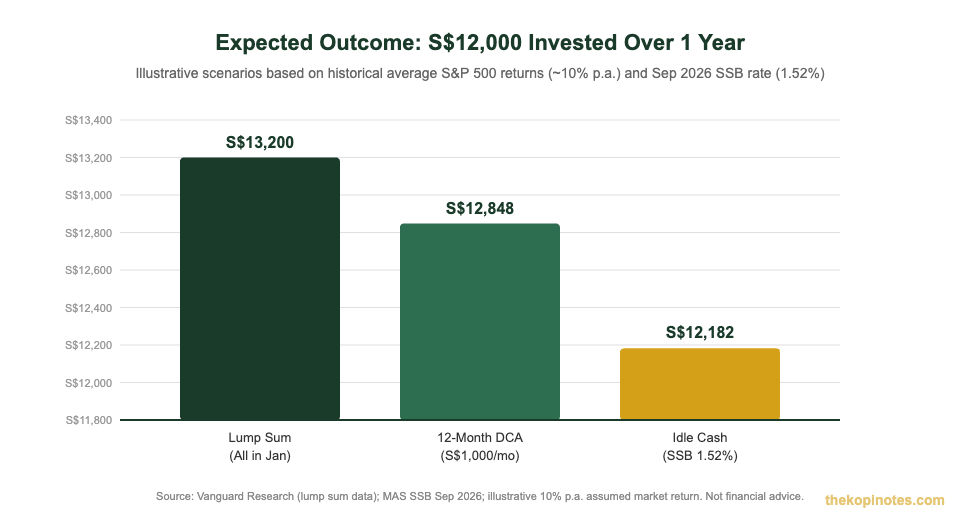
For example: you receive a year-end bonus of S$12,000. Do you invest all S$12,000 today or S$1,000 per month over 12 months? The Vanguard data — covered in the next section — gives a clear answer for most situations.
However, lump sum investing has one requirement most Singaporeans cannot meet: a large pool of uninvested cash ready to deploy right now. Most working adults invest from monthly income. That means they are already dollar cost averaging whether they know it or not.
What the Data Actually Says (Vanguard Study)
The most widely cited academic research on this question comes from Vanguard. Their analysis examined multiple equity markets over decades. The finding was consistent: lump sum investing beats a 12-month DCA schedule roughly two-thirds of the time — approximately 67%.
When lump sum wins, the average advantage is significant:
| Portfolio Type | Lump Sum Wins | Avg Return Advantage |
|---|---|---|
| All-equity (100% stocks) | ~67% | +2.4% |
| Balanced (60% stocks / 40% bonds) | ~67% | +2.3% |
| DCA over 12 months | ~33% | –2.3% to –2.4% |
Source: Vanguard Research, “Dollar-cost averaging just means taking risk later”. Averages across US, UK, and Australian equity markets over several decades. Past performance does not guarantee future results.
But here is the nuance the headline misses. The Vanguard study compares lump sum against DCA only for investors who already have the full amount available. The question it answers is: “Should I invest my S$60,000 inheritance today or spread it over 12 months?” Answer: invest it today.
The study does not address the situation most Singaporeans face: you have S$1,500 from this month’s salary. For you, lump sum is not an option — you are already DCA-ing. And that is perfectly fine.
Why Singaporeans Often DCA by Default
For most Singaporeans, DCA is not a deliberate strategic choice — it is simply how investing works when you earn a monthly salary.
Consider the typical investing flow for a Singaporean in their 30s:
- CPF contributions: Automatically deducted and credited monthly. Your Ordinary Account earns 2.5% p.a. and your Special Account earns 4% p.a. — the government extended the 4% SA floor to 31 December 2026, confirmed by CPF Board. This is DCA into a government-guaranteed instrument, happening with zero effort on your part.
- SRS top-ups: Many Singaporeans top up their Supplementary Retirement Scheme (SRS) account monthly or in a year-end lump sum. The 2026 SRS contribution cap is S$15,300 for Singapore citizens and PRs, confirmed by IRAS. Once invested, SRS funds should be deployed into instruments immediately — not left in the SRS cash account at near-zero interest.
- Cash investments: After CPF, expenses, and savings, your investable monthly surplus (often S$500–S$2,000) goes into a brokerage account or RSP. Monthly investing is the natural rhythm of salaried life.
If you are investing monthly from salary, you are already DCA-ing. The real question is not whether to DCA — it is what to invest in and through which platform. For a detailed look at how to sequence CPF, SRS, and cash investing, see our guide on CPF investment strategy Singapore.
And if you want to see whether your current monthly investing pace is on track for retirement, run the numbers on our free Singapore retirement calculator.
How to Set Up DCA in Singapore
There are three practical ways to DCA in Singapore, each with a different cost, effort level, and target investor:
1. Regular Savings Plans (RSPs) — the easiest option
An RSP lets you invest a fixed amount monthly into an ETF or fund automatically. You set your amount, your ETF, and the platform handles the rest. No need to log in and buy each month.
FSMOne (now rebranded as FSM Global in February 2026) offers an ETF RSP with S$0 transaction fee. This is one of the most cost-effective DCA options in Singapore for ETFs like VWRA or CSPX. Use our FSMOne referral code (code: P0544985) for account opening rewards.
Syfe offers managed portfolios with automated monthly investing. The platform fee ranges from 0.35% to 0.65% per year on your assets. It is the simplest option for hands-off investors. Use our Syfe referral code (SRPRFFFCD) for a sign-up bonus.
2. Park Idle Cash in T-Bills or SSBs While Deploying
Some investors hold a lump sum but choose to deploy it gradually due to discomfort with volatility. While doing so, idle cash should earn a return — not sit in a savings account at 0.05%.
In September 2026, the 6-month Singapore T-bill yields approximately 1.60% per annum (based on the 27 August 2026 MAS auction result). The Singapore Savings Bond (SSB) September 2026 issue pays 1.52% in Year 1 and a 10-year average of 2.25% per annum. Both options are capital-guaranteed by the Singapore government.
These rates are lower than the 2024 peaks but still comfortably beat most savings accounts. See our Singapore Savings Bonds guide and Singapore T-bills 2026 guide for full details on how to subscribe.
3. DIY Brokerage — maximum control, lowest cost at scale
You manually buy a fixed dollar amount of your target ETF each month. This gives you full control over ETF selection, exchange, and execution — but requires the discipline to click “buy” even when markets are falling.
Interactive Brokers (IBKR) Lite charges S$0 commission on US-listed stocks and ETFs. SGX stocks cost 0.08% with a minimum of S$2.50. For larger monthly purchases (above S$3,000), IBKR is the most cost-effective option in Singapore. Sign up with referral code jianxiong368.
moomoo Singapore charges 0.03% (minimum S$0.99) for SGX stocks after the promotional period, and S$0 for US stocks with a S$0.99 platform fee per order. Good for mid-sized monthly purchases. For a full review, see our moomoo Singapore review.
DCA Platforms and Fees Compared
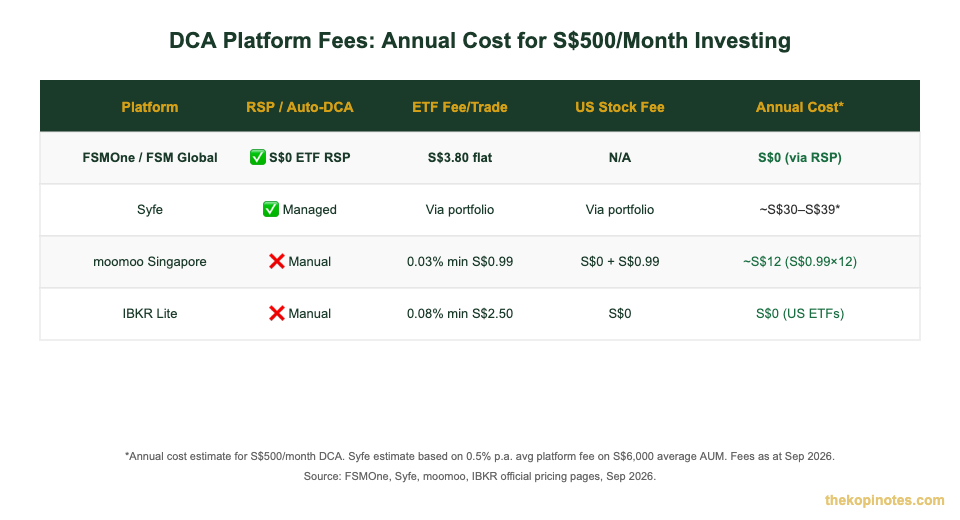
Here is a direct comparison of the main platforms Singapore investors use for regular DCA investing in 2026. All fees are verified from official pricing pages as at September 2026:
Bottom line on platform choice:
- Cheapest DCA setup: FSMOne / FSM Global ETF RSP at S$0 per transaction. Set a monthly amount into a globally diversified ETF and let it run.
- Best for hands-off, managed approach: Syfe. You pay a platform fee, but get auto-rebalancing and a curated portfolio.
- Best for US ETFs (DIY): IBKR Lite at S$0 commission. Requires manual monthly buys but has the lowest long-run cost for larger amounts.
- Best starter account: moomoo Singapore — promotions for new users and low minimum investment amount.
When Lump Sum Makes More Sense
Despite the default DCA reality for salaried Singaporeans, there are specific situations where deploying a lump sum immediately is clearly the right move:
- You received a windfall — year-end bonus, inheritance, property sale proceeds, or insurance payout. Do not split this into monthly tranches unless you are extremely uncomfortable with volatility. The Vanguard data is clear: invest it today.
- Your investment horizon is 15+ years — over long timeframes, short-term market timing has almost no impact on your final outcome. Getting money in early matters more. A 20-year investor who invests a lump sum in January will almost always do better than one who waits to DCA it in over 12 months.
- Markets have corrected 20–30% from a recent peak — if you have cash and the market has pulled back significantly, deploying a lump sum into a broad index ETF like VWRA or CSPX is especially attractive. You are buying units at a meaningful discount.
- Your SRS top-up is done for the year — once your SRS account is topped up (up to S$15,300 for citizens and PRs in 2026), invest the full SRS balance immediately. Letting SRS cash sit idle at near-zero bank interest defeats the purpose of the SRS tax deferral. Invest it in a single transaction into your target ETF or fund.
- You are investing into T-bills or SSBs — these are not volatile instruments. There is no DCA benefit. Apply for the full amount in a single subscription.
The Verdict for Singapore Investors
For most Singaporeans, this is not an either-or decision. You will naturally use both strategies depending on where your money comes from. Here is the practical framework:
| Your Situation | Recommended Approach |
|---|---|
| Monthly salary surplus (S$500–S$2,000) | DCA via RSP or manual monthly buy |
| Year-end bonus or windfall (S$10,000+) | Lump sum — invest immediately |
| SRS annual top-up (up to S$15,300) | Lump sum — invest right after top-up |
| CPF OA funds for CPFIS investment | DCA monthly or quarterly (post S$20k set-aside) |
| Windfall but uncomfortable with volatility | DCA over 3 months max — not longer |
Source: Based on Vanguard research and Singapore-specific account mechanics as at September 2026.
The single most important rule: both strategies beat doing nothing by a wide margin. Whether your S$100,000 earns 7% (lump sum) or 5.5% (DCA) over 10 years, both crush 1.52% in an SSB. The gap between investing and not investing is far larger than the gap between DCA and lump sum.
Pick your approach, automate it where possible, and stay consistent. That is how wealth is built in Singapore — one monthly buy at a time, or one bonus invested immediately.
To see how your investing strategy maps to your retirement goals, use our free Singapore retirement calculator to model different monthly contribution amounts and time horizons.
Frequently Asked Questions
Is dollar cost averaging better than lump sum investing in Singapore?
By the historical data, lump sum investing wins about 67% of the time over 12-month periods according to Vanguard Research. However, most Singaporeans invest monthly from salary and do not have a lump sum to deploy — in that situation, DCA is the default and is perfectly effective over the long run. If you have a lump sum (bonus, inheritance), invest it immediately rather than spreading it out.
What is the cheapest platform for DCA investing in Singapore?
FSMOne (now FSM Global) offers an ETF Regular Savings Plan (RSP) with S$0 transaction fee — making it the lowest-cost DCA option for ETF investing in Singapore. For US-listed stocks and ETFs, Interactive Brokers (IBKR) Lite charges S$0 commission. Both platforms have no annual platform fee on stocks and ETFs.
Should I DCA or lump sum into my SRS account?
Top up your SRS account in whatever way suits your cash flow (monthly or annual lump sum up to the S$15,300 cap for citizens and PRs in 2026). Once the SRS funds are in the account, invest them as a lump sum immediately. Leaving SRS cash sitting uninvested earns near-zero interest and defeats the purpose of the tax deferral benefit.
How much should I invest per month through DCA in Singapore?
A common starting point is 10–20% of your take-home monthly income. For someone earning S$4,000 net per month, that is S$400–S$800 per month into a diversified ETF or RSP. The exact amount is less important than consistency — investing S$300 every month for 20 years beats investing S$500 three times and stopping. Use our Singapore retirement calculator to find the monthly amount that maps to your retirement target.
What happens if I DCA into an ETF that keeps falling?
If you are DCA-ing into a broadly diversified global ETF like VWRA or a S&P 500 ETF like CSPX, sustained multi-year declines are historically rare. You are buying more units at lower prices during dips — which actually reduces your average cost and improves your position when the market recovers. The key is to stick to broad index ETFs and not stop investing during downturns.
Can I use CPF funds to dollar cost average into ETFs?
Yes, through the CPF Investment Scheme (CPFIS). You can invest OA savings above the S$20,000 set-aside into approved ETFs listed on SGX, subject to the 35% equity and 10% gold concentration limits. However, your CPF OA already earns 2.5% p.a. with zero risk — any investment must be expected to return more than 2.5% to justify moving OA funds. For strategy details, see our guide on CPF investment strategy Singapore.
Ready to Start Investing in Singapore?
Open a brokerage account and set up your first DCA plan today. Use our referral links for exclusive sign-up bonuses.
This article was researched with the help of AI. While we strive to keep all information accurate and up to date, there may be errors. If you notice any discrepancies, please contact us.