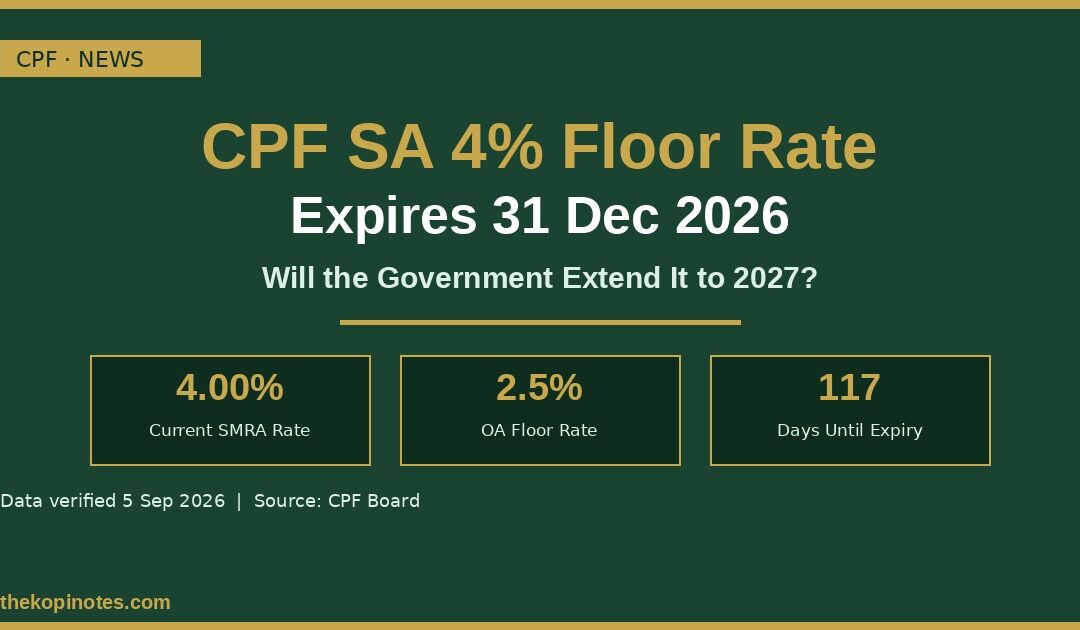
The 4% interest rate floor on CPF Special, MediSave, and Retirement Account (SMRA) savings expires on 31 December 2026. As of 5 September 2026, the government has not announced whether it will be extended to 2027. With the floor rate shielding millions of Singaporeans from a potential rate drop — and September being the traditional window for such announcements — every CPF member should understand what is at stake.
This is an editorial analysis. Not financial advice. Data verified as at 5 Sep 2026. Source: CPF Board official announcements.
What Is the CPF SMRA 4% Floor Rate?
Your CPF Special Account (SA), MediSave Account (MA), and Retirement Account (RA) all earn interest pegged to the 12-month average yield of 10-year Singapore Government Securities (10YSGS), plus 1%. In theory, this means your interest rate moves with bond market yields.
In practice, Singapore’s government introduced a 4% floor rate back in 2008, guaranteeing that SMRA balances earn at least 4% per year regardless of what the underlying bond formula produces. This has been extended — year by year, typically announced in September or October — every single year since it was introduced.
The current extension covers the full calendar year 2026. Once 31 December 2026 passes, if no extension is announced, your SA, MA, and RA balances would automatically drop to the pegged rate — which, based on recent SGS yields, sits below 4%.
Your CPF Interest Calculator can show you exactly how much your accounts earn at different rate scenarios.
Why September Is the Decisive Month
For the past several years, the government has typically announced the following year’s SMRA floor extension in the third or fourth week of September. The announcement for 2026 was made in November 2025 — slightly later than usual. The announcement for 2025 came in September 2024.
As of 5 September 2026, the government has not yet made the 2027 announcement. This does not mean it will not happen — the September window is still open — but it has created noticeable attention among CPF watchers and personal finance communities.
The stakes are high: over S$600 billion in total CPF savings sits in SA, MA, and RA accounts, currently benefiting from the 4% floor guarantee. Any change to this rate has a direct impact on the retirement savings of virtually every working Singaporean.
The Historical Pattern — Extended Every Year Since 2008
The 4% SMRA floor has been extended annually for 18 consecutive years. This is not a legislative requirement — the floor is a government policy decision, not hardwired into the CPF Act. The CPF Board and Ministry of Finance announce it as a separate policy measure each year.
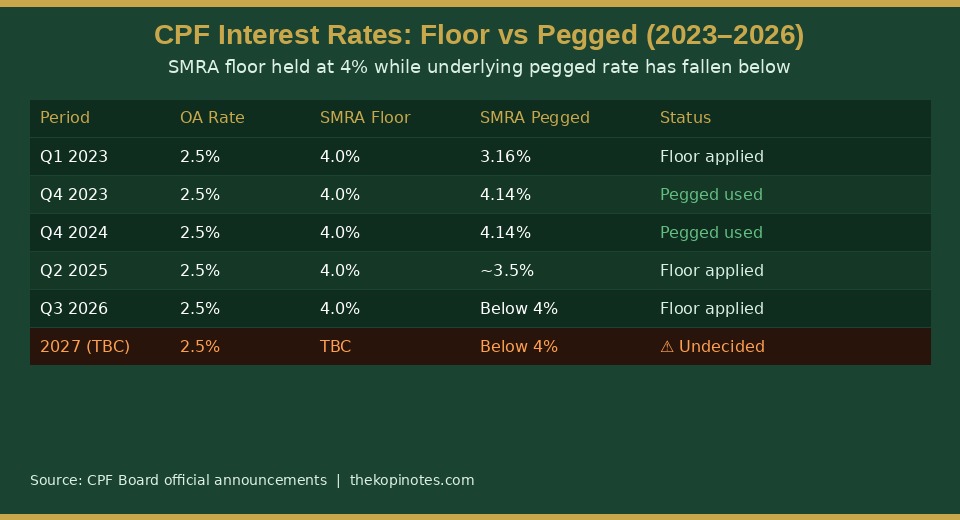
Here is how the SMRA rate has moved in recent periods:
| Period | OA Rate | SMRA Floor | SMRA Pegged Rate | Effective Rate |
|---|---|---|---|---|
| Q1 2023 | 2.5% | 4.0% | ~3.2% | 4.0% (floor applies) |
| Q4 2023 | 2.5% | 4.0% | 4.14% | 4.14% (pegged exceeds floor) |
| Q4 2024 | 2.5% | 4.0% | 4.14% | 4.14% (pegged exceeds floor) |
| Q2 2025 | 2.5% | 4.0% | Below 4% | 4.0% (floor applies) |
| Q3 2026 | 2.5% | 4.0% | Below 4% | 4.0% (floor applies) |
| 2027 (TBC) | 2.5% | Undecided | Below 4% | Announcement pending |
Note how in 2023-2024, the pegged rate briefly exceeded 4% on the back of high SGS yields — meaning the floor did not matter during those periods. But as rates eased in 2025 and 2026, the pegged rate slipped below 4% again, and the floor is once again doing the heavy lifting for most CPF savers.
What Happens If the Floor Is Not Extended to 2027?
If the government decides not to extend the 4% floor, your SMRA accounts would earn the pegged rate from 1 January 2027 onwards. Based on current 10-year SGS yields, the pegged rate would be approximately 3%-3.5% per annum — a meaningful reduction from 4%.
This would affect three groups of CPF members:
Special Account (SA) balances — for members below 55. The SA earns the SMRA rate and is a primary vehicle for voluntary top-ups and retirement savings accumulation. Read our CPF Contribution 2026 guide to understand how contributions interact with the interest rate system.
MediSave Account (MA) — all CPF members retain their MA. The MediSave Basic Healthcare Sum (BHS) in 2026 is $79,000. See our full CPF MediSave Guide for details on how to maximise your MA.
Retirement Account (RA) — this is the most significant. Singaporeans aged 55 and above have their savings primarily in the RA (which feeds CPF LIFE). A lower interest rate on RA directly reduces the compound growth that determines their eventual CPF LIFE monthly payouts.
There is also a critical secondary effect: members currently earn extra interest on top of the base SMRA rate — an extra 1% on the first $60,000 of combined CPF balances for those under 55, and extra 2% on the first $30,000 plus 1% on the next $30,000 for those aged 55 and above. A lower base rate does not cancel the extra interest, but the combined returns would still be lower overall.
How Much Does the 4% Floor Actually Matter in Dollar Terms?
Let us make this concrete. Assuming the pegged rate drops to approximately 3.3% if the floor is not extended:
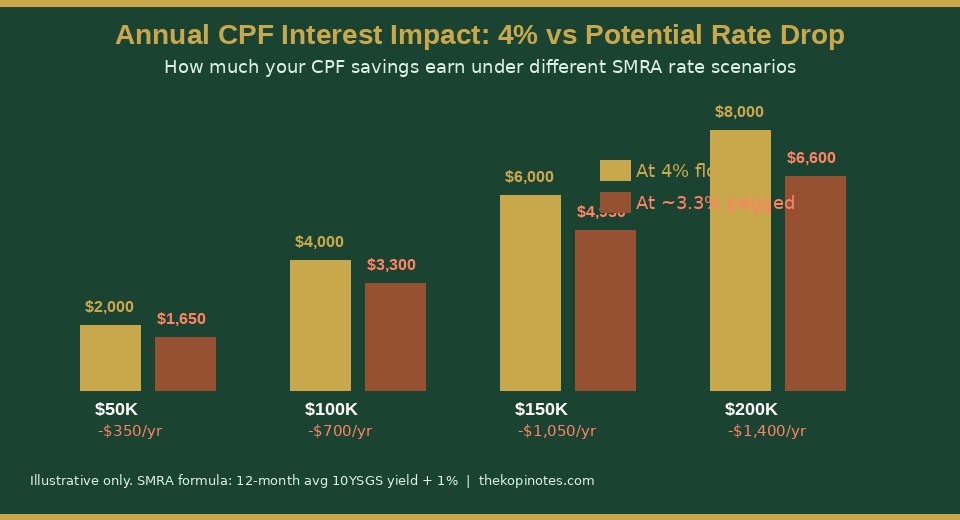
At a $100,000 SMRA balance, the difference between 4% and 3.3% is $700 per year in lost interest. For someone with $200,000 in their MA and RA combined — which is not unusual for a Singaporean in their 50s — that is $1,400 per year in potentially lost passive income. Over a decade, compounded, the gap becomes very significant.
This is why the floor rate announcement matters so much to retirement planning. It is not just a number on paper — it directly determines how much your CPF balance compounds over time.
What Should Singapore Investors Do Right Now?
The honest answer is: wait and watch. The 4% floor has been extended for 18 consecutive years and the government’s rationale — providing certainty on returns in a falling interest rate environment — still applies in 2026. There is no strong reason to expect the floor to be dropped.
Here are practical steps to take in September 2026:
1. Do not rush to withdraw CPF savings prematurely. Some members near age 55 might consider accelerating withdrawals if they fear a rate drop. This is rarely optimal — the extra 2% bonus interest on RA balances for those 55+ means the effective rate on the first $30,000 is currently 6% (4% base + 2% bonus), which no savings account or T-bill matches.
2. Maximise your MA if you have not already. The MediSave account earns the same SMRA rate and also provides tax relief on contributions (up to the BHS of $79,000). If you have cash sitting in a savings account earning below 4%, topping up your MA is still an attractive move while the 4% floor holds.
3. Consider voluntary top-ups to your RA. For CPF LIFE purposes, a larger RA balance means higher lifetime monthly payouts. If the 4% rate continues, this is a very competitive guaranteed return with zero credit risk.
4. Compare alternatives. Singapore Savings Bonds (SSB) currently yield around 2.25% p.a. (see our SSB September 2026 rate analysis). T-Bills are around 1.56%-1.60% (see our T-Bill analysis). Neither comes close to 4% with the same risk profile.
5. Monitor the CPF Board announcement page. The extension (or non-extension) will be announced at cpf.gov.sg. Set a bookmark or Google alert for “CPF interest rate floor”. Also keep an eye on the Fed rate trajectory, since 10-year SGS yields are influenced by global rate expectations.
Bottom Line for SG Investors
The CPF 4% SMRA floor rate is one of the best guaranteed returns available to Singapore retail investors. It expires on 31 December 2026, and the September announcement that would extend it to 2027 has not yet been made as of today, 5 September 2026. Based on 18 years of unbroken extensions, the probability of another extension is high — but it is a policy decision, not a statutory guarantee.
Do not restructure your finances yet. Watch for the announcement. In the meantime, make the most of the current 4% rate by maximising your MA and RA contributions where eligible. If the floor is unexpectedly removed, it would represent a genuine shift in CPF retirement strategy — and we will update you immediately when that happens.
Frequently Asked Questions
What is the CPF SMRA 4% floor rate?
It is a government guarantee that your CPF Special, MediSave, and Retirement Account balances earn at least 4% interest per year, regardless of what the underlying market-linked formula produces. Without the floor, the rate would be the 12-month average yield of 10-year Singapore Government Securities plus 1%.
When does the 4% floor rate expire?
The current extension covers the full calendar year 2026 and expires on 31 December 2026. No extension to 2027 has been announced as of 5 September 2026.
Has the government ever not extended the 4% floor?
No. The 4% SMRA floor has been extended annually since it was introduced in 2008 — a streak of 18 consecutive years. However, it is a policy decision, not a legal requirement.
What would the CPF SMRA rate be without the floor?
The SMRA pegged rate is calculated as the 12-month average yield of 10-year Singapore Government Securities plus 1%. Based on current 10YSGS yields in 2026, the pegged rate is below 4%, meaning the floor is actively protecting CPF members’ returns right now.
Does the 4% floor apply to the CPF Ordinary Account?
No. The OA has a separate floor of 2.5% per annum, which remains in effect through 2026. The 4% floor applies only to Special, MediSave, and Retirement Accounts.
What extra interest can I earn on top of the 4% SMRA rate?
CPF members below age 55 earn an extra 1% interest on the first $60,000 of their combined CPF balances (capped at $20,000 from OA). Members aged 55 and above earn an extra 2% on the first $30,000 (capped at $20,000 from OA) and an extra 1% on the next $30,000.
Should I make a CPF top-up now before the 4% floor expires?
Top-ups to your MediSave and Retirement Account are generally beneficial while the 4% rate holds, especially compared to current T-Bill yields of ~1.56% and SSB rates of ~2.25%. However, CPF top-ups are largely irreversible — consult a financial advisor before committing large sums based solely on current rate conditions.
This article was researched with the help of AI. While we strive to keep all information accurate and up to date, there may be errors. If you notice any discrepancies, please contact us.