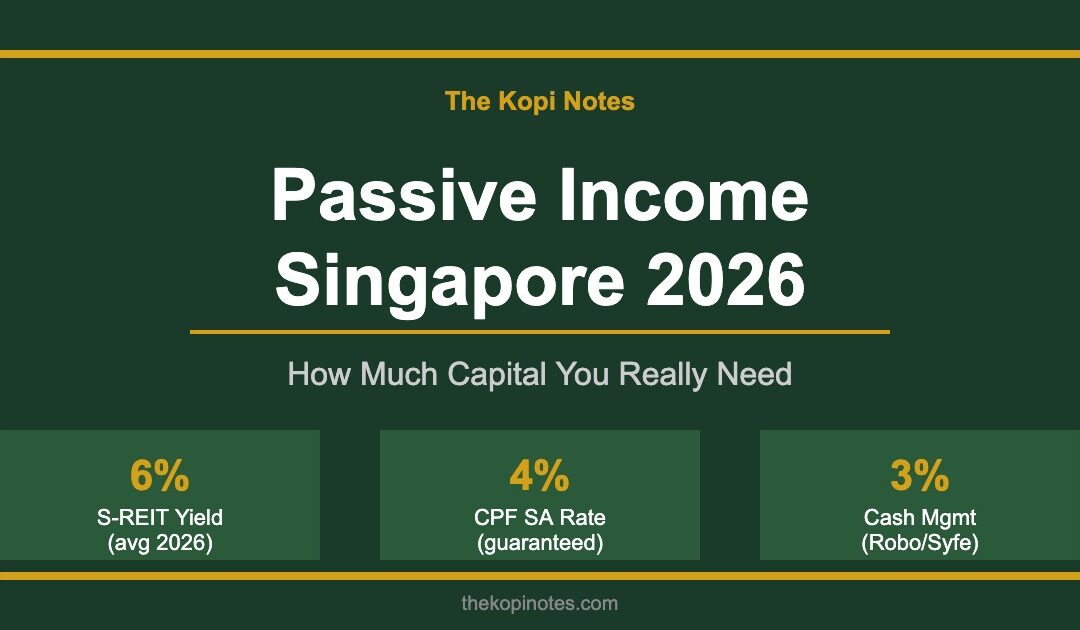
Passive Income Singapore 2026: How Much Capital You Really Need
📋 Table of Contents
- What Counts as Passive Income in Singapore?
- 2026 Rate Environment: Why It Matters
- The Capital Requirements Table (Key Data)
- Strategy 1: S-REITs — The Passive Income Workhorse
- Strategy 2: Dividend Stocks — Growing Income
- Strategy 3: CPF — Guaranteed Passive Income at Retirement
- Strategy 4: Cash Management (Syfe, Endowus)
- Strategy 5: T-Bills & SSBs — Safe but Low
- Building Your Passive Income Stack
- Frequently Asked Questions
What Counts as Passive Income in Singapore?
Passive income is money earned with minimal ongoing effort — dividends from REITs and stocks, interest from CPF or T-bills, or distributions from funds. Unlike a salary, it compounds quietly in the background.
In Singapore’s 2026 rate environment — CPF SA at 4%, S-REITs averaging 5.5–6.5% yield, and T-bills at ~1.6% — the gap between strategies is enormous. The difference between investing S$300,000 in T-bills versus S-REITs is the difference between S$400/month and S$1,500/month.
This guide cuts through the noise with one clear framework: how much capital you actually need to hit your monthly passive income target in Singapore.
2026 Rate Environment: Why It Matters
Understanding where rates stand in September 2026 is essential for calculating realistic passive income projections.
- CPF Ordinary Account (OA): 2.5% p.a. (legislated minimum), with +1% extra interest on the first S$20,000
- CPF Special/MediSave/Retirement Accounts: 4% p.a. — Government extended the 4% floor rate until 31 December 2026 (source: CPF Board)
- Singapore T-Bills: ~1.60% p.a. — this is the 2026 high; most auctions have been below this
- Bank savings accounts (base): ~0.32% p.a. — the base rate local banks are paying (CPF Board reported this figure for Q3 2026)
- S-REITs: Average dividend yield ~5.5–6.5% for 2026, with rate-cut tailwinds supporting distributions
- Singapore Savings Bonds (SSB): ~1.5–1.8% p.a. for current issues
The key insight: S-REITs and CPF top-ups offer dramatically better passive income per dollar of capital invested than T-bills or bank savings in today’s environment.
The Capital Requirements Table: How Much Do You Need?
The table below shows exactly how much capital is required to earn S$1,000, S$2,000, S$3,000 and S$5,000 per month from each major passive income source in Singapore. Use this as your planning benchmark.
| Strategy | Est. Annual Yield | Capital for $1k/mo | Capital for $2k/mo | Capital for $3k/mo | Capital for $5k/mo |
|---|---|---|---|---|---|
| S-REITs (SGX) | ~6% | S$200,000 | S$400,000 | S$600,000 | S$1,000,000 |
| Dividend Stocks (SGX) | ~4–5% | S$240,000–300,000 | S$480,000–600,000 | S$720,000–900,000 | S$1.2M–1.5M |
| CPF RA top-up (retirement) | 4% (guaranteed) | S$300,000* | S$600,000* | S$900,000* | N/A (cap applies)* |
| Cash Management (Syfe/Endowus) | ~3% | S$400,000 | S$800,000 | S$1,200,000 | S$2,000,000 |
| T-Bills / SSBs | ~1.6% | S$750,000 | S$1,500,000 | S$2,250,000 | S$3,750,000 |
| Bank Savings (base) | ~0.32% | S$3,750,000 | S$7,500,000 | S$11,250,000 | S$18,750,000 |
*CPF payouts begin from age 65 under CPF LIFE; the capital shown is illustrative of the RA balance needed. CPF has annual top-up limits and Enhanced Retirement Sum caps. Consult CPF Board for exact numbers.
Key takeaway: To earn S$3,000/month passively, you need roughly S$600,000 in S-REITs — but S$2,250,000 in T-bills. That is a 3.75x capital efficiency gap. The strategy you pick matters enormously.
Strategy 1: S-REITs — The Passive Income Workhorse
Singapore-listed REITs (S-REITs) are the go-to passive income vehicle for most local investors. They are legally required to distribute at least 90% of their taxable income to unitholders — meaning consistent, high-frequency distributions (typically quarterly or semi-annually).
In 2026, the rate-cut cycle has provided S-REITs with a tailwind: lower borrowing costs reduce debt servicing expenses, protecting distributions. The average S-REIT on SGX yields approximately 5.5–6.5%, with select diversified REITs offering 6%+.
What makes S-REITs ideal for passive income?
- No dividend withholding tax for Singapore residents receiving distributions
- Quarterly/semi-annual distributions — steady cash flow timing
- SGX-listed — highly liquid, buy or sell any trading day
- Regulated by MAS — transparent reporting and gearing limits (max 50%)
- Low minimum investment — most REITs trade between S$0.50 and S$3.00 per unit
To earn S$2,000/month (S$24,000/year) from S-REITs at a 6% average yield, you need approximately S$400,000 invested. This is achievable through a diversified basket of 5–8 REITs across sectors (industrial, retail, hospitality, healthcare, data centres).
Referral: You can invest in S-REITs through Syfe (code: SRPRFFFCD), which offers a REIT-focused portfolio, or Endowus (code: 2V343) for managed REIT exposure. You can also build your own portfolio via FSMOne (code: P0544985).
📖 Read more: Best Ways to Earn Passive Income in Singapore 2026
Strategy 2: Dividend Stocks — Growing Income Over Time
While S-REITs offer higher initial yields, Singapore blue-chip dividend stocks offer something different: dividend growth. Companies like DBS, OCBC, UOB, Singtel and Keppel have track records of increasing dividends over time, meaning your passive income stream can grow without additional capital.
Typical dividend yields for Singapore blue chips range from 3% to 5%, lower than S-REITs but with capital appreciation potential that partially compensates. For passive income, the key advantage is that dividends from Singapore-listed companies are also exempt from tax for individual investors.
To earn S$2,000/month from dividend stocks at a 4.5% average yield, you need approximately S$533,000 invested — roughly 33% more capital than S-REITs, but with potentially lower volatility and growth in income over time.
📖 Read more: Dividend Investing Singapore Guide
Strategy 3: CPF — Guaranteed Passive Income at Retirement
CPF is Singapore’s most underrated passive income engine — especially for those approaching retirement. The Retirement Account (RA) earns 4% p.a. (Government has extended this floor rate until December 2026), and CPF LIFE converts your RA balance into monthly payouts for life starting from age 65.
CPF interest rates from 1 July to 30 September 2026 (Source: CPF Board):
- Ordinary Account: 2.5% p.a.
- Special / MediSave / Retirement Accounts: 4% p.a.
- Extra interest: +1% on the first S$60,000 of combined balances (capped at S$20,000 for OA)
CPF is not a traditional “passive income” source for those under 55 — you cannot freely withdraw it. But for retirement planning, optimising your CPF RA is one of the highest-yield, zero-risk moves available in Singapore: a guaranteed 4% return, government-backed.
For Singaporeans aged 55+, the Enhanced Retirement Sum (ERS) in 2026 allows topping up your RA to unlock higher CPF LIFE monthly payouts. Under the Standard Plan, an ERS balance translates to monthly payouts of ~S$2,200–2,500 from age 65.
📖 See also: Singapore Retirement Calculator | CPF Contribution Rate 2026
Strategy 4: Cash Management — The Safe Floor
Cash management accounts offered by robo advisors like Syfe Cash+ Enhanced and Endowus Cash Smart provide a middle ground: better yields than bank savings with high liquidity and capital preservation.
In 2026, typical cash management returns range from 2.5% to 3.5% p.a., primarily through money market funds and short-duration fixed income. These are not guaranteed returns, but have been historically stable.
For passive income purposes, cash management is best used as:
- An emergency fund that also earns a return (3–6 months of expenses)
- A staging area while you deploy capital into higher-yielding S-REITs
- Capital preservation for shorter-time horizons (1–3 years)
To earn S$1,000/month from cash management at a 3% yield, you need S$400,000 — twice the capital required from S-REITs. However, the volatility and drawdown risk is far lower. For risk-averse investors or retirees, combining cash management with S-REITs creates a balanced passive income structure.
Try it: Open a Syfe account (code: SRPRFFFCD) for Cash+ Enhanced or Endowus (code: 2V343) for Cash Smart.
Strategy 5: T-Bills & SSBs — Government-Backed but Capital-Heavy
Singapore Government Securities — T-bills (91-day and 182-day) and Singapore Savings Bonds (SSB) — are capital-safe and MAS-backed. However, at current 2026 yields of approximately 1.6%, they are the least capital-efficient passive income option.
To generate S$1,000/month passively from T-bills at 1.6%, you would need S$750,000 in capital — 3.75 times more than S-REITs. This makes T-bills unsuitable as a primary passive income strategy for most Singaporeans, but highly appropriate for capital preservation and emergency fund deployment.
T-bills are best used for: keeping short-term cash you might need within 6 months safely parked while earning something above the near-zero bank base rate.
Note: T-bill rates may rise if the Fed hikes rates in September 2026 (odds have been elevated per recent market pricing). If rates recover to 2–3%, the capital efficiency gap narrows — but S-REITs still significantly outperform on income per dollar.
Building Your Passive Income Stack: A Practical Framework
The most effective passive income strategy in Singapore is not to pick one instrument, but to build a layered stack with different roles:
| Layer | Role | Vehicle | Target Allocation |
|---|---|---|---|
| Foundation | Capital-safe floor | CPF OA/SA top-ups, Cash mgmt | 20–30% |
| Core Income | High yield, liquid | Diversified S-REIT basket | 40–60% |
| Growth | Dividend growth + appreciation | SG/global dividend stocks, ETFs | 20–30% |
| Tactical | Short-term parking, liquidity | T-bills, SSBs, Cash mgmt | 5–15% |
Example: S$500,000 portfolio targeting S$2,000–2,500/month passive income
- S$250,000 in S-REIT basket (~6% yield = S$1,250/month)
- S$150,000 in SG blue-chip dividend stocks (~4.5% = S$563/month)
- S$75,000 in Syfe Cash+ or Endowus Cash Smart (~3% = S$188/month)
- S$25,000 in T-bills or SSB as emergency reserve
- Total passive income: ~S$2,000/month
Use the Singapore Retirement Calculator to model how long your capital will sustain this income at various withdrawal rates.
📖 Also read: Best Investments in Singapore 2026
Frequently Asked Questions
How much passive income can I earn in Singapore per month?
Is passive income taxable in Singapore?
What is the best passive income investment in Singapore for 2026?
How much capital do I need to retire on passive income in Singapore?
Can I use CPF to generate passive income?
How do Singapore T-bills compare to S-REITs for passive income?
What is the average S-REIT dividend yield in 2026?
Ready to Start Earning Passive Income?
Open your accounts through TKN referral codes and get exclusive sign-up bonuses while supporting this site at no extra cost to you.
This article was researched with the help of AI. While we strive to keep all information accurate and up to date, there may be errors. If you notice any discrepancies, please contact us.