Endowment Plan vs Savings Plan Singapore (2026): Key Differences Explained
Compare premiums, guaranteed returns, flexibility, and which product suits your financial goals.An endowment plan in Singapore is a short-to-medium-term insurance savings product that pays guaranteed returns upon maturity — most run 2 to 5 years and suit lump-sum investors. A savings plan (also called a regular premium plan or participating policy) is a long-term insurance contract funded with monthly contributions, typically over 10 to 25 years. Both include some life insurance cover, but the right choice depends entirely on your timeline and cash-flow needs.
Not financial advice. All figures are for educational reference only. Data verified as at September 2026 unless noted.
- Endowment plans suit lump-sum savers who want short-term guaranteed returns (2–5 years)
- Savings plans suit regular savers building long-term wealth over 10–25 years with higher (partly non-guaranteed) projected returns
- Both carry heavy early surrender penalties — only commit money you won’t need before maturity
What Is an Endowment Plan?
An endowment plan is a life insurance policy that matures after a specific term — usually 2, 3, or 5 years. You pay a lump sum (single premium) upfront, and at maturity the insurer pays back your principal plus guaranteed returns.
Think of it as a fixed deposit with a thin layer of insurance. If you pass away during the policy term, your beneficiaries receive a death benefit — typically 101%–105% of the single premium. The core appeal, however, is the guaranteed maturity payout, not the insurance cover.
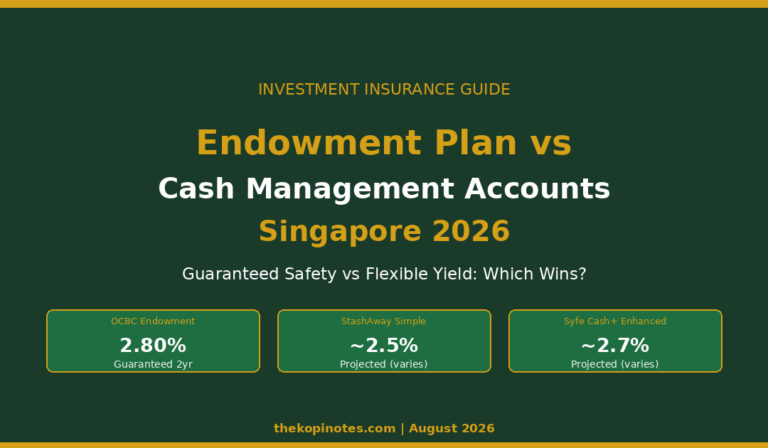
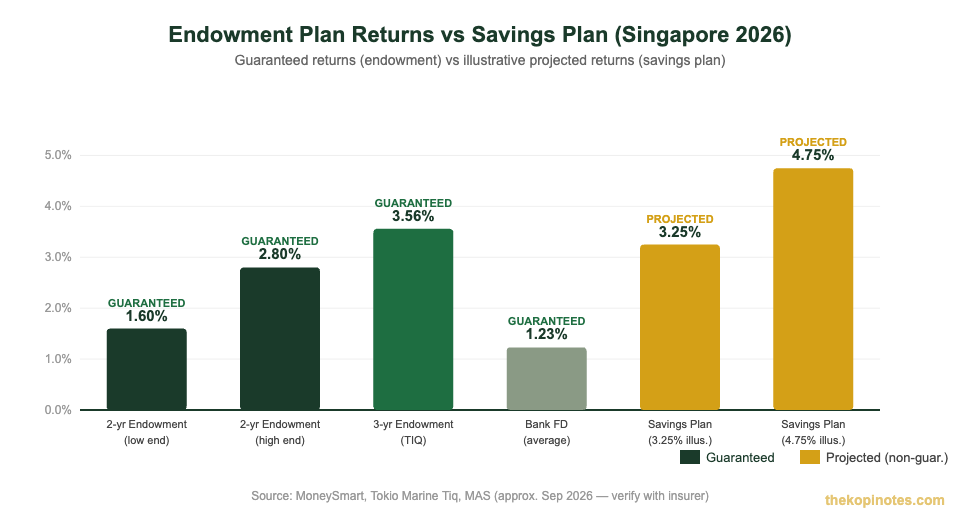
Current 2-year endowment plans in Singapore pay between 1.6% and 2.8% p.a. in guaranteed returns. Three-year plans go higher — Tiq by Tokio Marine’s 3-Year plan offered a guaranteed yield of 3.56% p.a. as at mid-2026. Exact rates change frequently, so always confirm with the insurer before committing.
Key features at a glance:
- Single premium payment (lump sum upfront)
- Fixed maturity date — no extensions
- Returns known upfront (guaranteed portion)
- SDIC-protected up to S$100,000 per insurer per life assured
- Early surrender usually means receiving less than total premiums paid
For a head-to-head with T-bills specifically, see our endowment plan vs T-bills Singapore guide. Prefer no lock-in? Our endowment plan vs savings account comparison covers those trade-offs.
What Is a Savings Plan?
A savings plan — sometimes called a regular premium endowment plan or participating (par) policy — is a longer-commitment insurance product. Instead of a lump sum, you contribute a fixed monthly or yearly premium over 10, 15, 20, or 25 years.
Par plans invest your premiums into the insurer’s Participating Fund, a pooled portfolio of bonds, equities, and other assets. Returns come from two sources:
- Guaranteed benefits: a fixed minimum maturity payout stated in your policy — this is set at purchase and cannot be reduced
- Non-guaranteed bonuses: annual reversionary bonuses and a terminal bonus at maturity, declared based on the fund’s actual performance each year
MAS (Monetary Authority of Singapore) requires all par fund product illustrations to show projections at 3.25% and 4.75% p.a. These are benchmarks to help you compare across insurers — your actual return could be higher or lower depending on how the par fund performs over your full policy term.
Savings plans typically provide a much higher sum assured than endowment plans — often 150%–250% of total premiums paid. That makes them more suitable if life insurance coverage is also a priority alongside your savings goal.
Major savings plan providers in Singapore include AIA, Great Eastern, NTUC Income, Prudential, Manulife, Singlife, and Tokio Marine Life. You can compare plan illustrations on platforms like FSMOne, which offers access to multiple insurer par plans.
Key Differences: Endowment Plan vs Savings Plan
Here’s a side-by-side breakdown across the dimensions that matter most for your decision:
| Feature | Endowment Plan | Savings Plan (Par) |
|---|---|---|
| Premium payment | Single lump sum | Regular monthly / yearly |
| Typical tenor | 2–5 years | 10–25 years |
| Guaranteed returns | Yes — fixed at purchase | Partial only |
| Non-guaranteed returns | None (non-par plans) | Yes — par fund bonuses |
| Minimum entry | S$10,000–S$20,000+ | ~S$100–S$500/month |
| Life coverage | 101%–105% of premium | 150%–250% of total premiums |
| Early exit penalty | High | High (especially years 1–5) |
| SDIC protection | Up to S$100,000 | Up to S$100,000 |
| Flexibility | Low (locked in at purchase) | Some (premium holiday, partial surrender options vary by insurer) |
| Best for | Lump-sum, short-term savings | Long-term wealth building + insurance |
Source: MAS, LIA Singapore, insurer product sheets (as at Sep 2026)
Returns Comparison with Real Numbers
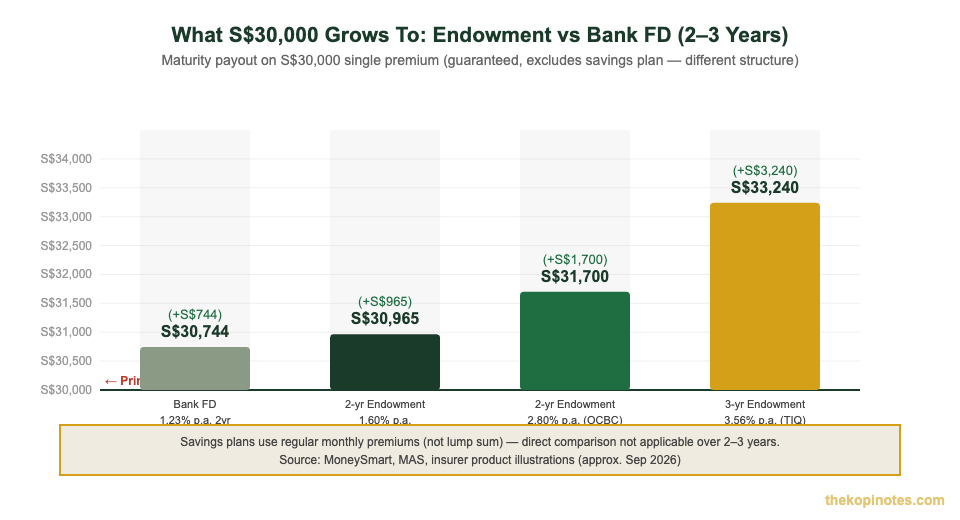
Let’s put this into concrete SGD numbers. Assume you have S$30,000 to invest — a common starting point for Singaporeans comparing both products.
Short-Term Scenario: S$30,000 over 2–3 Years
| Product | Return p.a. | Payout on S$30,000 | Type |
|---|---|---|---|
| Bank FD (average) | ~1.23% p.a. | ~S$30,744 (2yr) | Guaranteed |
| 2-yr endowment (low end) | 1.60% p.a. | ~S$30,965 | Guaranteed |
| 2-yr endowment (e.g. OCBC) | 2.80% p.a. | ~S$31,700 | Guaranteed |
| 3-yr endowment (e.g. Tiq) | 3.56% p.a. | ~S$33,240 | Guaranteed |
Sources: MoneySmart, Tokio Marine Tiq, MAS (approx. Sep 2026 — verify current rates with insurer before committing)
The key insight: for 2–3 year money, endowment plans clearly beat bank FDs. A savings plan, however, isn’t designed for short timelines — surrendering early means heavy penalties and likely getting back less than you paid.
Long-Term Scenario: Savings Plan at S$300/month for 25 Years
Total premiums paid: S$90,000. Projected maturity value at MAS illustration rates (non-guaranteed): S$120,000–S$160,000+ depending on the insurer’s par fund performance.
These projections are MAS-mandated estimates — not promises. Your actual outcome depends on how the par fund performs over the full 25 years. That said, Singapore par funds have historically performed within or above the MAS illustration range for long-running policies.
Use our Singapore retirement calculator to see how either product fits your retirement income needs.
Which Should You Choose?
Choose an Endowment Plan If…
- You have a lump sum (S$10,000+) you won’t need for 2–5 years
- You want certainty — a guaranteed maturity payout with zero market risk
- You already have sufficient life insurance coverage elsewhere (e.g. through term life or whole life policy)
- You’re looking for a fixed-deposit alternative with better guaranteed rates
Choose a Savings Plan If…
- You want to build wealth over 10–25 years through regular monthly contributions
- You need meaningful life insurance coverage alongside your savings commitment
- You’re comfortable with a portion of returns being non-guaranteed (par fund bonuses)
- You value the discipline of a regular savings habit — the monthly deduction keeps you accountable
Neither May Be Right If…
- You might need the money within 1 year — both products have heavy early surrender penalties
- You’re chasing high returns — equity ETFs and S-REITs may outperform both over long periods, depending on your risk tolerance
- You have no emergency fund yet — always build 6 months of expenses in liquid savings before locking money into any insurance plan
For investors comfortable with some market volatility, platforms like Syfe and Endowus offer investment portfolios that have historically delivered returns above par fund projections over 10+ year periods — without the insurance wrapper, and with greater liquidity.
For a broader look at savings products specifically for SRS funds, see our guide to best savings plans for SRS funds.
Frequently Asked Questions
Is an endowment plan the same as a savings plan?
Which gives better returns — an endowment plan or a savings plan?
Are endowment plans and savings plans SDIC-protected?
Can I exit an endowment or savings plan early?
Should I use CPF-OA money for an endowment plan?
What is the difference between a par and non-par endowment plan?
Get Free Insurance Advice
Speak with a licensed insurance advisor. No obligation, no cost.
By submitting this form, you agree to our Privacy Policy.
This article was researched with the help of AI. While we strive to keep all information accurate and up to date, there may be errors. If you notice any discrepancies, please contact us.