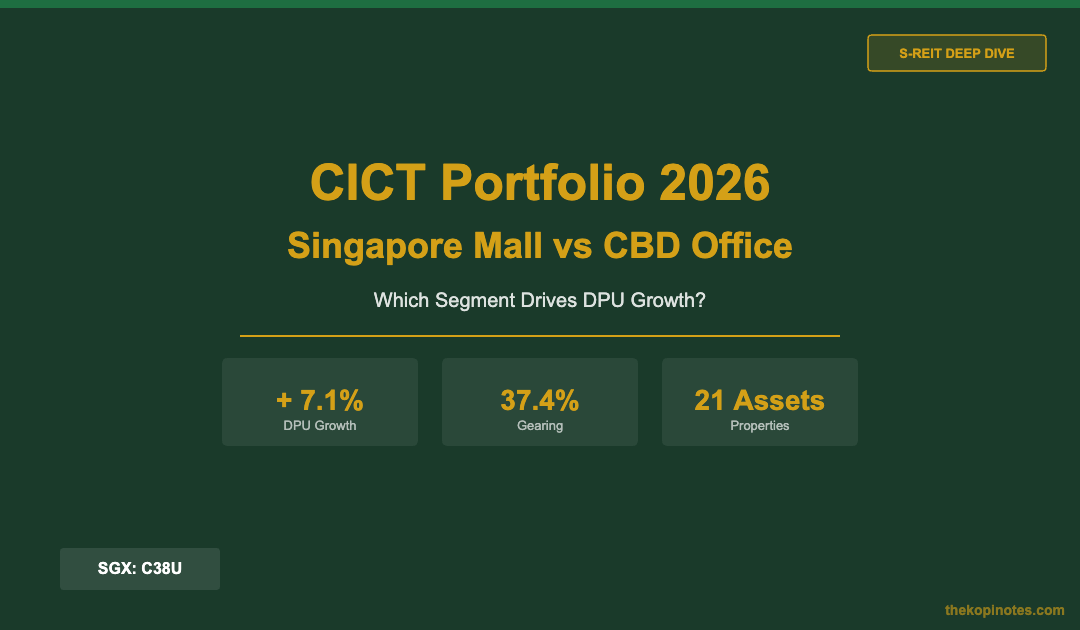
CICT Portfolio 2026: Singapore Mall vs CBD Office — Which Segment Drives DPU Growth?
CapitaLand Integrated Commercial Trust (CICT, SGX: C38U) is Singapore’s largest diversified commercial REIT, holding 21 properties across Singapore, Germany, and Australia. Its 1H2026 DPU reached 6.02 cents — up 7.1% year-on-year — while portfolio gearing fell to a healthy 37.4%. But which segment is doing the heavy lifting: the retail malls or the CBD offices? This deep dive breaks down CICT’s performance by portfolio segment to reveal where the income actually comes from.
Not financial advice. All figures are for educational reference only. Data as at August 2026 unless noted.
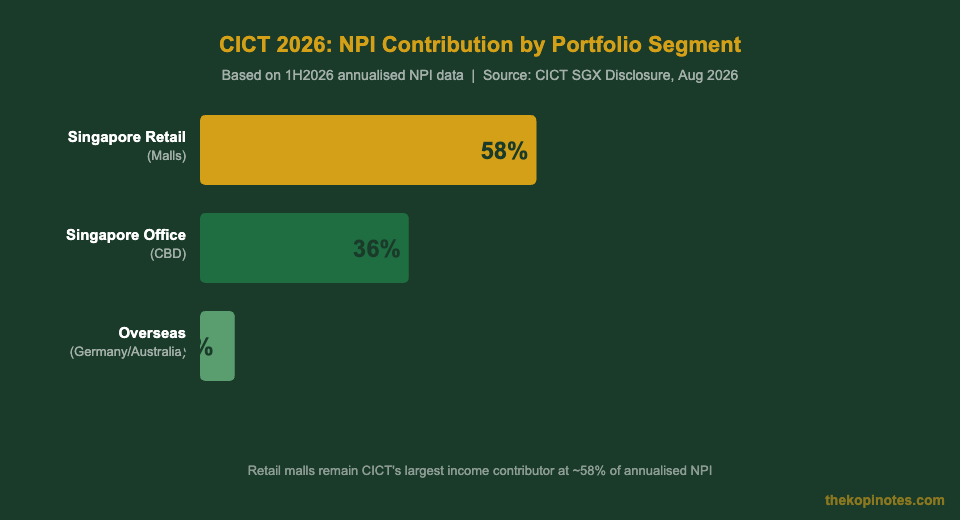
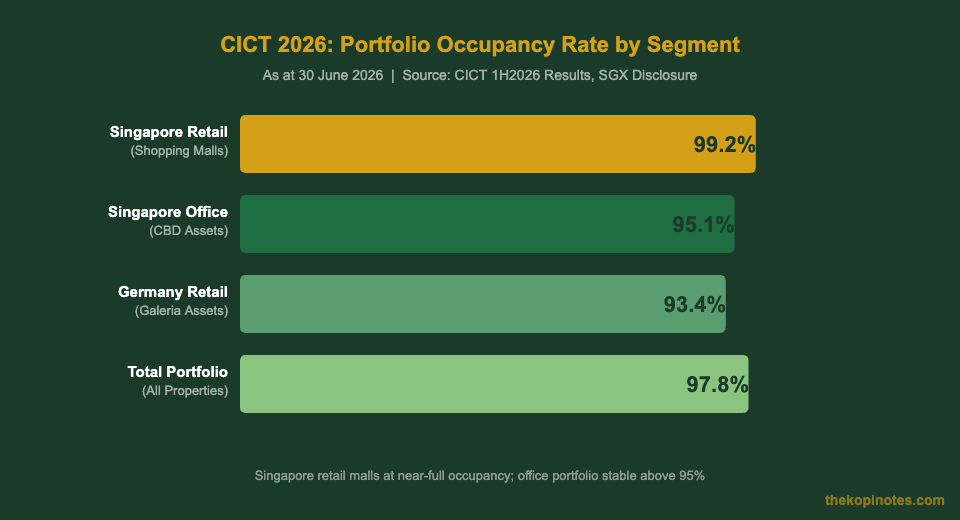
- CICT’s Singapore retail malls contribute ~58% of NPI and run at 99.2% occupancy — the income backbone.
- CBD office assets contribute ~36% of NPI, with occupancy stable at 95.1% even as the broader market softens.
- 1H2026 DPU grew 7.1% driven by the Paragon Tower acquisition (office) and positive rental reversions across both segments.
Table of Contents
Table of Contents
CICT at a Glance: Key Metrics 2026
Before diving into the segment breakdown, here is a quick snapshot of where CICT stands as at August 2026.
| Metric | Value (Aug 2026) |
|---|---|
| SGX Ticker | C38U |
| REIT Type | Diversified Commercial (Retail + Office) |
| Properties | 21 (Singapore, Germany, Australia) |
| 1H2026 DPU | 6.02 cents (7.1% YoY growth) |
| Aggregate Leverage (Gearing) | 37.4% (well below MAS 50% limit) |
| Total Portfolio Occupancy | ~97.8% |
| REIT Manager | CapitaLand Integrated Commercial Trust Management Ltd |
| Sponsor | CapitaLand Investment (CLI) |
Source: CICT SGX Disclosure, 1H2026 Results Announcement, August 2026
The 7.1% DPU growth in 1H2026 is standout performance. For context, Singapore’s broader S-REIT sector averaged around 3–5% DPU growth over the same period. CICT’s outperformance is directly linked to its portfolio structure. So let us examine that structure segment by segment.
What Does CICT Own? Full Portfolio Breakdown
CICT was formed in 2020 through the merger of CapitaLand Mall Trust and CapitaLand Commercial Trust. That merger gave it a dual-portfolio structure that no other Singapore REIT replicates at the same scale: it owns both prime shopping malls and Grade A CBD offices. Here is what that looks like in practice.
| Segment | Key Properties | NPI Share |
|---|---|---|
| Singapore Retail | Raffles City Singapore, Plaza Singapura, Westgate, IMM, Bugis Junction, Funan, Clarke Quay, Junction 8, Lot One, Tampines Mall, The Atrium@Orchard | ~58% |
| Singapore Office | CapitaGreen, Six Battery Road, Asia Square Tower 2 (50% stake), 21 Collyer Quay, Paragon Tower, Capital Tower | ~36% |
| Overseas (Germany/Australia) | Galeria Kaufhof assets (Germany), Lot One Shoppers Mall (Australia partial) | ~6% |
Source: CICT 1H2026 Results Presentation, CapitaLand Investment, August 2026
Three things stand out in this breakdown. First, retail is the dominant segment by income. Second, office contributes roughly one-third of CICT’s total NPI. Third, the overseas portfolio is small enough that it barely moves the needle. For practical purposes, CICT is a Singapore retail-plus-office story.
If you are evaluating the best S-REITs in Singapore for 2026, CICT’s diversification across both retail and office gives it a stability advantage that most single-sector REITs cannot match.
Singapore Retail Malls: The Income Backbone
CICT’s Singapore retail portfolio is the envy of the S-REIT sector. It operates malls across a range of catchments — from Orchard Road trophy assets like Plaza Singapura and The Atrium@Orchard, to suburban heartland malls like IMM, Westgate, and Junction 8 that serve captive HDB communities week after week.
A 99.2% occupancy rate is exceptional. Singapore’s overall retail occupancy typically runs between 92–95% across all grades. CICT’s malls achieve near-full tenancy because of their prime locations and CICT’s active tenant remixing strategy — regularly refreshing anchors and food and beverage offerings to keep shopper traffic high and justify premium rents.
On the NPI side, retail income grew steadily in 1H2026. The key driver was positive rental reversion: when leases expired and renewed, new rents were set above the expiring rents. CICT has consistently delivered positive reversions across its portfolio. This is especially true for its suburban malls, which benefit from population growth and limited competing supply in their catchment areas.
Why suburban malls outperform Orchard Road on income stability
There is a structural advantage baked into CICT’s retail mix. Suburban malls like IMM (Jurong) and Westgate serve essential retail — groceries, food and beverage, healthcare, and childcare. Shoppers visit weekly regardless of economic conditions. Orchard Road luxury retail is more discretionary and more sensitive to tourism and consumer sentiment.
CICT’s retail portfolio is weighted toward suburban community malls. This means its occupancy and NPI are relatively defensive — important if you are building passive income in Singapore that needs to hold up through economic cycles.
Raffles City Singapore, CICT’s flagship integrated development combining retail, hotel, and office, remains a standout performer. Post-pandemic tourism recovery has boosted both retail spending and the hotel component’s RevPAR (Revenue Per Available Room), delivering NPI above pre-COVID levels.
Singapore CBD Office: Steady Growth Driver
CICT’s Singapore office portfolio is anchored in the CBD’s premium Grade A towers. CapitaGreen at Market Street, Six Battery Road at Raffles Place, Asia Square Tower 2 (held as a 50% joint venture), and the newer Paragon Tower at Orchard give CICT exposure to the tightest end of Singapore’s office market.
At 95.1%, CICT’s office occupancy is solid — especially given Singapore’s broader office market softness in 2025–2026 as some global firms right-sized their footprints. Grade A office space in the Marina Bay and Raffles Place cluster has held up better than Grade B office elsewhere, precisely because multinational tenants prefer premier addresses.
Paragon Tower: CICT’s newest office growth engine
The Paragon Tower acquisition, completed in early 2026, added meaningful office NPI to CICT’s portfolio. This is the office component of Paragon Shopping Centre at Orchard Road — one of Singapore’s most prestigious commercial addresses. The full period contribution of Paragon Tower in 1H2026 was a key driver behind the 7.1% DPU growth.
Singapore CBD Grade A office rents have been under mild pressure in 2026 as some occupiers consolidate space. However, CICT’s long weighted average lease expiry (WALE) across its office portfolio provides income visibility. Most leases signed in 2022–2023 are only coming up for renewal in 2026–2027, meaning CICT still benefits from positive reversion potential as rents normalise higher.
For Singapore investors building a retirement portfolio, understanding how REIT income compounds over time is crucial. Use our Singapore retirement planning calculator to model how a S$100,000 CICT position at a 5.5% yield grows over 10–20 years with distributions reinvested.
Which Segment Drives CICT’s DPU Growth?
The 7.1% DPU growth in 1H2026 came from multiple sources. Breaking it down by segment gives a clearer picture of where the growth originated.
| Growth Driver | Segment | Impact on DPU |
|---|---|---|
| Paragon Tower (full period NPI contribution) | Office | Significant — key driver of YoY growth |
| Positive retail rental reversions (suburban malls) | Retail | Moderate — steady organic contribution |
| Office rent renewals (positive reversion on expiring leases) | Office | Moderate positive uplift |
| Lower all-in financing costs (partial benefit of rate environment) | Balance Sheet | Minor positive tailwind |
Source: CICT 1H2026 Results Presentation, SGX Disclosure, August 2026
The key insight is counterintuitive: retail provides the stable, defensive income base, while office delivered the incremental DPU growth in 1H2026. Most investors think of CICT as a “mall REIT.” In reality, the Paragon Tower acquisition and office rent reversions were the 1H2026 outperformance story.
Looking ahead to 2H2026, the September 2026 Fed rate cut cycle adds a further tailwind. Lower rates reduce CICT’s financing costs — at 37.4% gearing on a large property portfolio, even a 25–50 basis point cut translates into meaningful interest expense savings and a boost to distributable income. Both segments benefit, but the balance sheet impact is cross-cutting.
Is CICT’s 5.5%+ Yield Sustainable?
For dividend investors, the yield is what matters most. Here is how to assess CICT’s distribution sustainability across its dual-segment portfolio.
Annualised DPU forecast: Based on 1H2026 DPU of 6.02 cents, the full-year 2026 DPU is tracking toward approximately 11.5–12.0 cents, assuming 2H2026 remains in line with the first half. At the share price prevailing in August 2026, this translates to an indicative distribution yield of approximately 5.3–5.8%. Always check the latest SGX filing and live share price for the current figure.
Payout ratio discipline: Singapore REITs must distribute at least 90% of taxable income to maintain their tax-exempt REIT status. CICT has consistently paid out 90%+ of distributable income. The payout ratio is stable and sustainable as long as NPI holds.
Gearing headroom: At 37.4% aggregate leverage — well below the MAS regulatory limit of 50% — CICT has substantial capacity to take on additional debt for future acquisitions without diluting existing unitholders or triggering a distress scenario. A REIT approaching 45–48% gearing starts to face constraints; CICT is nowhere near that threshold.
Key risks to watch:
- Retail anchor vacancy: If a major anchor tenant vacates and cannot be quickly replaced, NPI falls. CICT mitigates this through a diversified tenant mix — no single tenant exceeds ~5% of gross rental income.
- Office demand slowdown: A prolonged global economic slowdown could soften CBD office demand, increasing vacancies and pressuring rents at renewal. CICT’s long WALE provides a multi-year buffer.
- Interest rate surprise: If rates rise again unexpectedly, CICT’s refinancing costs increase. However, with 37.4% gearing and well-staggered debt maturities, CICT’s balance sheet can absorb a modest rate reversal.
Overall, CICT’s dual-segment structure — retail providing the stable base, office adding growth optionality — makes it one of the more resilient income REITs in Singapore. The 7.1% DPU growth in 1H2026 is not a one-off; it reflects genuine asset quality and active management. That said, all REITs carry risk, and a diversified S-REIT approach is always prudent.
How to Buy CICT in Singapore
CICT (SGX: C38U) can be purchased through any Singapore brokerage that offers SGX access. Here are the options most relevant for retail investors in Singapore.
Syfe REIT+: Syfe’s REIT+ portfolio holds CICT as one of its core S-REIT positions. You can get started with as little as S$100 and benefit from automatic rebalancing and dividend reinvestment. Use the Syfe referral code SRPRFFFCD to receive your sign-up bonus.
FSMOne: For direct SGX share purchases with competitive commissions, FSMOne is one of the most cost-efficient platforms for Singapore investors buying individual REITs. Use FSMOne referral code P0544985 when you sign up.
Endowus (CPF or SRS investing): If you want to invest CPF Ordinary Account or SRS savings into a REIT-focused fund that includes CICT, Endowus offers CPF-approved and SRS-eligible fund options. Use Endowus referral code 2V343 for a fee discount on your first investment.
Before committing capital, run your numbers. Our retirement planning calculator helps you model how a REIT position at 5.5% yield grows over 10–20 years — a useful sanity-check before sizing a position.
Frequently Asked Questions
What is CICT's current distribution yield in 2026?
Based on CICT’s 1H2026 DPU of 6.02 cents, the annualised DPU is tracking approximately 11.5–12.0 cents for full-year 2026. At the prevailing share price as at August 2026, this implies an indicative yield of approximately 5.3–5.8%. Check the latest SGX announcement and live price for the most current figure before investing.
Which is bigger — CICT's retail portfolio or office portfolio?
By NPI contribution, CICT’s Singapore retail (shopping malls) is the larger segment at approximately 58% of total NPI. Singapore office contributes approximately 36%, and the overseas portfolio (Germany and Australia) makes up the remaining 6%. By number of assets, retail accounts for the majority of CICT’s 21 properties.
What drove CICT's 7.1% DPU growth in 1H2026?
The primary driver was the full-period NPI contribution from Paragon Tower, CICT’s office acquisition completed in early 2026. Secondary drivers included positive rental reversions across both the retail mall portfolio (renewed leases set above expiring rents) and the office portfolio (pre-COVID era leases rolling to market rates). Lower overall financing costs provided a minor additional uplift.
Is CICT a safe long-term dividend hold?
CICT is considered one of Singapore’s higher-quality S-REITs. It has a strong sponsor in CapitaLand Investment, prime assets in Singapore’s most sought-after retail and office locations, near-full retail occupancy at 99.2%, and conservative gearing at 37.4%. That said, no REIT is risk-free. A prolonged economic downturn, major retail tenant departure, or unexpected interest rate surge could reduce DPU. Position sizing and portfolio diversification across multiple S-REITs remain important.
How does CICT compare to Suntec REIT for Singapore investors?
CICT and Suntec REIT are both Singapore commercial REITs but with different profiles. CICT is significantly larger (~S$14B market cap vs Suntec’s ~S$4B), has lower gearing (~37% vs ~44%), and offers broader diversification across retail and office. Suntec REIT carries more pure-play office exposure and typically trades at a higher yield, reflecting its higher leverage and concentration risk. CICT is generally considered the lower-risk, lower-yield option; Suntec offers a higher-yield trade-off with higher risk.
Will CICT benefit from the Sep 2026 Fed rate cut cycle?
Yes, in two ways. First, lower rates reduce CICT’s borrowing costs. With 37.4% gearing on a large asset base, even a 25–50 basis point rate cut meaningfully reduces interest expense and boosts distributable income. Second, a rate-cut environment typically increases investor appetite for yield assets like S-REITs, which can support CICT’s share price. The Sep–Dec 2026 Fed rate cut cycle is broadly positive for CICT and the wider S-REIT sector.
This article was researched with the help of AI. While we strive to keep all information accurate and up to date, there may be errors. If you notice any discrepancies, please contact us.