CICT Share Price Target 2026: What CGS & Maybank Analysts Predict (SGX: C38U)
CapitaLand Integrated Commercial Trust — analyst verdicts, the Paragon acquisition, and where the consensus target sits.
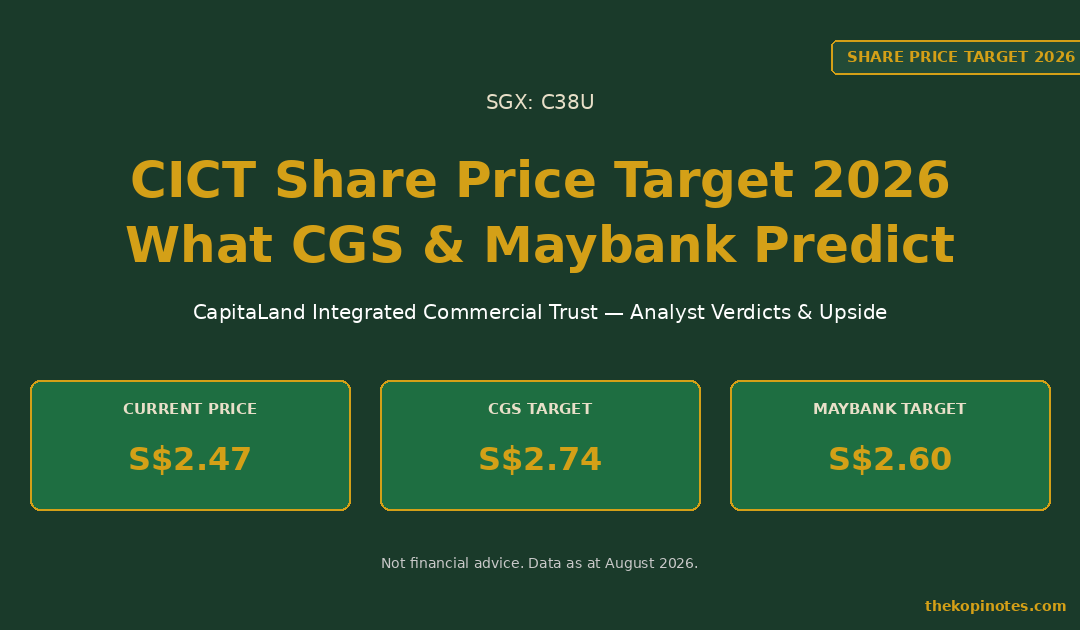
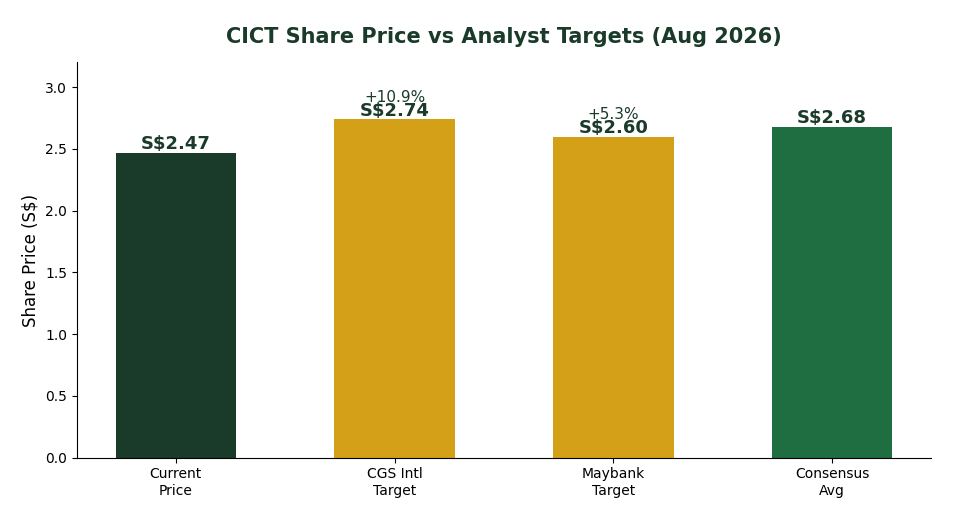
CapitaLand Integrated Commercial Trust (CICT, SGX: C38U) trades at S$2.47 as at 6 August 2026. CGS International’s most recent target is S$2.74 (Add, +10.9% implied upside), while Maybank Research’s target is S$2.60 (Buy, +5.3% implied upside). Both brokers cite CICT’s pending S$3.9 billion Paragon acquisition and resilient Singapore retail rents as the key catalysts.
Not financial advice. All figures are for educational reference only. Data as at August 2026 unless noted.
- CGS International: S$2.74 target (Add), Maybank: S$2.60 target (Buy) — both above the current S$2.47 price
- 12 analysts covering CICT are all rated Buy, with a consensus average target of S$2.68
- The Paragon acquisition (Orchard Road, S$3.9bn) is the swing factor most brokers are watching for FY2027 DPU growth
Table of Contents
Contents — Click to expand
- What Is CICT & Where Its Share Price Stands
- CGS International’s Target: S$2.74 (Add)
- Maybank Research’s Target: S$2.60 (Buy)
- Broker Consensus: 12 Analysts, All Buy
- The Paragon Acquisition Behind the Bull Case
- Rental Reversions & Portfolio Performance
- Key Risks to the Price Target
- How to Buy CICT Units in Singapore
- Frequently Asked Questions
What Is CICT & Where Its Share Price Stands
CapitaLand Integrated Commercial Trust is Singapore’s largest diversified commercial REIT. It owns shopping malls and office towers such as Raffles City, Plaza Singapura, ION Orchard (partial), Funan, and CapitaGreen. The trust was formed in 2020 through the merger of CapitaLand Mall Trust and CapitaLand Commercial Trust.
As at 6 August 2026, CICT units traded at S$2.47, down 1.2% on the day. Over the past year, the counter has moved mostly in a S$2.20–S$2.60 band as the market weighed rising interest rates against CICT’s defensive Singapore-heavy income base.
You’ll see CICT compared often with Frasers Centrepoint Trust and Mapletree Pan Asia Commercial Trust — both are also retail-heavy S-REITs. What sets CICT apart is scale: it’s the biggest of the three by asset value, which brokers say gives it an edge in chasing large acquisitions like Paragon.
CGS International’s Target: S$2.74 (Add)
CGS International maintained an “Add” call on CICT with a target price of S$2.74, unchanged from its prior call, in a report dated 27 April 2026. At the time of that report, CICT traded at S$2.48 — implying a 10.5% upside at that price. Using today’s S$2.47 close, that same S$2.74 target now implies 10.9% upside.
CGS International’s report flagged a few specifics worth noting. First-quarter FY2026 revenue and net property income both landed in line with forecasts, at roughly 25% of the full-year estimate. Retail rental reversions came in at +4.4% and office at +6.1% — both positive, meaning new and renewed leases are being signed at higher rents than before.
| Metric | CGS International (27 Apr 2026) |
|---|---|
| Rating | Add (Maintained) |
| Target Price | S$2.74 |
| Aggregate Leverage | 38.5% |
| Committed Occupancy | 95.2% |
| FY26F Dividend Yield | 4.81% |
Source: CGS International research report via Minichart, 27 April 2026.
CGS also flagged asset enhancement works at Plaza Singapura and The Atrium @ Orchard — a combined S$160 million upgrade phased from Q3 2026 to Q4 2028. That’s a multi-year drag on those two malls’ income, but the brokerage still sees the net effect as positive once completed.
Maybank Research’s Target: S$2.60 (Buy)
Maybank Research Pte Ltd maintained a “Buy” rating with a target price of S$2.60 in a report dated 20 April 2026. At the time, Maybank quoted CICT’s price at S$2.39, implying a 9% upside. Off today’s S$2.47 close, that same target now implies a smaller 5.3% upside — a reminder that these figures move as the share price moves, even when the target itself hasn’t changed.
Maybank’s report centres almost entirely on the Paragon deal. The brokerage expects the acquisition to be immediately accretive, lifting pro-forma distribution per unit (DPU) — basically how much cash each CICT unit pays you per quarter — by 2.1%, while keeping portfolio leverage below 40%.
That’s a meaningful number for income-focused investors. A 2.1% DPU bump, on top of CICT’s existing ~4.8% forward yield, is the kind of incremental growth that keeps a REIT’s distribution compounding even without broader market tailwinds.
Broker Consensus: 12 Analysts, All Buy
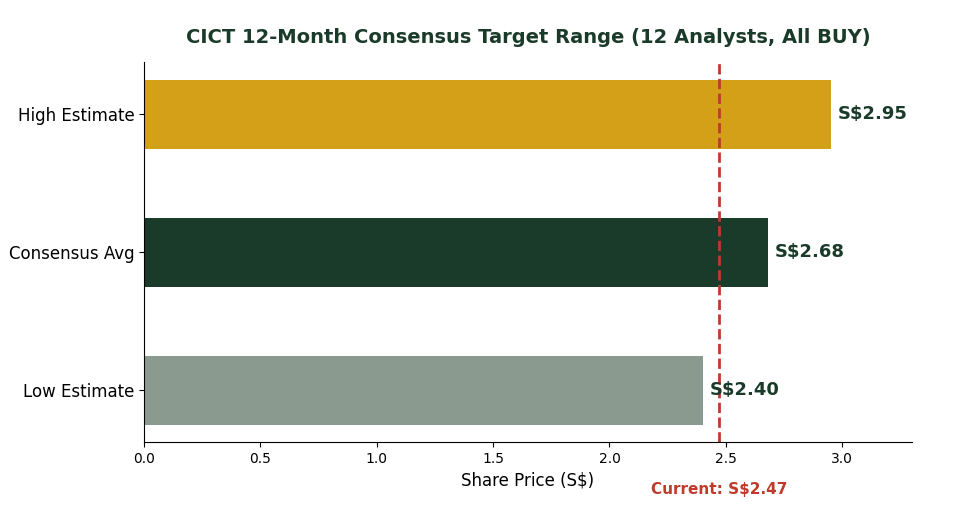
Beyond CGS and Maybank, the wider analyst consensus on CICT is unanimously bullish. Twelve analysts currently cover the counter, and every single one rates it a Buy — zero Sell or Hold calls, according to consensus data aggregated by Stockopedia.
| Estimate | Target Price | Implied Upside* |
|---|---|---|
| Low | S$2.40 | -2.8% |
| Average | S$2.68 | +8.5% |
| High | S$2.95 | +19.4% |
*Implied upside calculated off S$2.47 close, 6 Aug 2026. Source: Stockopedia analyst consensus data, accessed 6 August 2026.
Here’s why that matters: even the lowest analyst estimate (S$2.40) sits only marginally below today’s price, while the average sits comfortably above it. That’s an unusually tight, one-sided spread for a REIT — most S-REITs see at least one bearish outlier in their consensus range.
The Paragon Acquisition Behind the Bull Case
Almost every recent analyst report on CICT circles back to one deal: the proposed acquisition of Paragon, a freehold integrated retail-and-medical development on Orchard Road, for S$3.9 billion.
The purchase is funded through a mix of three sources: the divestment of Asia Square Tower 2 for S$2.5 billion, a S$600 million equity raise, and the balance in debt. For a Singapore investor, the key question is whether that funding mix dilutes existing unitholders or grows income per unit — and Maybank’s 2.1% DPU accretion estimate suggests the latter.
Paragon adds upscale retail and medical-suite exposure to CICT’s portfolio, both segments with limited direct REIT-listed competition in Singapore. About 40% of Paragon’s leases expire by 2027, which gives CICT’s manager an early opportunity to reprice rents upward if demand holds.
The trade-off: divesting Asia Square Tower 2 reduces CICT’s office exposure just as office rents have been recovering. Whether that’s a net positive depends on how you weight defensive retail income against potential office upside — a genuine judgement call, not a settled one.
Rental Reversions & Portfolio Performance
Rental reversion — the percentage change between a lease’s old rent and its new rent upon renewal — is one of the clearest signals of a REIT’s pricing power. CICT’s 1Q26 reversions of +4.4% (retail) and +6.1% (office) mean tenants are, on average, paying more than they were before, a sign of healthy demand rather than a landlord discounting to keep space filled.
Committed occupancy across the portfolio stood at 95.2% as at the CGS report date — a level most REIT managers would consider close to full. Combined with an all-in debt cost of 2.9% and aggregate leverage of 38.5%, CICT’s balance sheet gives it headroom to absorb the Paragon acquisition without breaching MAS’s 50% leverage ceiling for S-REITs.
If you’re building a passive income Singapore portfolio around S-REITs, occupancy and reversion trends like these are worth tracking every quarter — they tend to move share prices faster than headline DPU numbers alone.
Key Risks to the Price Target
No analyst target is guaranteed. A few risks could keep CICT below both the CGS and Maybank targets:
Deal completion risk. The Paragon acquisition is still pending — if financing terms, regulatory approval, or negotiated pricing shift before completion, the DPU accretion assumptions both brokers rely on could change.
Interest rate sensitivity. S-REITs generally trade inversely to bond yields. If interest rates stay higher for longer than expected, CICT’s ~4.8% yield looks less attractive relative to risk-free alternatives like Singapore T-bills, which can compress the unit price even if operating metrics stay strong.
AEI execution risk. The S$160 million Plaza Singapura and Atrium @ Orchard upgrades run through Q4 2028. Cost overruns or longer-than-planned downtime would weigh on near-term income from those assets.
Weigh these against the bull case rather than dismissing either side — that’s the honest way to use an analyst target, not as a guarantee but as one input into your own view.
How to Buy CICT Units in Singapore
CICT (SGX: C38U) trades on the SGX Mainboard like any other listed stock, so you can buy it through any Singapore brokerage. If you’re comparing platforms, low-cost options with CPF/SRS compatibility are worth checking first since CICT is a common CPF Investment Scheme counter.
You can also access broad exposure to CICT and other Singapore REITs indirectly through a diversified Singapore REIT ETF, or through a robo-advisor REIT-income portfolio if you’d rather not pick individual counters. Platforms like Syfe (referral code and sign-up bonus) and Endowus (referral code) both offer curated income portfolios that include S-REITs such as CICT.
For deeper research before you buy, our best S-REITs in Singapore 2026 guide ranks CICT against its retail and diversified-REIT peers, and our Singapore retirement calculator can help you model how a REIT-heavy portfolio like this fits your income goals.
Building a Singapore dividend portfolio? Compare brokers and get a sign-up bonus.
Frequently Asked Questions
What is CICT's share price target for 2026?
Is CICT a buy right now?
What is the Paragon acquisition and why does it matter for CICT?
What is CICT's dividend yield?
What are the main risks to CICT's price target?
How do I buy CICT units in Singapore?
This article was researched with the help of AI. While we strive to keep all information accurate and up to date, there may be errors. If you notice any discrepancies, please contact us.