Retiring in Singapore 2026: The Complete Checklist
Singapore is one of Asia’s best places to retire — world-class healthcare, a safe environment, excellent public transport and a robust CPF system that pays you a monthly income for life. But retirement here requires careful planning. With a comfortable retirement costing S$4,000–5,000 per month and healthcare expenses rising, the decisions you make in your 50s will define your retirement decades.
This complete 2026 checklist walks you through every pillar of retirement in Singapore — from CPF LIFE payouts to SRS tax savings, healthcare planning, housing choices and a 10-step action plan you can start today.
Free download: The Singapore Money Playbook — 7 money mindset shifts written for Singapore, with the CPF-adjusted retirement number most guides get wrong (PDF + Notion).
How Much Does Retirement in Singapore Cost?
The biggest question for anyone planning retirement in Singapore is: how much do I actually need each month? The honest answer depends on your lifestyle — but here are realistic 2026 estimates based on CPF Board data and the Department of Statistics household expenditure survey.
| Category | Modest (S$/month) | Comfortable (S$/month) |
|---|---|---|
| Housing (HDB, utilities, maintenance) | 300–500 | 700–1,200 |
| Food & Groceries | 500–700 | 900–1,400 |
| Healthcare & Medications | 300–450 | 500–800 |
| Transport (MRT, bus, taxi) | 150–200 | 250–400 |
| Utilities & Communications | 150–200 | 200–300 |
| Leisure, Travel & Lifestyle | 300–400 | 600–1,000 |
| Miscellaneous & Emergency Buffer | 200–300 | 350–500 |
| Total Monthly Budget | ~S$2,000–2,750 | ~S$3,500–5,600 |
The Lee Kuan Yew School of Public Policy’s 2024 Retirement Adequacy Study pegged a “modest” retirement at around S$1,379/month and a “comfortable” standard at S$2,351/month per person (2024 dollars). In 2026 terms with inflation, a realistic comfortable retirement for a couple living in an HDB flat runs S$4,500–5,500/month combined.
Use our free Singapore Retirement Planning Calculator to model exactly how much your CPF LIFE, SRS and investments will cover — and how big the gap is.
CPF LIFE: Your Guaranteed Monthly Payout for Life
CPF LIFE (Lifelong Income For the Elderly) is the cornerstone of retirement in Singapore. It is a national longevity insurance annuity that pays you a monthly income from age 65 until death — no matter how long you live. You are automatically enrolled if you are a Singapore Citizen or PR with a Retirement Account (RA) of at least S$60,000 at age 65.
2026 Retirement Sums (Turning 55 in 2026)
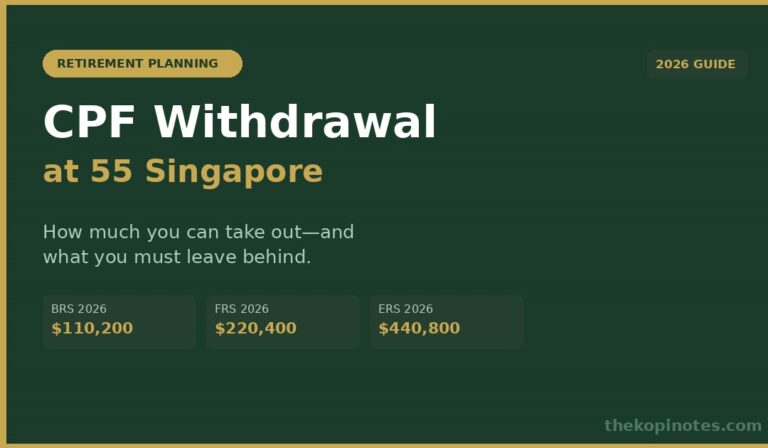
The amount you set aside in your Retirement Account at age 55 determines your monthly payout. The 2026 cohort (those turning 55 in 2026) has the following Retirement Sums:
| Retirement Sum | Amount (2026) | Est. CPF LIFE Payout/month* |
|---|---|---|
| Basic Retirement Sum (BRS) | ~S$99,400 | ~S$790–850 |
| Full Retirement Sum (FRS) | ~S$198,800 | ~S$1,550–1,650 |
| Enhanced Retirement Sum (ERS) | ~S$397,600 | ~S$3,070–3,250 |
*Estimates for CPF LIFE Standard Plan, payout starts at age 65. Source: CPF Board 2026.
Most Singaporeans retire with the FRS, giving them roughly S$1,600/month. Topping up to ERS (4× BRS since 2025) is increasingly popular for higher-income earners who want to maximise their guaranteed income. Full plan comparison details are in Step 4 of the checklist below.
CPF LIFE Plans: Which Should You Choose?
There are three CPF LIFE plans — Standard, Basic and Escalating. The Standard Plan offers the highest fixed monthly payout and is the default choice for most retirees. The Escalating Plan starts lower but increases by 2% annually, protecting against inflation. The Basic Plan pays less monthly but preserves more bequest for your beneficiaries. You must choose your plan by age 65.
SRS: Boost Your Retirement Savings with Tax Relief
The Supplementary Retirement Scheme (SRS) is a voluntary government scheme that lets you contribute up to S$15,300 per year (Singaporeans and PRs) and get immediate income tax relief on every dollar contributed. Foreigners can contribute up to S$35,700 per year.
Money in your SRS account can be invested in stocks, ETFs, unit trusts, insurance endowments and fixed deposits. At retirement (age 62), you can withdraw at 50% taxable — meaning effectively only half your withdrawals are taxed. Spread withdrawals over 10 years and you can potentially withdraw tax-free if your total chargeable income stays below the S$20,000 taxable threshold.
SRS Quick-Win: The Numbers
For a Singaporean in the 7% tax bracket contributing S$15,300/year to SRS, the immediate tax saving is S$1,071/year. Over 20 years of contributing before retirement, that’s more than S$21,000 in tax saved — before investment returns. For those in the 11.5% bracket, savings exceed S$1,750/year. This makes SRS one of the most straightforward tax optimisation moves available to Singapore residents.
See our complete SRS Account Singapore guide for withdrawal strategies, best platforms and investment options.
Healthcare in Retirement: MediSave, MediShield Life & ISP
Healthcare is the biggest variable expense in retirement. Singapore’s three-tier healthcare system — MediSave, MediShield Life and Integrated Shield Plans — provides strong protection, but gaps remain that retirees must plan for.
MediSave (2026 BHS: S$79,000)
MediSave is your dedicated healthcare savings account within CPF. In 2026, the Basic Healthcare Sum (BHS) is S$79,000. Any MediSave above BHS flows into your Retirement Account. MediSave covers hospitalisation, day surgery, selected outpatient treatments and MediShield Life premiums. In retirement, you can use it for approved treatments without a cash outlay.
MediShield Life
MediShield Life is a mandatory national health insurance that pays for large Class B2/C hospitalisation bills. It is lifelong — there is no expiry — and premiums are fully payable from MediSave. In 2026, MediShield Life underwent a major enhancement, raising claim limits significantly. Annual premium for a 65-year-old is approximately S$1,235–1,590 per year, fully MediSave-payable.
Integrated Shield Plan (ISP)
An ISP tops up your MediShield Life to cover Class A/B1 wards or private hospitals, with higher claim limits. Basic ISP premiums are partially MediSave-claimable; riders (for co-insurance waiver) are cash-only. For retirees, the key decision is whether to keep an ISP rider in retirement or downgrade to reduce premiums. At age 65, ISP annual premiums (basic + rider) can reach S$3,000–5,000/year and rise steeply with age — budget for this carefully.
CareShield Life
CareShield Life provides long-term care insurance for severe disability (unable to perform 3 of 6 daily activities). For Singaporeans born 1980 or later, it is mandatory. The basic payout starts at S$600/month (increasing 2%/year) and supplements are available. Budget for CareShield Life as part of your healthcare retirement plan.
Housing in Retirement: Options for Singapore Retirees
For most Singaporeans, the family HDB flat is both their primary home and their largest asset. In retirement, housing decisions significantly affect both your monthly cashflow and quality of life.
Option 1: Stay in Your HDB Flat
The simplest option. Most retirees own their flat outright or have small remaining loans. Monthly costs are limited to S&CC (service and conservancy charges, typically S$50–100), utilities and property tax (significantly lower for owner-occupied HDB). This is the most common retirement housing situation in Singapore.
Option 2: Lease Buyback Scheme (LBS)
The HDB Lease Buyback Scheme lets flat owners aged 65+ sell part of their remaining lease back to HDB in exchange for a cash payout into their CPF Retirement Account — boosting CPF LIFE monthly payouts. This is ideal for those who are asset-rich but cash-poor. Available for 3-room and larger flats.
Option 3: Right-Size to a Smaller Flat
Selling a 4-5 room flat and buying a smaller 2-3 room flat can unlock S$200,000–400,000 in cash proceeds. Combined with the Enhanced CPF Housing Grant for right-sizing, this can significantly boost retirement savings. The Silver Housing Bonus adds up to S$30,000 in cash on top for eligible retirees who top up their RA using the sale proceeds.
Option 4: Retirement Villages
For those who prefer a supported living environment, Singapore has a growing network of retirement villages offering community facilities, healthcare on site and social activities. See our Retirement Village Singapore guide for costs and options.
The 10-Step Retirement Checklist for Singapore (2026)
Work through these steps in your 50s and 60s to retire with confidence. Tick each item off your list.
Step 1: Know Your Retirement Number
use our Retirement Planning Calculator (linked above) to estimate how much you need and whether your current CPF + savings will cover the gap.
Step 2: Maximise Your CPF Retirement Account
Top up your CPF RA (or your spouse’s) to the Full Retirement Sum or Enhanced Retirement Sum. Each dollar earns a guaranteed 4% p.a., and the cash top-up gives you dollar-for-dollar income tax relief.
Step 3: Open an SRS Account Before You Retire
Contribute the maximum S$15,300/year to your SRS account to cut your annual tax bill. Invest your SRS into diversified ETFs or dividend stocks — don’t leave it in cash earning near zero.
Step 4: Review Your CPF LIFE Plan Choice
By age 65, you must select Standard, Basic or Escalating CPF LIFE plan. The decision is irrevocable. Read our CPF LIFE guide and model all three payout scenarios.
Step 5: Fill the MediSave BHS (S$79,000 in 2026)
Top up MediSave to the Basic Healthcare Sum to maximise the CPF interest compounding in your RA. Voluntary MediSave top-ups also receive income tax relief.
Step 6: Review Your Integrated Shield Plan
Decide whether to keep ISP + rider in retirement or downgrade to reduce premiums. Premiums rise sharply after 70. Ensure you can fund premiums from MediSave (for basic ISP) and cash (for riders) long-term.
Step 7: Eliminate High-Interest Debt
Pay off any personal loans or credit card debt before retiring. The last thing you want in retirement is servicing high-interest debt on a fixed income.
Step 8: Build a Dividend & Passive Income Portfolio
CPF LIFE + SRS alone may not be enough. A portfolio of Singapore dividend stocks, S-REITs and global ETFs can generate S$1,000–2,000/month in passive income. Read our passive income Singapore guide for a practical starting framework.
Step 9: Decide on Your Housing Plan
Will you stay in your HDB, downsize via the Silver Housing Bonus, or use the Lease Buyback Scheme to monetise your flat? A housing decision can unlock S$100,000–400,000 in additional retirement capital.
Step 10: Update Your Will, LPA & Advance Care Directive
A Lasting Power of Attorney (LPA) lets a trusted person manage your financial and personal affairs if you lose capacity. A will ensures your CPF nominations and estate are distributed as you wish. Both are easy to execute but often neglected.
Growing Your Retirement Portfolio: Robo-Advisors & DIY ETFs
CPF LIFE and SRS are excellent foundations, but most retirees need additional investment income to achieve a comfortable retirement lifestyle. Two approaches work well for Singapore investors — robo-advisor managed portfolios and self-directed ETF investing.
Robo-advisors like Endowus and Syfe make it easy to invest your SRS funds, CPF-OA (via CPFIS) and cash savings into globally diversified portfolios. They handle rebalancing automatically, have low fees and are regulated by MAS. For SRS investing in particular, Endowus is the leading robo-advisor that accepts CPF, SRS and cash in a single platform (AutoWealth also now offers CPF OA portfolios).
DIY ETF investing via FSMOne or IBKR lets you build a low-cost portfolio of broad-market ETFs like CSPX, VWRA or Singapore dividend ETFs. This approach has the lowest fees but requires more active management.
Read our complete Retirement Planning Singapore 2026 guide for a step-by-step comparison of retirement investment strategies.
”Endowus
”Syfe
Frequently Asked Questions: Retiring in Singapore
”How
”What
”How
”Can
”Is
”What
”Should
”How
”What
Start Planning Your Retirement Today
Retiring comfortably in Singapore is achievable with the right plan — but the earlier you start, the more flexibility you have. The biggest levers are maximising your CPF Retirement Account, contributing to SRS every year, and building a dividend or ETF portfolio to supplement CPF LIFE.
For a deeper dive into CPF investment strategy, read our CPF investment guide.
This article was researched with the help of AI. While we strive to keep all information accurate and up to date, there may be errors. If you notice any discrepancies, please contact us.