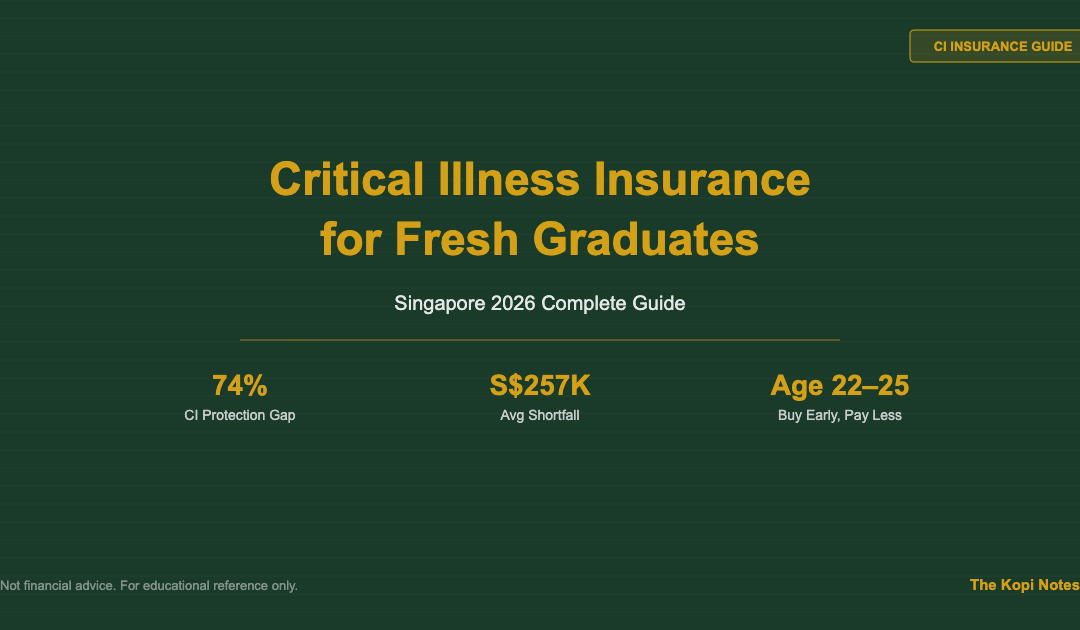
Critical Illness Insurance for Fresh Graduates in Singapore (2026 Guide)
What your employer’s group policy won’t tell you — and why buying early changes everything.
📋 Table of Contents
Table of Contents
- Why Fresh Graduates Have a Unique Advantage
- The Employer Group CI Trap
- How Much CI Cover Does a Fresh Grad Actually Need?
- Which Type of CI Policy Is Right for You?
- CI Premium Comparison by Age
- The Coverage Gap You Cannot Afford to Ignore
- Budget Tips: Fitting CI Into Your First Salary
- Frequently Asked Questions
Critical illness insurance for fresh graduates in Singapore is not just advisable — it is the single highest-leverage financial move you can make in your first year of work. Singapore’s LIA 2022 Protection Gap Study found that 74% of economically active adults aged 20–69 have insufficient CI coverage, with an average shortfall of S$256,826. Yet premiums for a 22-year-old non-smoker cost as little as S$300 per year for S$200,000 of severe-stage cover — a sum that can represent more than three years of income replacement. Buy early, pay less, and lock in insurability before any health condition arises.
Not financial advice. All figures are for educational reference only. Data as at November 2026 unless noted. Consult a licensed financial adviser before purchasing any insurance product.
Why Fresh Graduates Have a Unique Advantage
Your first year of full-time work is the optimal window for buying critical illness insurance, for three reasons that compound over time.
1. You are at peak insurability. CI underwriters assess your health at the point of application. Any pre-existing condition — even a family history of heart disease discovered during a routine check-up — can trigger exclusions or premium loading. At 22–25, most fresh graduates are in excellent health with no declared conditions, which means standard rates and full coverage across all 37 LIA-standardised severe-stage conditions effective 1 October 2025.
2. Premiums lock in at your entry age. Most CI policies in Singapore use a stepped or guaranteed renewal premium structure. The younger you are when you buy, the lower your base premium — and that savings compresses all the way through your policy term. A 22-year-old who starts a 20-year renewable policy pays roughly S$300–S$350 per year for S$200,000 in cover. The same policy purchased at 35 costs S$600–S$700 per year. That difference, invested in a Syfe portfolio over 13 years, represents tens of thousands in real money.
3. Employers rarely cover you adequately. Most Singapore employers offer group CI as part of a benefits package — but the coverage is typically one to two times your monthly or annual salary, the policy terminates the day you resign or are retrenched, and the insurer sets the conditions (you have zero say). A fresh grad earning S$3,500 per month may have only S$42,000–S$84,000 in group CI cover — roughly one-fifth of what the LIA recommends for adequate protection.
The Employer Group CI Trap
Group CI is a valuable perk, but relying on it as your primary CI protection is a classic first-job financial mistake. Here is exactly why.
Coverage ends on your last day of employment. Whether you resign for a better offer, get retrenched during a downturn, or take a career break to study, your group CI lapses immediately. If a critical illness is diagnosed the week after your last payslip, you receive nothing — regardless of how many years you contributed to the scheme. Singapore’s labour market data shows that the median job tenure for workers aged 25–34 is around three to four years. That means most fresh graduates will change jobs — and lose their group CI — multiple times before 35.
Conversion options are limited. Some group schemes allow conversion to an individual policy on leaving, but conversion windows are short (typically 30 days), the converted policy is often more expensive than a fresh individual application, and not all conditions are covered. By contrast, buying a personal policy now means you own the coverage outright, regardless of employment status.
Coverage amounts are inadequate. The HL Assurance 2024 survey found the average Singaporean’s existing CI cover is S$59,776 — well below the S$316,603 recommended to cover lost income, treatment, and recovery costs for a severe illness. For a fresh graduate earning S$3,500/month, two to three years of income replacement alone requires S$84,000–S$126,000, before factoring in specialist treatment costs that can exceed S$150,000 for cancer or S$80,000 for a major cardiac event.
How Much CI Cover Does a Fresh Grad Actually Need?
The standard recommendation is 3–5 years of gross income, plus estimated treatment costs. For a fresh graduate earning S$3,500 per month in 2026, that works out to:
| Component | Estimated Amount |
|---|---|
| Income replacement (3 years × S$42K) | S$126,000 |
| Cancer treatment (specialist, surgery, chemo) | S$80,000–S$150,000 |
| Out-of-pocket after MediShield Life/IP | S$20,000–S$50,000 |
| Recovery, rehab, lifestyle adjustments | S$20,000–S$40,000 |
| Recommended minimum CI sum assured | S$200,000–S$300,000 |
Source: LIA Singapore; MoH published hospital bills data; HL Assurance 2024 CI Protection Survey. Figures are estimates for educational reference only.
Starting with S$200,000 of CI cover is a practical first step. This sum is achievable at a reasonable premium for a 22–25 year old, and can be supplemented later (via additional policies or upgrading your existing plan) as your income grows. The critical thing is not to leave the window open — if you develop a chronic condition in your late 20s, adding cover becomes more difficult and more expensive.
Need help estimating your longer-term retirement income needs alongside protection planning? TKN’s Singapore retirement planning calculator lets you model different scenarios.
Which Type of CI Policy Is Right for a Fresh Graduate?
Singapore’s CI market offers two main structures: standalone CI and CI riders attached to a life policy. For most fresh graduates, a standalone CI policy (or a term life policy with a CI rider) is the most cost-efficient approach.
| Policy Type | Best For | Key Trade-off |
|---|---|---|
| Standalone CI (severe stage) | Maximum CI cover for the premium dollar | No death or TPD benefit |
| Multi-pay CI | Those wanting CI cover after recovery or recurrence | Higher premium; better value if claim history |
| Early CI (early + severe stage) | Those wanting payout at early cancer / TIA stages | Significantly higher premium; check definitions carefully |
| CI Rider on Term Life | Fresh grads needing both CI + death cover on a budget | Lower absolute cost; policy lapse affects both covers |
Source: MAS product disclosure requirements; LIA product classification guidelines 2025.
For more detail on how early-stage and late-stage CI differ in definitions and payout triggers, read our guide on early stage vs late stage critical illness insurance in Singapore.
As a fresh graduate on a starting salary, the most practical approach is usually: buy S$200,000–S$250,000 of severe-stage standalone CI now (cheapest premium, highest CI coverage per dollar), and add an Integrated Shield Plan or early CI rider once you have more disposable income. This staged approach maximises your coverage now while keeping costs manageable.
If you are single, you should also consider whether a term life insurance policy belongs alongside your CI cover — particularly if you have parents or dependants relying on your income.
CI Premium Comparison by Age (Singapore, 2026)
The chart below shows indicative annual premiums for S$200,000 of severe-stage CI cover across age groups, for a non-smoking male in good health. Premiums vary by insurer, gender, occupation class, and product features — these figures are illustrative, not a quote.
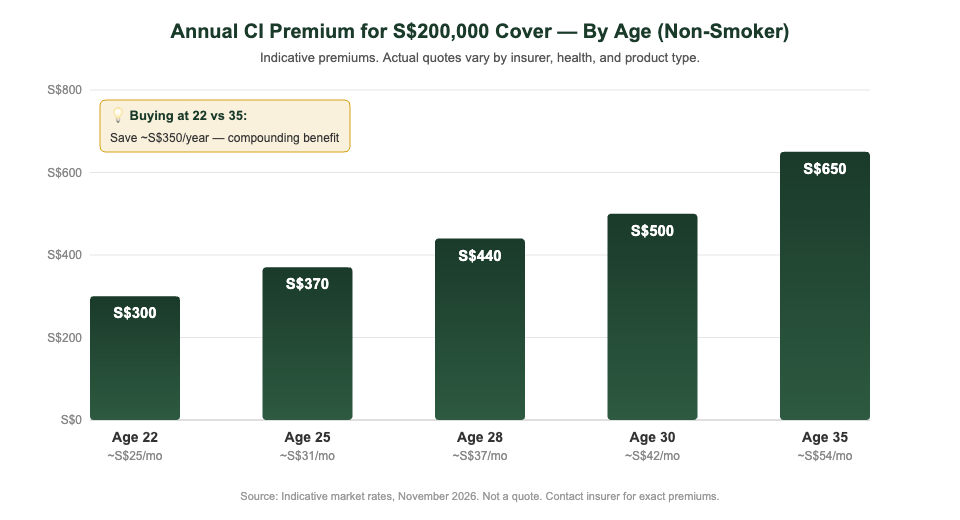
Source: Indicative market rates, November 2026. Not a binding quote. Contact a licensed adviser or insurer for personalised premiums.
The takeaway is stark: a 22-year-old pays roughly S$300–S$350 per year for S$200,000 of CI cover. By age 35, the same coverage costs S$600–S$700 — more than double. The 13-year window represents S$3,000–S$4,500 in cumulative savings that a fresh graduate who buys early captures by locking in at young-age rates. If you are currently 22–25 and in good health, this window is open. At 30, it starts closing. At 35, the window is still there but the savings are significantly reduced.
Most fresh graduates can comfortably fit S$300–S$500/year of CI premiums into a starting salary — that is S$25–S$42 per month, roughly the cost of two meals at a coffee shop per week.
The Coverage Gap You Cannot Afford to Ignore
Singapore’s LIA 2022 Protection Gap Study is the most comprehensive public data available on CI under-insurance in Singapore. Its headline findings are sobering for anyone starting a career here.
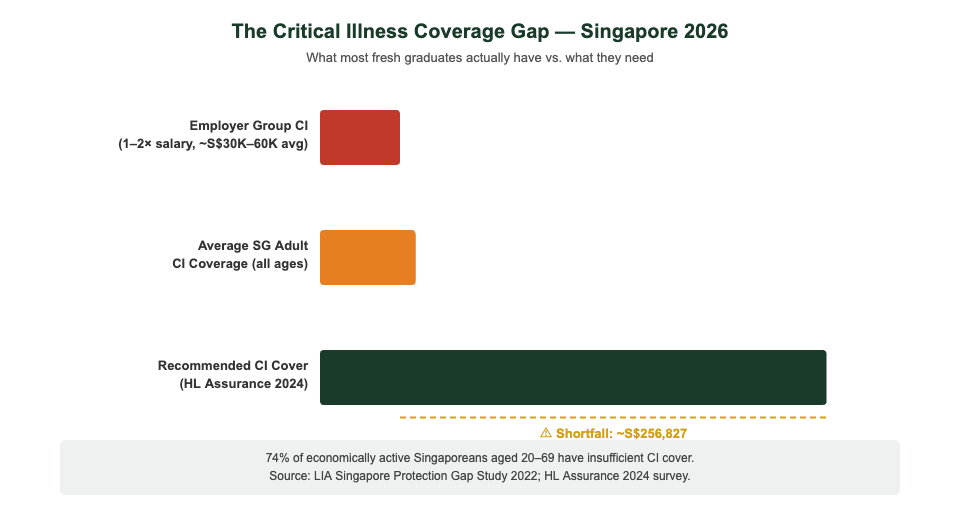
Source: LIA Singapore Protection Gap Study 2022; HL Assurance 2024 CI Protection Survey.
The chart illustrates three numbers that every fresh graduate should understand:
- Employer group CI (S$30,000–S$60,000) — what most employers provide as a benefit, typically one to two times salary. Ends when employment ends.
- Average existing CI coverage in Singapore (S$59,776) — the LIA-reported average across all working adults. It includes both employer group and personally-owned policies.
- Recommended CI coverage (S$316,603) — the HL Assurance 2024 survey’s estimate of what adequately covers lost income, treatment, and recovery for a severe illness in Singapore’s healthcare cost environment.
The shortfall — roughly S$256,827 — is not a rounding error. It represents years of lost income, treatment bills, and home adjustments that most Singaporeans would fund by draining savings, liquidating investments, or borrowing from family. For a fresh graduate with limited savings and no investment base, the consequences of a severe CI event without adequate coverage can be financially catastrophic.
A 2023 study highlighted by MSIG found that 68% of Gen Z respondents in Singapore had zero CI coverage. If you are in this group, the first step is not complex financial planning — it is simply buying a standard severe-stage CI policy at the best time you will ever have to do it.
Budget Tips: Fitting CI Into Your First Salary
The most common objection from fresh graduates is cost: “I’m already paying rent, student loans, and CPF — where does CI premium money come from?” Here are four practical approaches.
1. Start with severe-stage only. Severe-stage standalone CI is significantly cheaper than multi-stage or multipay CI products. You are buying the most critical protection first — the payout triggers that actually result in prolonged inability to work. Early-stage cover is valuable, but it is a discretionary upgrade once your income grows.
2. Consider a term CI rider. If you also need death and TPD cover (common for fresh grads with aging parents as dependants), a term life policy with a CI rider can be more economical than buying two separate policies. The combined premium can be S$400–S$700/year for meaningful coverage across all three events.
3. Use SRS or CPF-OA strategically for other savings goals. CI premiums are paid in cash (they are not SRS- or CPF-eligible under current MAS rules), but protecting your CI coverage frees up other financial resources. For example, if you are building a retirement nest egg, consider platforms like Syfe — use our Syfe referral code for a welcome bonus — where you can automate low-cost investing while keeping your protection coverage funded separately.
4. Review annually as income grows. Your first CI policy does not have to be your final one. Many Singaporeans start with S$100,000–S$200,000 of coverage at 22–25, then supplement with additional policies at 28–32 when salaries have grown and savings are established. The key is not letting the perfect be the enemy of the good — a S$200,000 policy bought today at age 23 beats a theoretical S$400,000 policy bought at 32 on every metric: premium cost, insurability, and accumulated coverage years.
For older professionals researching CI options later in their career, our guide to critical illness insurance for seniors in Singapore covers the considerations specific to those over 60.
Start Building Your Financial Foundation
CI insurance protects the income you are working hard to build. While you are setting up protection, also consider starting a low-cost investment portfolio for long-term growth. TKN readers can use the Syfe referral code SRPRFFFCD to get started with a cash management or Core portfolio.
TKN may earn a referral fee if you sign up. This is not financial advice.
Frequently Asked Questions
Do I really need CI insurance as a fresh graduate in Singapore?
Doesn't my employer already provide CI insurance?
How much CI coverage should a fresh graduate buy in Singapore?
What is the cheapest CI insurance for a 22-year-old in Singapore?
What are the 37 CI conditions covered under the LIA standard framework?
Is early-stage CI insurance worth it for a fresh graduate?
Disclaimer: This article is for general information and educational purposes only and does not constitute financial, insurance, or investment advice. The Kopi Notes is not a licensed financial adviser. All premium figures, coverage estimates, and statistics are indicative and may change. Please consult a MAS-licensed financial adviser before purchasing any insurance product. All data is as at November 2026 unless otherwise stated.
Get Free Insurance Advice
Speak with a licensed insurance advisor. No obligation, no cost.
By submitting this form, you agree to our Privacy Policy.
This article was researched with the help of AI. While we strive to keep all information accurate and up to date, there may be errors. If you notice any discrepancies, please contact us.