Critical Illness Insurance Exclusions Singapore 2026: What’s Not Covered
Critical illness insurance in Singapore covers 37 standardised conditions under the LIA CI Framework 2024, effective October 2025 for new policies — but every policy also contains exclusions that can void your claim. The most common are pre-existing conditions, a waiting period of 30 to 90 days from policy start, and a survival period of 14 to 30 days post-diagnosis. Understanding these exclusions before you buy can save you from a denied claim when you need it most.
Not financial advice. All figures are for educational reference only. Data as at October 2026 unless noted.
What Are CI Insurance Exclusions?
A CI insurance exclusion is a condition, circumstance, or time window under which your insurer will not pay out — even if you are diagnosed with one of the 37 standard critical illnesses. Exclusions exist in every policy, and they are not hidden in the fine print. Under MAS Notice 307, insurers must clearly disclose all exclusions in the policy document and at the point of sale.
Exclusions fall into two broad types: standard exclusions that appear in virtually every policy, and non-standard exclusions (also called special exclusions) added specifically to your policy based on your medical history at underwriting.
| Type | Examples | When Applied |
|---|---|---|
| Standard Exclusions | Pre-existing conditions, waiting period, self-inflicted harm | All policyholders |
| Non-Standard Exclusions | Specific organ exclusion, named pre-existing illness | Based on medical history |
| Temporal Exclusions | Waiting period, survival period | Time-bound, applies early in policy |
Source: MAS Notice 307, LIA Singapore guidelines, Oct 2026.
Pre-Existing Conditions: The Most Common Exclusion
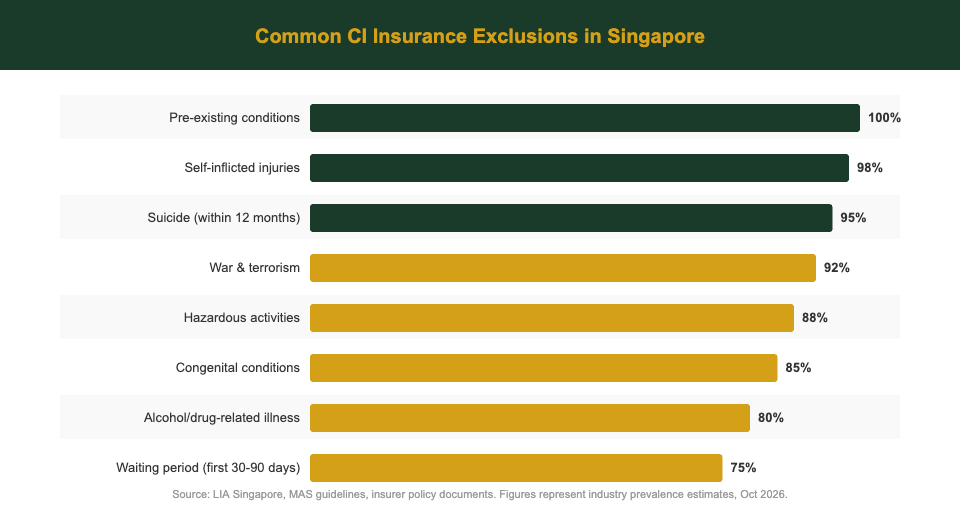
A pre-existing condition is any illness, injury, or medical condition that you had symptoms of, were diagnosed with, or sought treatment for before your CI policy start date. Every insurer in Singapore excludes pre-existing conditions as standard.
Here is the practical impact: if you were diagnosed with hypertension five years ago and later develop a CI-qualifying stroke, your claim may be denied if the insurer can link the stroke to the pre-existing hypertension. Similarly, a known family history of cancer combined with your own prior cancer scare could result in a cancer-specific exclusion added to your policy at underwriting.
Disclosure Is Mandatory
Under the MAS Guidelines on Fair Dealing (October 2015, updated 2024), Singapore policyholders have a duty to disclose all material facts at application. Non-disclosure of pre-existing conditions is one of the most common grounds for claim rejection. A material fact includes any symptom you consulted a doctor about, even if no formal diagnosis was made.
Group Insurance vs Individual Policy
One important exception: many employer group CI policies waive the pre-existing condition exclusion for employees who join the scheme within 60 to 90 days of employment. If you have a pre-existing condition, a group policy may provide CI cover that an individual policy would exclude — though coverage limits are typically lower.
For a deeper look at what CI policies cover versus exclude, see our guide on CI insurance Singapore. If you are building a comprehensive financial safety net, our Singapore retirement calculator can help you stress-test your coverage against future income needs.
Waiting Period: No Claims in the First 30 to 90 Days
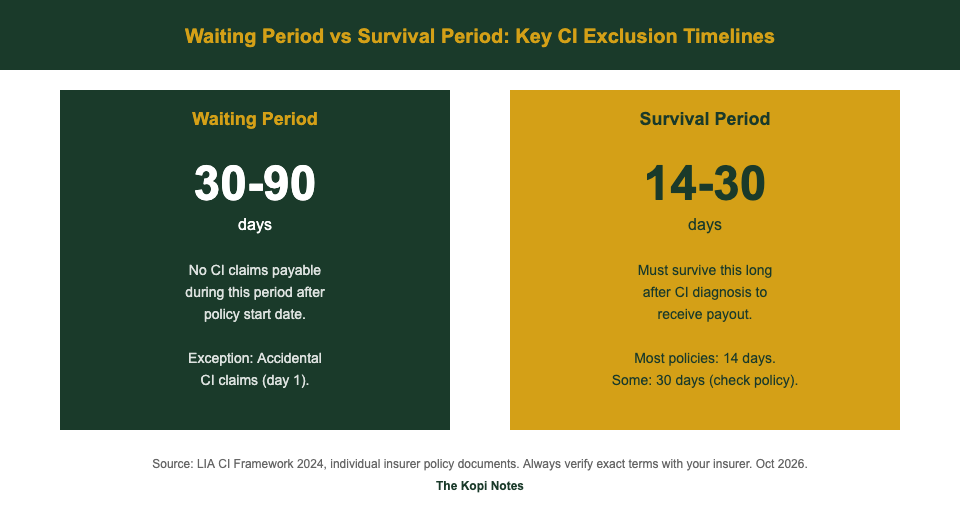
Most CI policies in Singapore impose a waiting period — a window from the policy start date during which no critical illness claims are payable. The standard industry waiting period is 30 days, though some policies extend this to 60 or 90 days for certain conditions, particularly cancer.
The waiting period exists to prevent adverse selection: people who suspect they are already ill buying a policy and immediately claiming. This is a standard actuarial safeguard, not a punitive measure.
The Cancer Exception
Cancer-specific CI policies or cancer riders often carry a 90-day waiting period, longer than the standard 30 days. This is disclosed in the policy schedule and Key Summary Document. If you are diagnosed with cancer within 90 days of policy inception, no payout is made — even if the policy is in force and premiums have been paid.
Accidental CI: No Waiting Period
A critical exception to the waiting period: CI resulting from an accident typically has no waiting period. If you suffer a traumatic brain injury in a road accident on day one of your policy, most insurers will pay out on the qualifying CI claim immediately. Always check your policy schedule to confirm.
This distinction matters for investors using Syfe or other platforms to build passive income — if your CI payout is delayed or denied, your investment portfolio may need to shoulder more of the income replacement burden than planned.
Survival Period: You Must Survive the Diagnosis
The survival period is distinct from the waiting period. It requires that you survive for a defined number of days after being diagnosed with a CI — before the insurer will pay out. Under the LIA CI Framework 2024 (effective October 2025 for new policies), the standard survival period is 14 days.
However, not all insurers have adopted the 2024 framework immediately, and older legacy policies may still impose a 30-day survival period. Check the definition section of your policy document under “Survival Period” or “Survival Clause” to confirm which applies to you.
Why This Matters More Than You Think
Consider this scenario: a policyholder is diagnosed with a major stroke and passes away 10 days later. Under a 14-day survival period policy, the CI benefit is not paid — but the death benefit from any linked term life or whole life policy would be. Under a 30-day survival period policy, the 14-day survival period clause in an older policy would not apply, but the 30-day clause would still bar the CI claim.
This is why financial planners in Singapore often recommend pairing CI coverage with term life insurance, so that if a CI claim is denied due to the survival period, the death benefit still provides for your dependants.
| Policy Type | Typical Survival Period | Framework |
|---|---|---|
| New CI policies (post-Oct 2025) | 14 days | LIA CI Framework 2024 |
| Legacy CI policies (pre-Oct 2025) | 30 days (most) | LIA CI Definitions 2014 |
| Direct purchase CI (DPI) policies | 14 days | MAS DPI guidelines |
Source: LIA CI Framework 2024, MAS Circular on DPI, Oct 2026. Always verify with your insurer.
Other Common CI Insurance Exclusions
Beyond pre-existing conditions and time-based exclusions, CI policies in Singapore typically exclude the following:
Self-Inflicted Injuries and Suicide
Any CI resulting from a self-inflicted injury is excluded. Most policies also exclude claims where the policyholder attempts or completes suicide within 12 months of the policy start date. After 12 months, policies typically allow death benefits (but not always CI benefits) in the event of suicide — the exact terms vary by policy.
War, Terrorism, and Civil Unrest
Claims arising from war, invasion, acts of terrorism, or participation in civil disturbance are universally excluded. This exclusion is standard across life and CI insurance globally, not specific to Singapore policies.
Hazardous Activities
Activities deemed hazardous by the insurer — which can include skydiving, free climbing, motorsports, and sometimes scuba diving — may result in excluded claims. Critically, Singapore expats and frequent travellers should note that some insurers also exclude CI events occurring in certain high-risk countries.
Alcohol and Substance Abuse
A CI directly caused by chronic alcohol abuse or substance dependency (e.g., alcohol-related liver cirrhosis) is excluded in most policies. Some policies also exclude claims where the policyholder was intoxicated at the time of the CI-triggering event.
Congenital and Genetic Conditions
Congenital conditions (conditions present from birth) are excluded. Genetic conditions diagnosed after birth may or may not be excluded depending on whether they were disclosed at underwriting. If you carry a BRCA1/BRCA2 gene mutation, for example, some insurers may add a cancer-specific exclusion or load your premiums.
For investors using platforms like Endowus for CPF or SRS investing, remember that CI payouts and investment portfolios serve different financial planning roles — CI provides immediate liquidity when you cannot work, while investments generate long-term passive income through assets like S-REITs.
How to Check Your CI Policy Exclusions
Every CI policy in Singapore must include a Policy Document and a Key Summary Document (under MAS requirements). Exclusions will appear in the Policy Document under the “Exclusions” or “Exceptions” section — typically Clause 5 or Clause 6 in most insurer formats.
Here is a practical checklist for reviewing your CI policy exclusions:
- Check the standard exclusions list — verify whether all 8 standard exclusions listed in your policy align with industry norms
- Review the policy schedule — look for any non-standard exclusions added specifically to your policy at underwriting (these appear as endorsements or special conditions)
- Verify the survival period — confirm whether it is 14 days (post-2025 framework) or 30 days (legacy)
- Confirm the waiting period — 30 days is standard, but cancer-specific riders may impose 90 days
- Check activity exclusions — if you participate in extreme sports or travel frequently to high-risk regions, confirm your policy’s position
If you are unsure about your existing CI coverage, an independent financial adviser (IFA) accredited by MAS can review your policy document and provide a gap analysis without any obligation to purchase new cover.
For building a complete passive income strategy alongside your CI protection, our passive income Singapore guide covers S-REITs, dividend stocks, and CPF strategies in detail.
Grow Your Financial Safety Net Alongside CI Coverage
CI insurance covers you when you cannot work. While you are healthy, build a passive income stream through S-REITs and diversified investing platforms so your wealth works even when you cannot.
Frequently Asked Questions
What is the most common reason CI insurance claims are rejected in Singapore?
The most common reason is non-disclosure of pre-existing conditions at the point of application. Under MAS regulations, policyholders have a duty to disclose all material facts. If an insurer finds that a CI condition is linked to a pre-existing illness that was not disclosed, the claim can be voided even if the policy is otherwise in force.
Does the LIA CI Framework 2024 change what is excluded?
The LIA CI Framework 2024, effective October 2025 for new policies, standardises the definitions of 37 CI conditions and reduces the survival period from 30 days to 14 days for most conditions. However, it does not change the standard exclusions (pre-existing conditions, self-inflicted harm, war, etc.), which remain at each insurer’s discretion.
Can I remove a non-standard exclusion from my CI policy?
Potentially. Non-standard exclusions added at underwriting (such as a specific organ or condition exclusion) can sometimes be reviewed after a defined period — typically 2 to 3 years — if you can demonstrate no further symptoms or treatment related to that condition. You would need to submit a formal request with supporting medical evidence to your insurer.
Does the waiting period reset if I lapse and reinstate my CI policy?
Yes, in most cases. If your CI policy lapses (due to missed premiums) and is later reinstated, the waiting period typically restarts from the reinstatement date, not the original policy start date. This is a critical reason to maintain premium payments without interruption.
What happens if I am diagnosed with a CI during the waiting period?
If you are diagnosed with a qualifying CI condition during the waiting period (typically the first 30 days), no benefit is payable for that condition under most policies. The one exception is a CI resulting from an accident — accidental CI claims are generally payable from day one of the policy, regardless of any standard waiting period.
Is diabetes covered under CI insurance in Singapore?
Diabetes itself is not one of the 37 standard CI conditions under the LIA CI Framework 2024. However, severe complications of diabetes — such as end-stage kidney disease or major organ failure — may qualify as a CI claim if they meet the policy definition of those conditions. Diabetes is also commonly listed as a pre-existing condition that triggers exclusions for related CI claims.
Get Free Insurance Advice
Speak with a licensed insurance advisor. No obligation, no cost.
By submitting this form, you agree to our Privacy Policy.
This article was researched with the help of AI. While we strive to keep all information accurate and up to date, there may be errors. If you notice any discrepancies, please contact us.