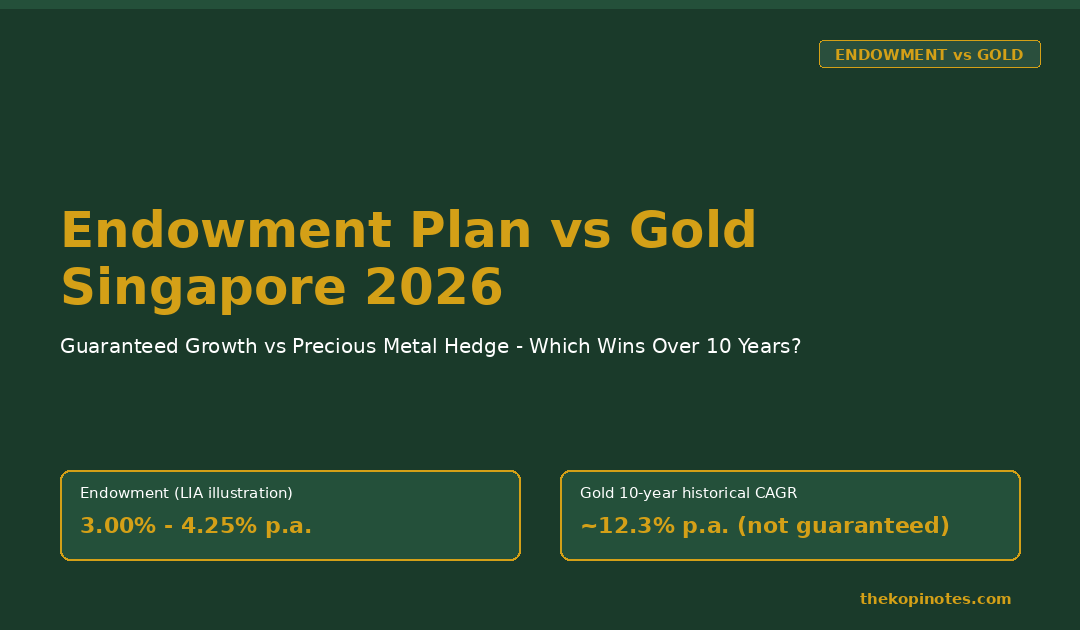
Endowment Plan vs Gold Singapore 2026: Guaranteed Growth vs Precious Metal Hedge
Which builds more wealth in 10 years — a guaranteed policy or a rallying precious metal?
An endowment plan guarantees a fixed maturity payout (LIA illustration rates 3.00%-4.25% p.a.), while gold has no guaranteed return but has delivered roughly 12.3% p.a. over the past decade. Gold offers no capital protection and can swing 20%+ in months, as it did between January and August 2026, so the “better” choice depends on whether you need certainty or can stomach volatility for higher potential upside.
Not financial advice. All figures are for educational reference only. Data verified as at 23 August 2026 unless otherwise noted.
- Endowment plans lock in 3.00%-4.25% p.a. by contract. Gold has averaged ~12.3% p.a. over 10 years but isn’t guaranteed and can fall hard.
- Gold dropped about 20% from its January 2026 peak of US$5,597/oz to around US$4,472-4,582/oz in August 2026 — a reminder that “safe haven” doesn’t mean “stable”.
- Endowments are protected under the PPF Scheme (capped); gold you buy yourself has no equivalent protection scheme, but GST-exempt investment-grade bars carry no counterparty risk either.
Table of Contents
Contents - Click to expand
- What Is an Endowment Plan?
- How Singaporeans Actually Invest in Gold
- Key Differences at a Glance
- Historical Performance: Illustration Rates vs Gold’s Track Record
- S$20,000 Over 10 Years: A Side-by-Side Projection
- Why Gold’s 2026 Swing Matters
- Tax Treatment and Protection Schemes
- Who Should Choose Which?
- Frequently Asked Questions
What Is an Endowment Plan?
An endowment plan is a life insurance policy that pays you a guaranteed lump sum at the end of a fixed term. You pay premiums for a set number of years. In return, the insurer promises a maturity benefit based on illustration rates set by the Life Insurance Association Singapore (LIA).
Those rates are currently 3.00% p.a. (lower, non-guaranteed scenario) and 4.25% p.a. (upper, non-guaranteed scenario), applying to policies sold from 1 July 2021 onward. A portion of the payout is usually guaranteed by contract, with the rest depending on the insurer’s actual investment performance.
This makes endowment plans a “set and forget” option. You know roughly what you’ll get, and when. That predictability is the entire selling point — you’re trading upside for certainty.
How Singaporeans Actually Invest in Gold
Gold isn’t one single product. In Singapore, you have three main ways to get exposure:
1. Physical Gold (Bars and Coins)
You can buy investment-grade gold bars or coins from banks like UOB, or bullion dealers like BullionStar and Silver Bullion. As long as the gold is at least 99.5% pure and comes from a refiner on the London Bullion Market Association’s Good Delivery list, it qualifies as an Investment Precious Metal (IPM) and is exempt from GST — a Singapore Customs and IRAS rule that’s been in place since October 2012.
You’ll need somewhere to store it. Options range from a home safe to paid vaulting.
2. Gold Savings Account (GSA)
UOB’s Gold Savings Account lets you buy and sell gold in grams without taking physical delivery. It’s convenient, but the bank charges a buy-sell spread — typically around 1.5%-2.5% in calm markets, widening to 3%+ during volatile periods like the March 2026 sell-off. That spread is a real cost that eats into your returns before gold even moves.
3. Gold ETF on the SGX
SPDR Gold Shares trades on the Singapore Exchange under two counters: GSD (SGD) and O87 (USD). It tracks the price of physical gold held by the SPDR Gold Trust, custodied by HSBC and JPMorgan Chase. The expense ratio is 0.40% p.a. — much cheaper than the GSA spread, and you can buy it through any SGX-linked brokerage, including moomoo Singapore review platforms.
For most retail investors comparing gold to an endowment plan, the GSA or the SGX-listed ETF are the most realistic apples-to-apples comparisons, since neither requires physical storage.
Key Differences at a Glance
| Feature | Endowment Plan | Gold |
|---|---|---|
| Return | 3.00%-4.25% p.a. (LIA illustration) | Not guaranteed; ~12.3% p.a. 10-year historical CAGR |
| Volatility | Very low — payout is contractual | High — can swing 20%+ in months |
| Liquidity | Low before maturity; surrender value often below premiums paid | High via ETF/GSA; lower for physical bars (need a buyer) |
| Income/yield while holding | None until maturity | None — gold pays no interest or dividend |
| Costs | Built into premium pricing | GSA spread 1.5%-3%+, or ETF expense ratio 0.40% p.a. |
| Protection scheme | PPF Scheme: S$500,000 guaranteed sum assured cap, S$100,000 guaranteed surrender value cap | None for self-held gold; ETF custodied by HSBC/JPMorgan |
| Tax | Payout generally not taxed as income | GST-exempt if IPM-qualifying; no capital gains tax in Singapore |
Source: LIA illustration-rate guidelines (2026), IRAS/Singapore Customs GST exemption guidance, SDIC PPF Scheme terms, SSGA SPDR Gold Shares factsheet.
Historical Performance: Illustration Rates vs Gold’s Track Record
Here’s the headline number that makes gold look unbeatable: over the past 10 years, gold has delivered roughly a 12.3% p.a. compound annual growth rate. That’s nearly triple the endowment’s upper illustration rate.
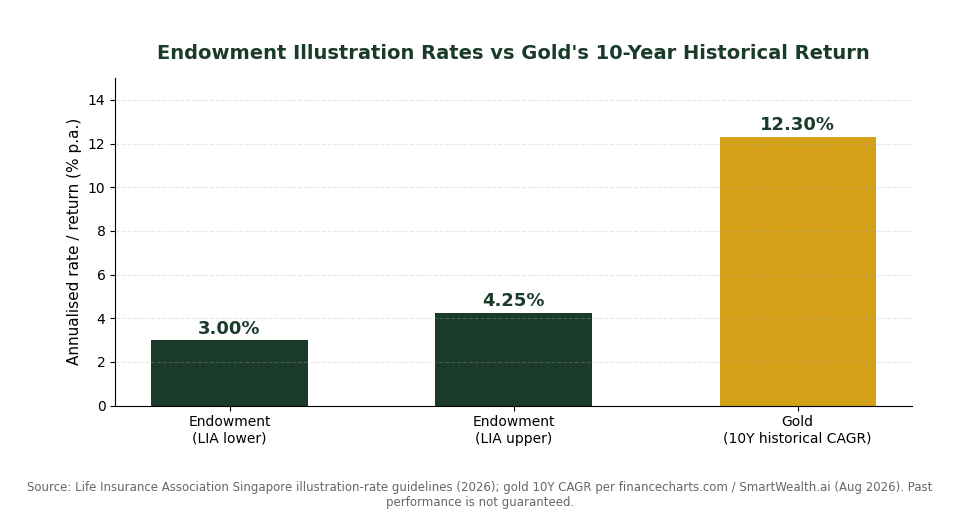
But here’s the catch — that 12.3% figure describes what already happened, not what will happen. Gold had an extraordinary run driven by central bank buying, persistent inflation, and flat mine supply growth. Extrapolating it forward is optimistic, not conservative.
S$20,000 Over 10 Years: A Side-by-Side Projection
Let’s run the numbers. If you put S$20,000 into each option today and held for 10 years, here’s how they’d compare — assuming each rate holds steady, which is a big assumption for gold.
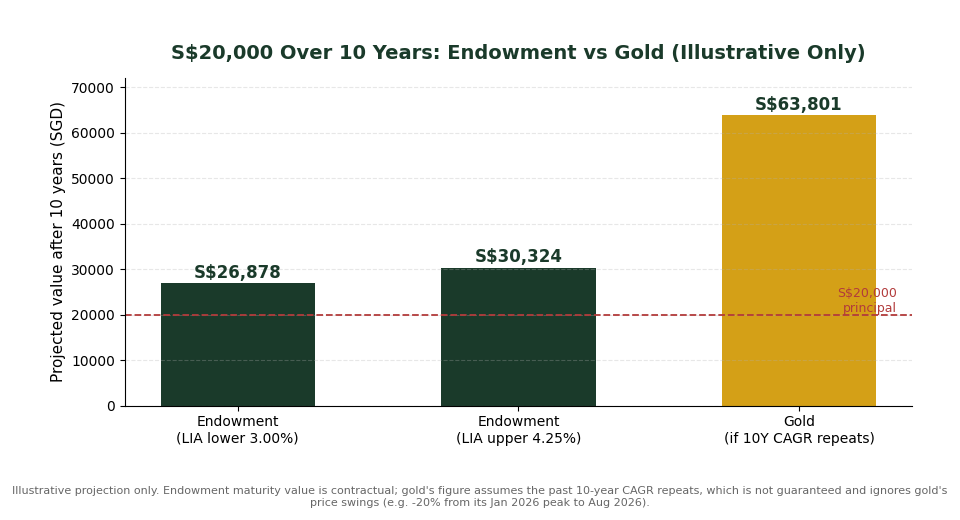
| Scenario | Rate Used | Value After 10 Years |
|---|---|---|
| Endowment (LIA lower) | 3.00% p.a. | S$26,878 |
| Endowment (LIA upper) | 4.25% p.a. | S$30,324 |
| Gold (if 10Y CAGR repeats) | ~12.3% p.a. | S$63,801 |
Source: original calculation, LIA illustration rates and gold 10Y CAGR as cited above. Illustrative only — gold’s actual future path is unknown.
That S$63,801 figure is the single biggest number in this article, and also the one you should trust the least. It assumes gold repeats a decade of exceptional performance driven by conditions that may not persist. Your endowment’s numbers, by contrast, are contractual commitments from a regulated insurer.
Why Gold’s 2026 Swing Matters
In January 2026, gold hit an all-time high of around US$5,597 per ounce. By August 2026, it had pulled back to roughly US$4,472-4,582 per ounce — a drop of about 20% in seven months.
At an exchange rate of roughly S$1.28 per US dollar, that August price works out to about S$5,724 per ounce, or around S$184 per gram. If you’d bought at the January peak, you’d be sitting on a paper loss today, even though gold is still considered a “safe haven” asset.
This is the part endowment plans simply don’t expose you to. Your maturity value doesn’t care what happens to gold prices, interest rates, or central bank buying patterns in between. Gold’s price does — and it can move against you just as easily as it moves in your favour.
Tax Treatment and Protection Schemes
Both options are reasonably tax-friendly in Singapore, but for different reasons.
Investment-grade gold (bars and coins at least 99.5% pure, from an LBMA-listed refiner) is exempt from GST under IRAS and Singapore Customs rules that have applied since October 2012. Gains from selling gold as a personal investment aren’t taxed either, since Singapore has no capital gains tax.
Endowment plan payouts are also generally not taxed as income. But the real difference is protection if something goes wrong with the provider. Endowment plans are covered under the Policy Owners’ Protection (PPF) Scheme, administered by SDIC — up to S$500,000 of guaranteed sum assured and S$100,000 of guaranteed surrender value per life assured, per insurer.
Gold you hold yourself has no equivalent scheme. If you store it yourself, you carry the full custody risk. A gold ETF like SPDR Gold Shares shifts some of that risk to institutional custodians (HSBC, JPMorgan), but it’s not deposit insurance in the SDIC sense.
Who Should Choose Which?
An endowment plan suits you if you have a specific, date-certain goal — a child’s university fees in 15 years, or a guaranteed retirement top-up — and you’d rather have certainty than chase a higher but unreliable number.
Gold suits you if you already have your guaranteed bases covered (emergency fund, insurance, some fixed income) and want a small allocation — often 5%-10% of a portfolio — as a hedge against inflation or market stress, not as your primary savings vehicle.
Most Singaporean households do best treating these as complements, not substitutes. If you want market-linked growth without gold’s single-asset concentration, you could also look at Singapore REIT ETF guide options or broader diversified investing through Syfe referral code and sign-up bonus or the Endowus referral code. If you’re weighing endowments against other guaranteed-return instruments, our endowment plan vs SGS bonds comparison and endowment plan vs fixed deposit guide cover the lower-risk side of that spectrum. And if retirement planning is the end goal either way, run your numbers through the Singapore retirement calculator first.
Frequently Asked Questions
Is gold a better investment than an endowment plan in Singapore?
Neither is universally “better” — they solve different problems. Gold has higher historical returns but no guarantee and real price swings (down ~20% from its January 2026 peak by August 2026). An endowment plan gives you a guaranteed, contractual payout at a lower rate. Choose based on whether you need certainty or can tolerate volatility.
Is gold GST-exempt in Singapore?
Yes, if it qualifies as an Investment Precious Metal (IPM) — at least 99.5% purity and from a refiner on the LBMA’s Good Delivery list. This exemption has applied since October 2012 under IRAS and Singapore Customs rules. Numismatic or collector coins don’t qualify.
What is the LIA illustration rate for endowment plans in 2026?
The Life Insurance Association Singapore sets two illustration rates for policies sold from 1 July 2021 onward: 3.00% p.a. (lower, non-guaranteed) and 4.25% p.a. (upper, non-guaranteed). These are industry-wide benchmarks, not guarantees from any single insurer.
How do I buy gold in Singapore without storing it myself?
Two common options: a Gold Savings Account (like UOB’s), which lets you buy/sell gold in grams without physical delivery but charges a buy-sell spread of roughly 1.5%-2.5% (wider in volatile markets), or SPDR Gold Shares on the SGX (tickers GSD/O87), an ETF with a 0.40% p.a. expense ratio that you can trade through any SGX-linked brokerage.
Are endowment plans protected if my insurer fails?
Yes, under the Policy Owners’ Protection (PPF) Scheme administered by SDIC. It covers up to S$500,000 of guaranteed sum assured and S$100,000 of guaranteed surrender value per life assured, per insurer. The non-guaranteed bonus portion isn’t covered by these caps.
Does gold pay any income while I hold it?
No. Gold pays no interest, dividend, or coupon. Any return comes purely from price appreciation. That’s a key difference from instruments like S-REITs or bonds, which pay you along the way — see our endowment plan vs S-REITs comparison for how dividend-paying assets stack up instead.
Want a Guaranteed Number Instead of a Gold Gamble?
See how endowment plans stack up against fixed deposits, SGS bonds, and robo-advisor portfolios before you decide.
Get Free Insurance Advice
Speak with a licensed insurance advisor. No obligation, no cost.
By submitting this form, you agree to our Privacy Policy.
This article was researched with the help of AI. While we strive to keep all information accurate and up to date, there may be errors. If you notice any discrepancies, please contact us.