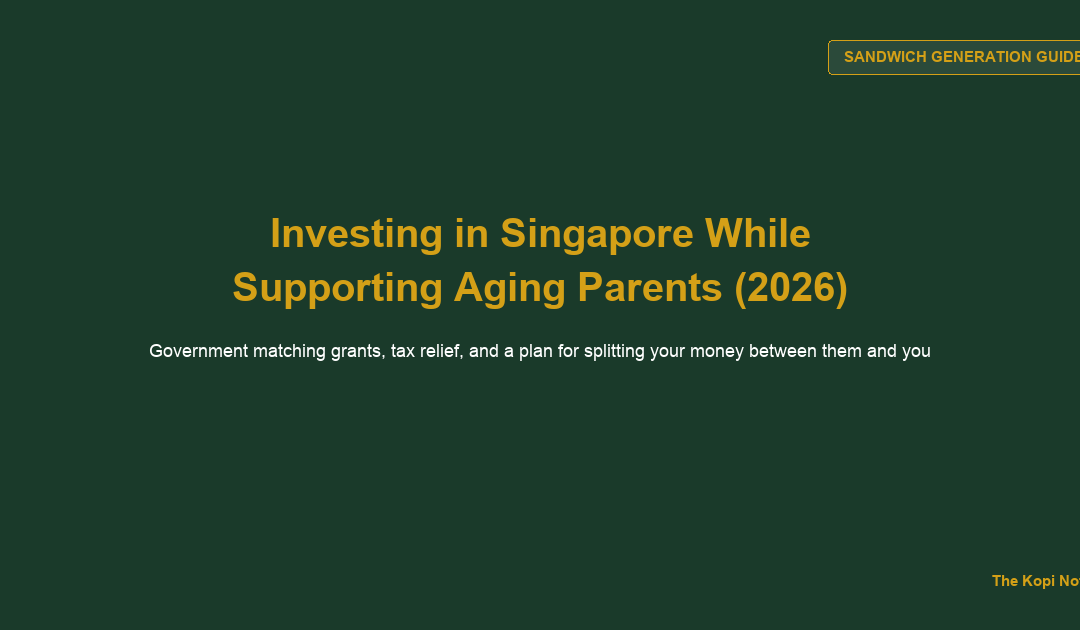
How to Invest in Singapore When You’re Supporting Aging Parents: A Guide to Government Matching Grants and Tax Relief (2026)
Balance your parents’ care costs with your own investing goals using MediSave matching, Parent Relief, CareShield Life, and CPF top-ups.
Supporting aging parents doesn’t have to derail your own investing plan. Singapore’s government matches your parents’ voluntary MediSave top-ups dollar-for-dollar (up to $1,000 a year) and rewards you with up to $9,000 in Parent Relief. The smart approach: claim every matching grant and tax relief available first, then split whatever’s left between their care costs and your own portfolio.
Not financial advice. All figures are for educational reference only. Data verified as at 13 August 2026.
- The Matched MediSave Scheme gives your parents $1 of free government money for every $1 you top up to their MediSave, up to $1,000 a year.
- Parent Relief cuts up to $9,000 off your taxable income if your parent lives with you, or $5,500 if they don’t — claim it every year you’re eligible.
- CareShield Life pays a guaranteed monthly income (starting at $689 in 2026) if your parent develops severe disability — factor it into how much extra insurance or savings they actually need.
Table of Contents
Contents — Click to expand
- Why the “Sandwich Generation” Squeeze Is Real in Singapore
- Parent Relief and Grandparent Caregiver Relief: Up to $9,000 in Tax Savings
- The Matched MediSave Scheme: Free Money for Your Parents’ Healthcare
- CareShield Life: A Guaranteed Income Floor If Your Parents Need Care
- Topping Up Your Parents’ CPF Retirement Account (RSTU and MRSS)
- A Framework for Splitting Your Money Between Parents and Yourself
- A Worked Example: $7,000/Month Income, Supporting a Parent
- What to Do This Week
- Frequently Asked Questions
Why the “Sandwich Generation” Squeeze Is Real in Singapore
If you’re in your 30s or 40s, you might be paying your own mortgage, saving for your kids’ education, and quietly worried about your parents’ healthcare bills — all at the same time. This is the “sandwich generation” squeeze, and in Singapore it’s getting sharper as parents live longer and healthcare costs keep climbing.
Singapore doesn’t have a universal state pension. Your parents’ retirement income usually comes from a mix of CPF LIFE payouts, personal savings, and — often — support from their children. The Maintenance of Parents Act even lets parents apply for a maintenance order if their children refuse to support them, though most families never come close to needing it.
Here’s the good news: you don’t have to choose between supporting your parents and investing for yourself. Several government schemes specifically reward you for helping your parents, through matching grants and tax relief. Claiming these first stretches every dollar you put toward their care — and what’s left over can keep growing in your own portfolio.
Parent Relief and Grandparent Caregiver Relief: Up to $9,000 in Tax Savings
If you’re supporting a parent, grandparent, or parent-in-law financially, check whether you qualify for Parent Relief before you file your taxes. For Year of Assessment (YA) 2026, the Inland Revenue Authority of Singapore (IRAS) allows a total claim of $9,000 if your dependant stayed with you in the preceding year, or $5,500 if they didn’t.
You can generally claim this relief once your dependant is 55 or older, or younger if handicapped, and it comes with conditions around their income and where they lived during the year — see IRAS’s Parent Relief page for the full eligibility list. If more than one child supports the same parent, the relief can typically be split between you, so it’s worth coordinating with your siblings rather than each of you assuming the other is claiming it.
There’s a second, related relief worth knowing about if your parents also help you raise your own kids. Grandparent Caregiver Relief gives a working mother up to $3,000 off her taxable income if her parent, parent-in-law, grandparent, or grandparent-in-law looks after her Singapore Citizen child aged 12 or younger, freeing her up to work. It’s a neat overlap for the sandwich generation: the same parent who needs your financial support might also be the one making your own career possible.
| Relief | Amount (YA2026) | Who It’s For |
|---|---|---|
| Parent Relief (staying with you) | $9,000 | Parent/grandparent/parent-in-law living with you |
| Parent Relief (not staying with you) | $5,500 | Parent/grandparent/parent-in-law living elsewhere |
| Grandparent Caregiver Relief | $3,000 | Working mothers whose parent/in-law cares for their child (12 or under) |
Source: IRAS Parent Relief and Grandparent Caregiver Relief pages, YA2026.
The Matched MediSave Scheme: Free Money for Your Parents’ Healthcare
Before you top up your parent’s MediSave Account out of your own pocket, check if they qualify for the Matched MediSave Scheme (MMS), a five-year pilot that started on 1 January 2026. Under MMS, the government matches every dollar you, or anyone else, tops up to an eligible parent’s MediSave Account, dollar-for-dollar, up to $1,000 a year.
Your parent generally qualifies if they’re a Singapore Citizen aged 55 to 70, their MediSave balance is below half of the current Basic Healthcare Sum ($39,500 in 2026, since the BHS is $79,000), their average monthly income doesn’t exceed $4,000, and they own at most one property with an annual value of $21,000 or less. CPF Board notifies eligible members directly, and you can also check your parent’s Healthcare Dashboard on the CPF website to confirm.
Here’s the trade-off worth knowing: cash top-ups that trigger the MMS matching grant are not eligible for CPF Cash Top-up tax relief. In practice, this rarely matters. A guaranteed, instant 100% return from the matching grant is usually worth far more than the tax relief you’d give up, especially if you’re not in a high tax bracket. Think of the matching grant as “free money” you should claim before anything else.
MediSave funds can be used for hospitalisation, day surgery, approved outpatient treatments, and insurance premiums, including MediShield Life and CareShield Life — which brings us to the next piece of the puzzle.
CareShield Life: A Guaranteed Income Floor If Your Parents Need Care
Long-term care is the cost that catches most families off guard. If a parent develops a severe disability — unable to perform at least three of six daily activities like feeding, bathing, or moving around — CareShield Life pays them a guaranteed monthly income for as long as they remain severely disabled.
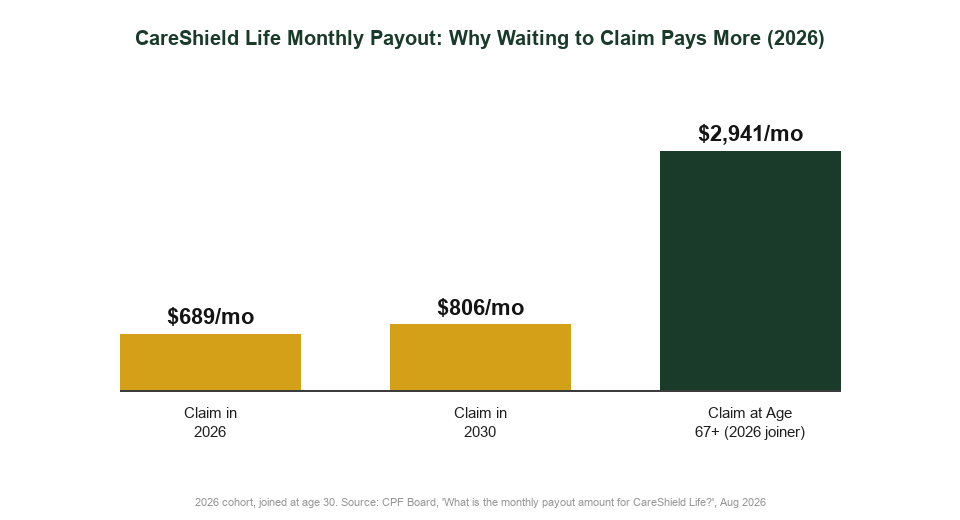
The payout starts at $689 a month in 2026 for a successful claim made this year, and it’s designed to grow the longer your parent waits before claiming, up to age 67, or until a successful claim, whichever comes first. From 2026 to 2030, payouts increase by 4% a year, double the earlier 2% rate, reaching roughly $806 a month for claims starting in 2030, before settling back to 2% annual growth after that.
The gap between claiming early and claiming later is significant. Someone who joined CareShield Life in 2026 and only develops severe disability at 67 or older would receive $2,941 a month — more than four times the 2026 starting payout — for the entire duration of their disability.
This matters for your planning because CareShield Life is a baseline, not a complete solution. It’s designed to cover part of long-term care costs, not all of them, so factor it in when deciding how much additional insurance, savings, or family support your parents might still need on top of it.
Topping Up Your Parents’ CPF Retirement Account (RSTU and MRSS)
If your parent’s CPF Retirement Account (RA) savings are on the lower side, a cash top-up under the Retirement Sum Topping-Up Scheme (RSTU) can boost their future CPF LIFE payouts, and it comes with its own tax relief and matching grant.
As the giver, you can claim up to $8,000 in CPF Cash Top-up Relief for top-ups made to loved ones each calendar year, on top of a separate $8,000 you can claim for topping up your own account, capped at your parent’s Full Retirement Sum of $220,400 in 2026 for members below 55. Unlike top-ups to a spouse or sibling, top-ups to a parent, parent-in-law, grandparent, or grandparent-in-law don’t require them to meet an income test — you can claim the relief regardless of how much your parent earns.
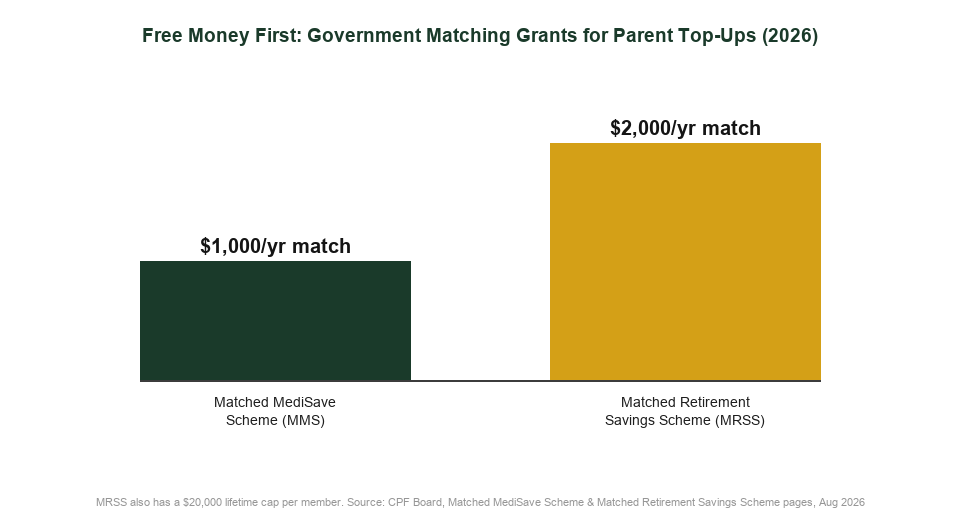
Separately, if your parent’s RA savings are still below the prevailing Full Retirement Sum, they may also qualify for the Matched Retirement Savings Scheme (MRSS). Like MMS, this matches cash top-ups dollar-for-dollar, up to $2,000 a year, with a lifetime cap of $20,000 per member.
| Scheme | What It Does | Annual Cap | Lifetime Cap |
|---|---|---|---|
| Matched MediSave Scheme (MMS) | $1-for-$1 match on MediSave top-ups | $1,000/year | None (5-year pilot from 2026) |
| Matched Retirement Savings Scheme (MRSS) | $1-for-$1 match on RA top-ups | $2,000/year | $20,000 |
| CPF Cash Top-up Relief (RSTU, loved ones) | Tax relief for the giver | $8,000/year | Capped at recipient’s FRS |
Source: CPF Board official pages on the Matched MediSave Scheme, Matched Retirement Savings Scheme, and CPF top-ups for loved ones; IRAS CPF Cash Top-up Relief. 2026.
A Framework for Splitting Your Money Between Parents and Yourself
Once you know what’s available, the practical question is how to actually divide your money each month. Here’s a simple order of priority that works for most sandwich-generation households.
First, claim every matching grant. Government matching money is a guaranteed, instant return that no investment can beat. If your parent qualifies for MMS or MRSS, top up to the annual cap before doing anything else — $1,000 into MediSave becomes $2,000, and $2,000 into their Retirement Account becomes $4,000.
Second, cover essential care costs. MediShield Life premiums, CareShield Life premiums, which get government subsidies based on income, and any shortfall in daily living expenses come next. This is non-negotiable spending, not optional saving.
Third, claim your tax reliefs. Parent Relief, Grandparent Caregiver Relief, and CPF Cash Top-up Relief for loved ones don’t cost you anything extra to claim — they just require accurate paperwork at tax time. Don’t leave this money on the table.
Fourth, split what’s left. Whatever surplus remains after the above, decide on a fixed percentage split between additional voluntary support for your parents and your own investing goals — for example, 60% toward your own portfolio and 40% toward extra parent support, adjusted based on how urgent their needs are. Our goal-based investing guide can help you match that portion to your own time horizon.
Resist the urge to pause your own investing completely to fund your parents’ needs, unless their situation is genuinely urgent. Your own retirement is a goal nobody else will fund for you, and the earlier you keep investing consistently, the less you’ll need to scramble later. Our Singapore retirement planning calculator can show you what even a partial pause costs you over 20-30 years.
A Worked Example: $7,000/Month Income, Supporting a Parent
Say you earn $7,000 a month and want to support your 68-year-old mother, who lives separately, has an average monthly income of $1,800, and lives in a flat with an annual value of $18,000, making her eligible for the Matched MediSave Scheme.
| Action | Your Cost | What Happens |
|---|---|---|
| Top up her MediSave (MMS-eligible) | $1,000 | Government matches $1,000 — her MA gets $2,000 total |
| Top up her CPF Retirement Account (RSTU) | $2,000 | You claim up to $2,000 in CPF Cash Top-up Relief; if she’s MRSS-eligible, government may match up to $2,000 more |
| Claim Parent Relief (not staying with you) | $0 | $5,500 off your taxable income |
| Your own investing (DCA into a diversified portfolio) | $800/month | Continues uninterrupted toward your own retirement |
Illustrative example only, using the verified 2026 scheme parameters above. Actual eligibility and amounts depend on your parent’s individual circumstances.
In this example, $3,000 of your own money potentially unlocks up to $4,000 in additional government support for your mother, plus $5,500 in tax relief for you, all while your own $800 monthly investing plan keeps running in the background. Supporting your parents and investing for yourself aren’t mutually exclusive when you claim what’s already on the table.
What to Do This Week
Step 1: Check your parent’s eligibility for the Matched MediSave Scheme and Matched Retirement Savings Scheme via their CPF Healthcare and Retirement dashboards.
Step 2: Confirm whether your parent has CareShield Life coverage and understand what the monthly payout would actually cover if they needed long-term care.
Step 3: Claim Parent Relief and, if applicable, Grandparent Caregiver Relief when you file your taxes — coordinate with siblings if more than one of you supports the same parent.
Step 4: Set a fixed monthly split between parent support and your own investing, and stick to it rather than deciding ad hoc each month.
Not financial advice. Every family’s situation is different — consider speaking with a licensed financial adviser about your specific circumstances. Data verified as at 13 August 2026.
Frequently Asked Questions
What tax relief can I claim for supporting my parents in Singapore?
You can generally claim Parent Relief of up to $9,000 (if your parent lives with you) or $5,500 (if they don’t) for YA2026, plus up to $8,000 in CPF Cash Top-up Relief if you make RSTU top-ups to their CPF Retirement Account. If your parent also helps care for your child aged 12 or under, you may additionally qualify for Grandparent Caregiver Relief of $3,000.
What is the Matched MediSave Scheme and how much can my parents receive?
The Matched MediSave Scheme (MMS) is a government pilot that matches cash top-ups to an eligible Singapore Citizen’s MediSave Account dollar-for-dollar, up to $1,000 a year. Your parent generally qualifies if they’re aged 55 to 70, have MediSave savings below half the Basic Healthcare Sum, an average monthly income of $4,000 or less, and own at most one property with an annual value up to $21,000.
Can I top up my parents' CPF Retirement Account, and will I get tax relief?
Yes. Under the Retirement Sum Topping-Up Scheme, you can top up a parent’s CPF Retirement Account up to their Full Retirement Sum and claim up to $8,000 in tax relief as the giver, on top of a separate $8,000 you can claim for topping up your own account. Unlike top-ups to a spouse or sibling, there’s no income test on your parent for you to qualify for this relief.
How much does CareShield Life pay out each month?
The CareShield Life monthly payout for a successful claim starts at $689 in 2026 and grows each year — by 4% annually from 2026 to 2030, then 2% a year after that — until the insured reaches age 67 or makes a successful claim, whichever comes first. Someone who joins in 2026 and only claims at 67 or older would receive $2,941 a month.
Should I prioritise topping up my parents' CPF or investing for myself?
Prioritise any top-up that unlocks a government matching grant first, since that’s an instant, guaranteed return no investment can match. After that, cover your parents’ essential healthcare and living costs, claim your tax reliefs, and split whatever’s left between additional parent support and your own investing based on a fixed percentage you decide in advance.
Can I claim Grandparent Caregiver Relief if my parents help look after my kids?
Yes. If you’re a working mother and your parent, parent-in-law, grandparent, or grandparent-in-law looks after your Singapore Citizen child aged 12 or younger so that you can work, you may claim Grandparent Caregiver Relief of $3,000. This is separate from and can be claimed alongside Parent Relief for the same dependant, subject to IRAS’s conditions.
Ready to Plan Your Own Investing Alongside Family Support?
Open a brokerage or robo-advisor account through our referral links, and use our retirement calculator to see how your numbers add up.
This article was researched with the help of AI. While we strive to keep all information accurate and up to date, there may be errors. If you notice any discrepancies, please contact us.