How to Invest Your NS Allowance: A Beginner’s Guide for NSFs in Singapore (2026)
No CPF deductions, meals and lodging covered — here’s how to turn your monthly NS allowance into your first investing habit.
Full-time National Servicemen (NSFs) earn a monthly allowance of $790 to $1,955, and unlike a regular paycheck, none of it goes to CPF. With SAF covering your food, lodging, and medical care, NS is one of the best times to start investing — even with just $50 a month, through a brokerage account and a broad-market index fund or ETF.
Not financial advice. All figures are for educational reference only. Data as at August 2026 unless noted.
- Your NS allowance isn’t taxed by CPF, so every dollar you save is 100% yours — a rare advantage over working adults.
- You can start investing from age 18 with as little as $50/month through a Regular Savings Plan (RSP), even on an NSF’s income.
- The real advantage isn’t the amount — it’s the 40+ year head start. Starting during NS beats waiting until after graduation.
Table of Contents
Contents — Click to expand
- Why NSFs Have a Unique Investing Advantage
- How Much Does an NSF Actually Earn?
- Can an 18-Year-Old NSF Open a Brokerage Account?
- Before You Invest: 3 Things to Sort Out First
- How to Start Investing With Your NS Allowance
- Where Should Your Money Go?
- The NS HOME Award: Free Money You Shouldn’t Ignore
- What to Do With Your Savings After ORD
- 4 Mistakes NSFs Make With Their Allowance
- Frequently Asked Questions
Why NSFs Have a Unique Investing Advantage
Most 18-year-olds don’t get a real chance to invest until they start working. National Service actually gives you a head start most Singaporeans never get. Two things make your NS allowance different from a normal salary.
First, no CPF is deducted. CPF contributions apply to wages paid under a contract of service. NSFs are enlisted under the Enlistment Act, not employed under a contract of service — so there’s no CPF, no annual bonus, and no leave encashment on your allowance. Whatever the SAF pays you, you keep the full amount in your bank account.
For comparison: a working adult earning $1,000 a month has around 20% (the standard employee CPF contribution rate for Singapore Citizens and PRs aged 55 and below in 2026) deducted before it even reaches the bank, leaving $800 take-home. An NSF earning the same $1,000 allowance keeps the full $1,000.
Second, your living costs are mostly covered. The SAF pays for your bunk, meals in camp, uniform, and medical care. Unless you’re staying out or travelling overseas, you don’t have rent, groceries, or transport eating into your allowance the way it does for a working adult.
Put those two things together, and NS becomes one of the few windows in life where a large share of your income can go straight into savings or investments instead of expenses.
How Much Does an NSF Actually Earn?
Your total NS allowance is made up of a rank allowance and a vocation allowance, both credited straight to your bank account every month.
| Rank | Monthly Rank Allowance |
|---|---|
| Recruit / Private | $715 |
| Lance Corporal | $740 |
| Corporal | $790 |
| Corporal First Class | $835 |
| Specialist Cadet | $810 |
| Third Sergeant | $1,055 |
| Second Sergeant | $1,160 |
| First Sergeant | $1,235 |
| Officer Cadet | $1,010 |
| Second Lieutenant | $1,265 |
| Lieutenant | $1,455 |
Source: CMPB, Monthly Allowance, updated 24 July 2025 (in effect as at August 2026)
On top of your rank allowance, you get a vocation allowance based on your role:
| Vocation Category | Monthly Vocation Allowance |
|---|---|
| Service and Technical vocations | $75 |
| Most combat vocations | $225 |
| Aircrew, Armour, Guards, Infantry, Combat Medics, Seagoing | $300 |
| Commando, Naval Diver, CBRE / Explosive Ordnance Disposal | $500 |
Source: CMPB, Monthly Allowance, updated 24 July 2025 (in effect as at August 2026)
Here’s a worked example. Say you enlist as a Recruit in an Infantry vocation ($300/month vocation allowance) and get promoted to Lance Corporal after 9 months, staying at that rank for the rest of your 24-month NS:
- Months 1–9: ($715 + $300) × 9 = $9,135
- Months 10–24: ($740 + $300) × 15 = $15,600
- Total: $24,735 over 24 months — an average of about $1,031 a month
That’s before any further promotions to Corporal or Corporal First Class, which most NSFs reach by month 13–16, so your actual total is often higher.
Can an 18-Year-Old NSF Open a Brokerage Account?
Yes. In Singapore, you can legally open a brokerage account, CDP account, or Regular Savings Plan (RSP) once you turn 18, as a Singapore Citizen or PR — regardless of whether you’re employed, self-employed, or serving NS. You don’t need a full-time job to qualify; an NSF allowance is generally accepted as income for most account applications.
Local brokers like Tiger Brokers, moomoo, and Interactive Brokers (IBKR) let you open an account online with no minimum funding requirement. Robo-advisors and RSP platforms such as Endowus and Syfe let you start investing from as little as $50 to $100 a month, which fits comfortably within an NSF’s allowance.
The one thing you can’t do yet is invest through your CPF Investment Scheme (CPFIS) or Supplementary Retirement Scheme (SRS). SRS in particular only makes sense once you’re paying income tax, which most NSFs aren’t. Stick to a regular cash brokerage or RSP account during NS, and revisit choosing between a DIY broker and a robo-advisor once you’re working full-time.
Before You Invest: 3 Things to Sort Out First
1. Confirm you don’t need the cash soon. If you’re planning to use your savings for university tuition, a gap-year trip, or a big purchase right after ORD, keep that portion in a savings account or T-bills instead of the stock market. You don’t want to be forced to sell investments at a loss right when you need the money.
2. Check your insurance coverage. NSFs already get complimentary $350,000 Group Term Life and $350,000 Group Personal Injury coverage from the SAF during service. That’s solid baseline protection, so there’s no need to rush into a personal insurance policy while you’re still serving.
3. Set a small, fixed amount you can commit monthly. Even $50 a month is enough to start an RSP. The goal during NS isn’t to grow a huge portfolio — it’s to build the habit of investing consistently before life gets busier with university, work, and bigger financial commitments. This ties into matching your investments to your life goals rather than investing without a plan.
How to Start Investing With Your NS Allowance
Pick a platform with a low or no minimum. FSMOne’s RSP starts from $50/month per counter. Syfe and Endowus let you start a diversified portfolio from smaller sums; Tiger Brokers, moomoo, and IBKR have $0 account minimums if you’d rather buy ETFs or stocks directly. See how much you actually need to start investing in Singapore for a fuller breakdown by platform.
Automate it. Set up a recurring transfer from the bank account your NS allowance is credited to, timed to payday, so you’re not tempted to spend the money first and invest “whatever’s left.”
Choose a broad-market fund, not single stocks. At 18 to 20 years old with decades until retirement, you don’t need to pick individual winners. A globally diversified index fund or ETF spreads your risk across thousands of companies instead of betting on one.
Keep contributing through your ORNS years too, not just as an NSF. The habit matters more than the exact dollar amount you start with.
Where Should Your Money Go?
As an NSF, you have one thing most investors would kill for: time. If you don’t touch this money until retirement, that’s a 40+ year runway — long enough to ride out multiple market downturns and still come out ahead. That argues for a growth-focused, equity-heavy approach for money you genuinely won’t need for years, alongside a small cash buffer for anything you might need sooner.
| Time Horizon | Where It Might Go | Example |
|---|---|---|
| Needed within 1 year | Savings account or T-bills | A new laptop, phone repair fund |
| Needed in 1–3 years | Short-duration T-bills or Singapore Savings Bonds | University-related costs after ORD |
| Not needed for 5+ years | Diversified equity index fund or ETF via RSP | Long-term investing habit |
Illustrative framework, not personalised financial advice — adjust based on your own plans and risk tolerance.
The NS HOME Award: Free Money You Shouldn’t Ignore
Beyond your monthly allowance, the NS HOME (Housing, Medical and Education) Award pays NSmen between $17,000 and $18,500 across three milestones over their Operationally Ready NS (ORNS) journey — credited into your Post-Secondary Education Account (PSEA), CPF Ordinary Account (OA), CPF MediSave Account (MA), and as LifeSG Credits. You’ll also get IPPT incentives of up to $500 for a Gold award, and NSmen (plus their spouses and parents) receive CPF-related tax reliefs once you’re working and contributing.
None of this needs “investing” in the traditional sense — it flows automatically into your CPF and PSEA accounts. But it’s worth knowing about, because it changes your starting CPF OA balance before you’ve even started your first job, which affects how you plan things like a first home purchase later. For the bigger picture on how CPF fits into your investing plan once you’re working, see our complete guide on how to invest in Singapore.
What to Do With Your Savings After ORD
When you ORD, you’ll likely have a lump sum sitting in your bank account — a mix of unspent allowance and possibly part of the NS HOME Award payout. Resist the urge to spend it all at once. A sensible split: keep 3–6 months of expected expenses (or tuition, if you’re heading to university) in cash or T-bills, and continue or top up your investing plan with the rest. If you’re starting full-time work right after ORD, that’s also the point to start thinking seriously about CPF contributions and — once you’re paying income tax — SRS.
4 Mistakes NSFs Make With Their Allowance
1. Spending it all on gadgets and food in camp. It’s your money, but a $50/month “invest first” habit costs less than a weekly bubble tea run.
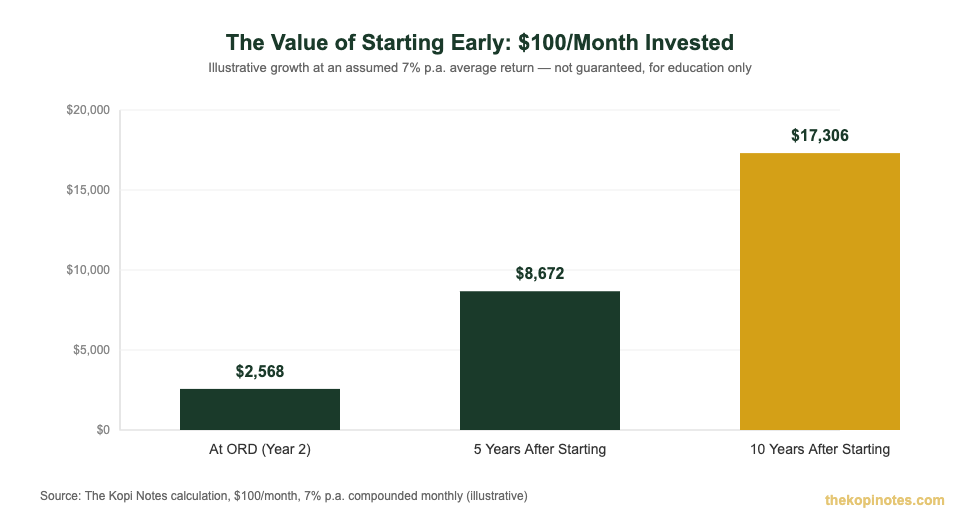
2. Waiting until after ORD to start. Two years of compounding, even on small sums, adds up — see the chart above.
3. Chasing hot stock tips from bunkmates. Single stocks picked on a whim are a shaky foundation for a first-time investor; start with a diversified fund instead.
4. Not automating contributions. If investing depends on remembering to do it manually every month, it won’t happen consistently — set up a standing instruction instead.
Ready to open your first account? Check out the Syfe referral code and sign-up bonus for a simple way to start.
Disclaimer: This article is for educational purposes only and does not constitute financial advice. NS allowance figures are sourced from CMPB (Ministry of Defence) as at their last update of 24 July 2025, and remain in effect as at August 2026. Investment return figures used in illustrative examples are assumptions, not guarantees or forecasts.
Frequently Asked Questions
Do NSFs pay CPF on their NS allowance?
No. Full-time NSFs are enlisted under the Enlistment Act, not employed under a contract of service, so no CPF contributions are deducted from your monthly rank and vocation allowance — the full amount is credited to your bank account.
Can an 18-year-old NSF open a brokerage account in Singapore?
Yes. Any Singapore Citizen or PR aged 18 and above can open a brokerage account, CDP account, or Regular Savings Plan, regardless of employment status. An NSF allowance is generally accepted as income for account applications.
How much does a full-time NSF earn in total over 2 years of National Service?
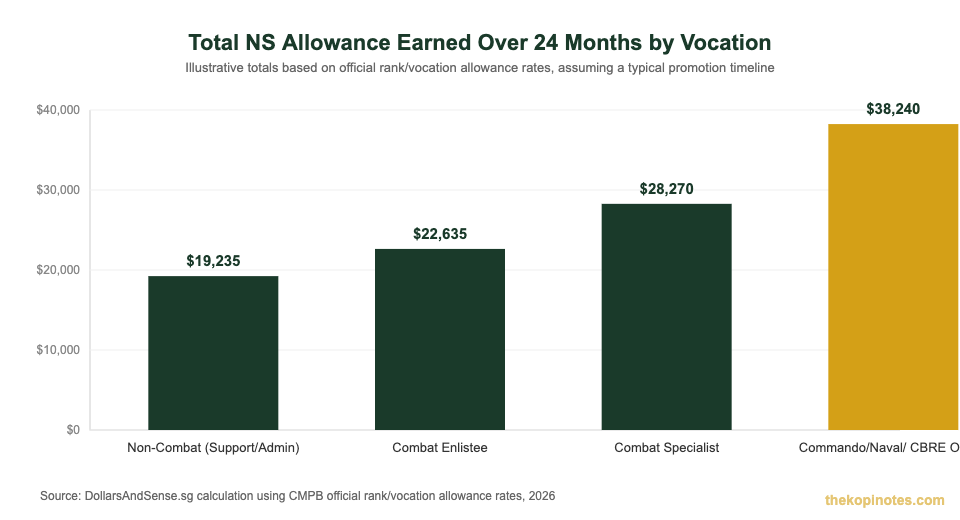
It depends on rank and vocation, but illustrative totals range from about $19,235 for a non-combat role to $38,240 for the highest-risk combat officer vocations, based on 2026 CMPB allowance rates and a typical promotion timeline.
Should NSFs invest their allowance or just save it in a bank account?
For money you won’t need for years, investing in a diversified, low-cost fund generally beats leaving it in a low-interest savings account, since inflation erodes cash value over time. Keep a portion in cash or T-bills for near-term needs like tuition or a gap-year trip.
What is the NS HOME Award and how does it help NSFs financially?
It’s a government award that pays NSmen between $17,000 and $18,500 across three milestones during their Operationally Ready NS journey, credited into their PSEA, CPF OA, CPF MA, and as LifeSG Credits — separate from the monthly NS allowance.
Is NS allowance taxable in Singapore?
Technically yes, but in practice most NSFs owe little to no tax on it, since the total allowance rarely exceeds the tax-free chargeable income threshold for individuals in a given year.
Ready to Start Investing Your Allowance?
Open a brokerage account or RSP and start small — even $50 a month builds a real habit before you ORD.
This article was researched with the help of AI. While we strive to keep all information accurate and up to date, there may be errors. If you notice any discrepancies, please contact us.