Endowus for Self-Employed Singaporeans: SRS Strategy Without Employer CPF (2026)
No employer, no automatic OA or SA inflow — here’s how to build a tax-efficient investing plan around SRS instead.
If you’re self-employed in Singapore, you only get compulsory MediSave contributions — there’s no employer CPF, so no automatic Ordinary Account or Special Account inflow. That makes the Supplementary Retirement Scheme (SRS), capped at S$15,300 a year, your main voluntary tax-relief and investing channel, and Endowus lets you invest those SRS dollars in portfolios priced at a flat 0.40% (or 0.30% for a single fund) instead of leaving them at SRS’s default 0.05% p.a.
Not financial advice. All figures are for educational reference only. Data verified against CPF Board and IRAS sources as at November 2026.
Table of Contents
Why self-employed Singaporeans need a different Endowus strategy
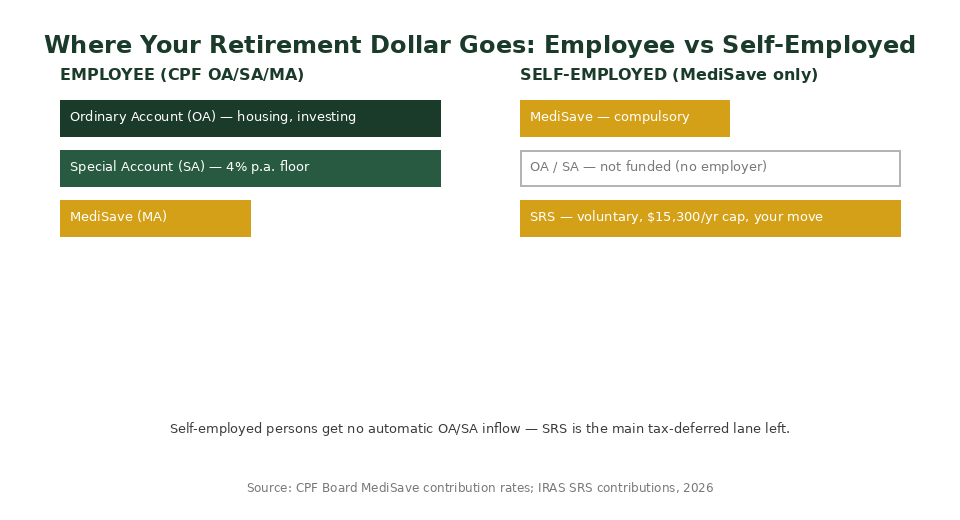
The CPF gap: MediSave is compulsory, OA/SA is not
SRS becomes your main tax-advantaged lane
Endowus SRS fees and portfolio options
Funding SRS on irregular income
Voluntary CPF top-ups vs SRS: which first?
How to get started
FAQ
Why Self-Employed Singaporeans Need a Different Endowus Strategy
Most Endowus guides are written for salaried employees: CPF OA building up automatically every month, SA growing at a guaranteed floor rate, and SRS as a nice-to-have on top. Freelancers, sole proprietors, private-hire drivers, real estate agents, insurance agents and other self-employed persons (SEPs) don’t have that automatic CPF engine running in the background. The only CPF contribution that’s compulsory for you is MediSave — and even that is based on your net trade income from the previous year, not a monthly salary deduction.
That changes the order of operations. If you’re self-employed, the usual “max your CPF, then SRS, then cash” playbook doesn’t apply cleanly, because two of those three buckets (OA and SA) aren’t being filled for you. SRS and voluntary CPF top-ups become active decisions you have to make yourself, every year, out of income that can swing 30-50% month to month.
The CPF Gap: MediSave Is Compulsory, OA/SA Is Not
Under CPF Board rules, self-employed persons must pay compulsory MediSave contributions once their net trade income (NTI) for the year exceeds S$6,000, based on a rate table set by age and income band. This money goes into MediSave only — it does not touch your Ordinary Account or Special Account. Employees, by contrast, have their employer contribute across all three accounts (OA, SA/RA, MA) every month as a percentage of wages.
Self-employed persons can voluntarily top up their CPF accounts (OA, SA, MA together) up to the CPF Annual Limit of S$37,740 for 2026, less whatever compulsory MediSave they’ve already paid for the year. Relief on that voluntary portion is capped at the lower of 37% of net trade income or the remaining room under the limit — and if compulsory MediSave alone already eats up 37% or more of your net trade income, you get no further relief on voluntary CPF contributions at all. For many SEPs with modest or lumpy income, that makes voluntary CPF top-ups a weaker tax lever than they are for employees.
SRS Becomes Your Main Tax-Advantaged Lane
This is where SRS earns its keep. The annual SRS contribution cap is S$15,300 for Singapore Citizens and PRs (S$35,700 for foreigners), and every dollar you put in reduces your chargeable income dollar-for-dollar, subject to the overall S$80,000 personal income tax relief cap for the Year of Assessment. Unlike the CPF voluntary top-up relief, SRS relief isn’t reduced by how much MediSave you’ve already paid — it’s a separate, cleaner lever.
For a self-employed person taxed at the 15–20% marginal bracket on net trade income, a full S$15,300 SRS contribution is worth roughly S$2,295–S$3,060 in tax saved for that Year of Assessment, before the invested amount has even grown a cent. Left in the SRS account itself, idle cash earns just 0.05% p.a. — which is the entire reason to route it into an investment platform instead of letting it sit.
[et_pb_table _builder_version=”4.16″ header=”on”]
| Account | Who funds it | 2026 Annual Cap | Tax Relief |
|---|---|---|---|
| MediSave (MA) | Compulsory, by CPF Board formula on NTI | Varies by age/income | Relief on full compulsory amount paid (from YA2026) |
| CPF OA/SA (voluntary top-up) | Self-employed, voluntary | S$37,740 CPF Annual Limit minus compulsory MediSave | Lower of 37% of NTI or room left under limit |
| SRS | Self-employed, fully voluntary | S$15,300 (Citizens/PRs); S$35,700 (Foreigners) | Dollar-for-dollar, subject to S$80,000 overall cap |
Source: CPF Board MediSave contribution rates and CPF Annual Limit; IRAS SRS contributions and tax relief, 2026
[/et_pb_table]
Endowus SRS Fees and Portfolio Options
Endowus is one of the few platforms that accepts SRS funds directly (alongside CPF OA/SA and cash) and prices them on a separate, flat fee schedule rather than the tiered cash rates. As at November 2026, per Endowus’s own pricing page:
[et_pb_table _builder_version=”4.16″ header=”on”]
| SRS Product | Endowus Access Fee | Minimum |
|---|---|---|
| Advised Portfolios (Flagship, Income, ESG, Fund Smart with 2+ funds) | 0.40% p.a. flat | S$1,000 initial |
| Fund Smart single fund | 0.30% p.a. flat | S$1,000 initial |
| Cash Smart / money market funds (via SRS) | 0.15% p.a. flat | S$1,000 initial |
Source: endowus.com/pricing, accessed November 2026. Fund-level TER (0.05–1%) is charged separately by the underlying fund manager and reflected in the fund’s NAV.
[/et_pb_table]
Note that CPF and SRS portfolios are priced separately from Cash and don’t combine with your Cash balance for tiering — so a self-employed investor with, say, S$15,300 in SRS and S$20,000 in cash pays 0.40% on the SRS piece and whatever cash tier applies (0.60% below S$200,000) on the cash piece, not a single blended rate.
For most self-employed first-time SRS investors, a globally diversified Advised Portfolio (Flagship or Income, at 0.40%) is simpler to manage than hand-picking funds on Fund Smart, especially since you won’t be adding to it as predictably as a salaried employee on autopilot.
Funding SRS on Irregular Income
The biggest practical problem for SEPs isn’t the fee — it’s the cash flow. A salaried employee can set a standing instruction to top up SRS monthly. A freelancer whose income swings from S$2,000 one month to S$8,000 the next can’t reliably commit to that without risking an overdraft in a slow month.
Three approaches that work better for lumpy self-employed income:
- Percentage-of-invoice contributions. Route a fixed percentage (e.g. 10–15%) of every client payment into your SRS account as it arrives, rather than a fixed monthly amount. This tracks your actual cash flow instead of fighting it.
- Year-end lump sum before 31 December. SRS contributions must be made by 31 December of the calendar year to count toward that year’s relief. Many SEPs only know their full-year net trade income in Q4, making a single year-end top-up (up to the remaining S$15,300 cap) more realistic than monthly drip-feeding.
- Separate “tax bucket” account. Keep a dedicated high-yield account (not your operating cash) that automatically receives a cut of every invoice, specifically earmarked for SRS and income tax — so the SRS contribution is never competing with this month’s rent.
Voluntary CPF Top-Ups vs SRS: Which First?
If you have spare cash after compulsory MediSave and want to decide between a voluntary CPF top-up (OA/SA/MA) and an SRS contribution, consider:
- Relief ceiling. Voluntary CPF top-up relief is capped at 37% of net trade income (and reduced further by compulsory MediSave already paid). SRS relief has no such NTI-linked cap — it’s capped only by the flat S$15,300 contribution limit and the overall S$80,000 relief ceiling.
- Liquidity. SRS withdrawals before the statutory retirement age in effect when you first contributed incur a 5% penalty plus full taxation on the withdrawn amount. CPF is even more locked up. If you expect to need the money in the next 5–10 years for business reinvestment, neither is ideal — but SRS is marginally more flexible for planned, penalty-accepted early withdrawals.
- Investment control. SRS funds invested via Endowus can go into a genuinely globally diversified multi-asset portfolio. CPF OA/SA investing (CPFIS) has a narrower approved fund list and a S$20,000 OA / S$40,000 SA threshold before you can invest the excess at all.
For most self-employed Singaporeans without a high and stable net trade income, maxing SRS first — then considering voluntary CPF top-ups with whatever relief room is left — is the more tax-efficient sequence.
How to Get Started
To invest SRS through Endowus: open an SRS account with one of the three SRS operators (DBS, OCBC or UOB) if you don’t already have one, then link it to Endowus during account sign-up or from your existing Endowus dashboard. Minimum initial investment is S$1,000. Endowus is a Capital Markets Services licence holder (CMS101051) regulated by MAS, and accepts CPF OA/SA, SRS and cash funding sources.
If you also run a side cash buffer alongside SRS, you may want to compare the Endowus Cash Smart vs MariBank breakdown, or see how Endowus stacks up against a self-directed broker in the Endowus vs IBKR comparison. For the mechanics of CPFIS investing itself (relevant if you later start drawing a salary and gain employer CPF), see our Endowus CPFIS 2026 guide. And if retirement planning as a whole is on your mind, our Singapore retirement calculator and CPF investment strategy guide cover the rest of the picture. Self-employed readers juggling savings and payouts may also find our passive income Singapore guide useful for building an income cushion outside SRS.
Frequently Asked Questions
Can self-employed Singaporeans invest in Endowus?
Do self-employed persons get CPF OA and SA contributions?
What is the SRS contribution cap for 2026?
How much does Endowus charge on SRS investments?
Should I prioritise voluntary CPF top-ups or SRS as a self-employed person?
What happens if I withdraw SRS funds early as a self-employed person?
[/et_pb_column][/et_pb_row][/et_pb_section]
This article was researched with the help of AI. While we strive to keep all information accurate and up to date, there may be errors. If you notice any discrepancies, please contact us.