Disability Income Insurance vs CPF DPS Singapore 2026: Which Gap Matters More?
The complete guide to plugging Singapore’s income protection gap — with real numbers
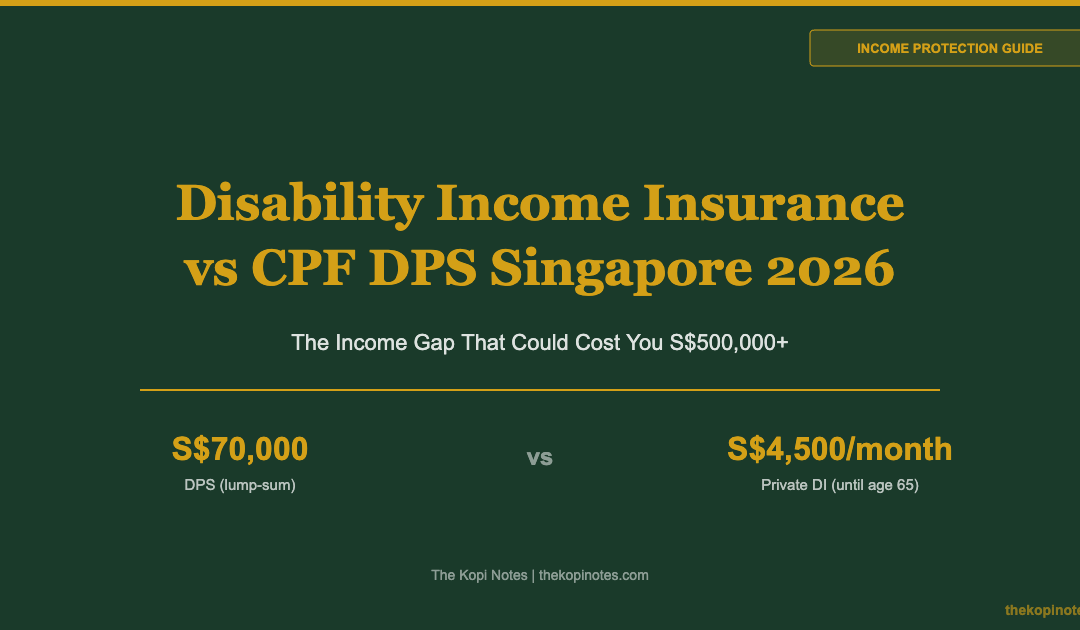
Disability income (DI) insurance pays you a monthly benefit — up to 75% of your gross salary — if illness or injury stops you from working. CPF’s Dependants’ Protection Scheme (DPS) pays a one-off lump sum of up to S$70,000 for total permanent disability. Both cover disability, but they solve very different problems. Most Singaporeans rely on DPS alone and unknowingly face a multi-year income gap worth hundreds of thousands of dollars.
Not financial advice. All figures are for educational reference only. Data verified as at August 2026.
- DPS pays a one-off lump sum (up to S$70,000). Private DI pays a monthly income for years.
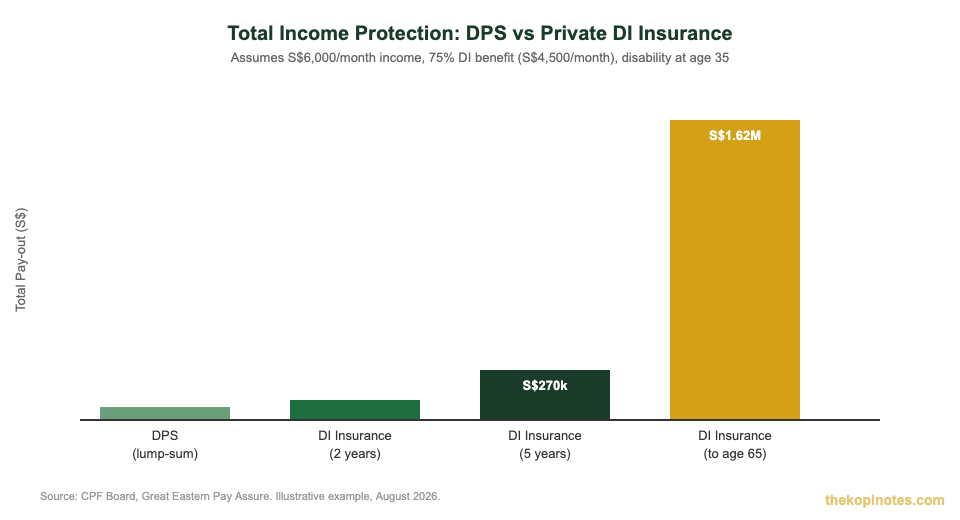
- If you can’t work for 5+ years, S$70,000 won’t last. A S$4,500/month DI benefit could pay out over S$1.6M over 30 years.
- Target 50–75% of your gross monthly income in DI cover — stacked above CareShield Life.
Table of Contents
Show / Hide Contents
- What Is Disability Income Insurance?
- What Does CPF DPS Actually Cover?
- DPS vs Private DI Insurance: Side-by-Side
- The Coverage Gap: Why DPS Alone Isn’t Enough
- How Much Private DI Insurance Do You Need?
- CareShield Life: The Severe Disability Layer
- Key DI Policy Terms Before You Buy
- Is DI Insurance Tax Deductible?
- Frequently Asked Questions
What Is Disability Income Insurance?
Disability income (DI) insurance replaces part of your salary if a medical condition stops you from working. Think of it as a salary safety net — one that kicks in when your employer’s sick leave runs out and keeps paying for months or years.
Here’s how it works in practice. If you earn S$6,000/month and your policy covers 75% of your income, you receive S$4,500 every month during the disability period. That benefit continues — sometimes until age 65 — as long as you qualify under the policy’s definition of disability.
Major insurers offering DI plans in Singapore include Great Eastern (Pay Assure), AIA (Premier Disability Cover), Singlife (MyIncomeProtector), and Prudential (PRUIncome). Common features across plans:
- Benefit amount: Up to 75% of average gross monthly income, capped at S$25,000/month
- Pre-benefit period: 30, 60, 90, or 180 days before payments start
- Benefit period: Until recovery, or until age 55, 60, or 65
- Disability definition: “Own occupation” (can’t do your specific job) or “any occupation” (can’t do any work at all) — own occupation is more generous
The monthly benefit you receive is entirely tax-free under Singapore tax law. IRAS does not treat DI payouts as taxable income.
For insurer-specific plan comparisons, see our full disability income insurance guide.
What Does CPF DPS Actually Cover?
The Dependants’ Protection Scheme (DPS) is a term life insurance plan automatically extended to CPF members aged 21 to 65. It is administered by Great Eastern and NTUC Income, with premiums deducted from your CPF Ordinary Account.
DPS provides a one-off lump-sum payout in three scenarios: death, terminal illness, or total and permanent disability (TPD). For disability purposes, “TPD” under DPS means you are permanently unable to perform ANY work — a high threshold that excludes most partial or temporary disabilities.
Premiums are affordable — as low as S$18/year for members under 35, rising to S$298/year for members aged 60–65. Most Singaporeans keep DPS active because it is cheap and auto-deducted from CPF.
What DPS does not cover:
- It does not pay monthly — only one payment, ever
- It does not cover partial disability or “own occupation” inability
- It does not replace ongoing income loss beyond the lump sum
- S$70,000 at S$4,500/month expenses = roughly 15 months of coverage. After that, you’re on your own
Read our CPF DPS complete guide for coverage, opt-out rules, and insurer options.
DPS vs Private DI Insurance: Side-by-Side
The key difference: DPS is a one-time safety net, while private DI insurance is a long-term monthly income stream. Here is how they compare across the metrics that matter most.
| Feature | CPF DPS | Private DI Insurance |
|---|---|---|
| Payout type | One-off lump sum | Monthly income |
| Maximum payout | S$70,000 | 75% of gross income (max S$25,000/month) |
| Disability definition | Total permanent disability (any occupation) | Own occupation or any occupation (plan-dependent) |
| Duration | One payment only | Until recovery or to age 65 |
| Premium source | CPF Ordinary Account | Cash (after-tax) |
| Annual cost (age 35) | ~S$52/year | ~S$1,000–S$2,500/year |
| Covers partial disability? | No | Yes (some plans) |
| Tax treatment of benefit | Tax-free | Tax-free |
Source: CPF Board, Great Eastern Pay Assure product summary, August 2026
The Coverage Gap: Why DPS Alone Isn’t Enough
Here is a real-numbers scenario that shows why the gap matters.
Meet Marcus, 38, an IT project manager earning S$7,500/month. He has DPS (S$70,000) but no private DI insurance. A stroke leaves him unable to work for 8 years until partial recovery at age 46.
| Coverage Layer | Marcus Receives | Total |
|---|---|---|
| CPF DPS | S$70,000 one-time | S$70,000 |
| CareShield Life (if severe) | ~S$712/month × 96 months | ~S$68,352 |
| Total income replacement | ~S$138,352 | vs S$720,000 salary over 8 years |
Illustrative example. CareShield Life only pays if 3+ ADLs are affected. Individual circumstances vary.
That S$581,648 gap is precisely what private DI insurance plugs. A S$5,625/month DI benefit (75% of S$7,500) over 8 years pays out S$540,000 — closing almost the entire gap.
For a full analysis of the DPS shortfall, read our DPS coverage gap analysis.
How Much Private DI Insurance Do You Need?
The calculation is straightforward. Start with your monthly spending needs, then subtract what government schemes already provide.
Less: CareShield Life payout (~S$712/month) + any employer group DI
In practice, most financial planners target 50–75% of gross income as the DI benefit. Here is why that range makes sense:
- Insurers cap benefits at 75% of gross income to prevent moral hazard
- Your CPF contributions stop during disability, so your actual cash outflow is lower than your gross salary
- CareShield Life (if you qualify) adds ~S$712/month on top of your private DI benefit
Worked example — Sarah, 32, nurse earning S$5,000/month gross:
- Target DI: 75% × S$5,000 = S$3,750/month
- Less CareShield Life (if severely disabled): −S$712/month
- Net private DI to buy: ~S$3,038/month
- Benefit period: to age 65 (33 more years)
- Total potential payout if she never recovers: S$3,038 × 396 months = S$1,203,048
That puts the premium in perspective. Paying ~S$1,200–S$1,800/year for S$1.2M of potential income protection is a strong risk-transfer trade for most working Singaporeans.
Use our retirement planning calculator to see how DI cover fits into your overall income replacement strategy.
CareShield Life: The Severe Disability Layer
Before buying private DI insurance, understand CareShield Life — Singapore’s national severe disability scheme that all citizens and PRs born in 1980 or later are enrolled in.
CareShield Life pays a monthly benefit if you are severely disabled — defined as unable to perform at least 3 out of 6 Activities of Daily Living (ADLs): washing, dressing, feeding, toileting, mobility, and transferring.
Key distinctions versus private DI insurance:
- CareShield threshold is much higher: 3+ ADLs must be affected. A back injury preventing desk work would not qualify.
- Private DI has a lower threshold: “Own occupation” DI pays if you can’t do your specific job, regardless of ADL status.
- They are complementary, not overlapping: CareShield covers long-term severe care; private DI covers income disruption at lower disability severity.
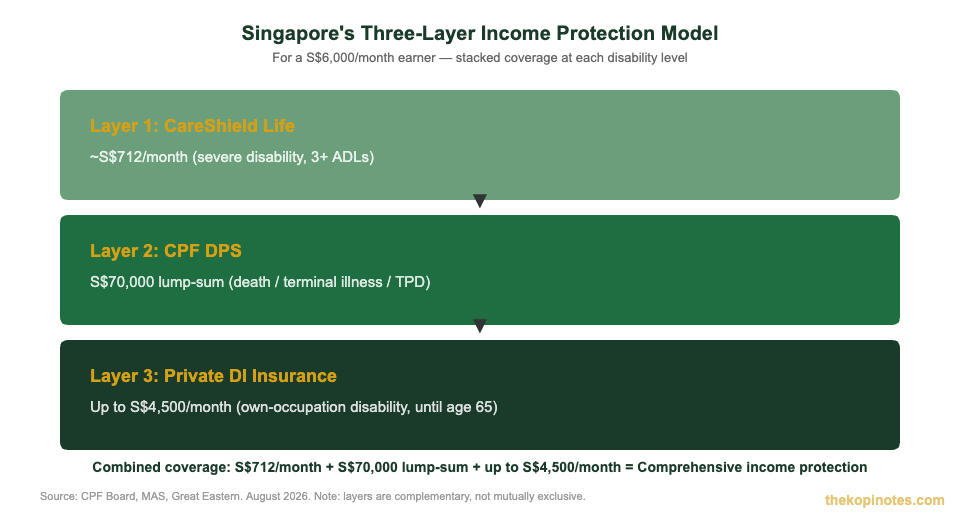
The three-layer model for complete income protection:
- CareShield Life — baseline ~S$712/month for severe disability (mandatory, government)
- CPF DPS — S$70,000 lump sum for TPD or death (low-cost CPF-funded)
- Private DI Insurance — monthly income replacement for own-occupation disability (purchased separately)
Stack all three layers and you have comprehensive income protection across the full spectrum of disability severity.
Key DI Policy Terms to Check Before You Buy
Not all DI policies are equal. These are the terms that most affect your actual coverage.
| Policy Term | What It Means | What to Look For |
|---|---|---|
| Definition of disability | Own occupation vs any occupation | Own occupation is more generous — prefer it |
| Pre-benefit period | Waiting period before payments start | 60–90 days is standard; shorter = higher premium |
| Benefit period | How long benefits are paid | To age 65 is best — covers your full working life |
| Premium waiver | Premiums waived while on claim | Most plans include this — confirm it is automatic |
| Partial disability benefit | Reduced benefit if partially disabled | Valuable for returning to work part-time |
| Guaranteed renewability | Insurer cannot cancel your policy | Non-negotiable — always check this clause |
Source: MAS, insurer product summaries, August 2026. Always read the full policy document before purchasing.
If you are comparing CI insurance alongside DI, read our CI vs ISP comparison guide to understand how coverage layers interact.
Is DI Insurance Tax Deductible in Singapore?
Two separate questions — what tax treatment applies to the premiums you pay, and the benefit you receive.
DI benefit — tax-free: Monthly benefit payments received during a valid disability claim are completely exempt from Singapore income tax. IRAS does not classify DI payouts as taxable income. Your effective replacement rate is therefore higher than the nominal 75%, since you owe no tax on the benefit.
DI premiums — potentially tax-deductible: You may claim DI premiums under the Life Insurance Relief, subject to:
- Relief applies only if your total CPF contributions are below S$5,000/year
- Most salaried employees earning above ~S$42,000/year will have mandatory CPF contributions exceeding S$5,000/year — meaning no premium relief applies to them
- Self-employed persons with voluntary CPF contributions below S$5,000/year may benefit from this relief
- The S$5,000 cap is combined across CPF top-ups and life/CI/DI premiums
For long-term wealth building alongside your DI protection, consider Syfe or Endowus for portfolio investment that grows your financial buffer.
Frequently Asked Questions
Is CPF DPS the same as disability income insurance?
Can I have both CPF DPS and private DI insurance?
How long does the waiting period last before DI benefits start?
How long does the waiting period last before DI benefits start?
Does CareShield Life replace private DI insurance?
Is the disability income benefit taxable in Singapore?
How much does disability income insurance cost in Singapore?
Get Free Insurance Advice
Speak with a licensed insurance advisor. No obligation, no cost.
By submitting this form, you agree to our Privacy Policy.
This article was researched with the help of AI. While we strive to keep all information accurate and up to date, there may be errors. If you notice any discrepancies, please contact us.