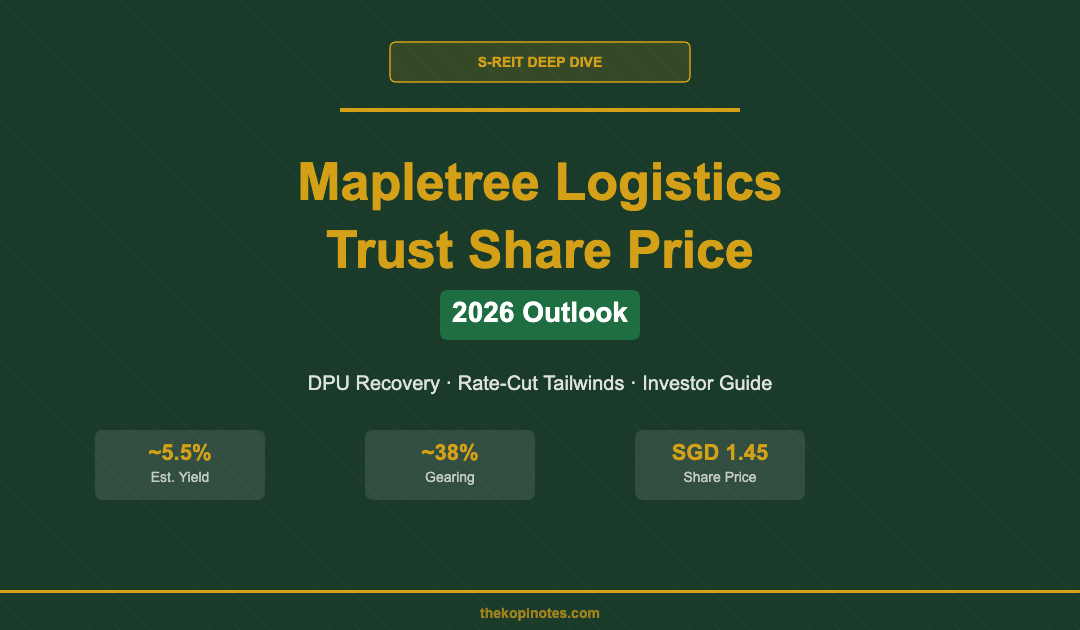
Mapletree Logistics Trust Share Price 2026: DPU Outlook & Rate-Cut Tailwinds
Last updated: August 2026 | SGX: M44U | S-REIT Deep Dive
Mapletree Logistics Trust (SGX: M44U) is Singapore’s largest pure-play logistics REIT, holding over 180 warehouses and distribution centres across eight countries in Asia-Pacific. Its share price has ranged between SGD 1.38–1.62 in 2026, offering an estimated distribution yield of 5.4–5.7% at current levels. With the Fed rate-cut cycle now in full swing, MLT’s floating-rate debt burden is easing—pointing toward DPU recovery in 2H 2026 and beyond.
Not financial advice. All figures are for educational reference only. Data as at August 2026 unless noted. Verify current DPU and share price before investing.
- MLT’s DPU dipped in FY2024–25 from rate headwinds and China divestments, but is recovering as the Fed cuts rates and portfolio quality improves.
- Gearing sits at a comfortable ~38%, well below the 50% MAS cap, giving MLT room to acquire yield-accretive assets.
- For income investors, a 5.5% yield backed by quality logistics assets across 8 countries makes MLT a core S-REIT holding to consider.
MLT at a Glance (August 2026)
| Metric | Value | Notes |
|---|---|---|
| SGX Ticker | M44U | Listed 2005 |
| Share Price (est.) | SGD 1.45 | 52-week range: SGD 1.38–1.62 |
| Market Cap | ~SGD 5.8B | Large-cap S-REIT |
| FY2026 Est. DPU | ~8.0–8.2¢ | Rate-cut recovery boost |
| Distribution Yield | ~5.5% | Based on SGD 1.45 price |
| Gearing | ~38.2% | Post China divestments |
| Properties | 186+ | 8 countries across Asia-Pacific |
Source: MLT investor reports, SGX filings, The Kopi Notes estimates. Aug 2026.
Table of Contents
Jump to Section
- MLT Share Price History & 2026 Outlook
- DPU History and Distribution Yield
- Rate-Cut Tailwinds: What It Means for MLT
- Portfolio Breakdown: Post-China Divestment
- Balance Sheet, Gearing & Peer Comparison
- Is MLT a Buy? Analyst Verdict
- How to Buy Mapletree Logistics Trust in Singapore
- Frequently Asked Questions
MLT Share Price History & 2026 Outlook
Mapletree Logistics Trust had a challenging 2022–2024 as rising interest rates squeezed distributions and investor appetite for high-yielding assets cooled. The share price fell from a peak of around SGD 2.10 in 2022 to a trough near SGD 1.35 in early 2025.
The good news: 2026 has seen a steady recovery. At around SGD 1.45, MLT is trading at roughly 0.95x its net asset value (NAV) — a slight discount that historically signals a buying opportunity for patient income investors. When a quality REIT like MLT trades below book, it often means the market is pricing in more bad news than fundamentals justify.
Three factors are driving the 2026 recovery story. First, the Fed rate-cut cycle is reducing financing costs. Second, MLT has cleaned up its balance sheet by divesting weaker China assets (see our deep dive on MLT’s China divestment strategy). Third, Asia-Pacific logistics demand remains structurally strong as e-commerce growth continues to outpace traditional retail.
DPU History and Distribution Yield
MLT’s Distribution Per Unit (DPU) — the amount of cash you receive per REIT unit each half-year — peaked around 4.5 Singapore cents per half-year in FY2022/23, before declining as interest costs rose. By FY2024/25, the half-yearly DPU had dipped to approximately 3.9–4.0 cents.
The chart below shows MLT’s DPU trajectory from FY2022/23 through our 2026 estimate. Notice the dip in FY2024–25 and the expected recovery as rate cuts flow through to lower debt costs.
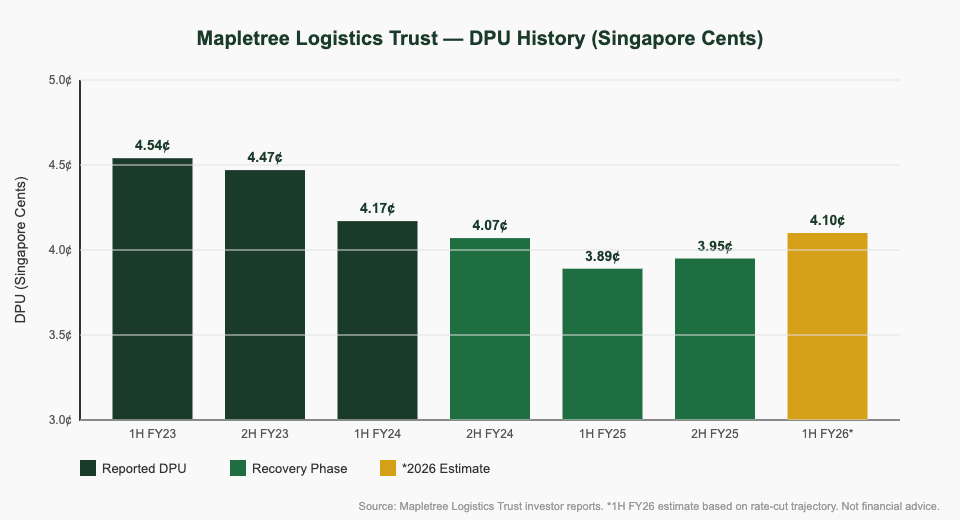
For FY2026, our estimate is a total DPU of approximately 8.0–8.2 cents, representing a yield of ~5.5% at SGD 1.45. That’s not the 6%+ you can get from higher-geared REITs like MPACT, but MLT’s quality portfolio and diversified geography justify the modest premium.
If you own 10,000 MLT units — worth about SGD 14,500 — you would receive approximately SGD 820 per year in distributions. That’s tax-exempt for individual investors in Singapore, making it highly efficient for income generation.
To compare MLT’s distributions with other S-REITs in your portfolio, check out our guide to the best S-REITs in Singapore 2026.
Rate-Cut Tailwinds: What It Means for MLT
The Fed cut rates by a cumulative 150 basis points from September 2025 through mid-2026. For a REIT like MLT that carries a large debt book, this is a material tailwind.
Here’s why it matters. MLT holds around SGD 5 billion in total debt. Approximately 35–40% of this is on floating interest rates — meaning it reprices down as benchmark rates fall. A 100 basis point cut on 40% of SGD 5 billion saves roughly SGD 20 million in annual interest. That flows straight through to distributable income.
MLT’s management has also been opportunistic about locking in fixed rates at lower levels during 2026, extending the weighted average debt maturity to approximately 3.8 years. This gives the REIT a stable cost-of-debt outlook and reduces refinancing risk through 2027–2028.
The Bank of Australia and the Bank of Japan have also moved rates, affecting MLT’s AUD- and JPY-denominated debt portfolios. The net effect across all currencies is modestly positive for DPU in FY2026. For a broader read on how rate cuts are affecting Singapore REITs, see our CICT rate-cut recovery analysis.
Portfolio Breakdown: Post-China Divestment
MLT owns more than 186 logistics properties across eight countries. Here’s roughly how the portfolio breaks down by geography (as a percentage of total assets under management):
| Country | AUM Share | Key Highlights |
|---|---|---|
| Singapore | ~30% | Core market, 97%+ occupancy |
| Australia | ~22% | E-commerce-driven demand |
| Japan | ~18% | Logistics modernisation wave |
| China | ~10% | Reduced after Wuxi divestments |
| South Korea | ~8% | Last-mile and cold chain |
| Vietnam / India / Others | ~12% | High-growth emerging markets |
Source: MLT investor presentations, estimates as at 2H 2026.
The reduction of China exposure from ~17% (peak) to ~10% has been a deliberate strategic move. Chinese logistics cap rates have compressed under property-sector stress, and MLT’s management chose to recycle capital toward higher-growth markets in Australia, Japan, and Vietnam instead. We covered this in depth in our MLT China divestment analysis.
The overall occupancy rate across the portfolio sits at approximately 96–97%. That’s excellent for a REIT with 186+ properties — it means almost every square metre is generating income. This diversification is one of MLT’s biggest competitive advantages over single-country logistics REITs.
Balance Sheet, Gearing & Peer Comparison
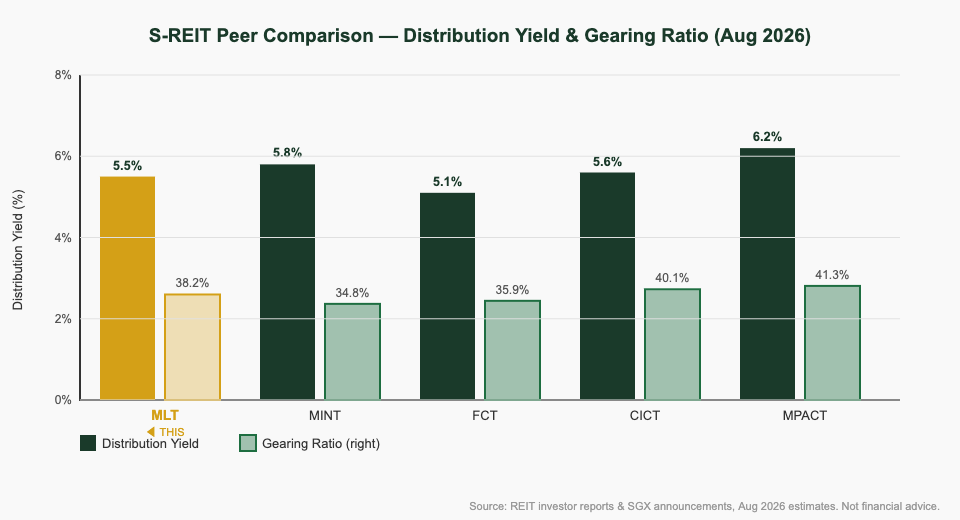
MLT’s gearing (aggregate leverage) stands at approximately 38.2% as at mid-2026. This is comfortably below the 50% MAS regulatory limit and gives management the firepower to acquire up to ~SGD 1.5–2 billion in additional assets before hitting constraints. With logistics assets in Asia still trading at attractive yields, MLT has room to grow.
How does MLT compare to its S-REIT peers? The chart and table below break this down:
| REIT | Ticker | Est. Yield | Gearing | P/NAV |
|---|---|---|---|---|
| Mapletree Logistics (MLT) | M44U | 5.5% | 38.2% | 0.95x |
| Mapletree Industrial (MINT) | ME8U | 5.8% | 34.8% | 0.87x |
| Frasers Centrepoint Trust (FCT) | J69U | 5.1% | 35.9% | 0.98x |
| CapitaLand Integrated Commercial (CICT) | C38U | 5.6% | 40.1% | 1.02x |
| MPACT | N2IU | 6.2% | 41.3% | 0.82x |
Source: SGX filings, company investor presentations, The Kopi Notes estimates. Aug 2026. Not financial advice.
Is MLT a Buy? Analyst Verdict
MLT ticks most of the boxes for a core S-REIT holding in a passive income portfolio. Here is the balanced view:
Bull case: Rate cuts improve DPU. China exposure has been reduced. The logistics sector is supported by long-term e-commerce tailwinds. Trading at a discount to NAV (0.95x) suggests market pessimism is already priced in. Mapletree’s Temasek backing provides a stable sponsor with deep pockets for injections.
Bear case: Japan interest rate normalisation could pressure JPY-denominated debt costs. China economic weakness could still weigh on the remaining 10% of portfolio. AUD fluctuations affect distributions if currency hedges roll off. Any broader global recession would hurt e-commerce volumes.
Bottom line: At a 5.5% yield and 0.95x P/NAV, MLT offers an attractive entry point for investors with a 2–5 year horizon. It is not the highest-yielding S-REIT, but it is among the best-managed, with a quality portfolio and a responsible balance sheet. For Singapore investors building a passive income portfolio, MLT earns its place as a core holding. Use our Singapore retirement calculator to see how MLT distributions fit into your retirement income plan.
How to Buy Mapletree Logistics Trust in Singapore
You can buy MLT units (SGX: M44U) through any Singapore-licensed brokerage or robo-adviser. Here are some options popular with TKN readers:
Self-directed investing: Use a brokerage like moomoo Singapore, IBKR, or Saxo to buy MLT directly on the SGX. Standard brokerage commissions apply. This gives you full control over the price you pay and the timing.
Robo-adviser portfolios: Syfe’s referral code SRPRFFFCD gives you a fee waiver on your first investment. Syfe’s REIT+ portfolio holds a diversified basket of S-REITs including MLT, so you get broad exposure without picking individual names.
Fund platform: FSMOne (referral code P0544985) allows you to buy S-REITs and REIT ETFs with low commissions. It’s a good platform if you also invest in unit trusts or bonds alongside REITs.
Endowus: Endowus (referral code 2V343) lets you invest CPF-OA funds into REIT unit trusts and other income funds — a tax-efficient way to build REIT exposure using money that would otherwise earn just 2.5% in CPF.
Frequently Asked Questions — Mapletree Logistics Trust
What is Mapletree Logistics Trust’s share price today?
MLT (SGX: M44U) traded around SGD 1.38–1.62 in 2026. The current share price changes daily — check the SGX website or your brokerage app for the live price. As at August 2026, the price is approximately SGD 1.45, offering an estimated distribution yield of ~5.5%.
How much DPU does Mapletree Logistics Trust pay?
MLT distributes income twice a year (half-yearly). In FY2024/25, the total DPU was approximately 7.84 Singapore cents. For FY2025/26, analysts estimate a recovery toward 8.0–8.2 cents as rate-cut tailwinds reduce financing costs. DPU is subject to fluctuation — always check the latest investor presentation for confirmed figures.
Is Mapletree Logistics Trust a good buy in 2026?
MLT is widely regarded as a quality core S-REIT holding. It offers geographic diversification across 8 countries, a conservative gearing ratio (~38%), and a Temasek-backed sponsor. At ~0.95x P/NAV and a 5.5% yield, valuations look reasonable for a long-term income investor. That said, risks include Japan rate normalisation, China property headwinds, and currency volatility. This is not financial advice — please conduct your own due diligence.
What is MLT’s gearing ratio in 2026?
MLT’s aggregate leverage (gearing) is approximately 38.2% as at mid-2026, after completing several China asset divestments. This is well below the 50% MAS cap, giving MLT balance sheet headroom to pursue acquisitions or weather any portfolio write-downs without a rights issue.
How does MLT compare to Mapletree Industrial Trust (MINT)?
Both are Mapletree-sponsored S-REITs but with different asset classes. MLT focuses on logistics and warehousing assets across Asia-Pacific, while MINT focuses on industrial properties — data centres, flatted factories, hi-tech parks — primarily in Singapore and the US. MLT currently offers a slightly lower yield (~5.5%) vs MINT (~5.8%), but MLT has broader geographic diversification. Many Singapore investors hold both as complementary positions.
Can I buy MLT with CPF funds?
You can buy MLT units directly using your CPF Investment Scheme (CPFIS-OA) account through an approved brokerage. Alternatively, Endowus (referral code 2V343) allows you to invest CPF-OA savings into REIT unit trusts that may include MLT as an underlying holding. Note that direct share purchases require you to maintain the CPF OA minimum balance first.
What are the risks of investing in Mapletree Logistics Trust?
Key risks include: (1) Japan interest rate increases pressing JPY-denominated debt costs; (2) China economic weakness affecting the remaining ~10% China portfolio; (3) AUD/JPY currency fluctuations impacting SGD distributions; (4) a global recession reducing e-commerce demand; and (5) rising cap rates potentially compressing property valuations. Always read MLT’s full investor reports and consult a licensed financial adviser before investing.
This article was researched with the help of AI. While we strive to keep all information accurate and up to date, there may be errors. If you notice any discrepancies, please contact us.