AIMS APAC REIT 2026 Deep Dive: Ultra-Low 26.8% Gearing + Rate Cut Tailwinds
Is This Singapore’s Most Underrated Industrial REIT?
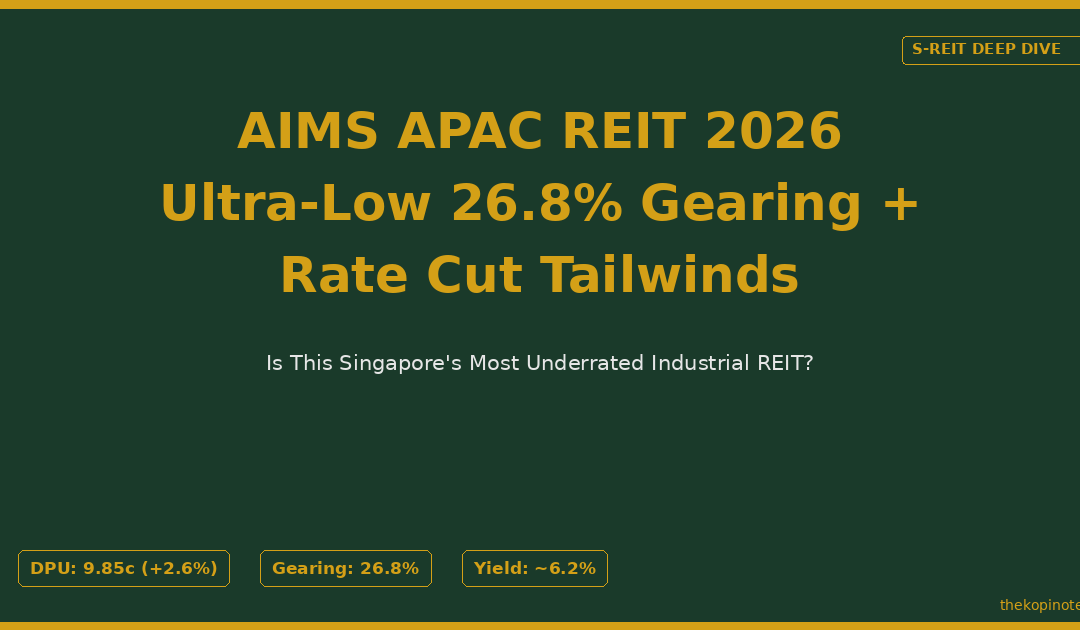
AIMS APAC REIT (SGX: O5RU) is a Singapore-listed industrial REIT with 28 properties across Singapore and Australia. With FY2026 DPU at 9.85 Singapore cents — up 2.6% year-on-year — a trailing 12-month yield of ~6.2% at S$1.60, and gearing at just 26.8%, AAREIT combines consistent income growth with one of the strongest balance sheets in the S-REIT sector heading into the 2026 rate-cut cycle.
Not financial advice. All figures are for educational reference only. Data as at August 2026 unless noted.
- FY2026 DPU grew 2.6% to 9.85 cents; 1Q FY2027 added another 2.5% YoY — consistent growth, not a one-off
- 26.8% gearing is among the lowest in the sector — 23 percentage points below the MAS 50% ceiling
- Rate cut tailwinds: 80% fixed-rate debt + every 25bps rate cut adds ~0.12 cents to annual DPU as loans roll over
Table of Contents
Table of Contents
- AIMS APAC REIT at a Glance
- FY2026 and 1Q FY2027 Financial Results
- Portfolio Quality: Occupancy and Rental Reversion
- Ultra-Low Gearing — Why It Matters Now
- Rate Cut Cycle: How Much More DPU Can You Expect?
- Australia Exposure and Data-Centre Optionality
- How AAREIT Compares to Peer Industrial REITs
- Who Should Consider AIMS APAC REIT?
- Frequently Asked Questions
AIMS APAC REIT at a Glance
AAREIT has flown under the radar for years. Its market cap sits well below the headline names like Mapletree Industrial or Keppel DC REIT. But its fundamentals tell a different story — one of steady compounding, disciplined capital management, and a balance sheet that most peers would envy.
Here are the key numbers you need to know as of August 2026:
| Metric | Value | Notes |
|---|---|---|
| SGX Ticker | O5RU | Listed on Mainboard |
| Share Price (Aug 2026) | ~S$1.60 | Closing price 4 Aug 2026 |
| FY2026 DPU | 9.85 cents | +2.6% year-on-year |
| Trailing 12M DPU | 9.907 cents | As at 1Q FY2027 (4 Aug 2026) |
| Distribution Yield | ~6.2% | At S$1.60 per unit |
| Aggregate Leverage | 26.8% | Among lowest in sector |
| Number of Properties | 28 (25 SG + 3 AU) | Singapore and Australia |
| Portfolio Occupancy | 93.6% (96.8% committed) | As at FY2026 |
| WALE | 4.0 years | Weighted average lease expiry |
| Blended Cost of Debt | 4.1% | Down from 4.3% in FY2025 |
Source: AIMS APAC REIT company results, SGX disclosures, August 2026
FY2026 and 1Q FY2027 Financial Results
AAREIT’s latest financials show a REIT firing on multiple cylinders. FY2026 (ended March 2026) delivered solid top-line growth, but the real standout was NPI margin expansion — which means more cash reaching unitholders relative to revenue.
In FY2026 full year, gross revenue rose 2.2% to S$190.7 million, while Net Property Income (NPI — the revenue left after property expenses) grew a stronger 5.7% to S$141.3 million. That gap between 2.2% revenue growth and 5.7% NPI growth is significant. It tells you that AAREIT’s property management team is getting better at controlling costs — a bullish signal for future DPU sustainability.
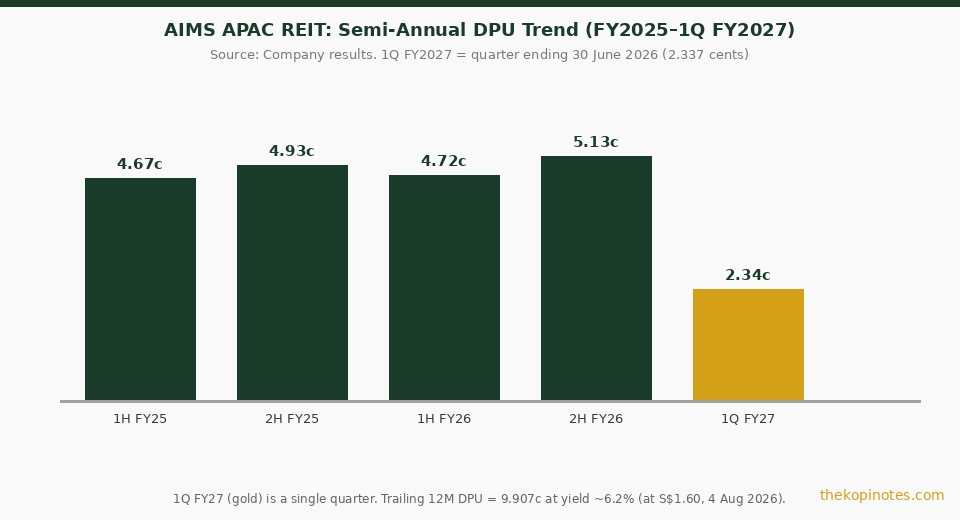
In 1Q FY2027 (April–June 2026), the trend accelerated. Revenue climbed 6.6% and NPI surged 12.5% — the same pattern, but more pronounced. DPU for the quarter came in at 2.337 cents, up 2.5% year-on-year. Distributions to unitholders rose 3.4% to S$19.3 million.
If you annualise the 1Q FY2027 DPU of 2.337 cents, you get roughly 9.35 cents per year. That’s slightly below the trailing 12-month figure of 9.907 cents — partly because 2H FY2026 included an elevated 2.60-cent quarter driven by strong rental reversions. The forward trajectory still points upward.
To put the yield in context: at a purchase price of S$1.60, AAREIT’s trailing 12-month yield of 9.907 cents translates to approximately 6.2%. That sits above the 10-year Singapore government bond yield of roughly 2.8–3.0% as at August 2026 — a premium of over 300 basis points. For income investors building a passive income Singapore portfolio, that spread matters.
Portfolio Quality: Occupancy and Rental Reversion
A REIT is only as good as its properties. AAREIT’s portfolio of 28 assets spans Singapore’s industrial heartland — warehouses, manufacturing facilities, hi-tech industrial, and business park space — plus three assets in New South Wales, Australia.
Here’s how the portfolio breaks down by asset type:
| Asset Type | Portfolio Weight | Key Driver |
|---|---|---|
| Warehouse / Logistics | 36% | E-commerce demand, 3PL growth |
| Australia (NSW) | 34% | 100% occupied, data-centre optionality |
| Industrial / Manufacturing | 19% | Stable long-term leases |
| Hi-Tech Industrial | 7% | Higher rents, tech-sector demand |
| Business Park | 4% | Knowledge economy tenants |
Source: AIMS APAC REIT FY2026 Annual Results presentation, May 2026
Portfolio occupancy stands at 93.6% (96.8% on a committed basis — meaning leases are signed but the tenant hasn’t moved in yet). Singapore assets sit at 92.8% while Australian assets are fully occupied at 100%. The weighted average lease expiry (WALE) is 4.0 years — giving you good income visibility without excessive rollover risk.
On rental reversions: AAREIT signed 33 new leases and 65 renewals in FY2026, covering roughly 27% of total net lettable area. The average reversion came in at +7.7% — a moderation from +20% in FY2025, but still positive. This normalization is healthy. It reflects a market where rents rose sharply post-COVID and are now settling at higher levels rather than correcting downward.
Positive rental reversion at lease renewal means the REIT’s income base is ratcheting up organically — without needing acquisitions or development projects to grow DPU.
Ultra-Low Gearing — Why It Matters Now
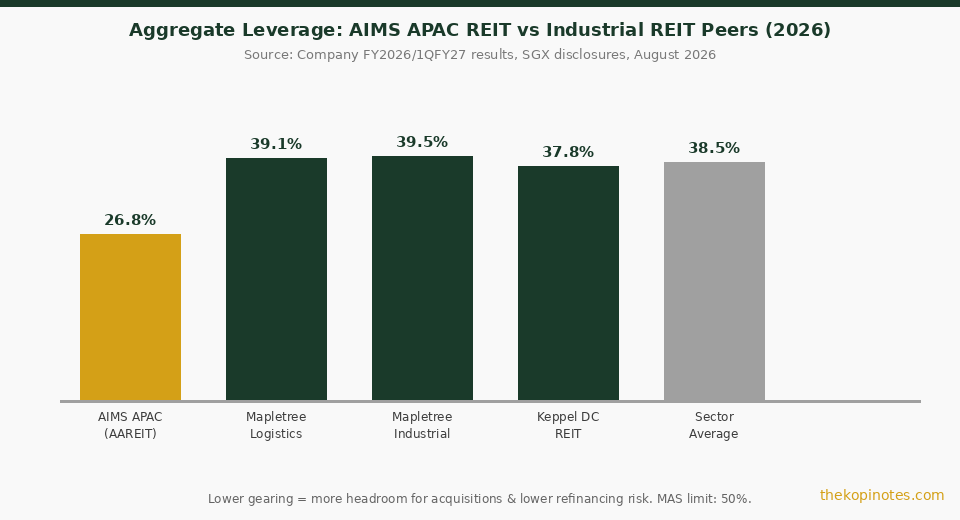
The headline number is 26.8%. That’s AAREIT’s aggregate leverage — the proportion of its assets funded by debt. To put that in context:
- MAS regulatory limit: 50%
- S-REIT sector average: approximately 38–40%
- AAREIT: 26.8% — roughly 23 percentage points below the MAS ceiling
How did gearing get this low? In 4Q FY2026, AAREIT issued S$250 million in perpetual securities (in two tranches: S$150M at 4.10% in January 2026 and S$100M at 4.25% in March 2026). Perpetual securities are classified as equity under accounting standards — they count toward the denominator, not the numerator, in the gearing ratio. The proceeds were used to repay existing borrowings, reducing both reported leverage and refinancing risk in one move.
The practical implication for you as an investor: ultra-low gearing gives AAREIT firepower. If management identifies attractive acquisition targets — particularly in the industrial or logistics space — they can fund deals with fresh debt without breaching 40% gearing. Peers sitting at 39% have far less room to manoeuvre.
Low gearing also means AAREIT is less exposed to rising interest costs if rates surprise to the upside. With the Sep 17 FOMC decision approaching, that’s a meaningful buffer. Use the Singapore retirement calculator to model how S-REIT income fits your long-term portfolio.
Rate Cut Cycle: How Much More DPU Can You Expect?
As of August 2026, market consensus puts the US Federal Reserve on track for further rate cuts through 2H2026. Singapore’s SORA (Singapore Overnight Rate Average) follows US rates with a lag. This matters for AAREIT because lower interest rates reduce the cost of refinancing debt — which flows directly to higher distributable income.
Here’s the math AAREIT management disclosed:
- 80% of borrowings are on fixed rates as at March 2026
- Every 25 basis points (0.25%) increase in interest rates reduces annual DPU by ~0.03 Singapore cents
- The inverse applies for cuts: a 25bps cut adds ~0.03 cents per year
- A 100bps rate cut cycle would add approximately 0.12 cents annually — roughly 1.2% of FY2026 DPU
The 80% fixed-rate hedge means most of AAREIT’s debt won’t benefit immediately from rate cuts. The benefit accrues gradually as fixed-rate loans mature and are refinanced at lower rates. The weighted average debt maturity is 3.8 years as at June 2026 — so you’ll see the full impact unfold over the next few years, not overnight.
That said, the blended cost of debt is already falling: 4.1% in FY2026, down from 4.3% in FY2025. If rates fall another 100bps, and AAREIT refinances at progressively lower rates, the tailwind could push cost of debt toward 3.5–3.8% by FY2028 — adding meaningful basis points to yield.
If you’re building a best S-REITs in Singapore 2026 watchlist, AAREIT’s combination of low gearing and falling cost of debt makes it a compelling income compounder in a rate-cut environment.
Australia Exposure and the Data-Centre Optionality Play
AAREIT’s three Australian assets in New South Wales represent 34% of portfolio AUM — a significant slice. All three are 100% occupied. That alone makes Australia a reliable income anchor.
But there’s a longer-term story developing. AAREIT management has flagged that two of the NSW assets sit on sites with potential for data-centre conversion or development. This is significant in the context of Australia’s booming hyperscaler demand — Amazon Web Services, Microsoft Azure, and Google have all committed to major infrastructure investment in Australia through 2026 and beyond.
Data-centre rents command a substantial premium over standard warehouse rents. If AAREIT successfully converts or partially repositions these NSW assets, the NPI uplift could be substantial. This is speculative — not promised — but it represents optionality not priced into the current yield.
AAREIT also successfully divested a non-core asset at a 32.5% premium to book value in FY2026. This demonstrates management’s willingness to recycle capital — selling non-core assets at strong premiums and redeploying into higher-quality properties. It’s exactly the kind of active asset management that builds NAV over time rather than just holding static assets.
The Singapore REIT ETF guide at Singapore REIT ETF guide can help you understand how AAREIT fits within a diversified S-REIT fund context versus individual REIT picking.
How Does AAREIT Compare to Peer Industrial REITs?
No single metric tells the full story, but looking at AAREIT alongside its industrial and diversified peers reveals where it stands out — and where investors need to manage expectations.
| REIT | Yield (approx.) | Gearing | WALE (yrs) | Market Cap |
|---|---|---|---|---|
| AIMS APAC REIT | ~6.2% | 26.8% | 4.0 | ~S$1.3B |
| Mapletree Logistics Trust | ~6.8% | ~39.1% | ~3.4 | ~S$9.5B |
| Mapletree Industrial Trust | ~5.5% | ~39.5% | ~3.8 | ~S$6.2B |
| Keppel DC REIT | ~3.8% | ~37.8% | ~7.4 | ~S$3.9B |
| SABANA Industrial REIT | ~6.5% | ~33% | ~2.1 | ~S$0.5B |
Source: Company results, SGX, analyst estimates, August 2026. Figures are approximate and for comparison purposes only.
The comparison shows AAREIT’s sweet spot: higher yield than MIT and Keppel DC, substantially lower gearing than all industrial peers, and a mid-market size that’s large enough to be liquid but small enough to grow.
The tradeoff: smaller market cap means less analyst coverage and lower index weighting. AAREIT won’t automatically benefit from passive fund inflows the way Mapletree entities do. You’re buying it for the fundamentals, not the indexing effect.
If you’re comparing investment platforms, the Syfe referral code and sign-up bonus gives you access to Syfe’s REIT+ portfolio (which holds a basket of S-REITs) or you can buy AAREIT directly through a brokerage.
Who Should Consider AIMS APAC REIT?
AAREIT suits investors who prioritise balance sheet resilience and consistent income over hypergrowth. Specifically, you might want to consider it if:
- You want a defensive industrial REIT — 26.8% gearing means management has headroom to manage through a downturn without emergency equity raising
- You’re building passive income for retirement — the quarterly distribution (approximately 2.3–2.6 cents per quarter) is predictable and growing
- You want rate-cut tailwinds — fixed-rate refinancing over 3.8-year debt maturity means DPU should grow as rates fall
- You like the data-centre optionality story — the NSW assets could be worth substantially more than current valuations if repositioned for hyperscaler demand
AAREIT is not right for you if you need a high headline yield above 8%, want exposure to premium retail or hospitality REITs, or need the liquidity of a large-cap blue-chip. Its S$1.3 billion market cap is tradeable but narrower than the Mapletrees of the world.
For those using robo-advisors as a starting point, compare the Endowus referral code offerings, which include access to institutional-grade REIT fund portfolios alongside individual stock picking.
If you’re thinking about how REIT income fits into your retirement plan, check the Singapore REIT ETF guide to understand the trade-off between holding individual REITs versus a REIT ETF.
Frequently Asked Questions About AIMS APAC REIT
What is the current DPU and yield for AIMS APAC REIT?
Why is AIMS APAC REIT's gearing so low at 26.8%?
How does a Fed rate cut affect AIMS APAC REIT's DPU?
What is the rental reversion outlook for AAREIT?
What is AAREIT's Australia exposure and what is the data-centre play?
How do I buy AIMS APAC REIT (O5RU) in Singapore?
Is AIMS APAC REIT a good long-term investment?
This article was researched with the help of AI. While we strive to keep all information accurate and up to date, there may be errors. If you notice any discrepancies, please contact us.