ISP Rider Changes 2026: Keep Your Old Rider or Switch? A Complete Guide
Your plain-English guide to the April 2026 MOH rules — what changed, who’s affected, and what to do next.
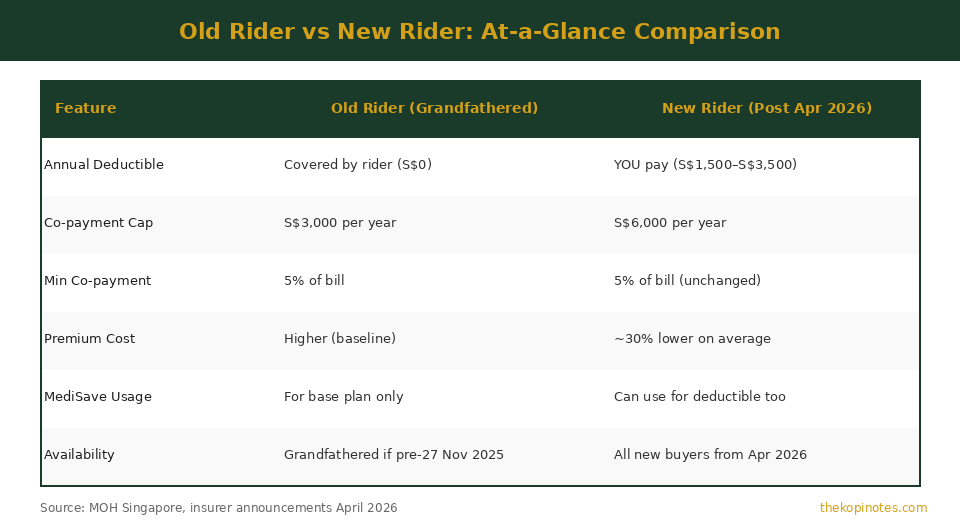
From 1 April 2026, MOH’s new Integrated Shield Plan (ISP) rider rules changed the game for health insurance in Singapore. New riders can no longer cover your deductible, and the annual co-payment cap has doubled from S$3,000 to S$6,000. In return, new rider premiums are about 30% cheaper. If you bought your rider before 27 November 2025, you’re grandfathered — but you need to know what that means for your wallet.
Not financial advice. All figures are for educational reference only. Data verified as at August 2026.
- Old rider (bought before 27 Nov 2025): keep it. You’re fully grandfathered and switching costs you coverage you already paid for.
- New buyer or switching after Apr 2026: your rider won’t cover the deductible (S$1,500–S$3,500), and your co-pay cap is S$6,000 — but you’ll pay ~30% less in premiums.
- You can use MediSave to pay your new deductible and co-payments, up to prevailing withdrawal limits.
What Changed in April 2026?
Singapore’s Ministry of Health (MOH) announced on 26 November 2025 that new design requirements for ISP riders would kick in from 1 April 2026. The goal: slow down rising healthcare costs that had been pushing up premiums for years.
Here’s what changed — in plain English:
1. Riders can no longer cover your deductible
Before April 2026, if you had a top-tier rider, you could walk out of a private hospital without paying a cent. Your rider absorbed everything — including the annual deductible.
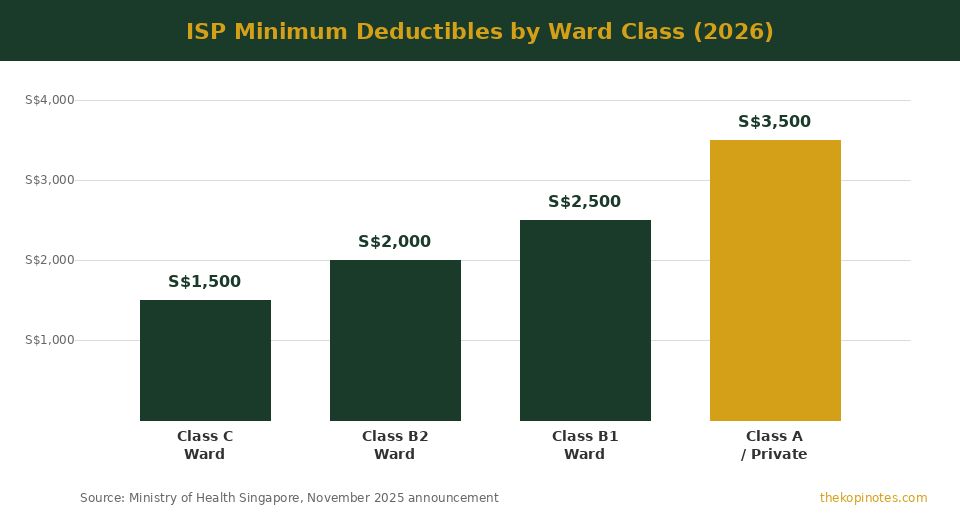
That’s gone for new riders. From 1 April 2026, every new rider must leave you responsible for your minimum IP deductible. That’s the first chunk of your hospital bill before insurance kicks in. The deductible ranges from S$1,500 to S$3,500 depending on your ward class.
2. The co-payment cap doubled
After you’ve paid your deductible, your insurer covers most of the remaining bill — except for a co-insurance portion (minimum 5% of the bill). Under old riders, once your co-payments hit S$3,000 in a year, your rider covered the rest. That cap has now doubled to S$6,000 for new riders.
In practice: if you have a long hospitalisation with a big bill, you could pay up to S$6,000 in co-payments — plus your deductible on top.
3. Premiums dropped significantly
Here’s the upside. Because new riders cover less, they cost less. MOH projected new private hospital rider premiums would be about 30% cheaper on average compared to the old maximum-coverage riders. Some insurers went further — Prudential’s new PRUExtra Preferred Care rider was up to 55% cheaper for certain age groups.
Who Is Affected — and Who Is Grandfathered?
Whether these changes apply to you depends entirely on when you bought your rider.
| When You Bought Your Rider | What Happens to You |
|---|---|
| Before 27 November 2025 | Fully grandfathered. Your old rider terms — deductible coverage + S$3,000 cap — stay intact indefinitely, as long as you don’t voluntarily switch riders. |
| 27 Nov 2025 – 31 Mar 2026 | Your insurer must inform you that your rider will be transitioned to a compliant version no later than your first policy renewal after 1 April 2028. |
| 1 April 2026 onwards (new buyer) | You can only buy the new compliant rider. No deductible coverage; S$6,000 co-pay cap; lower premiums. |
Source: Ministry of Health Singapore, November 2025 announcement
The key insight: if you’re grandfathered, do not switch your rider unless you’ve carefully done the maths. Switching means giving up the deductible coverage and the lower S$3,000 cap — permanently.
Deductible Amounts by Ward Class (2026)
Under the new rules, you must pay the deductible yourself. Here’s exactly how much that is, broken down by the ward class you use:
| Ward Class Used | Minimum Annual Deductible |
|---|---|
| Class C Ward | S$1,500 |
| Class B2 Ward | S$2,000 |
| Class B1 Ward | S$2,500 |
| Class A / Private Hospital | S$3,500 |
Source: Ministry of Health Singapore, November 2025
So if you’re planning to use a private hospital and you have a new rider, the first S$3,500 of your bill comes out of your own pocket before insurance activates.
The good news: you can pay this deductible using your MediSave account, subject to prevailing withdrawal limits. You don’t have to dip into cash savings.
Should You Keep Your Old Rider or Switch?
This is the question most Singaporeans with grandfathered riders are asking. Here’s a simple framework.
Keep your old rider if:
- You have existing health conditions. Higher hospitalisation risk means the deductible coverage is genuinely valuable. One surgery could easily cost you S$3,500+ in deductible alone under a new rider.
- You use private hospitals regularly. The S$3,500 deductible per year adds up fast if you’re hospitalised more than once. Your old rider absorbs this at no extra cost.
- The premium savings don’t justify the risk. If switching saves you S$400 a year in premiums but exposes you to up to S$9,500 more in out-of-pocket costs (S$3,500 deductible + S$6,000 co-pay cap vs S$0 + S$3,000), the maths often doesn’t work in favour of switching.
- You’re older or in higher age bands. Premium savings may be proportionally smaller while hospitalisation risk is higher.
Consider switching if:
- You’re young and healthy. Lower hospitalisation risk means you’re unlikely to hit the deductible every year. The 30%+ premium savings could outweigh the occasional deductible payment.
- You can self-fund the deductible from MediSave. If you have a healthy MediSave balance, the deductible is less painful — it’s not coming from your cash.
- Premium savings are significant. For some younger age bands, switching could save S$600–S$1,200 per year. Over 10 years, that’s meaningful.
The Out-of-Pocket Cost Maths
Let’s make this concrete with a worked example.
Scenario: You’re hospitalised in a private hospital for a procedure. Total bill: S$30,000.
| Cost Component | Old Rider (Grandfathered) | New Rider (Post Apr 2026) |
|---|---|---|
| Deductible paid by you | S$0 (rider covers it) | S$3,500 |
| 5% co-insurance on S$26,500 balance | S$1,325 | S$1,325 |
| Co-pay covered by rider (cap applies) | S$1,325 covered, cap: S$3,000 | S$1,325 covered, cap: S$6,000 |
| Total out-of-pocket (this hospitalisation) | ~S$0–S$1,325 | ~S$3,500–S$4,825 |
Illustrative example only. Actual costs vary by insurer, plan type, and ward class. Source: TKN calculation based on MOH April 2026 framework.
For a single hospitalisation at a private hospital, the old rider leaves you paying almost nothing. The new rider could leave you S$3,500–S$4,825 out of pocket for the same event.
However, if you’re young and pay S$800/year less in premiums, it takes about 4–5 hospitalisation-free years to break even. That’s the trade-off.
How MediSave Fits Into All of This
Here’s some relief: under the new rules, you can use your MediSave to pay your deductible and co-payments, subject to prevailing MediSave withdrawal limits.
This matters because MediSave is earmarked for healthcare. You’re not dipping into your emergency cash fund. If you have a healthy MediSave balance — which most working Singaporeans do — the deductible feels less painful in practice.
The 5% minimum co-payment cannot be paid via MediSave, but the deductible itself can. Check the CPF Board’s prevailing annual withdrawal limits for your plan type.
Overview of New Compliant Riders in 2026
All seven ISP insurers in Singapore have launched compliant riders since April 2026. Here’s a quick overview of the landscape:
The seven insurers offering ISPs in Singapore are: NTUC Income, AIA, Great Eastern, Prudential, Singlife, HSBC Life, and Raffles Health Insurance.
| Insurer | Base Plan | New Compliant Rider | Est. Premium Saving |
|---|---|---|---|
| Prudential | PRUShield | PRUExtra Preferred Care | 45–55% cheaper |
| AIA | HealthShield Gold Max | New compliant rider (2026) | ~30% cheaper |
| Singlife | Shield Plan 1 / Plan 2 | Health Plus (new terms) | 30–84% cheaper |
| Great Eastern | SupremeHealth | GREAT TotalCare (new terms) | ~30% cheaper |
| NTUC Income | Enhanced IncomeShield | Assurance Extra Care (new) | ~30% cheaper |
Source: Insurer announcements, April 2026. Savings are approximate and vary by age band. Consult individual insurer for exact premiums.
For a detailed look at specific plans, read our guides on the Singlife Shield Plan 2026 rider changes and the Great Eastern SupremeHealth P Plus premium table.
For a comprehensive comparison across all plans, see our complete Singapore shield plan guide and our picks for the best Class A ward integrated shield plan.
You can also check out the Prudential ISP guide for a deep dive into PRUShield and its new riders.
Frequently Asked Questions
What exactly changed for ISP riders from April 2026?
If I bought my rider before 27 November 2025, do I need to do anything?
How much is the deductible under the new ISP rider rules?
Can I use MediSave to pay the deductible under the new rules?
Should I switch from my old grandfathered rider to a new cheaper one?
Which insurers offer compliant ISP riders in 2026?
What is the 5% co-payment and has it changed?
This article is for general information only and does not constitute financial, medical, or insurance advice. Premiums and policy terms vary by insurer and individual health profile. Please consult a licensed financial adviser before making any insurance decisions. Data verified as at August 2026.
Get Free Insurance Advice
Speak with a licensed insurance advisor. No obligation, no cost.
By submitting this form, you agree to our Privacy Policy.
This article was researched with the help of AI. While we strive to keep all information accurate and up to date, there may be errors. If you notice any discrepancies, please contact us.