How to Invest in Singapore: Tax on Dividends, ETFs & Capital Gains (2026 Guide)
A plain-English tax guide for everyday Singapore investors — what’s taxable, what isn’t, and how to invest smarter in 2026.
Singapore investors have one of the world’s most tax-friendly environments. There is no capital gains tax, no tax on dividends from Singapore companies, and foreign dividends received directly by individuals are also not taxable. However, the ETFs you choose still matter — US-domiciled ETFs face a 30% withholding tax on dividends, while Irish-domiciled UCITS ETFs pay only 15%. The SRS scheme lets you invest and cut your tax bill at the same time.
Not financial advice. All figures are for educational reference only. Data verified as at 26 August 2026 against official IRAS, CPF Board, and MAS sources unless otherwise noted.
- Singapore has no capital gains tax and dividends from Singapore companies are tax-free in your hands.
- If you own ETFs, choosing Irish-domiciled UCITS ETFs (like CSPX or VWRA on the LSE) cuts withholding tax from 30% to 15% vs US-listed equivalents.
- The SRS account lets citizens and PRs contribute up to $15,300 per year — reducing your taxable income dollar-for-dollar and saving up to $3,366 in taxes annually.
Table of Contents
Contents — Click to expand
- No Capital Gains Tax in Singapore
- Dividend Tax on Singapore Stocks
- Foreign Dividends — What ETF Investors Need to Know
- ETF Withholding Tax: Irish vs US-Domiciled ETFs
- US Estate Tax — The Hidden Risk
- SRS: Invest and Cut Your Tax Bill
- Worked Example: SGD 100,000 Portfolio
- How to Get Started
- Frequently Asked Questions
No Capital Gains Tax in Singapore
If you sell your stocks or ETFs at a profit, Singapore does not tax that gain. This applies whether you’re selling Singapore stocks, global ETFs listed on the London Stock Exchange, or REITs bought on SGX.
According to IRAS, profits or losses from buying and selling shares or financial instruments are generally viewed as capital gains from personal investments — not taxable income. You don’t need to declare them on your tax return.
There is one important exception: if IRAS determines you are trading rather than investing — for example, you buy and sell dozens of stocks weekly as your main livelihood — your gains could be treated as trading income and taxed accordingly. But for the vast majority of Singapore retail investors making occasional buy-and-hold decisions, your capital gains are tax-free.
This makes Singapore an incredibly attractive base for long-term investors. A buy-and-hold strategy into a global index ETF like VWRA or CSPX benefits from decades of tax-free compounding on any price appreciation.
Dividend Tax on Singapore Stocks
Singapore operates a one-tier corporate tax system. What this means for you: when a Singapore-listed company like DBS, CapitaLand, or an S-REIT pays you a dividend, that dividend has already been taxed at the corporate level. You don’t pay any further income tax on it as a shareholder.
So if you earn $5,000 in dividends from Singapore stocks or S-REITs this year, you don’t need to declare it as income. It’s entirely tax-free in your hands.
| Dividend Source | Taxable in Your Hands? | Notes |
|---|---|---|
| Singapore company (one-tier) | No | Already taxed at corporate level |
| Singapore S-REIT | No | Tax-exempt distributions for individuals |
| Foreign company (received directly) | No | Overseas income for individuals generally not taxable |
| Foreign dividends via partnership | Possibly yes | Special rules apply — check with IRAS |
Source: IRAS — What Is Taxable, What Is Not; Dividends page (verified Aug 2026)
Foreign Dividends — What ETF Investors Need to Know
Here’s the good news for ETF investors: if you hold a global ETF and it distributes dividends to you, that income is generally not taxable in Singapore — even if the ETF holds US, European, or Asian stocks that themselves pay dividends.
IRAS guidance is clear: overseas income received in Singapore by individuals is generally not taxable. The key exception is income received through a Singapore partnership. For most retail investors holding ETFs directly through a brokerage account, you’re in the clear.
However, the foreign stock or ETF may withhold tax before it even reaches you. This is where the ETF’s domicile matters enormously.
ETF Withholding Tax: Irish vs US-Domiciled ETFs
This is the most important tax decision for Singapore ETF investors. The difference between a US-domiciled ETF and an Irish-domiciled one can cost — or save — thousands of dollars over your investing lifetime.
How Withholding Tax Works
When an ETF holds US stocks, those stocks pay dividends. Before those dividends reach the ETF (and then you), the US government withholds a percentage as tax. The rate depends on where the ETF is domiciled.
US-domiciled ETF (e.g. VOO, VT, SPY): Since Singapore has no tax treaty with the US, Singapore investors face the full 30% US withholding tax on dividends. So if VOO earns $100 in dividends, you effectively receive only $70.
Irish-domiciled UCITS ETF (e.g. CSPX, VWRA, SPYL on the LSE): Ireland has a tax treaty with the US that reduces the withholding rate to 15%. Ireland then passes these dividends onward to non-Irish investors with 0% additional withholding. So if CSPX earns $100 in dividends, you receive $85 — half the tax drag of VOO.
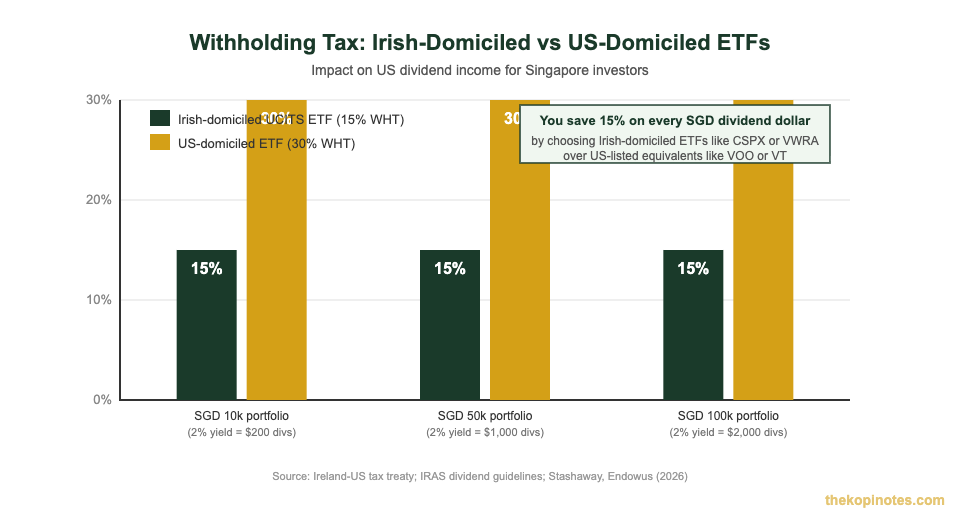
Source: Ireland-US tax treaty; IRAS dividend guidelines; Stashaway, Endowus analysis (verified Aug 2026)
| ETF Type | Example | Domicile | US Dividend WHT | WHT Saved vs US ETF |
|---|---|---|---|---|
| Irish UCITS (LSE) | CSPX, VWRA, SPYL | Ireland | 15% | Save 15% on US divs |
| US-listed ETF | VOO, VT, SPY | USA | 30% | Baseline |
| Singapore ETF (SGX) | ES3, CLR | Singapore | 0% (SG stocks) | N/A (SG index) |
Source: Endowus Insights, Stashaway Research, IRAS guidelines (Aug 2026)
Real Dollar Impact: SGD 100,000 Portfolio
Let’s make this concrete. Suppose you have SGD 100,000 invested in a US equity ETF with a 1.8% dividend yield (roughly what the S&P 500 yields today).
Annual dividends: SGD 1,800
With a US-domiciled ETF (30% WHT): you lose $540 in withholding tax annually.
With an Irish-domiciled ETF (15% WHT): you lose $270 in withholding tax annually.
You save $270 per year simply by choosing CSPX over VOO. Over 20 years at 7% annual returns, that $270/year saving compounds to roughly $14,000 in extra wealth. That’s why the ETF’s domicile matters so much.
Want to learn more about buying Irish-domiciled ETFs in Singapore? See our guide on London Stock Exchange ETFs for Singapore investors.
US Estate Tax — The Hidden Risk
Many Singapore investors don’t know about this one. The US imposes an estate tax on US-situs assets held by non-US persons at death. For Singapore residents, the exemption threshold is only USD 60,000 (about SGD 78,000 at current exchange rates).
That means if you die holding more than USD 60,000 in US-domiciled assets — including US-listed ETFs like VOO, VT, or individual US stocks — your estate could owe US estate tax of up to 40% on the amount above the threshold. This is a legal obligation, not a loophole or technicality.
Irish-domiciled ETFs completely avoid this risk. CSPX, VWRA, and other UCITS ETFs are Irish securities. They are not US-situs assets. No US estate tax applies, regardless of how large your portfolio grows.
For a Singapore investor with a $300,000 portfolio in US stocks, the potential US estate tax liability could be significant — well over $50,000 at the 26–40% marginal rates that apply above the $60k threshold. Switching to Irish-domiciled ETFs eliminates this entirely.
SRS: Invest and Cut Your Tax Bill
The Supplementary Retirement Scheme (SRS) is Singapore’s government-backed tax incentive for retirement savings. It’s one of the most effective legal tools you have to reduce your income tax.
Here’s how it works: you contribute money to an SRS account, and that amount is deducted from your taxable income for that year. You invest the money inside the SRS account, and it grows tax-free. You only pay tax on 50% of withdrawals at retirement age — and only at the prevailing rates then.
SRS Contribution Limits (2026)
| Residency Status | Annual SRS Cap | As % of Income |
|---|---|---|
| Singapore Citizen / PR | $15,300 | 15% of income |
| Foreigner (EP/PEP holder) | $35,700 | 35% of income |
Source: IRAS SRS contributions page (verified Aug 2026). Overall relief cap: $80,000 across all personal reliefs combined.
How Much Tax Do You Save?
The exact saving depends on your marginal tax rate. If you contribute $15,300 to SRS, you reduce your taxable income by $15,300. The tax you save equals $15,300 × your marginal rate.
For someone earning $100,000 per year (marginal rate 11.5%): contributing $15,300 saves about $1,760 in income tax.
For someone earning $160,000 per year (marginal rate 15%): the saving is about $2,295.
For someone earning $200,000 per year (marginal rate 18%): you’d save about $2,754.
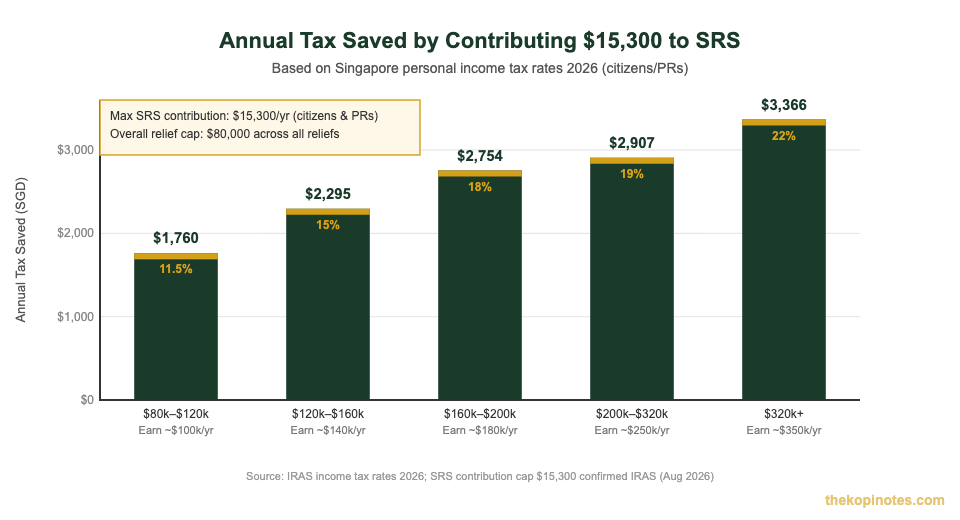
Source: IRAS income tax rates and SRS guidelines (verified Aug 2026)
What Can You Invest in With SRS?
Your SRS funds can be invested in a wide range of instruments: Singapore stocks, unit trusts, ETFs listed on SGX, fixed deposits, Singapore Savings Bonds, and endowment policies. Robo-advisors like Endowus and Syfe also accept SRS funds directly, making it easy to invest in globally diversified portfolios without having to pick individual stocks. You can also explore our CPF investment strategy guide for related tax-efficient investing ideas using your CPF OA alongside SRS.
Worked Example: SGD 100,000 Portfolio
Let’s put all this together with a realistic scenario. Imagine you’re a Singaporean earning $130,000 per year, with $100,000 invested for retirement.
Your portfolio: $100,000 in CSPX (Irish-domiciled ETF tracking the S&P 500, listed on the London Stock Exchange). You buy through moomoo Singapore or Interactive Brokers (IBKR referral code: jianxiong368).
| Tax Item | Amount | Outcome |
|---|---|---|
| Capital gains (if CSPX rises 8%) | $8,000 gain | $0 tax — capital gains exempt |
| Dividends from CSPX (1.8% yield) | $1,800 gross | $270 withheld by US (15%), $1,530 to you. Not taxed again in SG. |
| Same portfolio in VOO (US ETF) | $1,800 gross | $540 withheld (30%) — you lose $270 extra per year vs CSPX |
| SRS contribution (max for citizens/PRs) | $15,300 | Saves ~$2,295 in income tax (15% marginal rate at $130k salary) |
| US estate tax risk | $100k portfolio | $0 with CSPX (Irish) — full liability with VOO (US-domiciled) |
Illustrative example. IRAS, IBKR, iShares data (Aug 2026). Not financial advice.
By choosing an Irish-domiciled ETF and using SRS, this investor saves over $2,500 per year in taxes compared to someone investing in a US-domiciled ETF without SRS. Over 20 years at 7% returns, that compounding difference is significant.
How to Get Started
The tax advantages are built into the system — you just need to choose the right products and accounts. Here’s a simple action plan.
Step 1: Choose Irish-domiciled ETFs. Look for UCITS ETFs on the London Stock Exchange — CSPX (S&P 500), VWRA (global all-world), SPYL (S&P 500, lower cost). Avoid buying the US-listed equivalents VOO, VT, or SPY if you want the withholding tax advantage.
Step 2: Open an SRS account. Any of the three major Singapore banks (DBS, OCBC, UOB) can open an SRS account for you. Then invest your SRS funds through a robo-advisor or brokerage that accepts SRS. Use the Singapore retirement calculator to see how much SRS can boost your retirement nest egg.
Step 3: Choose the right brokerage. For Irish-domiciled ETFs on the LSE, Interactive Brokers (IBKR) is the most cost-effective option for larger portfolios, charging USD 1.70–3 per LSE trade with tight FX spreads. For beginners who want simplicity, Syfe Trade (referral: SRPRFFFCD) and FSMOne (referral: P0544985) are solid options. You can also invest your SRS through Endowus (referral: 2V343) in globally diversified funds.
Step 4: Hold for the long term. Singapore’s capital gains exemption is your reward for patience. Every year you stay invested and don’t sell is another year of tax-free compounding on your price appreciation.
Frequently Asked Questions
Do I need to pay capital gains tax when I sell ETFs in Singapore?
Are dividends from Singapore stocks taxable?
What is withholding tax on ETFs and how does it affect me?
How much can I contribute to SRS in 2026?
What is US estate tax and does it apply to Singapore investors?
Can I invest SRS funds in ETFs?
Do I pay tax on foreign dividends deposited into my Singapore bank account?
This article is for general educational purposes only and does not constitute financial, tax, or investment advice. Tax laws and policies may change. Always verify current rules with IRAS or a qualified tax professional before making investment decisions. The Kopi Notes may receive referral fees from partner services mentioned. Data verified as at 26 August 2026.
This article was researched with the help of AI. While we strive to keep all information accurate and up to date, there may be errors. If you notice any discrepancies, please contact us.