What Is Dollar Cost Averaging? Singapore Investor’s Guide (2026)
Updated October 2026 · 8 min read
Dollar cost averaging (DCA) is an investing strategy where you invest a fixed sum at regular intervals — say, SGD 500 every month — regardless of whether markets are up or down. By spreading purchases over time, you automatically buy more units when prices are low and fewer when prices are high, smoothing your average cost across market cycles. For Singapore investors with a regular monthly income, DCA is one of the most practical and psychologically sustainable ways to build long-term wealth.
Not financial advice. All figures are for educational reference only. Data as at October 2026 unless noted.
What Is Dollar Cost Averaging?
Dollar cost averaging (DCA) is a disciplined investing technique where you commit to investing a fixed dollar amount at regular intervals — weekly, monthly, or quarterly — over a long period, regardless of what the market is doing.
The name comes from the mathematical outcome: because you invest a fixed dollar amount rather than a fixed number of units or shares, you naturally purchase more units when prices fall and fewer when prices rise. Over time, this brings your average cost per unit down compared to the average price during the same period — a concept called the averaging effect.
Here is a concrete six-month example. Say you invest SGD 500 every month into CSPX (the iShares Core S&P 500 UCITS ETF), which trades on the London Stock Exchange:
| Month | CSPX Price (USD) | Units Bought | Cumulative Units | Total Invested |
|---|---|---|---|---|
| January | $90.00 | 5.56 | 5.56 | SGD 500 |
| February | $85.00 | 5.88 | 11.44 | SGD 1,000 |
| March | $95.00 | 5.26 | 16.70 | SGD 1,500 |
| April | $80.00 | 6.25 | 22.95 | SGD 2,000 |
| May | $92.00 | 5.43 | 28.38 | SGD 2,500 |
| June | $98.00 | 5.10 | 33.48 | SGD 3,000 |
Illustrative example. CSPX prices in USD; SGD investment amounts shown. Actual results will vary with exchange rates and real market prices.
After six months, the investor holds 33.48 units at an average cost of approximately USD 89.60 per unit (SGD 3,000 total invested ÷ 33.48 units). With CSPX trading at USD 98 by month six, the position is already showing a paper gain — achieved without trying to pick a single entry point.
The average cost of USD 89.60 is meaningfully lower than the simple arithmetic average of the six monthly prices (USD 90.00). This is the averaging effect at work: the investor bought more units at lower prices (April at $80 yielded 6.25 units — the most of any month), reducing the overall cost basis.
How DCA Works in Practice
The core mechanism behind DCA is simple: you remove the need to make timing decisions. Instead of asking “is now a good time to invest?”, you ask only “have I set aside this month’s investment?”. This shift in mindset is surprisingly powerful.
When markets fall — which they inevitably do, sometimes sharply — most investors feel fearful and hold back. The DCA investor sees the same downturn differently: a lower price means their fixed monthly contribution now buys more units. The market dip becomes an automatic buying opportunity, without requiring any special courage or contrarian conviction on the investor’s part.
When markets rise, the DCA investor also benefits — but they buy fewer units per dollar. This is the trade-off. If markets go up every single month in a straight line, a lump sum investor who invested everything on day one would outperform. But markets do not move in straight lines, and the emotional difficulty of committing a large lump sum at a market peak is something most investors experience as a real and significant barrier.
DCA vs Lump Sum — when does each win?
- DCA wins in volatile, flat, or falling markets — and when the investor lacks a large lump sum to deploy upfront.
- Lump sum wins in consistently rising bull markets — because time in the market beats timing the market on average, and all capital is invested from day one.
- In practice: most Singapore salaried employees naturally DCA because they receive a monthly salary and invest a portion of it each month. If you earn a salary, you are already a DCA investor — the question is which assets to direct those monthly contributions toward.
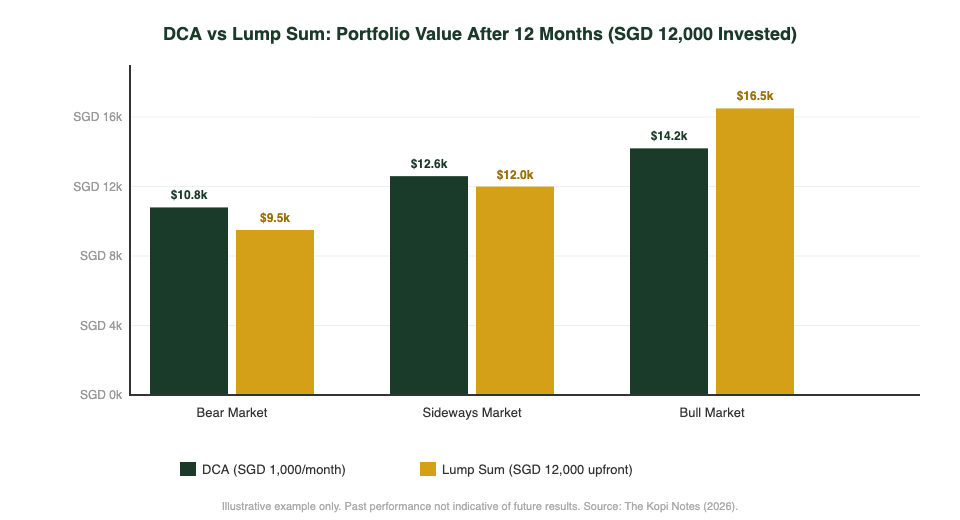
Illustrative scenario comparison. Bear market assumes prices fell 20% then recovered partially; bull market assumes steady 25% rise; sideways assumes high volatility around flat trend. Source: The Kopi Notes (2026).
DCA in the Singapore Context
Dollar cost averaging fits Singapore’s financial ecosystem particularly well, for three reasons.
1. The monthly salary structure. Most Singapore employees receive their salary monthly. By setting up a standing instruction to transfer a fixed amount to your brokerage or robo-advisor on payday, you automatically DCA. Many Singapore investors aim to invest 10–20% of their take-home pay each month, directing it into diversified ETFs like CSPX (S&P 500) or VWRA (global equities).
2. Supplementary Retirement Scheme (SRS). SRS contributions are an excellent DCA vehicle. You can contribute up to SGD 15,300 per year (for Singapore citizens and PRs), which works out to approximately SGD 1,275 per month. Each contribution earns you a dollar-for-dollar income tax deduction, potentially saving up to SGD 3,366 in income tax for top-tier earners. Robo-advisors like Endowus and Syfe allow you to invest your SRS funds into global ETF portfolios, making it straightforward to DCA within the SRS wrapper. You can explore Endowus referral code to get started with cashback on your first investment.
3. CPF Ordinary Account (OA). Your CPF OA earns a guaranteed 2.5% per annum. While the CPF investment strategy debate is complex, many investors choose to invest their CPF OA funds (above the first SGD 20,000) into low-cost ETFs or funds via the CPFIS scheme, effectively applying DCA logic to their CPF as well.
Which Platform for DCA in Singapore?
Choosing the right platform affects your total annual cost more than most investors realise. Here is a comparison of the major options for DCA in Singapore as at October 2026:
| Platform | Best For | Min. DCA Amount | Fee Structure | CPF/SRS? |
|---|---|---|---|---|
| IBKR | Active DIY investors buying LSE ETFs | No minimum | USD 1.70/trade for LSE ETFs; no custody fee | No (cash only) |
| moomoo | App-based traders; new investors | SGD 1 | SGD 0 custody; low trade commissions | No (cash only) |
| FSMOne RSP | Passive fund investors | SGD 50/month | 0.08% per RSP instalment (min SGD 1) | No (cash only) |
| Endowus | CPF/SRS/cash fund investing | SGD 1,000 (initial) | 0.25% access fee p.a. + fund TER (~0.05–0.20%) | Yes (CPF & SRS) |
| Syfe | Hands-off portfolio investors | SGD 1 | 0.35% p.a. (below SGD 100k) + fund TER | SRS only |
Source: The Kopi Notes research, October 2026. Fee structures subject to change. Check platform websites for latest rates. See FSMOne referral code and Syfe referral code and sign-up bonus for promotions.
DCA vs Lump Sum Investing: Which Wins?
This is one of the most debated questions in personal finance. The honest answer: lump sum investing outperforms DCA about two-thirds of the time when looking at historical equity market returns, because markets have historically trended upward over time. Money invested earlier has more time to compound.
However, this analysis misses several important dimensions:
Most people do not have a lump sum. The average Singapore working adult does not have SGD 100,000 sitting in cash waiting to be deployed. They have a monthly salary, monthly expenses, and a portion left over to invest. DCA is not a concession — for most people, it is the only practical option.
Behavioral risk is real. Investing a large lump sum and then watching the portfolio drop 30% in the first six months is psychologically devastating, even if the rational response is to hold. Many investors panic-sell at the bottom, turning a temporary paper loss into a permanent real one. DCA reduces this risk by smoothing the entry price and building the habit of investing regardless of market conditions.
Sequence of returns matters near retirement. For investors approaching retirement age, deploying a lump sum near a market peak could be catastrophic. DCA provides meaningful protection against this — use our Singapore retirement calculator to model how different investment rates affect your retirement outcome.
The practical verdict for Singapore investors:
- If you receive a windfall (inheritance, bonus, property sale proceeds) and intend to invest it all in equities: consider deploying it in 3–6 equal tranches over 3–6 months as a compromise between lump sum and DCA.
- If you are investing from regular income: DCA is the natural and superior approach for your situation.
- In both cases, consistency matters more than timing.
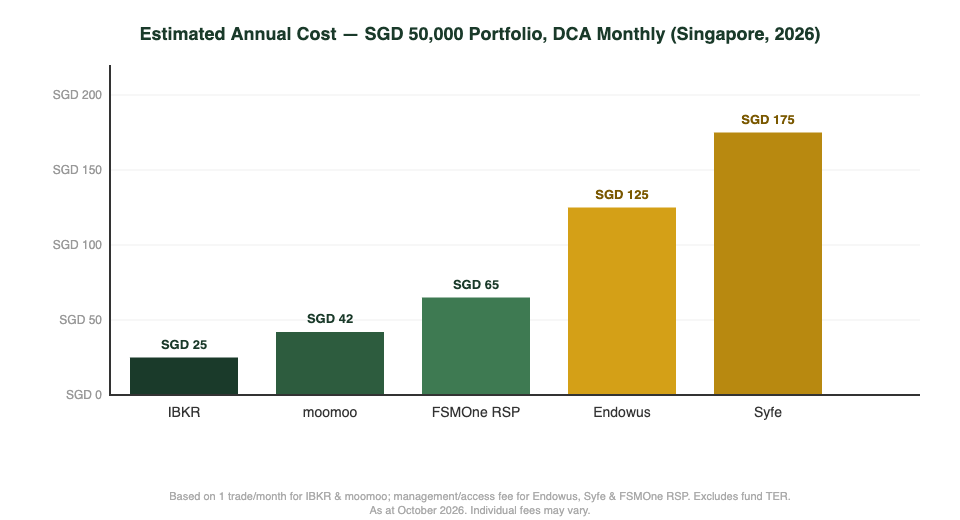
Estimated annual platform costs for a SGD 50,000 portfolio with monthly DCA. IBKR and moomoo costs based on 1 trade/month. Management/access fees only for Endowus, Syfe and FSMOne RSP — excludes underlying fund TER. As at October 2026.
How to Start DCA in Singapore
Getting started with dollar cost averaging in Singapore is simpler than most people expect. Here is a straightforward four-step process.
Step 1: Choose Your Platform
Your platform choice depends on your investment style and the accounts you want to invest through (cash, SRS, or CPF).
- Want to DIY with low fees? Open an moomoo Singapore account or Interactive Brokers (IBKR) account to buy ETFs directly. IBKR is especially cost-effective for regular buyers of London Stock Exchange ETFs like CSPX and VWRA.
- Want hands-off investing? Use Syfe or Endowus. Both allow automatic monthly investments into globally diversified portfolios. Use a Syfe referral code and sign-up bonus to reduce your initial fees.
- Want to invest SRS funds? Endowus is the most comprehensive SRS platform, offering access to low-cost global index funds within the SRS wrapper.
Step 2: Choose Your Asset
For most Singapore DCA investors, the simplest and most diversified options are:
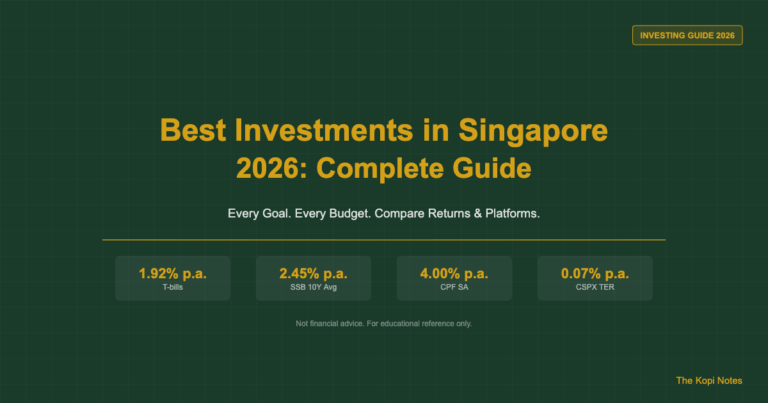
- CSPX — iShares Core S&P 500 UCITS ETF (LSE, USD). Tracks the 500 largest US companies. TER: 0.07% p.a. Best for: investors wanting US equity exposure with minimal cost drag.
- VWRA — Vanguard FTSE All-World UCITS ETF (LSE, USD). Tracks ~3,500 companies across developed and emerging markets. TER: 0.22% p.a. Best for: investors wanting true global diversification in a single fund.
- ES3 (STI ETF) — SPDR STI ETF (SGX, SGD). Tracks the 30 largest Singapore-listed companies. TER: ~0.30% p.a. Best for: local-currency DCA with no FX conversion needed.
Step 3: Decide Your Monthly Amount
A common rule of thumb is to invest 10–20% of your monthly take-home pay. If you earn SGD 5,000 per month, that is SGD 500–1,000 per month into your investment portfolio. You do not need to start large — even SGD 200 per month invested consistently over 20–30 years builds meaningful wealth through the power of compounding. Use a retirement planning calculator to project your portfolio’s growth under different contribution amounts.
Step 4: Automate and Forget
The single most powerful thing you can do to make DCA work: automate it. Set up a recurring instruction in your brokerage or robo-advisor to transfer and invest your chosen amount on the same day each month (ideally shortly after payday). Automation removes the temptation to skip a month during a market downturn — which is precisely when the extra units bought are most valuable. For building passive income in Singapore, consistent automated DCA into dividend-paying ETFs is one of the most reliable long-term strategies.
Common DCA Mistakes to Avoid
DCA is straightforward, but Singapore investors frequently make a handful of avoidable mistakes that limit their returns.
1. Stopping during market downturns. This is the most damaging mistake. A market correction is when DCA delivers its highest value — your fixed contribution buys more units at lower prices. Stopping during a downturn converts the strategy into something far less effective. If market volatility makes you want to stop, consider reducing your monthly contribution amount to something you can comfortably maintain even in bad markets, rather than stopping entirely.
2. DCA-ing into individual stocks. DCA works best with broadly diversified assets like index ETFs. Applying DCA to a single company’s stock concentrates your risk — the stock could go to zero despite your disciplined investing. Stick to diversified funds unless you have a specific, well-researched reason to hold individual equities.
3. Ignoring fees. A 1% annual management fee on a 30-year investment reduces your ending portfolio value by roughly 26% compared to a 0% fee. This matters enormously over long time horizons. CSPX’s 0.07% TER is 14 times cheaper than a typical actively managed unit trust charging 1.0% or more. Always check the total expense ratio (TER) before investing.
4. Forgetting currency risk. If you buy USD-denominated ETFs like CSPX or VWRA using Singapore dollars, you carry USD/SGD exchange rate risk. Over long horizons, this risk often averages out, but it is worth understanding. Using SGD-denominated ETFs (like ES3 on SGX) or SRS-eligible SGD-denominated funds eliminates this specific risk.
5. Not reviewing SRS opportunities. Many Singapore investors miss out on substantial tax savings by not maximising their annual SRS contribution. At SGD 15,300 per year, a top-bracket earner saves up to SGD 3,366 in income tax while simultaneously building their retirement portfolio. DCA-ing into your SRS account through Endowus or Syfe is one of the most tax-efficient investment strategies available to Singapore residents.
Frequently Asked Questions
How much should I invest each month using DCA in Singapore?
There is no universal answer, but a common starting point is 10–20% of your monthly take-home pay. If you earn SGD 5,000 per month, that means SGD 500–1,000 per month. The most important factor is consistency: a smaller amount you sustain over decades will outperform a larger amount you stop and start erratically. Start with an amount that would not cause financial stress even if the market fell 30% the next month.
Can I do DCA with CSPX or VWRA in Singapore?
Yes. The most common approach is to open an Interactive Brokers (IBKR) account, set a reminder each month, and manually purchase your chosen amount of CSPX or VWRA on the London Stock Exchange. IBKR charges a minimum of USD 1.70 per trade for LSE ETFs, making it cost-effective even for monthly investments of SGD 300–500. For a more automated experience, robo-advisors like Endowus (with access to similar low-cost global ETFs) offer automatic monthly investments with no per-trade fee.
Is dollar cost averaging good for beginners in Singapore?
DCA is arguably the ideal strategy for investing beginners. It removes the intimidating question of “when is the right time to invest?”, builds a regular investing habit, reduces exposure to the risk of a poorly timed single large purchase, and works with the monthly income cycle most salaried Singaporeans are already on. Beginners who start with a simple DCA plan into CSPX or VWRA through a robo-advisor or IBKR have a solid foundation for long-term wealth building.
Should I DCA into my CPF or SRS account?
For SRS, yes — making regular monthly contributions throughout the year rather than a single end-of-year contribution is a form of DCA that smooths your entry price into SRS-eligible investments. You can contribute up to SGD 15,300 per year (for Singapore citizens and PRs), and each dollar contributed earns you a tax deduction. For CPF, contributions are automatically made from your salary, so you are already DCA-ing into CPF by default. If you invest CPF OA funds through CPFIS, you can also apply DCA timing logic to those purchases.
What is the difference between DCA and a Regular Savings Plan (RSP)?
A Regular Savings Plan (RSP) is simply an automated implementation of DCA offered by brokerages and robo-advisors. Platforms like FSMOne and Syfe allow you to set up a monthly automatic purchase of a chosen fund or ETF for a fixed SGD amount. An RSP removes the need for manual execution each month, making it one of the easiest ways to maintain a consistent DCA strategy. The underlying concept is identical — RSP is just the product name for an automated DCA service.
Ready to start dollar cost averaging?
Use a referral code to earn sign-up bonuses on Singapore’s top investing platforms — every dollar saved in fees compounds over time.
This article was researched with the help of AI. While we strive to keep all information accurate and up to date, there may be errors. If you notice any discrepancies, please contact us.