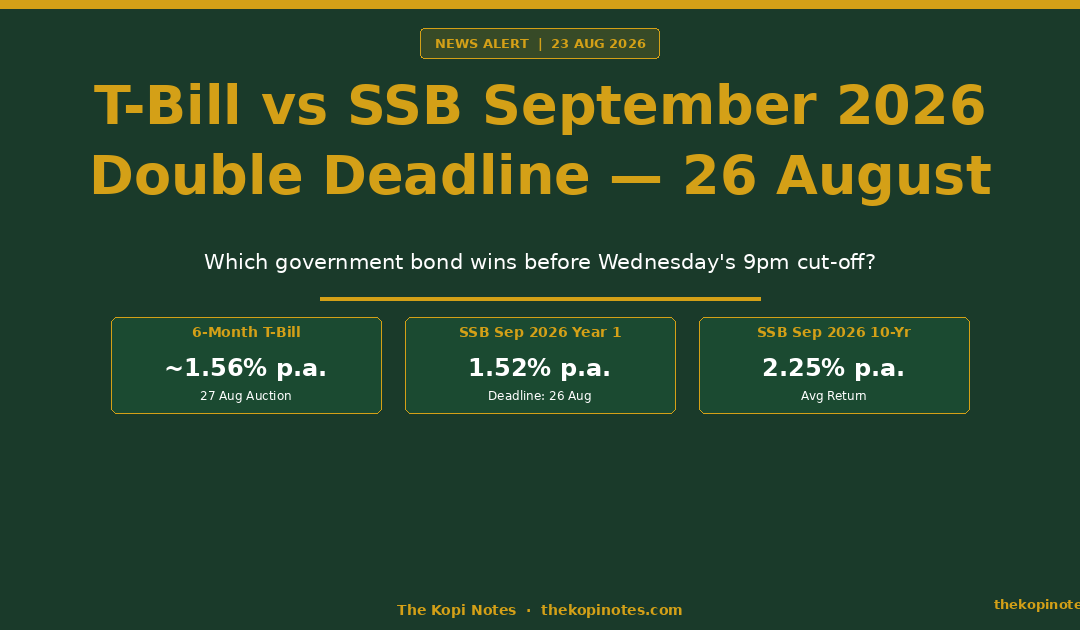
Both the September 2026 SSB and the 6-month T-bill share the same application deadline: Wednesday 26 August at 9pm. The SSB pays 1.52% in Year 1 and a 2.25% average over 10 years — the biggest month-on-month jump in months. The T-bill is expected to cut around 1.55–1.57%. If you have cash to deploy this week, the right choice depends entirely on your time horizon.
This is an editorial analysis. Not financial advice. Data verified as at 23 August 2026.
The Double Deadline Week: What’s Happening
It’s rare that two of Singapore retail investors’ most-watched fixed income instruments share the exact same application cut-off. But this week, that’s precisely what’s happening.
- The September 2026 SSB (SBSEP26, GX26090V) application closes 26 August 2026 at 9pm.
- Cash applications for the 6-month T-bill auction on 27 August (BS26117A) also close 26 August 2026 at 9pm.
If you’re looking to park cash in a government-backed instrument, Wednesday is your window. Miss it, and you’ll have to wait until the next T-bill auction in September, or the October 2026 SSB tranche (estimated 10-year average: ~2.32%, announced 21 August). Here’s what you need to know before you decide.
September 2026 SSB Rates: The Biggest Jump in Months
The September 2026 SSB saw a meaningful improvement in rates compared to August. The 10-year average yield climbed from 2.06% to 2.25% — a jump of 0.19 percentage points, the biggest month-on-month improvement in a long while. Still below the 3%-plus levels from two years ago, but rates are heading in the right direction.
Why did rates rise? Singapore’s 10-year government bond yield rose to 2.36% as of 19 August 2026, driven by a still-elevated US 10-year yield (4.65%) and persistent inflation expectations keeping the Federal Reserve’s rate outlook hawkish. SSB rates are pegged to Singapore Government Securities (SGS) yields — when SGS yields rise, SSB rates follow.
| Metric | Aug 2026 SSB | Sep 2026 SSB | Change |
|---|---|---|---|
| Year 1 Rate | 1.46% | 1.52% | +0.06% |
| Year 10 Rate | ~2.81% | 2.82% | +0.01% |
| 10-Year Average | 2.06% | 2.25% | +0.19% |
| Amount Offered | — | S$400M | — |
| Issue Date | 1 Aug 2026 | 1 Sep 2026 | — |
Source: MAS via TurtleInvestor / TheFinance.sg, August 2026. Aug 2026 Year 10 is approximate.
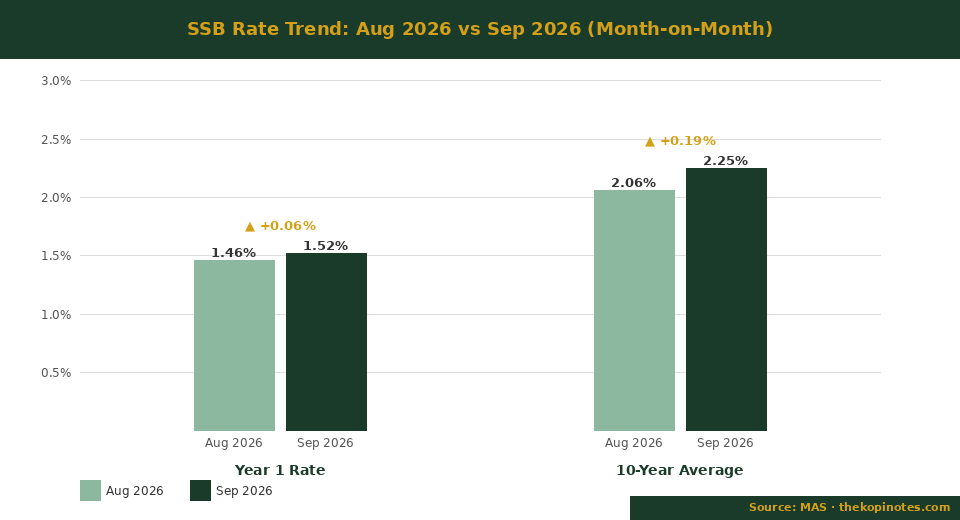
The SSB step-up structure means the coupon rate increases every year you hold — from 1.52% in Year 1 to 2.82% by Year 10. The longer you hold, the higher your effective average return. You can model your exact earnings at any holding period using the TKN SSB Interest Calculator.
For a full walkthrough of how SSBs work, see our complete SSB guide for 2026.
6-Month T-Bill Preview: What to Expect on 27 August
The next 6-month T-bill auction (BS26117A) takes place on 27 August. In the previous auction on 13 August, the cut-off yield came in at 1.56%, slightly down from 1.59% on 30 July. Secondary market data as of 20 August showed the T-bill closing yield at 1.55% — roughly in line with the last cut-off.
Three key indicators for the 27 August auction:
- US yields stable: The 10-year US government bond yield dipped slightly to 4.65% (from 4.67% two weeks prior). The 1-year US yield eased to 3.98% from 4.06%. No big directional shift expected.
- Singapore bond yields up: The 10-year SGS yield rose to 2.36%, which tends to support slightly higher T-bill yields — a mild upside signal.
- Strong demand: The 13 August auction attracted S$18.5 billion in applications against an issuance of S$8.7 billion (oversubscription ratio of ~2.1x). The 27 August issuance is also S$8.7 billion. High demand tends to compress the cut-off yield slightly.
Net effect: the cut-off for 27 August is most likely to print in the 1.54%–1.57% range. Don’t expect a dramatic move in either direction. The final rate is set at auction — you’re bidding blind on the yield, and non-competitive bids always get allotted in full at whatever the cut-off clears.
Track the full T-bill yield history at our T-Bill Auction Results 2026 tracker.
Head-to-Head: T-Bill vs SSB vs Fixed Deposit vs CPF
Here’s how all the key options stack up for Singapore investors this week:
| Option | Rate (p.a.) | Term | Capital Safety | Flexibility | Max Allocation |
|---|---|---|---|---|---|
| 6-Month T-Bill (27 Aug) | ~1.54%–1.57% | 6 months fixed | ✅ Full (govt) | ❌ No early exit | Unlimited |
| SSB Sep 2026 — Year 1 | 1.52% | Up to 10 years | ✅ Full (govt) | ✅ Redeem any month | S$200,000 |
| SSB Sep 2026 — 10-Yr Avg | 2.25% | 10 years | ✅ Full (govt) | ✅ Redeem any month | S$200,000 |
| Best Fixed Deposit (6-month) | ~2.00% | 6 months fixed | ✅ SDIC up to S$75K | ❌ Penalty for early exit | S$75,000 (SDIC) |
| CPF Ordinary Account | 2.50% | Ongoing | ✅ Full (govt) | ❌ Very restricted | No cap |
| CPF SA / MA / RA | 4.00% | Ongoing | ✅ Full (govt) | ❌ Extremely restricted | No cap |
T-bill rate is an estimate based on secondary market data as of 20 August 2026 (source: Beansprout / MAS). FD rate from Beansprout. CPF rates from CPF Board (Jul–Sep 2026 quarter).
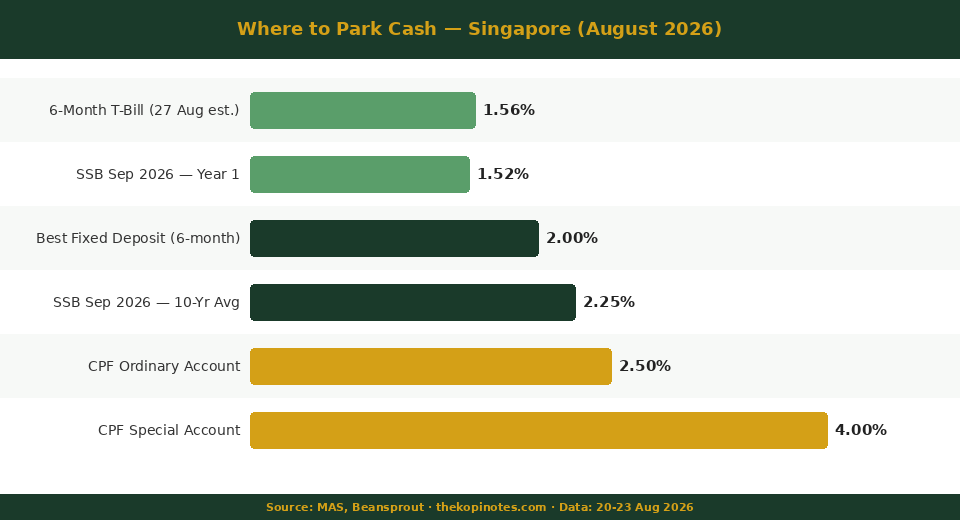
The headline finding: for a 6-month horizon, the best fixed deposit (2.00%) beats both the T-bill (~1.56%) and SSB Year 1 (1.52%) — if you’re comfortable with a bank lock-in and SDIC coverage limits. The T-bill marginally beats SSB for short-term cash, but the SSB’s 10-year average of 2.25% clearly wins for medium-to-long-term investors who want full flexibility to exit anytime.
Who Should Apply for the T-Bill?
The 6-month T-bill (27 August auction) is the better fit if:
- Your money is parked for exactly 6 months. T-bills mature on a fixed date (around 1 March 2027 for the 27 August issue). There is no early redemption option once you’re in.
- You have CPF OA funds to deploy. CPF Ordinary Account money can be used to buy T-bills under the CPF Investment Scheme (CPFIS). SSB is not CPFIS-eligible — CPF OA money cannot buy SSB.
- You’re already at your S$200,000 SSB limit. T-bills have no individual allocation cap. If you’ve maxed out SSB, T-bills are the next government-backed option.
- You’re marginally yield-chasing. At ~1.56% vs SSB’s 1.52% Year 1, the gap is slim — but on S$100,000 it amounts to about S$40 over 6 months.
See our full guide: Singapore T-Bills 2026 — Complete Guide.
Who Should Apply for the SSB?
The September 2026 SSB works better if:
- You want maximum flexibility. SSB is the only government-backed instrument in Singapore that lets you redeem in any month, with no penalty for exiting early. If rates shoot up next month, you can exit and reinvest without losing a cent.
- Your time horizon is 3 years or more. By Year 3–4, the SSB’s step-up rate starts pulling meaningfully ahead of rolling 6-month T-bills at current yields. By Year 10, you’re earning 2.82% — nearly double the T-bill rate today.
- You want less administrative friction. You don’t need to re-apply every 6 months. Set it up once and let the bond compound, with the option to redeem at any time.
- You want to diversify your liquidity reserves. SSB sits in the sweet spot between a savings account (low yield, fully liquid) and a fixed deposit (higher yield, no liquidity). It’s an ideal “rainy day fund” instrument.
Compare all SSB tranches: SSB August 2026: Yield Falls to 2.06%, T-Bills Close the Gap.
Can You Apply for Both?
Yes — if you have separate pools of cash. Both applications close simultaneously at 9pm on 26 August. The SSB has a S$200,000 total individual limit across all holdings; T-bills have none. A practical split many investors use: short-term cash earmarked for spending within 6 months goes into T-bills (or FDs), while the longer-term savings buffer goes into SSB.
Note that CPF OA funds can only go into the T-bill track (via CPFIS) — not SSB. If you’re deploying cash and CPF OA, you can potentially do both on the same day. Just ensure you submit both applications before 26 August at 9pm.
Bottom Line for SG Investors
This week is unusual: two of Singapore’s most popular government-backed instruments share the same application deadline. Here’s the one-line verdict for each investor type:
- Short-term cash (≤ 6 months): Consider the T-bill (~1.56%) for flexibility of no SSB cap, or a 6-month FD (up to 2%) if you’re fine with a bank lock-in. SSB Year 1 (1.52%) trails both on pure short-term yield.
- Medium-to-long-term savings (3–10 years): SSB Sep 2026’s 2.25% 10-year average with full redemption flexibility is the clear winner. No other fully government-backed instrument in Singapore lets you earn that with the ability to exit anytime, penalty-free.
- CPF OA investors: T-bill via CPFIS is your vehicle. SSB doesn’t accept CPF funds.
- Deadline: Both applications close Wednesday 26 August 2026 at 9pm. Mobile banking is available from 7am–9pm (Mon–Sat, excluding public holidays).
The September SSB rate jump to 2.25% — driven by rising SGS yields on elevated US rate expectations — is the biggest monthly improvement in months. If you’ve been sitting on the fence, this week is a good forcing function to commit.
Track the latest T-bill rates and yields at our Singapore T-Bill Interest Rate 2026 tracker.
Frequently Asked Questions
What are the September 2026 SSB interest rates?
The September 2026 SSB (SBSEP26, GX26090V) pays 1.52% in Year 1, stepping up each year to 2.82% by Year 10. The 10-year average return is 2.25% p.a. if held to maturity on 1 September 2036. This is the biggest month-on-month improvement in rates in a long while, up from 2.06% in August 2026.
When is the SSB September 2026 application deadline?
Applications close on Wednesday, 26 August 2026 at 9pm. The bond is allotted on 27 August 2026 and issued on 1 September 2026. Apply through DBS/POSB, OCBC, or UOB internet banking or ATMs, using your CDP Securities account. Application hours are 7am–9pm Mon–Sat (excluding public holidays).
What is the expected T-bill cut-off yield for the 27 August 2026 auction?
Based on secondary market closing yields of 1.55% as of 20 August 2026, the cut-off yield is expected to be around 1.54%–1.57% p.a. The previous cut-off on 13 August was 1.56%. The final rate is set at the auction on 27 August — you won’t know the exact yield until after allotment.
Can I apply for both the SSB and the T-bill at the same time?
Yes, if you have separate pools of cash. Both applications close 26 August at 9pm. The SSB has a S$200,000 total individual holdings cap; T-bills have no cap. CPF OA funds can go into T-bills via CPFIS but cannot be used to buy SSB — only cash or SRS funds can purchase SSB.
Is the SSB or T-bill better for short-term cash?
For a strict 6-month horizon, the T-bill (~1.56%) marginally beats SSB Year 1 (1.52%). But the best 6-month fixed deposits are currently offering around 2.00% p.a. — beating both. The SSB’s real advantage kicks in at the 3-year mark and beyond, where its step-up rates and penalty-free redemption flexibility are unmatched among government-backed instruments.
Can I use CPF money to buy the SSB September 2026?
No. SSB is not eligible under the CPF Investment Scheme (CPFIS). CPF Ordinary Account (OA) money can invest in T-bills, certain unit trusts, and SGS bonds via CPFIS — but not in SSBs. SSB purchases must use cash or SRS funds. If you have CPF OA to deploy, the T-bill is your government-backed option.
How do I apply for the September 2026 SSB?
Log in to your bank’s internet banking (DBS/POSB, OCBC, or UOB), navigate to Investments > Singapore Savings Bonds, enter the amount (minimum S$500, in S$500 multiples), and confirm before 26 August 9pm. You’ll need a CDP Securities account linked to your bank account. See our SSB Complete Guide for step-by-step instructions.
How much is the issuance size for the 27 August T-bill?
The 27 August 6-month T-bill (BS26117A) has an issuance size of S$8.7 billion — the same as the previous auction on 13 August. The 13 August auction received S$18.5 billion in applications (oversubscribed ~2.1x). High demand relative to issuance tends to compress the cut-off yield slightly, suggesting rates may come in at the lower end of expectations.
This article was researched with the help of AI. While we strive to keep all information accurate and up to date, there may be errors. If you notice any discrepancies, please contact us.