Small-Cap ETF Singapore Guide: How to Buy WSML in 2026
A complete Singapore investor guide to small-cap ETFs — WSML vs WOSC, tax advantages, step-by-step broker instructions, and why the 2026 Fed rate-cut cycle matters for this asset class.
WSML (iShares MSCI World Small Cap UCITS ETF) is an Ireland-domiciled ETF listed on the London Stock Exchange that tracks 3,588 small-cap companies across 23 developed markets. Singapore investors buy it through IBKR, Saxo, or moomoo. Its edge over US-listed equivalents like IWM: 15% US dividend withholding tax instead of 30%, no US estate tax exposure, and small-caps historically outperform after the Fed starts cutting rates — a live setup heading into the September 2026 FOMC meeting.
Not financial advice. All figures are for educational reference only. Data as at August 2026 unless noted.
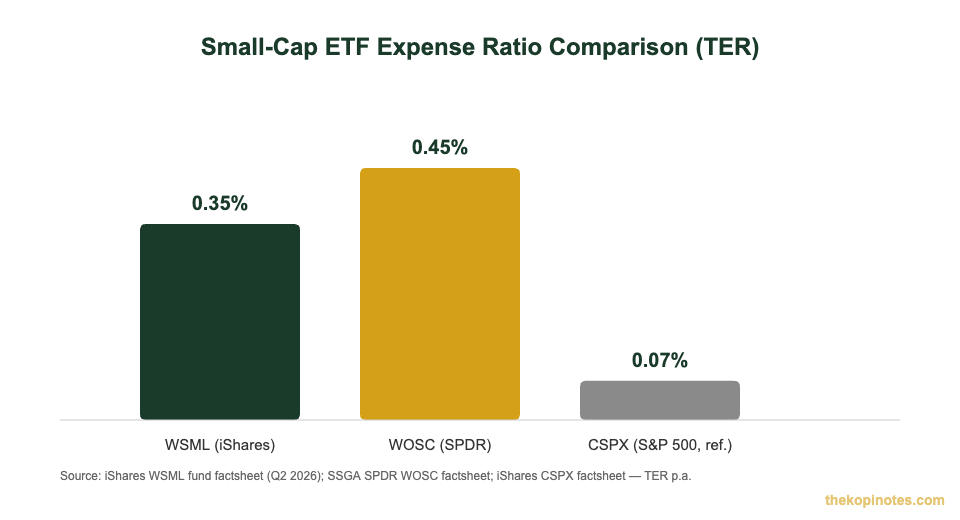
- WSML tracks 3,588 global small-cap stocks with a 0.35% TER — cheaper than SPDR’s WOSC at 0.45%.
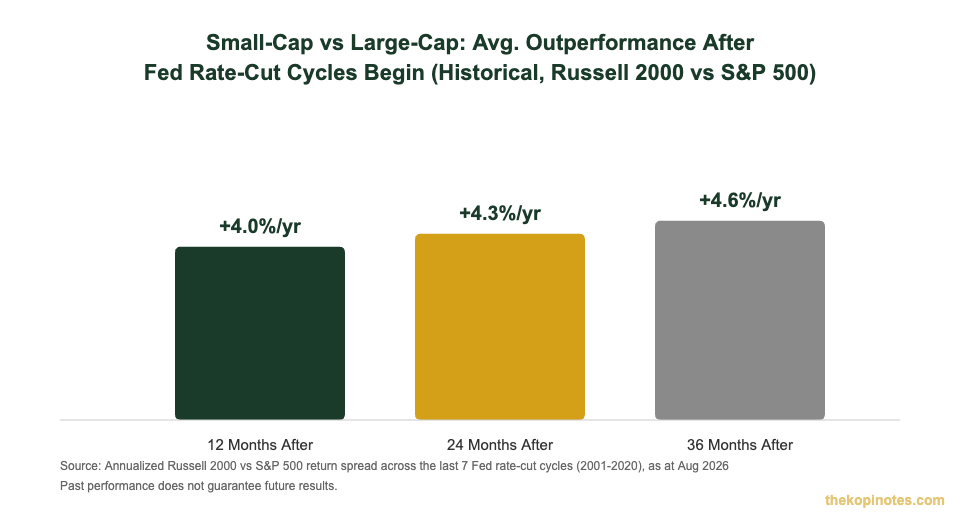
- Small-caps have beaten the S&P 500 by 4%+ a year in the 1–3 years after past Fed rate-cut cycles began — and the Fed left rates at 3.50–3.75% on 29 July 2026 with the next decision due 16 September 2026.
- Buy WSML on the LSE through IBKR, Saxo, or moomoo — it is SRS-compatible but not CPF-investable.
Table of Contents
Contents — Click to expand
- What Is a Small-Cap ETF (and WSML)?
- Key Facts at a Glance
- Why Small-Caps Matter in the 2026 Rate-Cut Cycle
- Why Singapore Investors Buy ETFs on the LSE
- Expense Ratio and Total Costs
- How to Buy WSML in Singapore (Step-by-Step)
- WSML vs Alternatives
- Who Should Buy Small-Cap ETFs?
- Frequently Asked Questions
What Is a Small-Cap ETF (and WSML)?
A small-cap ETF holds a basket of small companies instead of the household names you find in the S&P 500 or STI. “Small-cap” means small market capitalisation — usually the smallest 10-15% of listed companies in a given market, ranked by size.
WSML, the iShares MSCI World Small Cap UCITS ETF, is the largest small-cap ETF available to Singapore investors on the London Stock Exchange. It holds 3,588 companies across 23 developed markets, with the United States, Japan, and France as its biggest country weights. That is roughly ten times more holdings than CSPX, which only tracks 500 large US companies.
WSML is Ireland-domiciled and structured as accumulating (Acc) — meaning dividends are reinvested automatically rather than paid out as cash. It launched in 2014 and has grown to around USD 7.7 billion in assets under management (AUM) as at August 2026, making it the most widely-held global small-cap UCITS ETF among retail investors.
Key Facts at a Glance
| Metric | Detail |
|---|---|
| Full Name | iShares MSCI World Small Cap UCITS ETF USD (Acc) |
| Ticker (LSE) | WSML (also IUSN on Xetra) |
| ISIN | IE00BF4RFH31 |
| Index Tracked | MSCI World Small Cap Index |
| Domicile | Ireland |
| Structure | Accumulating |
| TER (Expense Ratio) | 0.35% p.a. |
| AUM | ~USD 7.7 billion (as at August 2026) |
| Number of Holdings | 3,588 |
| Currency | USD |
Source: iShares WSML fund factsheet, Q2 2026.
Why Small-Caps Matter in the 2026 Rate-Cut Cycle
Here is the timely bit. The US Federal Reserve held its funds rate at 3.50-3.75% at its 29 July 2026 meeting. The next decision lands on 16 September 2026, and as at 20 August 2026, futures markets (via CME FedWatch) were pricing in roughly a 31.6% chance of a cut that month — with the odds shifting as new data comes in.
Why does this matter for small-caps specifically? Small companies typically carry more floating-rate debt than large-caps. When the Fed cuts, their borrowing costs drop faster, which flows straight into earnings. That is not a theory — it is a repeatable pattern.
The chart below shows the historical pattern. That said, past performance never guarantees future results — this is context, not a promise.
Why Singapore Investors Buy ETFs on the London Stock Exchange
Two things make LSE-listed, Ireland-domiciled ETFs like WSML more efficient for you than their US-listed cousins: withholding tax (WHT) on dividends, and US estate tax.
Under the Ireland-US tax treaty, dividends paid by US companies inside an Ireland-domiciled UCITS ETF are taxed at 15% WHT. If you instead bought a US-listed small-cap ETF like IWM directly, the same dividends would be taxed at 30% WHT — because Singapore has no tax treaty with the US.
There is a second, bigger risk with US-listed ETFs: US estate tax. Non-resident aliens holding more than USD 60,000 in US-situs assets (which includes US-listed ETFs) can trigger US estate tax of up to 40% on the excess, payable by your estate before your heirs receive anything. Ireland-domiciled ETFs listed on the LSE are not US-situs assets, so this risk simply does not apply.
| ETF Type | Domicile | US Dividend WHT | US Estate Tax Risk |
|---|---|---|---|
| WSML (LSE) | Ireland | 15% | None |
| IWM (NYSE) | USA | 30% | Yes (above USD 60k) |
For example, on a SGD 50,000 small-cap allocation paying a 2% dividend yield, the WHT difference alone saves you roughly SGD 150 a year — before even counting the estate tax risk you avoid entirely.
This same 15% vs 30% WHT logic applies to S-REIT-focused ETFs too, and even directly to your own dividend and passive-income planning.
Expense Ratio and Total Costs
TER stands for Total Expense Ratio — the annual fee the fund manager deducts from your returns automatically, before you see a cent. WSML charges 0.35% p.a., while the SPDR alternative WOSC charges 0.45% p.a.
On a SGD 50,000 WSML holding, that works out to roughly SGD 175 a year in fund fees. The same amount in WOSC would cost about SGD 225 a year — SGD 50 more, every year, compounding silently in the background.
However, remember that TER is not the only cost. You also pay brokerage commission and FX spread each time you buy. A broker with a low minimum commission and tight FX spread often matters more than a 0.10% TER gap if you are investing smaller, regular amounts.
How to Buy WSML in Singapore (Step-by-Step)
WSML trades on the London Stock Exchange in USD. Here is how to buy it through the brokers most Singapore investors already use.
Interactive Brokers (IBKR)
Fund your IBKR account via FAST transfer, then search “WSML” in the order entry screen. Select the LSE (LSEETF) exchange listing, choose your order type (limit orders are safer for ETFs with wider spreads), and submit. IBKR charges among the lowest commissions for LSE trades, which makes it the most cost-effective choice for larger, less frequent purchases.
Saxo Markets
Saxo offers WSML directly through its platform with a similarly low minimum commission structure. If you already use Saxo for VWRA or CSPX, adding WSML to the same portfolio is a two-minute job — just search the ticker and select the LSE listing.
moomoo Singapore
moomoo has expanded its LSE-listed ETF access, including WSML, and is a reasonable option if you already hold your CSPX or VWRA positions there and want to keep everything under one roof. Check current commission rates before trading, as they change periodically — see our moomoo Singapore review for the latest breakdown.
Syfe Brokerage
If you want a simpler, more guided experience, use your Syfe referral code and sign-up bonus to open an account. Syfe is best suited to beginners who want a cleaner interface, even if the LSE ETF selection is narrower than IBKR’s.
Whichever broker you choose, remember: WSML is not eligible for CPF Investment Scheme (CPFIS) funds, but it is compatible with SRS if your broker supports SRS-funded international trades. Check with your broker directly, as SRS eligibility for LSE-listed ETFs varies by platform.
WSML vs Alternatives
WSML is not the only small-cap option available to Singapore investors. Here is how it stacks up against the main alternatives, including two US-listed ETFs shown for cost reference only — remember these carry the 30% WHT and US estate tax exposure discussed above.
| ETF | TER | Index | Domicile | AUM | Best For |
|---|---|---|---|---|---|
| WSML (LSE) | 0.35% | MSCI World Small Cap | Ireland | ~USD 7.7bn | Most SG investors — cheapest tax-efficient option |
| WOSC / WDSC (LSE) | 0.45% | MSCI World Small Cap | Ireland | ~USD 1.8bn | Investors who want a distributing (Dist) share class |
| IWM (NYSE, ref. only) | 0.19% | Russell 2000 (US only) | USA | ~USD 70bn | US-only exposure, not tax-efficient for SG investors |
| VSS (NYSE, ref. only) | 0.08% | FTSE Global ex-US Small Cap | USA | ~USD 9bn | Ex-US small-cap tilt, same tax drawbacks as IWM |
Source: iShares WSML factsheet, SSGA WOSC factsheet, iShares IWM factsheet, Vanguard VSS factsheet — all Q2 2026.
Notice that IWM only covers US small-caps, while WSML gives you global diversification across 23 developed markets in a single trade. That is part of why WSML, despite the slightly higher TER than IWM, remains the more practical single-fund choice for most Singapore portfolios.
Who Should Buy Small-Cap ETFs?
WSML is a good fit if you already hold a core large-cap ETF like CSPX or VWRA and want to diversify by company size, not just geography. It also suits you if you have a 10+ year horizon and can stomach higher short-term volatility — small-caps swing harder than large-caps in both directions.
Consider skipping it, or keeping the allocation small (5-15% of your equity portfolio), if you are close to retirement, need capital stability, or already feel fully exposed to market risk through your best S-REITs in Singapore 2026 holdings and other growth assets.
If you are investing through SRS as part of your CPF investment strategy, small-caps can sit alongside your core holdings — just check your broker supports SRS funding for LSE trades first. For a broader retirement view, map out your full portfolio numbers before committing new capital to any single asset class.
Disclaimer: This article is for educational purposes only and does not constitute financial advice. The Kopi Notes may earn a referral fee if you sign up through our broker links. Always do your own research and consider your personal risk tolerance before investing.
Frequently Asked Questions
What is a small-cap ETF and why do Singapore investors buy it?
A small-cap ETF holds shares of smaller, often faster-growing companies instead of large household names. Singapore investors add it to diversify beyond a core S&P 500 or global large-cap ETF, and to capture the historical outperformance small-caps show in the years after the Fed starts cutting interest rates.
Is WSML the same as buying Russell 2000 stocks directly?
No. WSML tracks the MSCI World Small Cap Index, which covers 3,588 small companies across 23 developed markets, including the US, Japan, and Europe. The Russell 2000 (tracked by IWM) only covers US small-caps. WSML gives you broader geographic diversification in one trade.
Can I buy WSML using my CPF or SRS funds?
WSML is not on the CPF Investment Scheme (CPFIS) list, so you cannot use CPF Ordinary Account funds to buy it. It can be SRS-compatible if your broker allows SRS funds to be used for LSE-listed international trades — confirm this with your broker before funding your account.
Which broker is best for buying WSML in Singapore?
Interactive Brokers (IBKR) is typically the most cost-effective for larger, less frequent trades due to its low LSE commission rates. Saxo Markets is a strong alternative if you already hold VWRA or CSPX there. Syfe Brokerage is a simpler option for beginners who want a guided experience.
Do small-cap ETFs actually benefit more from Fed rate cuts?
Historically, yes. Small companies tend to carry more floating-rate debt, so falling rates cut their borrowing costs faster and flow more directly into earnings. Across the last 7 Fed rate-cut cycles, the Russell 2000 has beaten the S&P 500 by more than 4% annualised over the following 1-3 years. This is a historical pattern, not a guarantee.
Is WSML riskier than a S&P 500 ETF like CSPX?
Yes, generally. Small-cap companies are more volatile than large-caps — they can fall harder in downturns but also rally harder in recoveries. Most financial planners suggest keeping small-cap exposure to 5-15% of your total equity allocation rather than making it your core holding.
Ready to Diversify Into Small-Caps?
Open a brokerage account and add WSML to your portfolio today. Use our referral links for exclusive sign-up bonuses.
This article was researched with the help of AI. While we strive to keep all information accurate and up to date, there may be errors. If you notice any discrepancies, please contact us.