YouTrip Card for Taiwan Travel: TWD Exchange Rate & ATM Guide (2026)
A Singapore traveller’s guide to spending and withdrawing New Taiwan Dollars with YouTrip — real ATM fees, DCC traps, and the cheapest way to get cash in Taipei, Taichung and Kaohsiung.
YouTrip lets Singaporeans spend and withdraw New Taiwan Dollars (TWD) at the live wholesale exchange rate with 0% FX fees, both in shops and at Taiwan’s 7-Eleven and bank ATMs. You get S$400 in free ATM withdrawals every month before a 2% fee kicks in. The catch: Taiwan’s local ATM operators still charge their own NT$100–200 fee, so picking the right machine matters as much as the card you use.
Not financial advice. All figures are for educational reference only. Data verified as at 22 August 2026 against YouTrip’s official fee schedule and its published Taiwan ATM guide (data snapshot 9 March 2026 for bank-specific figures).
- YouTrip charges 0% FX fees on TWD spending and gives you S$400 in free ATM withdrawals a month, then 2%.
- Taiwan ATMs still charge their own NT$100–200 local fee — Cathay United Bank and TCB machines are usually free of this.
- Always choose “Charge in TWD” at the ATM. Picking SGD triggers Dynamic Currency Conversion (DCC) and a worse rate.
Table of Contents
Contents — Click to expand
- How YouTrip Works for Taiwan Travel
- Key Facts at a Glance
- How the TWD Exchange Rate Works
- Taiwan ATM Fees: What You’ll Actually Pay
- Best ATMs in Taiwan for YouTrip
- How to Withdraw Cash With YouTrip in Taiwan
- How to Avoid the Dynamic Currency Conversion Trap
- YouTrip vs Wise vs Revolut for Taiwan
- Before You Go: Top-Up Checklist
- Frequently Asked Questions
How YouTrip Works for Taiwan Travel
YouTrip is a multi-currency wallet app and Mastercard, issued by You Technologies Group (Singapore) Pte Ltd. It’s a Principal Member of Mastercard and holds a Major Payment Institution licence under the Payment Services Act, regulated by the Monetary Authority of Singapore (MAS).
You top up your YouTrip wallet in SGD, then spend or withdraw in any of 12 supported currencies — including TWD — at the live wholesale exchange rate. There’s no card issuance fee, no annual fee, and no FX mark-up on spending. For a Taiwan trip, that means paying for your night market snacks, high-speed rail tickets, and hotel bills in TWD without the usual 1–3% foreign transaction fee your bank card would charge.
The card also works for cash withdrawals at Taiwan ATMs, which is where most of the fee confusion happens — covered in detail below.
Key Facts at a Glance
| Item | Detail |
|---|---|
| FX fee on spending | 0% — wholesale exchange rate |
| Free ATM withdrawals | S$400 per calendar month |
| Fee after free limit | 2% of withdrawal amount |
| Taiwan ATM operator fee | NT$100–200 (~S$4–S$8) at most banks, often NT$0 at Cathay United Bank/TCB |
| ATM withdrawal limit | NT$20,000 per transaction; NT$20,000–40,000 daily cap (varies by bank) |
| Card networks accepted in Taiwan | Mastercard, Cirrus, Maestro, Visa, Plus, UnionPay ATMs |
| Regulator | MAS — Major Payment Institution licence, PSA |
Source: You Technologies Group / YouTrip official fee schedule and Taiwan ATM Withdrawal Guide, verified 22 August 2026.
How the TWD Exchange Rate Works
When you spend or withdraw in TWD, YouTrip converts your SGD balance at the live Mastercard wholesale rate — the same interbank rate banks use among themselves, not a marked-up “tourist rate.” There’s no separate conversion fee layered on top.
As an illustration, YouTrip quoted 1 SGD = 24.82 TWD in its own comparison table published 9 March 2026, versus 24.78 for Revolut, 24.80 for Wise, and 24.34 for Trust. That said, all these rates move throughout the day — treat any published number as a snapshot, not a guarantee, and always check the live rate in-app before a large transaction.
For example, if you spend TWD 3,000 (about S$121 at the March 2026 rate) on a hotpot dinner in Taipei, YouTrip charges you exactly that converted amount — no 1–3% foreign transaction fee that a typical Singapore bank credit card would add.
Taiwan ATM Fees: What You’ll Actually Pay
Cash is still important in Taiwan — night markets, small eateries, and taxis often don’t take cards. When you withdraw TWD with YouTrip, you’re actually looking at two separate fees, not one:
| Fee Type | Who Charges It | Amount |
|---|---|---|
| YouTrip withdrawal fee | YouTrip | Free up to S$400/month, then 2% |
| Local ATM operator fee | The Taiwan bank that owns the ATM | NT$0–200 (~S$0–S$8) per withdrawal |
| DCC mark-up (if you accept it) | The ATM operator | Typically 3–8% worse than the wholesale rate |
Source: YouTrip Taiwan ATM Withdrawal Guide, you.co, snapshot 9 March 2026.
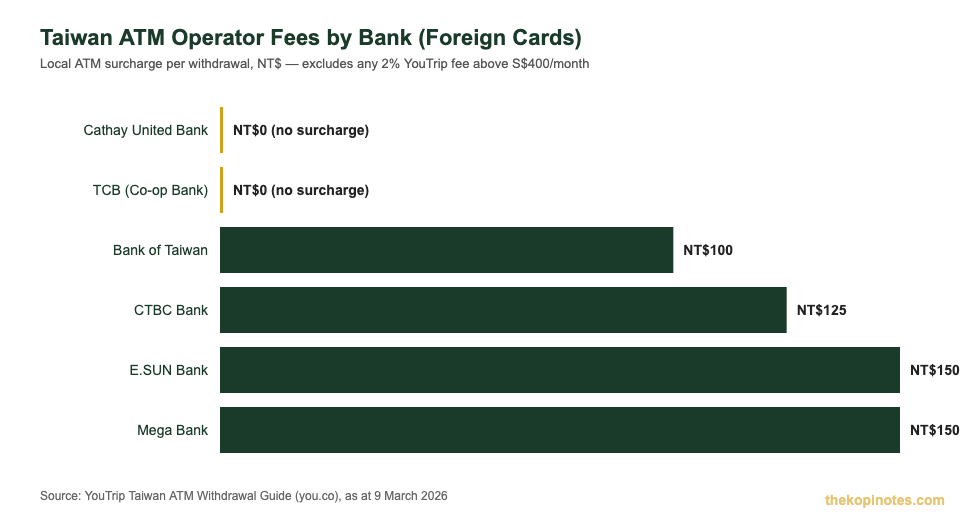
Here’s a worked example: if you withdraw NT$10,000 (about S$403 at the March 2026 rate) at a Bank of Taiwan ATM, you’d pay the NT$100 operator fee on top — roughly S$4 — but nothing from YouTrip itself since you’re still within your S$400 monthly free allowance. Do the same withdrawal at a Cathay United Bank machine inside 7-Eleven, and that NT$100 typically disappears.
Best ATMs in Taiwan for YouTrip
Not every ATM treats foreign cards the same way. If you want to dodge the local operator fee entirely, look for these machines:
Cathay United Bank
Widely considered the best option for foreign cards. Machines are often installed inside 7-Eleven stores, open 24/7, and are known for not charging extra ATM fees on top of what YouTrip already charges.
Taiwan Cooperative Bank (TCB)
Also frequently reported by travellers as skipping the standard NT$100 operator fee for foreign cards, though this can vary depending on YouTrip’s own agreement with the local network at the time.
Bank of Taiwan, CTBC, E.SUN, Mega Bank
These accept international cards but typically charge an operator fee of NT$100–200 per withdrawal. Always check the fee disclosure screen before confirming — Taiwan ATMs are required to show it.
How to Withdraw Cash With YouTrip in Taiwan
The process is the same at most Taiwan ATMs that accept Mastercard or Cirrus:
- Find an ATM displaying the Mastercard, Cirrus, or Maestro logo and insert your YouTrip card.
- Select “Savings Account” (not “Credit Account”) — YouTrip is a prepaid wallet, not a credit line.
- Key in your 4-digit YouTrip PIN.
- When prompted to choose a currency, select TWD, not SGD.
- Enter your withdrawal amount (up to NT$20,000 per transaction at most machines) and confirm.
Your free S$400 monthly YouTrip allowance applies automatically; you’ll only see a 2% YouTrip fee in-app if you’ve already withdrawn beyond that in the same calendar month.
How to Avoid the Dynamic Currency Conversion Trap
Here’s the single biggest mistake Singapore travellers make in Taiwan: at the currency selection screen, some ATMs ask if you’d like to withdraw in SGD instead of TWD. That’s Dynamic Currency Conversion (DCC) — and it’s a trap.
If you accept the SGD option, the local ATM operator applies its own conversion rate instead of YouTrip’s wholesale rate — usually 3–8% worse — plus its own handling fee. That single tap can wipe out the entire savings YouTrip was giving you. The rule is simple: whenever a Taiwan ATM or merchant terminal offers to charge you in SGD, decline it and choose TWD instead.
YouTrip vs Wise vs Revolut for Taiwan
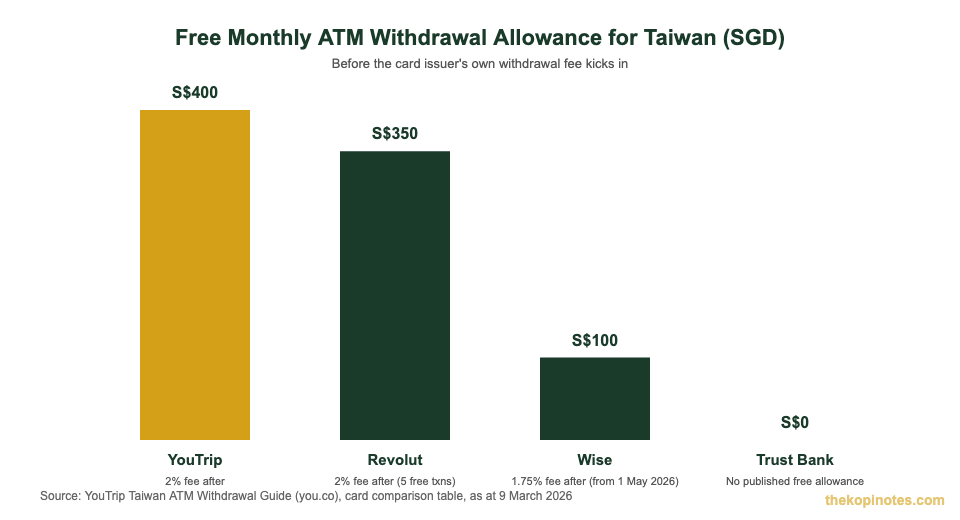
YouTrip isn’t the only multi-currency card Singaporeans use for Taiwan. Here’s how it stacks up against the other two most common choices, based on each provider’s own published fee schedules as at March 2026:
| Card | FX Fee on Spending | Free ATM Withdrawal | Fee After Limit |
|---|---|---|---|
| YouTrip | 0% | S$400/month | 2% |
| Revolut | 0% weekdays within plan limit; 1% weekends | S$350 (5 withdrawals)/month | 2% |
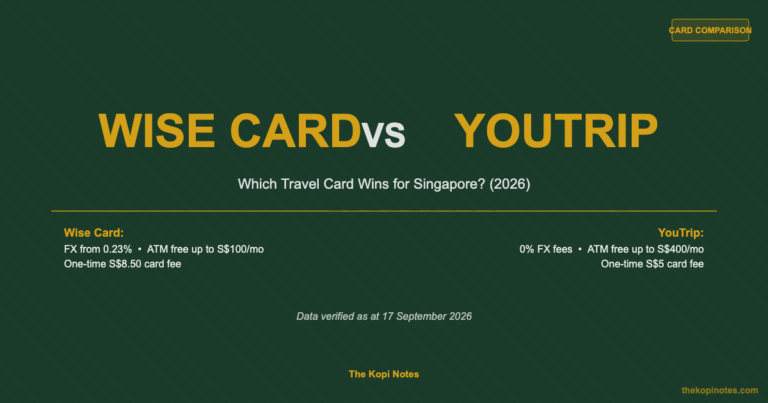
| Wise | From 0.26% (varies by currency) | S$100/month (from 1 May 2026) | 1.75% |
Source: YouTrip, Revolut and Wise published fee schedules, comparison table dated 9 March 2026. Fees may change — check each app before travel.
For most Singaporeans headed to Taiwan, YouTrip’s combination of a genuine 0% spending fee and the largest fee-free ATM allowance (S$400/month) makes it the simplest default. Wise can edge ahead on very large currency conversions thanks to its lower percentage fee, but its far smaller free ATM allowance makes it less convenient if you’re withdrawing cash more than once on a trip. Read our full Wise Card vs YouTrip comparison for a broader breakdown beyond Taiwan.
Before You Go: Top-Up Checklist
A few things to sort out before you land in Taipei:
- Top up in SGD before you fly. YouTrip converts to TWD at the point of spend or withdrawal, so there’s no need to pre-buy TWD.
- Check your monthly free ATM balance. If you’ve already used part of your S$400 allowance earlier in the month, plan your Taiwan withdrawals around what’s left.
- Enable your card for overseas use in-app if this is your first trip using it, and make sure notifications are on so you can track spending in real time.
- Carry a backup card. Some smaller shops and traditional markets are cash-only, so don’t rely purely on tap-to-pay.
- New to YouTrip? Sign up via the YouTrip referral code page for a welcome bonus, and see our full YouTrip card fees and limits guide for the complete rulebook.
If Taiwan is one stop on a bigger Northeast Asia trip, our YouTrip card guide for Japan and Korea covers the JPY and KRW side, and our YouTrip safety and MAS regulation guide is worth a read if you’re trusting the card with a big chunk of your travel budget. You can also see how YouTrip stacks up against local options in our YouTrip vs Trust Bank vs GXS comparison, or check the best money changer in Singapore guide if you’d still rather carry some physical TWD cash from home.
Frequently Asked Questions
Is the YouTrip card good for Taiwan travel?
Yes. YouTrip charges 0% FX fees on TWD spending at the live wholesale exchange rate, and gives you S$400 in free ATM withdrawals every calendar month. The main thing to watch is Taiwan’s own local ATM operator fee, which is separate from YouTrip and typically runs NT$100–200 unless you use a Cathay United Bank or TCB machine.
Does YouTrip charge a fee to withdraw cash in Taiwan?
YouTrip itself doesn’t charge anything on your first S$400 of ATM withdrawals each month; a 2% fee applies after that. Separately, the Taiwan bank that owns the ATM may charge its own operator fee of NT$100–200 (roughly S$4–S$8), regardless of which card you use.
Which Taiwan ATMs don't charge extra fees for foreign cards?
Cathay United Bank ATMs — often found inside 7-Eleven stores and open 24/7 — and Taiwan Cooperative Bank (TCB) machines are the most commonly reported as not charging the standard NT$100 operator fee on foreign cards. Other major banks like Bank of Taiwan, CTBC, E.SUN, and Mega Bank typically do charge it.
Should I choose TWD or SGD when withdrawing cash in Taiwan?
Always choose TWD. If the ATM offers to charge you in SGD instead, that’s Dynamic Currency Conversion (DCC) — the machine applies its own exchange rate, usually 3–8% worse than YouTrip’s wholesale rate, plus extra handling fees. Selecting TWD keeps you on YouTrip’s 0% FX rate.
What's the maximum I can withdraw from a Taiwan ATM?
Most Taiwan ATMs cap a single transaction at NT$20,000, with daily limits ranging from NT$20,000 to NT$40,000 depending on the bank. Your own YouTrip monthly free allowance (S$400) is a separate limit that applies across all your withdrawals combined, not per transaction.
Is YouTrip safe to use for a Taiwan trip?
YouTrip is issued by You Technologies Group (Singapore) Pte Ltd, a Principal Member of Mastercard and a Major Payment Institution licensed under Singapore’s Payment Services Act, regulated by MAS. For a deeper look at its security features and fraud protections, see our full YouTrip safety guide.
Heading to Taiwan? Get Your YouTrip Card Ready
Sign up, top up, and lock in the wholesale TWD rate before you fly — no FX fees, no surprises.
Disclaimer: This article is for general educational purposes and is not financial advice. Fees, exchange rates and ATM policies can change — always check the YouTrip app and the ATM screen before confirming a transaction. Data verified as at 22 August 2026.
This article was researched with the help of AI. While we strive to keep all information accurate and up to date, there may be errors. If you notice any discrepancies, please contact us.