Singapore’s CPF Board will roll out a new voluntary investment scheme in the first half of 2028, letting members put Ordinary and Special Account savings into low-cost, auto-rebalancing life-cycle funds. Unlike the existing CPF Investment Scheme, members won’t need to pick funds themselves. Here’s what the scheme means for your retirement savings, and how it stacks up against CPF’s guaranteed interest rates today.
This is an editorial analysis. Not financial advice. Data verified as at 20 August 2026 against official CPF Board sources.
What Is the New CPF Investment Scheme?
On 12 February 2026, Prime Minister Lawrence Wong used his Budget 2026 speech to confirm that the CPF Board will introduce a new investment scheme in the first half of 2028. The move responds to a recommendation from the CPF Advisory Panel for what has been referred to as a Lifetime Retirement Investment Scheme, and it is meant to sit alongside, not replace, the existing CPF Investment Scheme (CPFIS).
The CPF Board will work with two to three commercial product providers to offer simplified, low-cost, diversified life-cycle investment products. These products automatically shift a member’s portfolio mix from higher-risk assets like equities toward lower-risk assets like bonds as the member ages, then liquidate the holdings in phases as a target date approaches, typically age 65.
What this means for Singapore retail investors: if you have ever felt that CPFIS requires more time, knowledge, and fund-picking effort than you’re willing to give, this new scheme is being built specifically for you. It targets members who want long-term market exposure but don’t want to actively manage a portfolio.
How the Glidepath and Phased Liquidation Works
The scheme’s core mechanic is a “glidepath”: a pre-set formula that gradually reduces investment risk as a member gets older. According to the CPF Board’s official release, if a member’s target date is the Payout Eligibility Age of 65, the portfolio could begin phased liquidation a few years before that age, rather than being sold off in one lump sum.
Sale proceeds from liquidation get transferred first into the member’s Retirement Account, up to the Full Retirement Sum, with any excess going to the Ordinary Account. Funds that land in the Retirement Account can then be used to join CPF LIFE and boost monthly payouts from age 65.
What this means for Singapore retail investors: the design is meant to reduce the classic “bad sequence of returns” risk, where a market downturn right before retirement permanently dents a nest egg. Whether it succeeds depends heavily on which providers are selected and how conservatively the glidepath is calibrated, details the CPF Board has not yet released.
CPF Interest Rates Today: The Bar the New Scheme Has to Beat
Before evaluating whether a market-linked, fee-bearing product makes sense, it helps to know what CPF already pays for doing nothing. These are the official rates for the current quarter.
| CPF Account | Interest Rate (1 Jul – 30 Sep 2026) | Notes |
|---|---|---|
| Ordinary Account (OA) | 2.5% p.a. | Legislated minimum; reviewed quarterly |
| Special, MediSave & Retirement Accounts | 4.0% p.a. | Floor rate extended to 31 Dec 2026 |
| Extra interest, members below 55 | Up to 5% p.a. | On first $60,000 combined balances, capped at $20,000 for OA |
| Extra interest, members 55 and above | 6% on first $30,000; 5% on next $30,000 | Combined balances, capped at $20,000 for OA |
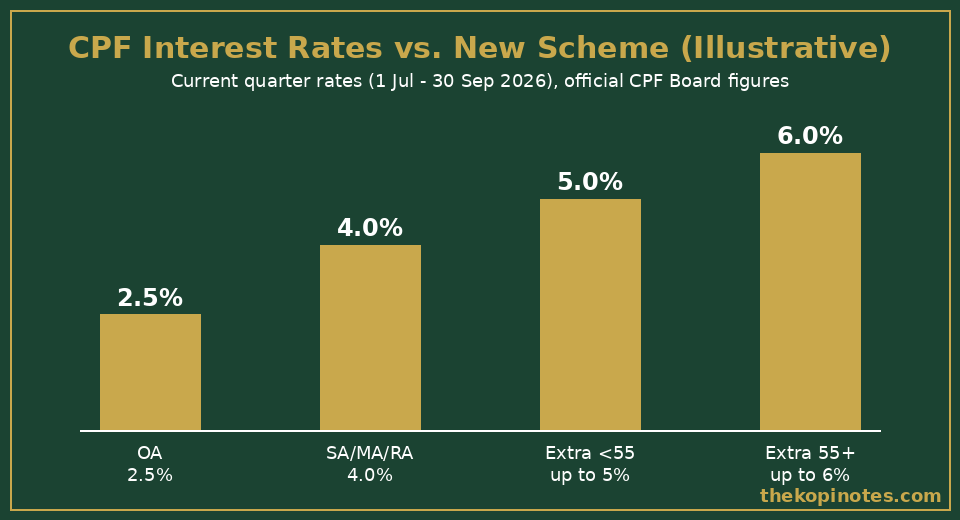
What this means for Singapore retail investors: a CPF Board study cited in TKN’s own coverage of CPFIS returns found that many CPFIS members underperformed the risk-free 2.5% OA rate over the long run, largely due to fees and poor fund selection. Any life-cycle product under the new scheme will need to clear CPF’s already-generous baseline, after fees, to be worth the added risk.
Timeline: From Budget 2026 to Launch in 2028
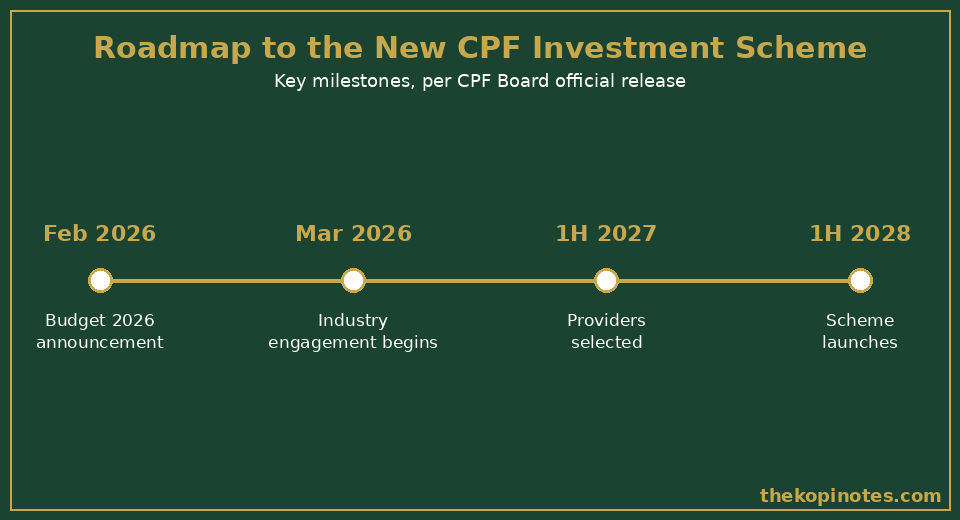
| Date | Milestone |
|---|---|
| 12 Feb 2026 | PM Lawrence Wong announces the scheme in the Budget 2026 speech |
| From Mar 2026 | CPF Board engages industry on product specifications and invites expressions of interest |
| 1H 2027 | Selected product providers (2–3) expected to be announced |
| 1H 2028 | New investment scheme launches; enrolment is voluntary |
How This Compares to CPFIS Today
CPFIS already lets Singapore Citizens and PRs invest CPF OA savings in SGX-listed shares, ETFs, unit trusts, Singapore Government Securities, and gold, but it requires members to research, select, and monitor their own holdings. The investable amount under CPFIS-OA is the OA balance minus the first $20,000, which must stay earning the 2.5% floor rate.
The new scheme flips that model. Instead of choosing individual counters or funds, members choose a provider and a target date, and the life-cycle fund does the rebalancing. It’s closer in spirit to target-date retirement funds already common in the US and UK than to CPFIS’s self-directed brokerage-style approach.
What this means for Singapore retail investors: readers already comfortable running their own CPF OA/SA allocation and picking instruments like the ones covered in TKN’s ETF guides probably won’t gain much from switching to the new scheme. It’s aimed squarely at members who want market exposure without the homework.
Why Now: The Global Push Toward Life-Cycle Funds
The CPF Board’s own release points to a broader trend as part of its rationale: life-cycle, or target-date, investment products have seen rising adoption internationally in recent years, particularly in defined-contribution retirement systems such as US 401(k) plans, where target-date funds have become a default option for millions of savers. The CPF Board argues that technological advancement and digital investment platforms now make it possible for commercial providers to offer these products at more affordable cost than in the past.
What this means for Singapore retail investors: Singapore is not inventing this model from scratch. It’s importing a structure that has already been tested at scale elsewhere, which should, in theory, make it easier for regulators and providers to calibrate sensible glidepaths and fee caps. Whether local execution matches that track record will depend on which providers are eventually selected and how competitively their fees are set.
Who Should Consider the New Scheme, and Who Shouldn’t
Based on the CPF Board’s own framing, three broad groups of members exist:
Members who are risk-averse can simply leave savings untouched and continue earning CPF’s guaranteed interest rates, or make voluntary CPF top-ups to boost their Special or Retirement Account balances directly.
Members who want long-term market exposure but lack the time, confidence, or expertise to manage a portfolio are the intended audience for the new scheme once it launches in 2028.
Members who are financially savvy and already comfortable picking their own instruments can continue using CPFIS, which remains untouched by this change and keeps its existing eligibility rules.
What this means for Singapore retail investors: nothing needs to happen today. Selected providers won’t even be named until the first half of 2027, and fee structures, projected returns, and specific fund mandates have not been disclosed. Readers with CPF savings currently sitting idle in OA above the $20,000 floor should evaluate near-term options, like CPFIS or voluntary top-ups, on their own merits rather than waiting two years for a product that doesn’t exist yet.
Bottom Line for SG Investors
The new CPF investment scheme is a genuine structural addition to Singapore’s retirement system, not a rebrand of CPFIS. Its glidepath design and capped-fee promise address two real complaints about self-directed CPF investing: complexity and cost. But with a 2028 launch date, provider selection still pending, and no published fee schedule or projected returns, there’s nothing actionable for retail investors to do right now beyond understanding how it will eventually fit alongside CPFIS and CPF’s own interest rates. TKN will publish a full breakdown as soon as the CPF Board names its selected providers in 2027.
Frequently Asked Questions
When does the new CPF investment scheme launch?
The scheme is set to launch in the first half of 2028. Selected product providers are expected to be named in the first half of 2027, ahead of the launch.
Is participation in the new scheme compulsory?
No. Participation is voluntary, in the same way CPFIS participation is voluntary today.
What happens to my CPF savings if I don’t opt in?
Your savings continue earning CPF’s standard risk-free interest rates: 2.5% p.a. on the Ordinary Account and 4% p.a. on the Special, MediSave and Retirement Accounts (current quarter rates, subject to quarterly and annual review).
How is this different from the existing CPF Investment Scheme (CPFIS)?
CPFIS requires members to select and manage individual instruments such as SGX shares, ETFs, or unit trusts themselves. The new scheme uses pre-built life-cycle funds from 2–3 selected providers that automatically rebalance and liquidate based on a member’s target retirement date.
Will the new scheme guarantee returns?
No. The CPF Board has explicitly stated that all investment products under the new scheme carry investment risk and returns are subject to market conditions, unlike CPF’s guaranteed interest rates.
Who are the product providers going to be?
Not yet announced. The CPF Board will engage the industry from March 2026 and expects to name 2–3 selected providers in the first half of 2027.
What happens to my invested savings as I approach retirement age?
Your portfolio automatically shifts from higher-risk assets toward lower-risk assets as you age, then liquidates in phases as you approach your target date (typically age 65), with proceeds transferred to your Retirement Account up to the Full Retirement Sum.
Should I wait for this scheme instead of using CPFIS now?
That depends on your individual risk appetite, expertise, and investment horizon. Since the new scheme won’t launch until 2028 and no fee or return details exist yet, readers weighing near-term CPF investment decisions should evaluate CPFIS or voluntary top-ups on their current merits rather than delaying two years for an unconfirmed product.
This article was researched with the help of AI. While we strive to keep all information accurate and up to date, there may be errors. If you notice any discrepancies, please contact us.